The Archive of Rusted Iron: A Landowner’s Battle Against the Encroaching Order of Asphalt
CHAPTER 1: The Morning Gate
The morning I found the steel gate chained across my ranch road, I actually laughed. It was a dry, hollow sound that barely traveled through the thick, stagnant air of dawn. I sat in the cab of my pickup, the engine idling low, the vibrations traveling up through the floorboards and into my tired bones.
I had driven this stretch of dirt track for two decades. I knew every dip where the rain pooled, every patch of gravel that shifted under the tires, and the way the fence posts leaned—a permanent, weary nod toward the west. But today, the view was wrong.
In front of me, a steel gate stood like a scar across the landscape. The posts were buried deep in fresh, overturned soil, the metal still coated in a factory-applied gray powder that didn’t belong in the natural rust and dust of the valley. It looked like a tombstone for a right-of-way that had existed before the subdivision across the highway was even a whisper of a plan.
I didn’t turn off the truck. I didn’t reach for my phone. I simply stared at the padlock—a heavy, brass-bodied piece of hardware that clamped the two sides of the chain together. It was a loud, vulgar exclamation point on a conversation I hadn’t agreed to have.
My hands felt heavy on the steering wheel. I could see movement down the road, near the edge of the subdivision, where a few residents stood under the morning sun. They weren’t moving like people who were lost; they were standing like people who were waiting for a reaction.
I killed the engine. The silence that followed was heavy, punctuated only by the distant, rhythmic creaking of the gate as the wind pushed against it. The scent of dry grass and heated earth, usually a comfort, now felt like the smell of a trapped animal.
I stepped out of the truck, the gravel crunching under my boots with an agonizing, deliberate sound. Every step toward that gate felt like a negotiation. Taped to the center bar was a sheet of paper, protected by a flimsy plastic sleeve. I didn’t need to read it to know what it said. “Access Control Notice.” The words were an insult to the dirt beneath my feet.
As I reached the gate, I noticed something that made my stomach tighten. A small, secondary wire had been run along the top bar—a thin, black line disappearing into the brush toward the subdivision. A camera. They weren’t just blocking the road; they were watching the reaction.
I reached out, my fingers hovering an inch from the cold steel of the padlock. It was brand new, the brass gleaming with a mocking brightness. I didn’t touch it. Instead, I looked past the gate, toward the familiar, dusty path that led home—to the office where my father’s records sat in steel cabinets, collecting the dust of history. If they wanted a war of ownership, they had picked a battlefield where the ground had a long memory.
I turned back to the truck, my decision made before I even reached the door. I didn’t look at the neighbors watching from the hill. I didn’t give them the satisfaction of a shout or a gesture. I just climbed in, shifted into reverse, and felt a strange, cold clarity settle into my chest. They had locked the road, but in doing so, they had given me the one thing I needed: a reason to dig.
I glanced at the rearview mirror as I pulled away. The gate looked smaller, but the black lens of the camera seemed to grow, staring back at me with an unblinking, artificial hunger.
CHAPTER 2: The Paper Trail
The drive back to the ranch office was a masterclass in controlled breathing. Every mile of gravel beneath my tires sounded like the snapping of old bones. I kept my eyes on the road, but the back of my neck prickled with the imaginary sensation of that camera’s gaze. It wasn’t just a machine; it was a silent auditor, tallying my movements, marking the exact moment I transitioned from a neighbor to a nuisance.
I pulled the pickup alongside the weathered barn, the siding grayed by decades of sun and salt. My office was a lean-to addition on the north side, a room where the light always seemed to struggle to penetrate. I stepped inside, and the air hit me—a heavy, dry mixture of oxidized metal, aging parchment, and the ghost of cedar oil.
I didn’t turn on the overhead light. I let my eyes adjust to the dim, amber glow filtering through the grime-streaked window. My father’s desk sat in the center, a slab of scarred oak that had hosted three generations of land disputes. My gaze drifted to the row of metal filing cabinets against the far wall. They were deep, industrial, and utterly indifferent to the suburban panic unfolding a few miles away.
Paper remembers things people forget.
That was the line from my father, usually muttered when he was trying to track down a stray cow or a property tax error. I stood in the silence, the memory of his voice manifesting as a phantom pressure in the room. He had been a man of meticulous, almost obsessive, documentation. If the HOA thought they could erase a corridor with a few pages of “administrative” legalese, they had clearly never met the man who had filed every fence-post receipt since 1985.
I moved to the bottom drawer. It groaned as I pulled it out, a long, rasping protest of metal on metal. Inside, the files were indexed with the kind of brutal efficiency that felt archaic in the digital age. I began to pull them.
Utility Agreements. Fence Surveys. Mineral Rights.
The physical weight of the paper was grounding. I sat in the chair, the leather cracked and cool against my skin, and began to spread the files across the desk. I was looking for the original division of the land, the primary source documents from when the ranch was carved up. My fingers moved with a practiced rhythm, skipping past the invoices for hay and the receipts for tractor parts.
I found it buried beneath a 1994 water rights ledger: a thick, vellum-bound folder with a rusted metal clasp. Property Transfer – Parcel 4B.
My pulse quickened, but I forced my hands to remain steady. I unfolded the map inside. It was a beautiful, terrifying piece of geometry—a blueprint of reality. The lines were sharp, inked in black, delineating the easement that cut through what was now the subdivision. There it was: a dotted line, specifically marked with the legal nomenclature for a perpetual access corridor.
As I stared at the map, the “administrative correction” I’d imagined the HOA might have filed began to feel less like a clerical error and more like an act of war. If they had bypassed this, they hadn’t just made a mistake; they had committed a fraud.
I checked the timestamp on the map. It was signed, stamped, and recorded by the county surveyor four decades ago.
I sat back, the chair springs creaking in the silence. The realization didn’t bring relief; it brought a sudden, sharp coldness. If the HOA board had reviewed the records, as Karen had claimed, they couldn’t possibly have missed this. They had seen this map, understood the legal weight of that dotted line, and had chosen to act against it anyway.
They weren’t just protecting their “community.” They were gambling on the fact that I wouldn’t bother to open this specific drawer.
I looked at the phone on the corner of the desk. The plastic was yellowed, the cord tangled like a vine. I picked up the receiver and listened to the steady, rhythmic pulse of the dial tone. It was a lifeline to the outside world, a tool to reach someone who could verify the document’s standing in the current legal landscape.
I dialed the county records office. The woman who answered sounded like she was made of granite and patience. I didn’t give her my name; I just gave her the parcel number and the recorded document ID.
“I need to know if this easement has been superseded by any recent filings,” I said, my voice sounding foreign and jagged in the quiet room.
“Hold, please,” she said.
The wait was an eternity of mechanical hums. I watched a spider crawl across the corner of the map, tracing the exact path of the access road. It seemed to confirm the fragility of everything I was looking at.
“Sir?” The clerk returned. “I’m looking at the record. That easement is listed as an ‘Encumbrance of Record’ on the entire subdivision plat. It hasn’t been superseded. Any attempt to modify that corridor would require a unanimous vote by every affected property owner, not just an HOA board decision. If someone has gated that, they’re in violation of the county master plan.”
I hung up the phone. The room felt smaller now, the shadows stretching across the floor like reaching fingers. I had the truth, but the truth was just ink on paper. Out there, on the road, the gate was still standing, and the camera was still watching.
I stood up, the chair clattering backward. I needed to see the clerk in person. I needed the certified copies, the ones with the raised seal that could stand up in a room full of angry homeowners. But as I turned to grab my keys, I caught sight of the window. A pair of headlights cut through the gathering dusk, turning into the ranch driveway, slowing as they approached the office.
They weren’t moving like a delivery truck. They were moving with the slow, predatory caution of someone who knew exactly where they were going. I stepped away from the light of the desk, pulling the file close to my chest, and waited to see who had come to check if I’d opened the bottom drawer.
CHAPTER 3: The Clubhouse Floor
The headlights hit the office window with a harsh, surgical glare, washing out the shadows and turning the room into a glass box. I didn’t reach for the light. Instead, I pressed the vellum-bound folder against my chest, the rough texture of the binding biting into my palm. I slipped back from the window, keeping low, the floorboards groaning under my boots with a sound that felt deafening in the sudden stillness.
Outside, the crunch of gravel signaled a stop. A heavy door slammed, and a set of footsteps—deliberate, steady—approached the office door. I didn’t wait to be knocked for. I retreated further into the gloom, toward the back corner where a small, rarely used service door led to the machine shed. I slipped through, the cold, greasy air of the shed greeting me like an old friend. I tucked the folder beneath a pile of heavy canvas tarps on the workbench and stood there, my breathing shallow, listening.
The office door creaked open. The visitor wasn’t looking for a social call; they walked in with the casual, proprietorial air of someone who expected to find nothing more than a stubborn, grieving rancher.
“You in here?”
It was the HOA president. I knew the voice—he sounded like a man who spent his life presiding over committees where the most dangerous thing discussed was the color of a mailbox.
I waited, keeping my hands empty and visible as I stepped back into the office. The president was silhouetted against the ambient light from the yard. He looked around the room, his eyes lingering on the empty chair, then on the desk where I had left the ledger open. His gaze tightened.
“Evening,” I said, my voice steady, though my heart was hammering against my ribs like a trapped bird.
He turned, a polite, practiced smile plastered over a face that looked tired. “I saw your lights on. I thought I’d drop by. There’s a bit of… frustration brewing, as you can imagine, regarding the gate.”
He didn’t mention the document. He didn’t mention the easement. He just looked at the desk, his eyes flicking toward the pile of folders I’d disturbed. He was testing the water.
“The gate is an obstacle,” I replied, keeping my tone flat. “An illegal one.”
“That’s a strong word,” he said, stepping further into the room. He reached up to pull the chain for the overhead light, but as he did, the bulb flickered—a stuttering, dying strobe—and went black. The sudden darkness was absolute, save for the pale moonlight filtering through the dusty windows. He didn’t seem bothered. “The neighborhood just wants clarity. We want to ensure the corridor is managed according to the new plat maps.”
“The plat maps that don’t exist,” I countered. I stayed exactly where I was, my back near the service door.
He laughed, a dry, humorless sound. “You’ve been out here too long, neighbor. Things change. Boundaries aren’t just lines on a dusty map from the eighties; they’re fluid. They follow the needs of the people living here now.”
He was dancing around it, but I could feel the shift in his posture. He wasn’t here to negotiate; he was here to gauge how much I knew. He was a man holding a losing hand, trying to convince the dealer to reshuffle the deck.
“The HOA meeting is tomorrow night,” he said, his voice dropping into that smooth, condescending register. “I suggest you come. Bring whatever concerns you have. But let’s keep it civil. We wouldn’t want this to escalate into a legal quagmire. It’s expensive, and frankly, I don’t think your ranch has the overhead for a prolonged fight with a municipality.”
He didn’t wait for a response. He turned and walked back toward the door, his silhouette cutting a sharp, dark line against the night. As he reached the threshold, he paused.
“Check the files again, if you’re so inclined. You’ll find the records have been… updated.”
He left without another word. The slam of his truck door echoed across the pasture, followed by the roar of an engine fading into the distance.
I didn’t move for a long time. I returned to the workbench, pulling the folder from beneath the canvas. The vellum felt brittle under my touch. Updated. The word hung in the air like smoke. He hadn’t just come to threaten me; he had come to tell me that the battleground was being salted behind my back.
I didn’t sleep that night. I spent the hours going through every single page of the transfer documents, cross-referencing dates, signatures, and stamps. By the time the first gray light of dawn bled through the windows, I found it—a faint, almost imperceptible smudge of an alteration on the county stamp of the file he’d referenced. Someone had been into the public archives, and they hadn’t just “updated” the record; they had forged a secondary document to create a conflict of evidence.
The HOA wasn’t just relying on confidence. They were manufacturing a paper trail. And if they were willing to forge county documents, they were far more desperate than I’d initially assumed.
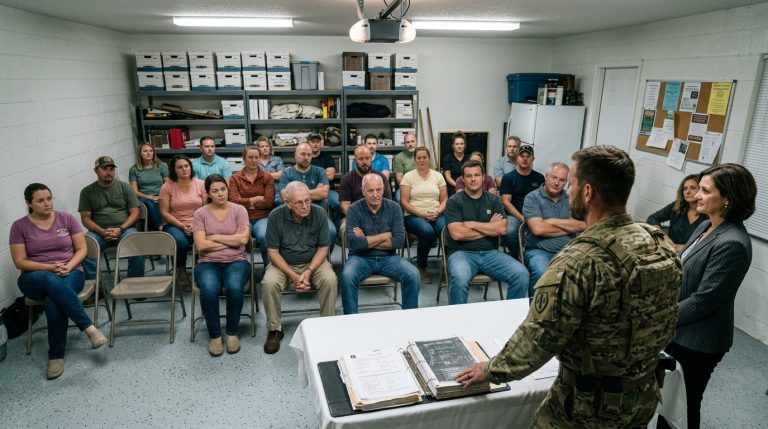
I stood up, my knees stiff, and looked out at the road. The gate was still there, a gray shadow in the morning light. The camera lens glared back, a dead, glass eye. I knew what I had to do. The meeting was tonight. I didn’t need to be civil; I needed to be ready. I walked over to the supply closet and pulled out a heavy-duty portable scanner and a stack of clear, archival sleeves.
If they wanted a fight over paperwork, I would give them a masterpiece of record-keeping. I would arrive at that meeting not as a neighbor, but as an architect of their undoing. I started the scanner, the hum of the machine filling the silence, a mechanical rhythm that felt like the steady ticking of a clock. Every page scanned, every line recorded, every seal captured.
The truth was still sitting on my desk, and for the first time, I realized the HOA had made a fatal mistake. They had underestimated the one thing that never moved, never changed, and never lied: the physical evidence of what was, not what they wanted it to be.