The Architect of Silence: A Cold Reconstruction of Property, Truth, and Necessary Retribution
CHAPTER 1: The Laminated Lie
The early morning mist clung to the timberline, turning the mountain into a charcoal sketch. I sat in the cab of my truck, engine idling, watching the two men stand beside my gate. They didn’t belong here. They wore high-visibility vests that looked too clean, too bright, standing out against the rugged gray of the shale and the muted greens of the forest like a glitch in a photograph.
I turned the engine off. The silence that followed wasn’t peaceful; it was heavy with the absence of the mechanical hum I had grown used to. I stepped out, the gravel crunching under my boots—a solid, familiar sound that grounded me.
“Morning,” I said. My voice was level, calibrated to keep my pulse steady.
The older guard moved first, his hand drifting toward his belt, a reflexive gesture that lacked purpose. He was older, thick around the middle, his face lined with the kind of weariness that comes from standing in places you aren’t wanted. Behind him, the younger one looked at the ground, shifting his weight.
They had zip-tied a piece of laminated cardstock to my fence. It fluttered in the light breeze, a sharp, white intrusion on the galvanized steel. I walked right up to it, close enough to smell the faint, chemical tang of the laminating plastic.
“Who issued this?” I asked, not looking at them. I kept my eyes on the text. Interim safety authority. Pending boundary clarification. It was a masterpiece of empty, heavy-handed bureaucracy.
“Board instruction, sir,” the older guard said. He didn’t sound official; he sounded rehearsed. “We’re here until the route gets finalized.”
“By who?”
He hesitated. A shadow crossed his face, a flicker of uncertainty that he quickly masked. “Ms. Harmon.”
There it was. The name hung in the air, a pivot point around which this entire farce was spinning. Celeste. The woman who spoke of ‘neighborhood resilience’ while measuring the distance between my trash bins and the curb.
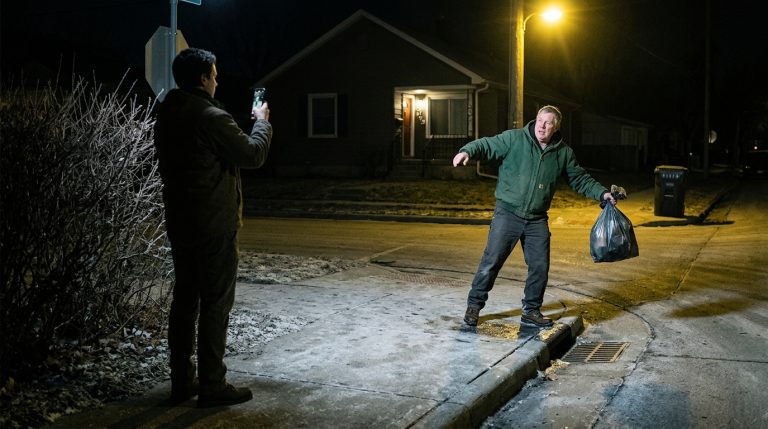
I didn’t argue. I didn’t shout. I reached into my pocket and pulled out my phone, the screen cool and unyielding against my palm. I held it up, framing the guard, the sign, and the gate in the lens. The phone was a weapon—not a physical one, but a recording device for the truth.
“I’m recording this,” I said, my voice cutting through the mist. “For the record.”
The younger guard looked up, his eyes wide. He looked at the sign, then at his partner, then at the dirt road that I had cleared with my own hands. He looked like he wanted to be anywhere else.
I backed away, keeping the frame steady. I had the incident, the timestamp, and the admission of the source. My truck door groaned as I opened it, the metal resisting me, a small, stubborn protest. As I climbed back inside, I noticed something odd about the laminate. There was a scratch, a jagged, fresh mark across the HOA logo that hadn’t been there when I first arrived, or maybe it had. It was a detail that didn’t fit, a physical discrepancy that snagged at my focus, whispering that this wasn’t just a barricade—it was a performance.
I turned the key. The truck roared to life, drowning out the silence. I wasn’t leaving; I was just shifting the battle to a terrain where they couldn’t follow.
CHAPTER 2: The Digital Audit
The truck’s interior remained warm for a few minutes, but the mountain air was already leeching the heat through the glass. I didn’t move. I sat behind the wheel, staring at the laminated notice on the gate until the white plastic seemed to burn into my retinas. That scratch across the logo—the jagged, fresh mark—kept pulling at my attention. It wasn’t just a sign of vandalism; it was a signature. Whoever had stapled that notice to the post had been in a hurry, or they were careless, and carelessness in an adversary is a crack in the armor.
I reached down and killed the ignition completely. The sudden death of the engine left the woods in a state of absolute, ringing silence. It triggered a memory—the smell of diesel and fresh-turned earth from three years ago, when I’d spent fourteen hours a day behind the controls of my excavator. I could still feel the phantom vibration of the joysticks in my hands, the way the weight of the machine had felt like an extension of my own body. I hadn’t just carved a road; I had etched my presence into the rock and shale. That memory acted like a cold compress against the heat of the encounter I’d just had. Anger was a fuel, but it burned hot and fast; I needed something more durable.
I pulled my laptop from the passenger seat, the metal casing cold against my thighs. My hands were steady. I opened the file I’d saved earlier—the PDF of the HOA’s “Courtesy Notice.” I didn’t look at the map this time. I went straight to the properties tab.
The file properties were pristine. Metadata didn’t lie, even when people did. I began the audit, cross-referencing the document’s creation timestamp against the last Aspen Veil board meeting I had observed from a distance. The timeline was tighter than they realized. They had drafted this “courtesy” document before they had even finished their secret committee meeting.
The screen glowed, casting a stark, blue-white light over the interior of the truck. I was looking for the trail, the digital breadcrumbs that connected the HOA to the consultant firm Celeste Harmon favored. My thumb hovered over the trackpad, moving with a surgeon’s precision. I was not just looking at a document; I was looking at the scaffolding of a lie. If the document was generated on a machine registered to an outside firm, their “internal safety authority” argument would evaporate in any court, or even under the basic scrutiny of a county inspector.
A sudden gust of wind rattled the truck, causing the exterior mirrors to vibrate. I didn’t flinch. I kept my focus on the scrolling lines of code and property data.
I realized then that the guards at the gate were not there to stop me from entering—they were there to observe my reaction. They were checking for weakness, for a flash of rage that they could document as “hostile behavior” to justify further escalation. I had denied them that. I had recorded them instead.
I saved the PDF again, this time to an encrypted drive I kept for exactly this kind of contingency. Then, I reached into the glove box and pulled out my original deed binder. I laid it open on the console, the paper thick and slightly yellowed. The contrast between the digital screen and the physical, ink-signed document was striking. I spent the next hour comparing the GIS overlays on my laptop with the survey lines in the binder.
The discrepancy wasn’t a mistake. The HOA had shifted the coordinates on their map by just enough—four, maybe five feet—to capture my primary turnout and the reinforced culvert I’d installed to handle the spring melt. It was clever. It was intended to look like a minor mapping error, the kind of “adjustment” that happens when documents are digitized and re-projected.
But I knew the exact GPS coordinates of every culvert I had set. I had the logs. I had the physical photos of the pour.
As the sun began to dip behind the ridge, casting long, sharp-edged shadows across the road, I finally closed the laptop. My vision was swimming slightly from the focus, but my resolve felt like tempered steel. They wanted to play with administrative theater? Fine. I would give them a performance they wouldn’t survive. I reached for the ignition, but before I turned the key, I paused, looking once more at the laminated sign through the windshield. It looked flimsy now, a paper mask over a hollow intent.
I wasn’t just defending a road. I was defending the reality of my labor against a world that wanted to rewrite it for the sake of their convenience. I backed the truck up, the tires biting into the gravel, and left the guards to their lonely vigil. I had what I needed. The audit had started, and the first layer of their strategy was already beginning to fray.
CHAPTER 3: The Theater of Order
I didn’t park in the lot. I left the truck half a mile down the road, tucked behind a screen of pine and brush, and hiked the rest of the way in. The Aspen Veil community center was a building of glass and polished cedar, designed to project an image of effortless, unified prosperity. It felt like a stage set. I checked my jacket—phone in the inside pocket, recorder engaged—and stepped through the heavy glass doors just as the meeting was being called to order.
I wasn’t a member, and I had no business being there, but in a town built on performative consensus, the best place to hide is in plain sight. I stayed at the back, leaning against the cold, white-painted drywall, and watched.
Celeste Harmon sat at the head of the long, rectangular table, positioned like a judge in a courtroom. She wore a cream-colored blazer that caught the overhead LED light, giving her a polished, almost luminous quality. Her hands were folded on a leather-bound folio, her fingers still and precise. Beside her, two other board members sat with identical, attentive posture. It was a well-rehearsed scene of civic duty.
“We need to discuss the secondary emergency access corridor,” Celeste said. Her voice was calm, measured, carrying easily to the back of the room without needing to be raised. She didn’t sound like a woman engaged in a land grab; she sounded like a woman burdened by the necessity of stewardship. “Recent wildfire concerns have highlighted the need for neighborhood resilience. We must ensure that our infrastructure reflects our commitment to collective safety.”
She spoke the words with practiced ease, turning the concept of ‘shared responsibility’ into a blunt instrument. I watched the room. The residents listened with that passive, nodding compliance that is the hallmark of any group afraid of losing its perceived status. Nobody questioned the necessity. Nobody asked who actually owned the land she was talking about.
I focused on her movements. She was the conductor of this orchestra, and every gesture she made was a signal. When she mentioned ‘safety,’ she smoothed the front of her blazer. When she mentioned ‘shared responsibility,’ she tilted her head just enough to invite agreement. It was textbook manipulation, built on the assumption that if the language was clean and the atmosphere was orderly, nobody would bother to look at the underlying facts.
I kept my hands in my pockets, my fingers curled around the recorder. I didn’t need to speak. I just needed to hear her confirm the narrative she was building.
“There are… inconsistencies,” Celeste continued, her voice dropping to a sympathetic, weary register. “Certain individual obstructions that hinder our collective ability to protect the mountain. It is unfortunate, but standards must be enforced if we are to maintain the value—and the safety—of this community.”
She was defining me as the anomaly. She was framing my property rights as an obstacle to the greater good. It was a clean, surgical extraction of the truth.
One resident, an elderly man in the second row, raised his hand. “What about the legal status of those routes?” he asked.
Celeste didn’t hesitate. She looked at him with a gentle, patient smile. “The county process is already underway, Arthur. We are working with the appropriate channels to ensure that the record reflects the reality of historic usage. Safety, after all, is a historical and collective priority.”
The ease of it—the way she could redefine reality with a single, practiced sentence—was almost impressive. She was announcing what the record would become, not what it was. I felt the cold wall behind me, its sterility biting through my jacket. She wasn’t fighting for the neighborhood. She was fighting to erase the existence of anything she didn’t control.
The meeting moved on to the enforcement of trash bin visibility, a petty, bureaucratic point that she handled with the same grave, judicial intensity. It was the contrast that mattered: a minor, aesthetic rule for the residents, and a major, existential land grab for the mountain. She was weaponizing order, using the community’s desire for a ‘clean’ neighborhood to justify the messiest kind of theft.
I didn’t stay for the final vote. I had what I came for. As the meeting shifted into the mundane details of maintenance schedules, I turned and walked out, the heavy glass door closing silently behind me.
Outside, the mountain air was cooling, the twilight turning the sky a deep, bruised purple. I walked back toward my truck, my boots silent on the asphalt. The board meeting had been a piece of theater, but the script was clear. They weren’t just taking the road; they were attempting to define the very nature of my ownership as a safety hazard.
I reached the truck and leaned against the cold metal of the bed, looking up toward the slope where my property began. The silence of the trees was a sharp contrast to the carefully curated noise of the community center. My mind was already racing, calculating the next move. She had the board, the blazer, and the language of stewardship. I had the deed, the receipts, and the reality of the gravel under my feet.
The theater was over. Now, the real work of dismantling her record had to begin. I didn’t start the truck immediately. I stood in the dark, watching the lights of the community center flicker, and felt the weight of the task ahead. It wasn’t about shouting; it was about the slow, cold pressure of documented, irrefutable truth.
CHAPTER 4: The Aerial Truth
The mountain air was thin and bitingly cold at this altitude. I stood on the narrow, rocky outcrop of my east line, my jacket zipped to the chin. The wind was picking up, carrying the metallic scent of an approaching squall, but the drone was already locked into its flight pattern. I held the controller with gloved hands, watching the monitor. The feed was clear, a steady stream of high-definition reality that stood in stark contrast to the performative lies I’d heard in the community center.
As the drone banked over the slope, the screen flickered. A sudden, driving rain began to lash against my face, cold needles stinging my cheeks. I ducked into the lee of a weathered cedar, my eyes locked on the monitor. The squall was localized, a chaotic gray curtain sweeping across the peak, and it forced the drone into an erratic, buffeting descent. I had to fight the controls, adjusting for the sudden gusts, my knuckles white against the plastic housing.
This was the vulnerability of evidence: it was subject to the elements.
Then, the clouds parted just enough. The drone stabilized, hovering four hundred yards upslope from the control point. I adjusted the gimbal. There it was.
The contractor crew was there, just as I’d suspected, but they weren’t doing maintenance. They were tearing into the turnout. One man was kneeling with a saw, the dust from his cut whipped away by the wind; another was frantically resetting stakes, marking a new line that would functionally kill the drainage. A third man was guiding a heavy steel pedestal into a fresh, ugly form.
I zoomed in. The camera captured the trench line, the old, established drainage angle, and the point where they had clearly veered onto my parcel to establish a new, deeper choke point. It was a physical, measurable violation. It wasn’t just a sign or a letter; it was the actual, physical destruction of my road.
I didn’t stop there. I pushed the drone lower, ignoring the battery warnings, and captured the foreman’s face. He looked harried, wiping his brow with a forearm, his movements rushed and imprecise. Then I saw her.
Celeste Harmon stood off to the side, protected by a high-end, waterproof tactical shell. She wasn’t touching a tool, wasn’t dirtying her hands. She stood with a clipboard in one hand, pointing at the excavation, her posture calm and authoritative. She looked like a general surveying a battlefield, the rain sliding off her hood without ruffling her hair. She was directing the destruction, the physical relocation of the drainage that would give her the “logical” basis for her new boundary claims.
I recorded it all. The trench, the stake placement, the specific, arrogant tilt of her head. Every second of the footage was a nail in the coffin of their “safety” narrative.
The wind lashed harder, a violent gust threatening to pull the drone into the slope. I tapped the return-to-home button. The machine groaned, its rotors fighting the atmospheric pressure, and began a slow, agonizing crawl back toward my position. I watched the battery indicator drop—15 percent, 10 percent. If it went down before it hit the clearing, I’d lose the SD card and the entire record.
I didn’t breathe until the drone hovered over the landing pad. As it touched down, the rotors spun to a halt, and the sudden quiet felt heavy. I pulled the SD card, the small, plastic chip feeling like a brick of gold in my glove, and tucked it into my inner pocket.
I started the trek back down the slope. The rain was steady now, soaking through my jacket, but I barely felt it. The physical exhaustion of the hike was a grounding presence. Every step on the rocky, uneven ground was a reminder of the road I had built myself, the literal weight of the labor they were trying to steal.
I reached the tree line where I’d left the truck. The vehicle was a dark, silent shape in the driving rain. I climbed in, the interior smelling of stale coffee and old upholstery, and for a long moment, I just sat there. The adrenaline was fading, replaced by a cold, hard clarity.
Celeste thought she was playing an administrative game, moving lines on a map and holding meetings to manufacture a consensus. But I had moved beyond that. I wasn’t playing with paper anymore; I was building a case out of hard, physical facts.
I pulled my phone out and logged the flight coordinates, the battery level, and the duration of the capture. I would have to transcribe the video and cross-reference it with the county permit portal again. My attorney would need a clean, segmented report.
I looked up toward the ridge. The rain had softened the silhouette of the mountain, but I knew what was happening up there. I knew the exact angle of the trench, the precise depth of the stakes, and the cold, unyielding indifference of the woman in the waterproof jacket.
I turned the ignition, and the truck roared into the storm. I wasn’t just a homeowner anymore. I was a researcher, a surveyor, and a witness. And the evidence I had just gathered made the HOA’s “temporary cooperation proposal” look exactly like what it was: a confession of intent. The fight was shifting from the boardroom to the archive, and I was holding all the cards.
CHAPTER 5: The Paper Weapon
The office was quiet, smelling of expensive toner and stale floor wax. Across from me, my attorney, Miller, sat with his sleeves rolled up, the red ink on his pen glistening like fresh blood. He had the physical folders spread out before him, a labyrinth of invoices, property deeds, and my construction logs. I had left the truck and its storm-battered silence behind, but the tension had only intensified. Here, the battlefield was white paper and cold, uncompromising language.
“You’re sure about the metadata?” Miller asked, not looking up. He was tapping a rhythm against the table, a staccato beat that underscored the seriousness of the pile.
“Intact,” I said. My voice sounded flat, stripped of the raw frustration I’d felt on the ridge. I kept my hands on the table, palms down. The coldness of the desk felt like a mirror to the coldness of the strategy we were building.
I reached into the satchel and pulled out the flash drive containing the footage of Celeste Harmon at the ridge. Miller took it, his eyes narrowing as he slotted it into his workstation. As the screen filled with the high-definition reality of the trenching, Miller’s face went still. He watched the foreman, the stake-setting, and finally, the figure in the waterproof shell.
“She’s overreached,” he murmured, his voice tight. “She’s not just trying to claim the road; she’s creating a physical record of ‘improvement’ that she intends to use as a, quote, ‘historical corridor.’ It’s the oldest trick in the land-use handbook, but she’s doing it with a level of arrogance that’s going to make her very, very vulnerable.”
He paused the video on a frame where Celeste was pointing at the drainage cut. “If we file for a temporary restraining order based on this, we’re not just stopping the work. We’re putting the contractor under oath. And he’s going to have to decide if his company’s liability is worth protecting Celeste Harmon’s ego.”
I watched the screen. Seeing it here, in the sterile light of a law firm, the act seemed even more calculated, even more vicious. It wasn’t just dirt and rock; it was a deliberate attempt to erase the evidence of my own presence on the land.
Miller began to pull documents from the pile, his red pen active. He was highlighting the ‘poison clauses’—those hidden, ambiguous legal phrasings buried in the HOA’s ‘cooperation proposal.’
“Look at this,” he said, sliding a copy toward me. “They want ‘limited operational discretion’ over the entire turnout. That’s not a request for emergency access; that’s a request for a total seizure of your property’s structural maintenance.”
I looked at the text. It was so dry, so neutral, it almost seemed harmless. But I knew the reality behind it. “If I sign that,” I said, “they move the gate, they reclaim the turnout, and six months from now, the county declares it a ‘community asset’ because I gave them the legal permission to manage it.”
“Exactly.” Miller clicked his pen. “They’re not trying to win in court. They’re trying to occupy the land administratively until you just get tired of the fight.”
I reached for the red pen. “Then we don’t fight on their terms.”
We worked in silence for the next three hours. I drafted the preservation notice. It was a precise, technical document, ordering every party involved—Celeste, the board, the contractor, and even the guard company—to cease any destruction of evidence. We were creating a legal paper trail that would make any further ‘adjustments’ to the site a criminal liability. I highlighted every clause that suggested bad faith and attached the screenshots I’d taken from the county permit portal, proving that no lawful excavation had been authorized.
Near the end of the session, I found it—tucked behind a generic quote for ‘grading services.’ It was a single, out-of-place invoice from a consultant firm. I squinted at the letterhead. It was a firm I didn’t recognize, but the address was suspiciously close to the business district where Celeste’s brother-in-law operated. It wasn’t a smoking gun, but it was a loose thread. I felt a cold chill run down my spine. The fraud wasn’t just the road; it was a financial loop, designed to funnel HOA dues into private pockets under the guise of ‘consulting.’
I set the invoice aside, my heartrate steady but elevated. I didn’t show Miller yet. I needed to know more. I needed to see if the trail led exactly where I suspected it did.
“Is this enough?” I asked, looking at the mountain of paper.
Miller leaned back, the leather of his chair creaking. “It’s enough to stop the bleeding. But Celeste is the type who won’t stop until she’s forced to. You’re not just going to win this in a meeting, you know. You’re going to have to make her the most expensive liability her own board has ever encountered.”
I stood up, the chair scraping against the floor—a sharp, dissonant sound in the quiet office. I looked at the red-inked documents, the physical manifestation of the truth I was building. The paper felt heavy, like a leaden weight I was finally ready to drop on their doorsteps. The war was no longer in the woods. It was on the docket. And for the first time, I felt the sharp, focused clarity of the endgame.
CHAPTER 6: The Expert Alignment
The consultant, an old county road inspector named Elias, stood by the turnout, his boots caked in the same red mountain clay that was currently being torn up by the HOA’s crew. He didn’t look like a man accustomed to private consulting. He looked like a man who spent his life measuring the slope of ditches and the strength of base rock. He held a high-precision transit level, his posture steady as he sighted down the length of the road.
I stood three paces behind him, my own muscles coiled with the kind of focus that only comes when you are watching your property being physically unmade. The rain had stopped, but the sky remained a bruised, heavy gray, and the air smelled of wet stone and ozone.
“You see that?” Elias asked, his voice low and raspy. He pointed a calloused finger toward the shoulder where the contractor had cut the new drainage trench. “That’s not engineering. That’s a burial.”
I followed his line of sight. He wasn’t talking about the rock. He was talking about the original, compacted base layer I’d installed three years ago. The trench had severed it, cutting through the structural integrity of the road like a surgeon’s scalpel through muscle.
“They’re making it look like a shared corridor,” I said. My voice sounded thin against the vastness of the mountain. “They’re trying to create a pattern of drainage that forces the road to rely on the neighborhood’s common area flow.”
Elias grunted and went back to the transit. He moved with a slow, deliberate cadence, the way a man moves when he knows the tools will tell the truth even if the people won’t. “I’ve seen this before. You change the topography, you change the map. You change the map, you change the history. It’s a clean way to kill a property right without ever having to touch the deed.”
He spent the next hour measuring. He checked the depth of the new culverts, the pitch of the turnout, and the way the new grade intersected with the original, hand-cut switchbacks. Every measurement was a data point that contradicted the HOA’s “temporary safety” narrative.
As he worked, I watched the ridge. The contractor crew was still active, their machinery humming in the distance, a low, mechanical growl that grated on my nerves. They were moving dirt with the indifference of machines, but the woman in the shell jacket—Celeste—was not there today. In her place was a man in a clean, crisp uniform, likely the consultant she’d mentioned in the petition, someone brought in to “verify” the site conditions for the upcoming county walk.
I felt a surge of cold, analytical rage. They weren’t just working the road; they were staging a scene. They were preparing a performance for the county inspectors, hoping that if they made the road look like a public route, the inspectors would simply write it into existence.
Elias stepped back from the transit. He pulled a notebook from his pocket, the pages frayed and stained, and began to sketch. “It’s a single construction sequence,” he said, not looking up. “The drainage logic, the shoulder reinforcement, the way the base rock transitions into the switchback… it’s all one piece. It’s an owner-built system, entirely contained within your parcel. Whoever told the county this was a ‘historically relied-upon corridor’ didn’t just lie. They manufactured an alternate reality.”
“Can you put that in a report?” I asked.
“I can put it in a sworn statement,” he replied, finally looking at me. His eyes were tired, the eyes of a man who had seen too many developers treat the landscape like a disposable commodity. “But you need to understand something. This won’t end when I hand you the paper. When you present this to the board, when you show the county planner that their ’emergency route’ is a physical fraud, the reaction is going to be violent. Not physically, but professionally. They’ll come after your character. They’ll try to paint you as the obstructionist.”
“Let them,” I said.
I took the notebook from him, the texture of the paper rough and grounding. I looked at the sketches, the clear, black-ink lines defining the truth of the road. It was an alignment of facts, a rigid, physical defense against the fluid, shifting lies of the HOA.
I walked to the edge of the turnout and looked down the road. It was scarred, cut open by the trench, but the structure—the bones of the thing I had built—was still there, buried beneath their artificial interference. I realized then that the fight wasn’t just about the road. It was about the integrity of the work itself. I had spent years pouring my sweat and my savings into this land, and they were trying to treat it like a variable in a real estate negotiation.
The hum of the construction machinery in the distance intensified, a discordant note in the silence of the woods. I looked at Elias, then back at the scarred road. “When do we file?”
“As soon as I finish the survey data,” he said, packing his transit. “But you’d better make sure your lawyer is ready for the response. Because once this goes into the record, there’s no walking it back.”
I nodded. The air felt charged, heavy with the weight of the coming confrontation. I had the expert, the evidence, and the clarity of the truth. The road was a part of me, a physical extension of my own intent, and as I walked back toward my truck, I felt not the heat of anger, but the cold, focused resolve of a man who was no longer just waiting for the storm. I was the one who was going to bring it.
CHAPTER 7: The Unmaking of the Map
The county hearing room was an environment of aggressive neutrality. Beige walls, flickering fluorescent lights, and the heavy, lingering scent of dry-erase markers and damp wool coats. I sat at the petitioner’s table, my laptop open and my files arranged in a precise, tactical formation. Across the aisle, Celeste Harmon sat with her board members. She looked composed, her cream blazer immaculate, but there was a tightness at the corners of her mouth that hadn’t been there at the community center. She was still performing, but the performance felt brittle.
The county chair, a man with a tired face and a habit of rubbing his temples, tapped his gavel. “Case 402-B, regarding the Aspen Veil secondary access corridor petition.”
I didn’t wait for Miller to open. I stood up, the chair legs screeching against the linoleum—a sharp, deliberate sound. I began with the drone footage.
“We are here to discuss a public safety asset,” I said, my voice steady, projecting to the back of the room. “But the record has been fundamentally altered to create that asset.”
I clicked the remote. The screen filled with the high-definition footage of the contractor crew trenching into the turnout. The courtroom went silent. The video didn’t need narration; it showed the truth of the destruction. I let it play for thirty seconds—long enough for the county inspector sitting on the dais to lean forward, his eyes narrowing as he recognized the unauthorized drainage cuts.
Celeste’s lawyer stood to interrupt, his voice rising in an attempt to bury the visual impact with procedural noise. “Objection. This is anecdotal footage—”
“The footage is geo-tagged, dated, and matches the site’s GIS metadata,” Miller cut in, his voice calm and lethal. “And it was taken during the active destruction of the defendant’s private property.”
The county chair held up a hand, silencing the lawyer. He was looking at the footage, his expression shifting from boredom to sharp, professional irritation. He turned his attention toward Celeste. “Ms. Harmon, is this your crew?”
Celeste didn’t look at the screen. She looked straight ahead, her posture rigid. “The committee was acting under the impression that we had the authority to stabilize a hazardous route for the greater community good.”
“That ‘impression’ required a permit,” the planner said, his voice hard. “Which you never filed for.”
I didn’t let up. I cycled the projector to the GIS overlay Miller had prepared. It was a visual, undeniable proof of the fraud. I showed them the original survey, the one from three years ago, and overlaid it with the “exhibit” Celeste had filed for the county. The shift in the lines was clear, a deliberate, four-foot discrepancy designed to swallow my gate and turnout into the ‘shared’ zone.
“The exhibit was generated by a firm linked to the committee’s own consultant,” I said, pointing to the metadata display. “They didn’t just miscalculate the boundary. They moved it. And then they brought in a contractor to make the ground match their new, false lines.”
I felt the room’s energy shift. The tension in the gallery—the local residents who had been led to believe this was about ‘wildfire safety’—began to evaporate. They were seeing the fraud for what it was: a targeted, cynical manipulation of the administrative process.
I looked over at Celeste. For a brief, flickering second, she looked at me. There was no apology in her eyes, no regret. There was only a cold, burning resentment. She wasn’t angry because she had been caught; she was angry because I had successfully dismantled the mechanism of her order. She had intended to make me a footnote in the history of the subdivision, and instead, I had made her a liability to it.
“For the record,” the sheriff added, his voice gravelly and authoritative, “armed guards were posted at the access point without lawful county authority. Any claim built on such conditions is fundamentally tainted.”
The chair leaned back, looking at the board members. Their eyes were averted, their focus suddenly very interested in their own notes. The performative consensus was shattering. They were already calculating the cost of distance—how quickly they could dissociate themselves from Celeste before the board’s liability hit their own bank accounts.
I clicked the final slide: the contractor’s scope sheet. Present as pre-existing route during county walk.
The words hung in the air, ten feet high and undeniably damning. It was the absolute, final truth of the matter. The room felt like it had been vacuumed of oxygen. Celeste’s lawyer tried to speak, but he stumbled, his own defense failing under the weight of the documentary trail.
I sat back down. My hands were perfectly steady. The room was noisy now, a chaotic buzz of whispering, rustling paper, and the frantic clicking of the planner’s keyboard. I looked at Celeste one last time. She was still sitting in her chair, but she looked diminished, smaller. The theater was gone. The performance had ended, and all that remained was the hard, unforgiving reality of the evidence. I had won the argument, but more importantly, I had protected the road. I had proven that in the battle for the truth, the only thing that matters is the ability to document the facts and the patience to let the pressure do the work.
CHAPTER 8: The Final Grade
The drive up to the cabin at dawn was different. The mountain looked the same—the same jagged pines, the same gray shale, the same mist clinging to the valley—but the road beneath my tires felt changed. It was solid. The temporary trenching had been restored, the culverts properly angled, and the base rock packed tight under the supervision of the county inspector. As I reached the lower gate, I paused. There were no guards. No laminated notices. No zip ties scarring the fence. There was only the sound of the wind through the needles and the steady, rhythmic crunch of gravel under the truck’s weight.
I drove to the turnout and stopped. I got out, my boots hitting the road with a definitive, heavy sound. The air was crisp, tasting of pine and the coming autumn. I walked to the edge of the slope, the place where Celeste had stood with her clipboard only weeks ago, and looked down the grade. It was mine. Every foot of it, every drainage channel, every compacted layer of dirt was the product of my own hands and my own stubborn adherence to the record.
Later that evening, the sun began to dip behind the peaks, painting the sky in colors of bruised orange and deep, quiet violet. My guests arrived shortly after: Miller, the surveyor, and Elias. We didn’t gather inside. We stayed out on the turnout, the site of the primary dispute, drinking bourbon from paper cups and listening to the mountain settle into its nightly quiet.
We didn’t talk about the hearing. The outcome had been total—the false filing withdrawn, the costs paid, the board presidency lost. We didn’t need to rehash the theater. We just stood there, watching the light drop behind the trees.
“You know,” Miller said, looking down the grade, “people like Celeste think they can re-engineer reality. They think if they change the words and move the stakes, they can redefine the world to suit their convenience.”
“They don’t realize,” Elias added, his voice low, “that the ground itself has a memory. You can pave it over, you can trench it, you can lie about it in a courtroom, but the geography doesn’t care. It stays exactly where you put it.”
I looked at the road. It wasn’t perfect—it was weathered, marked by the labor of the past few years—but it was honest. I thought about the files in my cabinet, the receipts from the quarry, the old logs from the skid steer. They weren’t just evidence anymore; they were the story of the land.
The atmosphere wasn’t one of triumph. Triumph felt like a shout, a transient heat that would soon fade. This felt deeper. It felt like balance.
As the light finally faded to gray, I walked over to the section of the retaining wall that had been partially displaced during the contractor’s “stabilization” work. I knelt, my fingers finding the cold, irregular surface of the stone. I spent the next twenty minutes methodically resetting the displaced rocks, tucking them back into the original, hand-fitted pattern I’d established when I first built the wall. My hands were stained with dirt, but I didn’t care. The tactile sensation of the stone, the friction of the earth, the way each piece clicked back into its intended place—that was the closure I needed.
Symbolic, yes. But it was also real.
When I finished, I sat back on my heels. The others were finishing their bourbon, the murmur of their voices fading into the evening air. There were no speeches. There didn’t need to be. The antagonist had been defeated by her own methods, her arrogance made an expensive, public liability that the HOA could no longer afford. The Poetic Justice was complete: she had tried to occupy the road administratively, and in doing so, she had documented her own downfall.
“It’s quiet,” Miller said, joining me at the edge of the turnout.
“It is,” I agreed.
The silence wasn’t empty. It was the sound of a thing returned to its proper name. I thought back to the very first day, the anger I’d felt when I saw that harmless-looking envelope in my mailbox. I remembered the heat of it, the way it had threatened to consume everything I’d worked for. But anger hadn’t fixed it. Anger was just a response. It was the process—the cold, document-driven, patient adherence to the facts—that had cleared the path.
As the stars began to appear above the ridge, I stood up and dusted the dirt from my jeans. The road was secure. The paperwork was closed. The mountain was mine, not by force, but by the irrefutable reality of the record.
I looked at the cabin, its windows glowing with a warm, steady light. I felt a sense of connection, a deep, resonant peace that had nothing to do with ownership and everything to do with the work. I had fought for this place, not just the dirt or the trees, but for the truth of it. And as I turned toward the cabin, the heavy, metallic weight of the conflict finally dissolved, leaving only the cool, quiet air and the steady, solid earth beneath my feet. The case was settled, the road was open, and for the first time in a long time, the future felt like something I could build, slowly and honestly, one layer at a time.