The Survey Pin: A Manual on How to Hold Your Ground Against the Weight of Paperwork
CHAPTER 1: The First Thread
The weight of the cabin keys in my pocket felt like the only anchor in a storm of shifting gravel. I had owned the place for exactly five days. Five days of silence, cedar wood, and the honest, heavy scent of lake water. Now, the air in the gravel turnaround was sharp with the smell of exhaust and expensive, synthetic perfume.
Karen stood near the bumper of her white SUV, the HOA logo on the door looking like a badge of office she hadn’t earned. Behind her, two board members hovered, their faces masks of performative concern. A maintenance supervisor clutched a clipboard as if it were a shield.
“You need to stop occupancy immediately,” Karen said. She didn’t bother with a hello. Women like her viewed introductions as a transaction they didn’t need to make. She extended a glossy sheet of paper—the kind of stationery designed to look like a court order if you glanced at it from ten feet away. “This structure is under review as a historic community amenity. You cannot move in until the board resolves ownership.”
I took the paper. I didn’t look at it yet. I looked at the survey pin three feet to her left, wrapped in a strip of faded orange ribbon. It was the only thing on this property that didn’t lie.
“I closed on this property three days ago,” I said, my voice steady, stripped of the urge to argue. Arguments were for people who didn’t have a deed.
“That may be what you were told,” she replied, her smile tightening.
The mechanics of it were simple. They weren’t trying to win a case; they were trying to freeze my life. They wanted me to hesitate, to doubt the legality of my own kitchen, to let the uncertainty curdle until I settled for a ‘compromise’ that would inevitably morph into a total loss.
I pulled out my phone. I didn’t point it at her. I pointed it at the sign they had just hammered into my dirt—a brand-new ‘Private Community Access’ placard sitting clearly inside the survey line. I framed the sign and the orange-ribboned pin in a single, unwavering shot.
Karen’s eyes flicked to the phone. “You won’t solve this with snapshots.”
“I don’t solve things with talking,” I said, catching a glimpse of the maintenance supervisor shifting his weight. He looked at the clipboard, then at the lake, then at the ground. He knew. “I solve them with records.”
I hit the button, saving the timestamp, and tucked the device away. I hadn’t even begun to unpack my moving bins, but I had already started the audit of her collapse. She didn’t know it yet, but the paper she’d handed me was already obsolete. A flicker of something crossed her face—not quite fear, but the sharp, sudden realization that the ground she was standing on was, for the first time, starting to feel like someone else’s.
She opened her mouth to pivot, to say something about community standards, but I turned my back to her and started toward the cabin. I had a survey pin to verify and a record to protect. The gate was locked, but I had the key.
CHAPTER 2: The Cartography of Fraud
The interior of the cabin was cooler than the outside, the air holding the scent of old cedar and the faint, lingering dust of a life lived by someone who valued distance as much as I did. I didn’t turn on the lights. I didn’t need them to navigate a space I was already learning to defend. I walked straight to the kitchen counter, where my laptop sat waiting—a glowing, quiet command center in the darkening room.
Karen had left the gravel, but the digital shadow she cast was growing longer. I opened the county GIS parcel map, the screen illuminating my face in a pale, sterile blue. I pulled up the Echo Ridge subdivision data. It wasn’t just a map; it was a digital cage they were trying to build around my parcel.
My fingers hovered over the touchpad. The map displayed the boundaries clearly—a thin, precise line separating my property from the sprawling, interconnected network of the resort neighborhood. I cross-referenced the citation from the glossy notice Karen had handed me. She had cited a plat amendment, a document meant to consolidate tax parcels for recreational use.
I traced the numbers, feeling the friction of the process—the way bureaucracy tried to turn land into nothing more than a coordinate to be manipulated.
A memory flared, sharp and unwanted: the previous owner, a fishing guide with hands like cured leather, standing on this very porch, telling me that the silence here was the only thing you couldn’t buy in a development. He hadn’t just sold me a cabin; he had sold me a buffer. Now, looking at the screen, I realized the HOA didn’t just want the dock. They wanted the entire parcel to satisfy a budget deficit they’d hidden under “waterfront hospitality conversion.”
I leaned back, the wooden chair creaking in the silence. It wasn’t about the cabin. It was about the math. If they could get the assessor to reclassify my land as common recreational property, they could bypass the title chain entirely.
My title officer had been right to worry. I pinged the GIS portal again, overlaying the plat amendment cited in Karen’s notice. It existed, yes, but it was three units north of my position. The error was so blatant it felt like a trap, a dare to see if I would notice or if I would simply crumble under the weight of the official-looking citation.
They weren’t just incompetent. They were desperate.
I picked up the phone. The screen showed a missed notification from the mover I’d hired. Access denied at the marina.
I didn’t call the mover back. I didn’t call the marina. Instead, I opened a new document, the cursor blinking like a heartbeat, and began to log every interaction with the HOA since I’d arrived. I stripped away the frustration, leaving only the tactical data: the sign placement, the timestamp of the threat, the surveyor’s pin that defied their map.
The house felt like it was holding its breath. The silence of the lake outside the window was no longer just atmosphere; it was a front line. I pulled up the county recorder’s database and cross-referenced the deed history one more time. There it was—a clear, unbroken chain, free of any encumbrance. Karen was trying to use a map from a different zip code to claim my dirt.
I stood up and walked to the window, watching the moonlight crawl across the dock gate. The sign they had planted was still there, a jagged piece of plastic stuck in the earth, marking a boundary that didn’t exist for anyone but them.
My phone vibrated. A text from my lawyer, Mara Keen.
“The marina just called. Karen’s been busy.”
I didn’t need to ask what that meant. The pressure was moving from the physical to the administrative, a slow-motion tightening of the screws designed to make the cost of moving in higher than the cost of walking away. I looked at the dark expanse of the lake, then at the map on my screen.
They thought they were dealing with a homeowner. They didn’t realize they were dealing with a man who had already mapped their failure. I sat back down, opened the file for the title insurance company, and began to draft a response that would turn their own administrative language against them.
The cabin was quiet, but for the first time, it didn’t feel like a refuge. It felt like a bunker. And as I worked, I could hear the distant, rhythmic slap of water against the dock—the only thing in this whole, manufactured disaster that wasn’t trying to lie to me.
CHAPTER 3: The Marinas Silence
The screen glowed with Mara’s update, but my focus remained on the phone sitting on the scarred pine table. It was a simple device, but in this moment, it was a weapon. I didn’t reach for it immediately. I sat in the dark for a long beat, letting the silence of the cabin recalibrate my resolve. The HOA didn’t just want the land; they wanted to strip away the infrastructure of my life, starting with the logistics of moving in.
I picked up the phone and dialed the number for the marina. I didn’t wait for a greeting. I put the call on speaker, the voice of the manager sounding tinny and defensive in the enclosed space.
“I’m sorry, I already told you,” the manager said, his voice jagged. “We have orders to pause the delivery. There’s an active dispute regarding the dock access.”
“I’m not calling to argue the dispute,” I said, my voice steady, stripped of the frantic energy they were likely expecting. “I’m calling to identify the source of the instruction. Tell me exactly who contacted you.”
A pause stretched across the line—long, uncomfortable, and heavy with the weight of an unsaid threat. I could hear the background noise of the marina, the distant slap of rigging against aluminum masts.
“Look,” he finally sighed, the hesitation practically leaking through the speaker. “A woman named Karen. From the Echo Ridge HOA. She called at 8:12 this morning. She said the dock is part of an active community review and that access is restricted.”
“Did she provide a case number?”
“No. Just… implied it was a board-level decision.”
“Can you forward me that voicemail?”
Another silence. This was the moment where the power shifted. He had been playing the part of a neutral party, but by recording that voicemail, he had become a witness—and he knew it. “I don’t know if I should—”
“You’re a commercial service provider,” I interrupted, keeping my tone professional, transactional. “If you refuse to deliver based on a verbal instruction from a third party with no legal standing, you are actively interfering with a signed contract. I’m not asking for a favor. I’m asking for the record of the interference.”
He breathed out, a sharp, ragged sound. “I’ll forward the file.”
The call ended. I set the phone down and listened to the silence of the cabin return. It felt different now—less like a vacuum and more like a space I was actively filling with evidence. The marina manager’s fear was the first crack in the HOA’s armor. It meant their influence was fragile, dependent on people being too afraid to ask for a paper trail.
I waited, pacing the length of the kitchen. The floorboards creaked under my weight, the sound grounding me. When the email finally pinged, I didn’t hesitate. I opened the audio file. Karen’s voice was unmistakable—clipped, polite, and dripping with the casual authority of someone who had never been told ‘no’. It was the sound of a woman who believed her own manufactured reality.
I saved the file, attached it to an encrypted email, and sent it to Mara.
I walked out onto the porch. The lake was a vast, dark expanse, mirroring the sky. The HOA sign, still standing near the property line, looked ridiculous in the moonlight. I could see the survey pin a few feet away, catching the light with a dull, metallic glint. It was a simple, brutal reminder of where the truth resided.
I didn’t need to yell at the sign. I didn’t need to pull it up. That would be an admission of a battle, and this wasn’t a battle—it was an audit. I watched the water, feeling the cool night air brush against my skin. They were using fear, using the threat of ‘community review’ to obscure the fact that they were trespassers on their own map.
Every action they took was a deposit into the evidence folder I was building. By Tuesday, they would have enough to hang themselves. I turned back into the cabin, the door clicking shut behind me with a finality that seemed to vibrate in the walls. I had the recording. I had the deed. I had the survey.
The cabin was no longer just a place to live; it was a laboratory for the dissolution of a lie. I sat back down at the laptop, the screen illuminating the next task: a formal records request to the county for the HOA’s budget. If Karen was weaponizing the board, she had to have a trail of financial allocation for the ‘waterfront hospitality conversion.’
I began to type, each keypress a deliberate, measured step. The manager’s hesitation had been the key, but the voicemail was the lock. And I was already turning it.
CHAPTER 4: The Affidavit of Interference
The envelope sat on the welcome mat, a stark white rectangle against the dark, polished wood of the cabin floor. I hadn’t heard the postman—which meant it had been hand-delivered. No stamp, no carrier mark. Just my address, written in a hand that looked practiced and precise.
I picked it up. The paper was heavy, expensive. I didn’t open it until I was back at the pine table, my phone positioned to record the movement of my hands. The affidavit from the county assessor’s office was a masterpiece of administrative malice. It was a formal claim, signed by Karen, asserting that my parcel had been historically taxed as ‘shared recreational property’ and that the deed chain was currently under ‘community oversight review.’
It was a blatant, technical lie. They were attempting to cloud the title, a move designed to spook any lender or insurance carrier that might be looking at my file. If they could get the assessor to accept the filing—even for a week—the property would become ‘unmarketable.’ That was their end game. They didn’t need to win a court case; they just needed to make the asset toxic enough that I’d be forced to negotiate a ‘temporary settlement’ just to get my name off the blacklist.
The air in the room felt heavy, the silence suddenly absolute. I looked at the signature at the bottom of the affidavit. It was bold, arrogant.
I didn’t reach for the phone to call Mara. Not yet. I sat there, the document spread out before me, and began to map the flaws. The plat amendment they cited was the key, but it was also the anchor that would sink them. I pulled up the recorder’s index, the digital interface acting as my counter-offensive.
I scrolled through the history of the subdivision. It took thirty seconds to find the plat they were referencing. It belonged to a development two miles south, a completely different tract of land, completely different jurisdiction. Karen hadn’t just filed a false claim; she had filed a demonstrably impossible one.
I felt a cold, sharp satisfaction. This wasn’t just a dispute anymore. This was perjury, or as close to it as an HOA board could get without a trial.
I stood up, the chair scraping against the floor, and walked to the window. Across the cove, the pavilion deck of the Echo Ridge clubhouse was a blur of lights. They were likely meeting right now, planning the next move, convinced that their authority was a suit of armor they could wear to avoid reality.
My phone buzzed. A message from the title officer: “Hey, just wanted to let you know, the county just received a filing from Echo Ridge. It’s… look, it’s not accurate. Do you want me to flag it as a clerical error or a formal challenge?”
“Formal challenge,” I said aloud, though I was alone. “Flag it as an intentional filing of fraudulent documentation.”
“That’s going to trigger an automatic investigation from the Recorder’s office. It could take weeks to clear.”
“Do it,” I said. “And make sure the assessor sees the plat amendment citation they used. I want them to know exactly why their filing is being flagged.”
I hung up and paced the kitchen, the reality of the situation clicking into place. This was the ‘gray zone’ they lived in—the space between a legal filing and a criminal act. They counted on the fact that I would be overwhelmed by the process, that I would buckle under the weight of county paperwork while they held the social high ground.
But every document they filed was a brick in a wall they were building around themselves. By filing this, Karen had moved from nuisance to liability. She had signed her name to a lie, and she had done it in a way that left a permanent, digital record.
I opened the file containing the Zoom transcript—the accidental leak from their internal strategy session. I compared the date of that meeting to the date of this affidavit. They aligned perfectly. The intent was no longer a theory; it was a timeline.
I stepped onto the porch. The night air was biting, but I didn’t feel the cold. I looked toward the dock. The padlock they had installed, the chain they had wrapped around the gate—it all looked different now. It wasn’t an act of power; it was a manifestation of panic. They were trying to manufacture a history that didn’t exist, and they were failing because the land—the survey pin, the deed, the county records—refused to play along.
I went back inside and grabbed my jacket. The cabin was a bunker, but I couldn’t stay inside a bunker forever. I needed to see the survey pin one last time, to touch the reality of the boundary before the next wave of paperwork hit in the morning. I walked down the path to the shoreline, the gravel crunching beneath my boots, every sound a deliberate, rhythmic beat in the dark.
I reached the dock gate and stood there, staring at the chain. It was cold to the touch, a reminder of the friction that defined this place. I didn’t unlock it. I just held the metal, feeling the vibration of the lake’s pulse against the shore. Tomorrow, the county would see the plat amendment. Tomorrow, the facade would begin to crumble. And when it did, I would be standing right here, waiting for the silence to return.
CHAPTER 5: The Midnight Audit
I didn’t turn around immediately. I stood on the porch, my hand still resting on the rough cedar of the doorframe, listening to the tires grind into the gravel turn-around. It was 11:30 PM. Nobody visited this cabin without an invitation, and the HOA board certainly didn’t conduct “audits” in the dark.
The headlights killed the silence, casting long, frantic shadows against the cabin siding. A sedan, nondescript and aggressive, came to a halt. A door opened—the sound of a hinge straining in the night—and a man stepped out. It was one of the two board loyalists I’d seen earlier, the one who had hovered near Karen with a clipboard he didn’t seem to understand. He didn’t look like an official. He looked like an errand boy who had been told that if he didn’t secure the ‘compliance,’ he’d be the one losing his position in the social hierarchy of Echo Ridge.
He didn’t walk up the steps. He stayed by the driver’s side door, his silhouette framed by the harsh glare of the headlights. “Property check,” he called out, his voice thin, lacking the practiced, hollow authority of his president. “We need to verify the utility meter. There’s a reported discrepancy regarding the historical usage.”
I remained on the porch, a shadow among shadows. “The utility company handles meters,” I said. My voice was calm, a sharp contrast to the tremor I detected in his. “Not the HOA.”
“The board has a mandate,” he insisted, though he didn’t move forward. “If you don’t comply, we’re authorized to initiate a lock-out under the emergency recreational access rules.”
He was reciting a script, a collection of administrative buzzwords he’d been fed to mask the simple fact that this was a private, illegal intrusion. I didn’t go down the stairs. I stayed where I was, the elevation giving me the perspective of someone watching a play rather than someone in a scene.
“You’re trespassing,” I said. I didn’t reach for my phone; I already had the record. I knew he was recording me—the way he held his phone, the way he hesitated—but I was recording him. “And every word you’re saying is being logged. The deputy knows your car, and I know your name. You’re being used, and you’re the one who’s going to face the liability when this goes to the Recorder’s office tomorrow.”
He stiffened. The mention of the Recorder’s office hit the mark. He had likely been told this was a simple, quiet way to rattle me, to get me to move my bins or sign a ‘temporary’ agreement to stop the noise. He hadn’t been told that I was playing with a legal deck.
“This is a community amenity,” he tried again, but the conviction had evaporated. He sounded like a man who suddenly realized he was standing in the middle of a lawsuit he didn’t know how to navigate.
“Go home,” I said. “Tell Karen that if she wants to talk to me, she can do it through counsel. And tell her that the next time someone shows up on my property at midnight, I won’t be talking to them. I’ll be calling the county.”
I didn’t wait for his response. I turned and walked into the cabin, closing the door and bolting it. I could hear him standing there for a long minute—the indecision was a physical presence on the other side of the cedar. Then, the car shifted into reverse. The tires spun, throwing gravel against the side of the house, and then the sound of the engine faded into the distance.
I leaned against the door, my heartrate steady, my mind already calculating the next day. This had been their ‘exhale’—a desperate attempt to force a confrontation before the paperwork cleared. By sending him, they had admitted they were losing control of the narrative. They were moving from ‘civic leadership’ to late-night harassment, a sign that the logic of the survey pin was finally winning.
I went to the desk. The affidavit was still there, but it looked different now—it looked like a desperate, flapping thing. I pulled up the digital file of the records request I had sent. Every action they took, every midnight visit, every false threat, was just more fuel for the fire.
The cabin was silent again, but the atmosphere had shifted. The weight of their intrusion was gone, replaced by the hardening certainty of the outcome. I didn’t sleep. I spent the hours until dawn refining the timeline, cross-referencing the Zoom transcript with the timeline of their ’emergency audits.’ When the sun began to bleed over the treeline, turning the lake into a sheet of hammered gold, I was ready. The paperwork would clear in hours. The board would be in session by noon. And I would be there, not to defend, but to finalize the record.
The game they played relied on the idea that they were the architects of this place. But they had forgotten the most important rule of the land: you can move all the dirt you want, but eventually, the lines on the map always reveal the truth. And I was the one holding the map.
CHAPTER 6: The Records Final Word
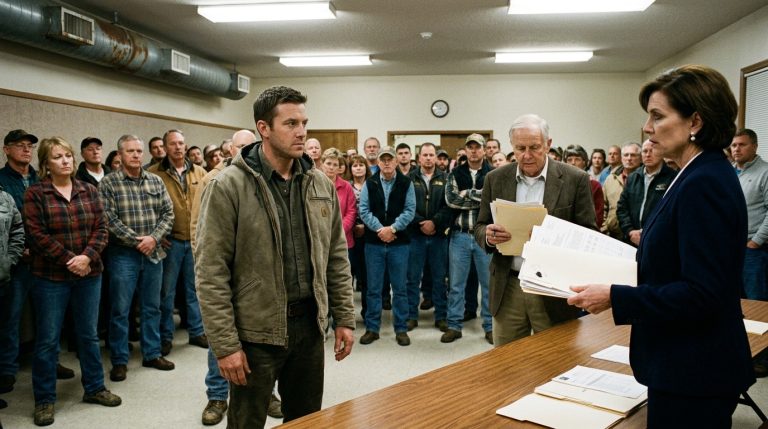
The county annex was cold, the air smelling of ozone and floor wax. It was a space designed for the accumulation of truth, and today, the truth was heavy. The room was packed, but the noise level was abnormally low—a tense, humming silence that precedes a collapse. Karen stood by the window, her silhouette sharp against the morning light. She had arrived early, flanked by her two loyalists and an attorney who looked increasingly uncomfortable with the file in his lap.
I walked to the table where Mara had already laid out our documentation. She didn’t look at Karen. She simply smoothed the edge of the certified abstract, a crisp, white sheet of paper that carried the weight of the entire county’s authority.
When the hearing officer entered, the room seemed to shrink. He sat down, adjusted his glasses, and looked at the mountain of paper before him. “We are here to address the petition regarding the Echo Ridge parcel boundary and the subsequent administrative interference claims.”
Karen leaned forward, ready to perform the confidence she had honed over months of neighborhood meetings. “This is a simple matter of community standards,” she began, her voice smooth, the rehearsed cadence of a woman used to getting her way. “The parcel in question is an essential part of our shoreline infrastructure. The board’s actions were taken to ensure the preservation of—”
Mara didn’t let her finish. She didn’t raise her voice; she didn’t need to. She simply slid the recorder’s certified abstract across the table. “This is the chain of title, certified as of 8:00 AM this morning. It reflects a clear, uninterrupted ownership from the estate to my client. There is no HOA interest. There is no shared amenity designation. And there is, specifically, no legal basis for the plat amendment referenced in the petitioner’s affidavit.”
The hearing officer glanced at the document, then at the affidavit. He looked at the plat amendment number, then pulled up the digital map on his tablet. The room was so quiet I could hear the hum of the overhead lights.
“Counsel,” the officer said, looking at Karen’s attorney. “This plat amendment pertains to the Miller subdivision. That’s two miles south of this parcel.”
Karen’s posture didn’t change, but her expression did—a sudden, brittle tightening. She turned to her attorney, who was now busy reviewing the page with a look of genuine shock. “That… that must be a clerical error,” she said, her voice missing its earlier polish. “The board was working off the documentation provided by the previous maintenance supervisor.”
“The board,” Mara said, her voice cutting through the excuse, “also held a closed Zoom session on the 14th. We have the transcript. Metadata proves it originated from your personal account, Karen.”
She read the line out loud—the one about jamming the deed chain, the one about keeping the house empty for summer. The words hung in the air like glass shards. Karen looked at the floor, her hands gripping the edge of the table until her knuckles turned white. The smile that had defined her civic persona was gone, replaced by the hollow, raw look of a woman who had just realized that the system she tried to weaponize had finally turned its gaze on her.
“Did you direct contractors to seize access to property your organization did not own?” the officer asked.
Karen opened her mouth to argue, but the words died in her throat. She looked at her attorney, who had effectively stopped listening, his pen hovering over the document as if he were trying to find a way to scrub his own name from the file.
The resolution was swift. A temporary injunction was granted on the spot, backed by the full force of the county. No contact. No interference. Immediate restoration of access.
As the hearing broke up, the atmosphere in the room shifted. Karen didn’t walk out with her head held high. She was surrounded by the neighbors she had promised to protect, and for the first time, she was just another person in the room—a person whose influence had been punctured by a single, damning truth.
By the time I reached the cabin, the sun was high and the heat was rising. I walked straight to the dock gate. The padlock and the heavy chain were gone—the deputy had removed them while I was still in the annex. I stood there, watching the water lap against the pilings. It sounded the same as it had on the first day, but now, the rhythm felt different. It was the sound of a space that was entirely my own.
I pulled the new cedar post from my truck—the one I’d carved with the address. I dug a hole just inside the property line, right where the survey pin sat. I set the post, packed the earth tight with my boots, and stepped back. There were no slogans, no flashy declarations. Just the number, clean and permanent, facing the road like a fact.
I went inside and opened the windows, letting the breeze flush out the stale air of the last few weeks. The cabin felt quiet—not the anxious, waiting silence of a bunker, but the solid, grounded peace of a home. I sat at the table with a cold drink, listening to the lake. The paperwork was filed, the record was corrected, and for the first time since I’d bought this place, the world outside was someone else’s problem. I took a slow breath, felt the weight of the day settle into the wood of the chair, and looked out at the water. The struggle had been loud, but the silence that followed was exactly what I had paid for.