A Fragile Equilibrium: Finding the Light Beneath the Marble and Dust of the Hargrove Estate
CHAPTER 1: The Weight of Silence
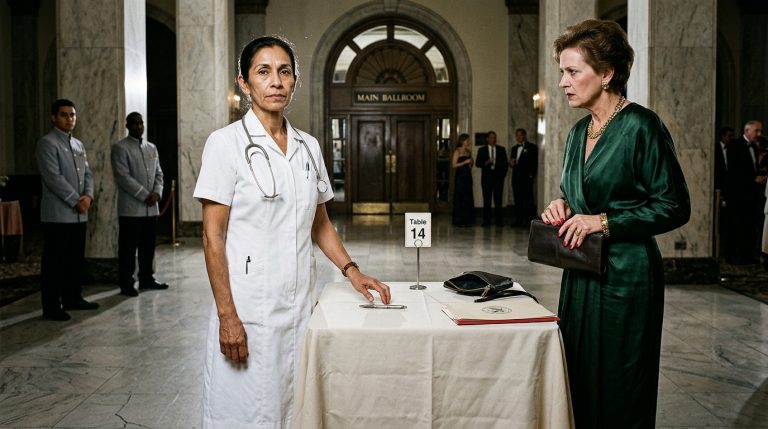
The marble of the foyer was always cold, even with the central heating humming somewhere deep in the bones of the Hargrove estate. Clara kept her gaze lowered, her knuckles white as she gripped the cleaning cloth. It was 9:00 PM on a Friday in December, and the ballroom glittered with the reflected light of a thousand crystal ornaments, but for Clara, the room felt suddenly, suffocatingly small.
“I want her gone.”
Vanessa’s voice didn’t belong in this space. It wasn’t a human sound; it was the sound of a closing door. Clara felt the familiar, heavy thrum of adrenaline in her ears, the same sound she had heard in the hospital rooms of her past, the same sound that preceded every major fracture in her world.
“Vanessa, let’s handle this privately,” Marcus Hargrove said. He stood beside his fiancé, his expression masked in a way that had always made the staff feel uneasy. He was the employer, the billionaire, the man who built empires, but tonight he seemed to be watching the scene unfold from a great, untouchable distance.
“No,” Vanessa snapped, her heels clicking against the floor like a ticking clock. She pointed at Clara. “She’s the only one who had access to my vanity. My mother’s bracelet didn’t just walk away.”
Clara opened her mouth, the defense she had rehearsed a hundred times in her head—I cleaned the glass, I didn’t touch the vanity, I was in the East Wing—dying in her throat. She had learned long ago that logic was a weak shield against someone with absolute power. She looked at the polished floor, focusing on a single, tiny smudge near the baseboard that she hadn’t managed to buff out yet.
She thought of Lily. Down the hall, in the small, quiet room that was the only place in the world that felt like home. If she lost this job, the room went with it.
“I did not take your bracelet,” Clara said, her voice betraying not a tremor, even as the walls of the room seemed to lean in.
“You’re a thief,” Vanessa replied, her gaze moving over Clara with a detached, clinical disgust, as if she were inspecting a broken plate. “And I want you off this property before midnight.”
Clara took a breath, the air tasting of pine needles and expensive perfume, feeling the crushing weight of the ‘someone like her’ label Vanessa had draped over her shoulders. She was about to turn, to walk away, to accept the inevitable, when the sound hit her.
Tiny, rhythmic footsteps. Unsteady.
Clara turned. Lily stood in the doorway, her yellow pajamas illuminated by the harsh, overhead lights. She held her stuffed elephant, Ellie, by the trunk. She looked around the room, blinking against the glare, her eyes landing on the console table in the hallway. Without a word, Lily walked past the silent guests, past the frozen security guard, and pointed a small, steady finger at the bowl of pine cones.
“Mama pretty,” Lily whispered.
The air in the room didn’t just shift; it vanished. Clara looked at the bowl. There, glinting beneath a branch of artificial pine, was the diamond bracelet.
CHAPTER 2: The Echo of Innocence
The silence that followed Lily’s whisper was not the hollow quiet of an empty room; it was a dense, suffocating pressure that seemed to vibrate against Clara’s skin. The bracelet rested in the bowl, a constellation of stolen light half-buried in ornamental pine, and for a heartbeat, time became entirely elastic.
Clara watched Marcus. His tall frame, usually characterized by a fluid, easy grace, had gone rigid. He stood over the console table, his hand hovering over the bowl as if the diamond itself were a live wire. Clara’s gaze shifted to Vanessa. The polish, the effortless confidence, the sharp-edged elegance that had dominated the estate for months—all of it had suddenly lost its sheen. Vanessa’s mouth remained parted slightly, her eyes flickering not with the outrage of the accused, but with the frantic, predatory assessment of someone who had just realized the trap she set was closing in on the wrong hand.
Clara felt the weight of Lily’s small, warm palm against her thigh. The child remained oblivious to the tectonic shift occurring in the lives of the adults around her. To Lily, the bracelet was simply a shiny bauble, a pretty object worthy of identification. She was playing. She was being a child. But for Clara, that tiny, innocent finger had dismantled the foundation of her fear.
“It must have fallen,” Vanessa said, the words brittle and thin, lacking the resonance of her earlier accusations. “Someone must have moved it when they were arranging the display. It’s a common mistake.”
“The display was arranged at three o’clock this afternoon,” the voice came from the kitchen threshold. It was Sarah, one of the catering staff, her arms crossed tightly over her apron. “Clara wasn’t in this hallway all afternoon, Vanessa. I was with her in the East Wing. I saw her move from the library to the linen closet, and she never once stopped at this console.”
The air shifted again. The guests—the senators, the CEOs, the people who lived for the intricate dance of social leverage—began to murmur. It wasn’t the sound of sympathy, but of a gathering storm. They were looking at Vanessa, and for the first time, they were seeing something they didn’t like.
Clara felt a sudden, sharp intrusive memory—a phantom sensation of her grandmother’s kitchen, the smell of burnt toast and the way her grandmother would grip the table when the bank collectors came to the door. That familiar, icy dread began to bloom in her chest. She had spent a lifetime learning how to be the victim, how to accept the accusations, how to fold her wings and become small. The habit of submissiveness was a deeply ingrained instinct, a survival mechanism that had kept her safe from sharper knives. But looking at the bracelet now, seeing the way Vanessa’s composure was unraveling like a cheap hem, Clara felt a flicker of something she had never allowed herself to feel before: the quiet, cold resolve of the truth.
Marcus finally reached down. He lifted the bracelet with two fingers. It caught the chandelier’s light, casting fragmented rainbows against the mahogany wainscoting. He didn’t look at Vanessa. He didn’t look at the guests. He looked at the floor, his brow furrowed in a way that suggested he was calculating a debt he was only just beginning to realize he owed.
“I think,” Marcus said, his voice dropping an octave, losing its public veneer and gaining an edge of raw, unfiltered reality, “we should continue this conversation privately.”
Vanessa straightened, trying to reclaim the room, but the effort was translucent. She looked at Clara—not through her, as she had done for months, but at her—and for a fleeting second, the mask slipped entirely. Behind her eyes was not remorse, but a terrifying, hollow fear. She had gambled on Clara’s invisibility, and she had lost.
“Marcus, don’t be dramatic,” Vanessa said, her voice rising in a desperate attempt to bridge the widening gap. “It’s a misunderstanding.”
Marcus didn’t respond. He simply turned, his back to her, and focused on Clara. The silence that had filled the hallway rushed back in, but it was different now. The tension had shifted from accusation to accountability.
Clara gripped Lily’s hand, her knuckles white. She wanted to bolt. She wanted to take her child and the stuffed elephant and run until the marble was replaced by grass and the silence was replaced by the noise of the world that didn’t demand explanations. But she didn’t move. She stood her ground, feeling the cold marble beneath her soles, grounding herself in the physical reality of the moment. She would not be the one to run. She had done nothing wrong, and for once, the weight of the truth was resting on someone else’s shoulders.
Marcus took a step toward her. He looked at Lily, then at Clara, his expression shifting from the distance of an employer to the focus of a man realizing he had been sleepwalking. “Mrs. Simmons,” he began, and the formality of the title was an acknowledgment, a recognition of her presence that she hadn’t dared to hope for. “I owe you an apology.”
Clara tightened her grip on Lily’s hand, her heart hammering against her ribs like a trapped bird. “I’m just doing my job, Mr. Hargrove,” she said, her voice steady, even if her insides were a storm. She wouldn’t accept his pity, not now. Not when the cost of this ‘misunderstanding’ had been the very fabric of her existence.
Vanessa turned on her heel and strode toward the sitting room, the sound of her exit more like a retreat than a departure. The guests, sensing the conclusion of the immediate spectacle, began to disperse, their whispers leaving trails of smoke in the hallway.
Clara was left standing in the lingering, heavy quiet. She looked at the console table, then at Marcus. The billionaire, the man of Forbes lists and grand galas, looked suddenly, vulnerably tired. The light in the hallway flickered, the shadows stretching and retreating, and Clara knew that whatever happened next, the walls of the life she had built—the small, safe, invisible life—had been permanently altered. She was no longer just the maid; she was the woman who had seen, and been seen, in the light of an uncomfortable truth.
CHAPTER 3: The Fragile Geometry of Departure
Clara felt the marble floor beneath her feet as if it were vibrating, carrying the echo of Vanessa’s retreating heels. The hallway was empty now, save for the scent of winter pine and the lingering, sharp ozone of a broken peace. Marcus stood before her, his shoulders slumped ever so slightly—the posture of a man whose armor had been dented by his own admission of failure.
“I don’t need an apology, Mr. Hargrove,” Clara said, her voice sounding thin and small against the vast, vaulted ceiling of the foyer. She wanted to reclaim the invisibility that had been her shield for months. She wanted to be back in the staff quarters, where the only thing that demanded anything of her was Lily’s breathing. “I just need to know if I’m still expected to be here in the morning.”
Marcus looked at her, his eyes dark and unreadable. He seemed to be weighing the cost of his next words. “The estate is in transition, Mrs. Simmons. There are… realities I have been ignoring that I can no longer look past. Please, go to your quarters. I will handle the immediate aftermath of this evening. You are not to be disturbed.”
Clara didn’t wait for him to change his mind. She turned, her hand tightening around Lily’s, and they walked toward the East Wing. Every step felt like walking across thin ice. Behind them, the house continued to operate—the distant clinking of silverware, the murmur of the remaining guests, the rhythmic hum of the HVAC system—but it felt like a film she was no longer a part of.
When they reached the staff wing, the door was slightly ajar. Mrs. Patton was there, a shadow in the doorway, her face etched with a mix of relief and wary curiosity. Clara moved past her, sinking into the armchair in the corner of her room. Lily, exhausted by the night’s strange theater, curled up on the small bed and was asleep within minutes, the stuffed elephant tucked firmly under her chin.
Clara sat in the dark, listening to the house settle. She wasn’t sleeping. She was watching the way the moonlight cut across the floorboards, observing the way the dust motes danced in the pale, cold light. She had spent years cultivating a life of quiet survival, and in one evening, the center of that life had been shattered by a child’s finger and a bowl of pine cones.
Around midnight, a low hum of machinery broke the silence outside her window. Clara stood and pulled back the heavy curtain. Below, a service truck was parked on the gravel drive—a maintenance crew. She watched as they unloaded coils of industrial insulation and heavy-duty tool kits. It was odd; maintenance for the staff wing was usually a matter of weeks of requests and polite follow-ups, not a midnight arrival.
As she watched, Marcus appeared in the glow of the truck’s floodlights. He was speaking to the foreman, his gestures sharp and authoritative, his coat collar turned up against the biting December wind. He looked less like the billionaire who hosted galas and more like the man she had heard rumors about—the one who would spend forty-five minutes on the phone fighting for a laborer’s pay. He wasn’t just managing a property; he was clearing out the rot.
Clara let the curtain drop. She felt a strange, cold flutter in her chest—the realization that the “something” that had shifted in the hallway was not going to be easily undone. Vanessa was gone, or at least, the version of Vanessa that had held court in the foyer was gone, and the house was responding to the void she left.
She turned back to the room. It was small, sparse, and entirely hers. For the first time, she noticed the draft near the window frame, the subtle peeling of the wallpaper near the floor. She had accepted these flaws as the price of admission to a safe life. But seeing the maintenance crew outside, she wondered if she had been too quick to accept the “small” life that had been offered to her.
A knock at the door, soft and hesitant, made her jump.
She walked to the door and opened it just a crack. Mrs. Patton stood there, clutching a sweater tightly around her shoulders. “He’s out there, Clara,” she whispered, her eyes wide with a mixture of apprehension and wonder. “He’s personally overseeing the repairs. I’ve lived on this estate for fifteen years, and I have never seen him do that.”
“He’s fixing a mistake,” Clara said, though her heart was hammering a different rhythm against her ribs.
“Is it?” Mrs. Patton asked, her voice low. “Or is he finally noticing what’s actually in his house?”
Clara didn’t answer. She closed the door and leaned against it, the cool wood pressing against her spine. The house was changing. The marble was no longer just a floor she cleaned; it was the foundation of a place where she had been forced to show her face. She looked at Lily, then at the empty room, and for the first time, she didn’t just feel like a transient worker in a billionaire’s estate. She felt like a person waiting for the next tremor to hit.
She crawled into bed, but the darkness offered no comfort. She was thinking about the bracelet—not the theft, but the way Marcus had looked at it, and then at her. It wasn’t the look of a man who had lost a piece of jewelry. It was the look of a man who had finally found the one thing he had been looking for, even if he didn’t know what it was yet. And that, she decided, was the most dangerous part of all.
CHAPTER 4: The Texture of Change
Morning did not arrive with the gentle light of a new beginning; it came with the harsh, sterile hum of an industrial vacuum cleaner and the smell of fresh plaster dust. Clara moved through the East Wing with a mechanical precision that felt, for the first time, like an act of rebellion. She was not just cleaning anymore; she was cataloging the environment.
She entered the linen closet, a space she had navigated a thousand times, and paused. The shelves were usually organized by thread count and use, a rigid geometry of white and cream. But on the second shelf, tucked behind a stack of folded duvet covers, sat a small, velvet-lined box that did not belong.
Clara reached out, her fingers trembling slightly against the soft, worn fabric of her uniform. She didn’t open it. She simply traced the edge of the box. It was cold, metallic under the velvet, and it didn’t match the inventory of the Hargrove estate. It was a detail—a physical discrepancy—that felt like a jarring note in a well-rehearsed song. She tucked it into her apron pocket, the weight of it suddenly anchors against her hip, and continued her work.
The house felt different in the daylight. The maintenance crews were still there, moving through the halls with their heavy boots and rolls of insulation, their presence turning the estate from a sanctuary of order into a site of active repair. Clara found herself watching them. She watched the foreman check his clipboard, the way he looked at Marcus with a mixture of professional distance and unspoken concern.
She caught a glimpse of Marcus in the hallway. He was wearing a casual sweater, his hair slightly disheveled—a stark contrast to the perfectly tailored suits he wore for his public life. He stopped near the kitchen doorway, his gaze sweeping the corridor as if he were seeing the very cracks in the plaster for the first time.
“Mrs. Simmons,” he said, his voice quiet as he approached her.
Clara stopped. She kept her hands occupied with the linens, focusing on the fold, the stack, the order. “Mr. Hargrove.”
“I’ve instructed the crews to focus on the staff quarters first,” he said. He wasn’t looking at the linens; he was looking at her, with an intensity that made the air feel thin. “The insulation is just the start. If there is anything else… anything you’ve noticed that hasn’t been up to par, I want you to tell me directly. No more agency reports. No more middle-men.”
Clara looked up. She saw the exhaustion in the lines around his eyes, the genuine, weary effort of a man who was trying to rebuild something he had only just realized was broken. “Why now?” she asked, the question slipping out before she could check it.
Marcus didn’t blink. “Because I don’t want to be the kind of man who looks through people anymore. It’s a habit I’m having to unlearn, and it’s harder than building a company.”
Clara searched his face for the performative edge—the practiced sincerity of a billionaire at a charity gala. She found nothing but a raw, unvarnished honesty that mirrored her own desire for something real. She thought of the velvet box in her pocket, the physical weight of the secret she had stumbled upon. She wasn’t ready to share it—not yet. She needed to know if it was a threat, a decoy, or simply another piece of the puzzle that was rearranging the architecture of her world.
“I’ll let you know,” she said, and the words were a promise, a tentative step into a new, dangerous dynamic.
Marcus nodded, a faint, fleeting smile touching his lips. “I’ll hold you to that.”
He turned and walked down the hall, his footsteps muffled by the new insulation they were laying. Clara watched him go, feeling the weight of the box in her pocket. The “someone like her” label that Vanessa had pinned to her felt like a fraying thread—something that was coming undone, leaving her exposed to a reality she hadn’t prepared for.
She spent the rest of the morning moving through the rooms with a focused, analytical mind. Every smudge on a window, every crooked frame, every subtle discrepancy in the house’s routine became a data point. She wasn’t just observing the estate; she was examining it. The fear that had kept her small for so long was slowly being replaced by a cool, pragmatic curiosity.
In the late afternoon, as the sun began to dip below the Atlanta skyline, casting long, orange shadows across the gardens, Clara took the velvet box to her room. She sat on the edge of the bed, Lily safely playing with her elephant in the corner, and opened the lid.
Inside was a key—a heavy, antique key with a jagged tooth that looked like it belonged to a door that had been locked for decades. There was no note, no identification. Just the key and the heavy silence of the room. Clara held it, the metal biting into her palm, and realized that the “misunderstanding” of the bracelet had been a distraction. The house was full of layers, and someone, somewhere, had been keeping their own secrets behind locked doors.
She felt a surge of adrenaline, not the cold, paralyzing fear of before, but a sharp, vibrant heat. She wasn’t a victim of this house; she was an observer of it. And for the first time, she felt like she might be the one to hold the key to its final, hidden truth.
CHAPTER 5: The Weight of the Unlocked
Clara stared at the key. It was heavy, a dense, cold weight that seemed to pull her hand toward the floorboards. The moonlight filtered through the sheer curtains, casting long, skeletal shadows across the room, and for a moment, she couldn’t move. She was trapped in the threshold between the life she had been living—the quiet, invisible existence—and this new, uncertain reality where secrets had physical shapes.
The voices outside grew louder. They were voices she recognized: the foreman and Marcus. They were moving down the hall toward the East Wing. Clara didn’t think; she acted with the frantic efficiency of a cornered animal. She shoved the velvet box into the back of her dresser drawer, wedging it behind her sparse collection of sweaters. The key she kept. She slipped it into the small, reinforced pocket inside her apron—a pocket she used for her nursing school study cards.
She stood up, smoothing her apron, her breath coming in shallow, jagged gasps. She had barely managed to sit back on the edge of the bed when the soft, deliberate knock echoed against her door.
“Clara?”
It was Marcus. He sounded tired, but there was an edge to his voice she hadn’t heard before—a sharpness, a focused urgency.
Clara walked to the door and opened it. Marcus stood in the hallway, the fluorescent overheads casting deep hollows beneath his eyes. Behind him, the corridor had been transformed by the insulation work; rolls of fiberglass and discarded plastic sheets lay everywhere, creating a maze of debris.
“I apologize for the hour,” Marcus said, his eyes scanning her face with a scrutiny that made her feel exposed. “The crew found something in the East Wing walls while they were installing the new fixtures. I thought you might have seen something similar during your shifts.”
Clara felt the key pressing against her thigh. She held her breath. “What did they find?”
Marcus gestured down the hall. “A compartment. It looks like it was designed for storage, but it’s been sealed for years. It’s empty, but the craftsmanship… it’s not original to the house.”
Clara followed his gaze. The foreman was standing near the entrance to the linen closet—the very closet where she had found the key. Her stomach dropped. Was there another? Had the key in her pocket been meant for the space they had just breached?
“I only clean what I can see, Mr. Hargrove,” Clara said, her voice steadying. She felt like an actor on a stage, reciting lines she had written in her head to survive. “I don’t look behind the walls.”
Marcus looked at her, his expression unreadable. He seemed to be looking for a hesitation, a crack in the façade. “I’ve spent a long time looking past what was right in front of me, Clara. I’m trying to change that. I need to know if anyone else has been in the East Wing after hours.”
The paranoia crept in, cold and damp. Had he seen her? Was he testing her? The way he stood, the way he watched her—it was no longer the gaze of an employer. It was the gaze of a man who was hunting for something, and he didn’t care who he stepped on to find it. Clara felt a flash of resentment. Was he truly trying to fix his house, or was he just clearing the board to make room for his own, new secrets?
“I’m here to work,” she said, her voice turning sharp. “I don’t know who comes and goes once I finish my shift.”
Marcus held her gaze for a long, uncomfortable moment. Then, he sighed, a sound of genuine defeat. “Right. Of course. Forgive me. The exhaustion… it’s making me see ghosts.”
He turned to leave, but stopped. He glanced back at her, his expression softening. “Clara, if you ever feel that something isn’t right—if you feel that this house is holding onto things it shouldn’t—tell me. I’m trying to make this a place where you and Lily can be safe. That’s not just a promise. It’s the only thing that matters right now.”
He walked away, his footsteps fading into the distance. Clara closed the door, her hands shaking so hard she had to grip the doorframe to keep from falling. She leaned her forehead against the wood, the cold surface grounding her.
She wasn’t safe. She realized that now with a clarity that was almost blinding. Marcus wasn’t just the savior she had painted him as; he was a man with his own desperate, hidden agendas. The house was not being repaired; it was being excavated. And she was standing right in the center of the dig.
She walked back to the dresser, but she didn’t open the drawer. Instead, she sat on the floor, listening to the house breathe. She had the key, but she didn’t have the door. She had the truth, but she didn’t have the context. And as she looked at her hands, she saw they were stained with the dust of the house. She had spent her life trying to stay clean, trying to keep her world small and manageable.
But the house was too big, the secrets were too deep, and Marcus was not as simple as she had hoped. She touched the pocket of her apron. The key felt heavier now, an accusation against her skin. She had to know what it opened. She had to find the door before they did, or she would be buried alongside whatever had been behind those walls for all those years.
CHAPTER 6: The Anatomy of a Secret
Clara didn’t wait for the sound of Marcus’s footsteps to completely fade. She dropped to her knees, not to pray, but to act. The key in her apron pocket felt like a brand, a heavy, metallic promise of answers she wasn’t sure she wanted to find. She needed to know where it fit, and she needed to do it before the maintenance crews returned for their next shift.
She moved to the hallway, her movements fluid and silent. The East Wing was a labyrinth of plastic sheeting and half-finished drywall. The smell of sawdust and fresh industrial adhesive was overwhelming, thick enough to taste on the back of her throat. She navigated the corridor with the ease of someone who had memorized every floorboard, every creak, every shadow.
She reached the linen closet where the crew had been working. The wall had been stripped back to the studs, exposing the original lath and plaster. It was a jagged, raw wound in the architecture of the house. Clara stepped over the debris, her heart hammering against her ribs. She scanned the wall, her eyes tracing the pattern of the studs, the odd, irregular spacing.
There, near the baseboard, was a small, recessed panel—a discrepancy in the alignment of the wood. It was almost invisible, disguised by years of wallpaper and paint, but now, with the plaster gone, it was an obvious, deliberate void.
She knelt, her fingers brushing the surface. It wasn’t wood; it was cold, polished brass, tarnished by time. She pulled the key from her pocket. It was a perfect fit. The lock groaned—a sound of protesting iron—and the panel clicked open, revealing a narrow, vertical cavity cut into the very spine of the house.
Clara reached inside. Her hand brushed against a bundle of documents, tightly rolled and wrapped in oilcloth. She pulled them out, the fabric fraying against the jagged edges of the wall cavity. She didn’t open them. She didn’t have to. The feel of them—the texture of the paper, the weight of the ink—told her more than the words could. These weren’t just financial records or personal correspondence; they were a roadmap of the estate’s history, a documentation of the very secrets that had kept this house standing for decades.
A floorboard creaked in the hall.
Clara froze. She shoved the oilcloth bundle into her apron, right against the key, and pressed herself into the shadows of the closet.
The foreman appeared at the end of the hall, his flashlight beam cutting through the gloom like a scalpel. He stopped, his gaze sweeping the corridor. He looked toward the linen closet, his brow furrowed.
“Who’s there?” he called out, his voice echoing against the bare walls.
Clara held her breath, her eyes fixed on the sliver of light coming through the plastic sheeting. She was invisible—the one role she had perfected, the one tool that had always kept her safe. She remained perfectly still, her mind a blank, white space of pure, focused intent.
The foreman hesitated, his flashlight lingering on the closet entrance for a heartbeat that felt like an eternity. Then, he grunted, turned on his heel, and walked away.
Clara waited for the sound of his footsteps to die out before she moved. She didn’t go back to her room. She knew that now, with the documents in her possession, her presence in the staff quarters was a liability. She had to move, to think, to plan. She slipped out through the service entrance, the cool night air hitting her face like a physical blow.
She found herself in the garden, the same garden where she had stood with Marcus only months ago. The space felt transformed. The winter air was sharp, biting, and the moonlight cast long, distorted shadows across the lawn. She walked to the low stone wall where they had sat, and she sat there, the oilcloth bundle resting in her lap.
She opened it. The documents were a collection of blueprints, marked with annotations and dates that went back to the original construction of the Hargrove estate. But there was something else—a photograph, tucked into the center of the roll. It was a picture of a woman, younger, standing in front of the house. She had the same dark, intelligent eyes as Lily.
Clara felt the ground beneath her shift. The secret wasn’t about the money. It wasn’t about the company, or the status, or the facade of a perfect life. It was about blood.
She looked at the house, the grand, imposing structure that had been her cage and her sanctuary. It wasn’t just a building. It was a vault. And she had just unlocked the first, most dangerous secret hidden behind its walls. She wasn’t just a maid anymore; she was the custodian of a history that someone had spent decades trying to erase. And she realized, with a chill that started at the base of her spine, that Marcus wasn’t just fixing his house. He was looking for these, too.
CHAPTER 7: The Weight of Disclosure
Clara pulled the oilcloth tight against her chest, the documents crinkling with a sound that seemed loud enough to wake the dead. She pressed herself into the shadows beneath the stone wall, her breath hitching. The flashlight beam swept the lawn, a thin, white finger of light that grazed the garden shrubs and illuminated the dew-slicked grass. It was searching, methodical, and headed directly for the stone wall.
She didn’t wait to be found. She scrambled to her feet, the weight of the key in her apron pocket a constant, rhythmic thump against her thigh. She slipped through the side gate, her feet silent on the dampened earth, and rounded the corner of the maintenance shed. The garden was a maze of familiar textures, but tonight, each shadow seemed to hold a threat, and every rustle of dry leaves sounded like a footstep.
She reached the service entrance of the staff wing, but stopped. The hallway lights were visible through the frosted glass, and the silhouette of someone pacing back and forth caught her attention. It was Marcus. He was holding his phone to his ear, his movements frantic, disjointed. He wasn’t the man she had spoken to earlier; this was a man whose carefully constructed reality was coming apart at the seams.
“I don’t care how long it takes,” she heard his voice, thin and strained, filtering through the glass. “You find where those files were moved. If she has them, the whole thing is over.”
The blood drained from Clara’s face. She leaned against the cold brick of the exterior wall, the oilcloth bundle biting into her ribs. The “whole thing.” He wasn’t fixing the house. He was sanitizing it. The insulation, the maintenance, the “apology”—it had all been a play to keep her from seeing what he was so desperately trying to bury. The decoy secret hadn’t been the theft; it had been the house itself, a carefully managed narrative of progress designed to keep anyone from digging deep enough to find the roots of the family tree.
She felt a phantom sensation—the harsh, metallic vibration of the textile factory floor where her grandmother had spent thirty years of her life. The realization hit her with the force of a physical blow: she had been playing by the rules of a game she didn’t understand, while the master of the house had been manipulating the board from the very beginning.
She could go to him. She could hold out the bundle and ask for the truth, for the humanity he had claimed he was learning. Or she could disappear. She could take Lily and the truth and vanish into the night, leaving the Hargrove estate to its crumbling foundations.
The choice wasn’t about the money or the security; it was about the dignity she had promised to hold onto, even when the world tried to strip it away. If she handed over the truth, she would be back where she started—a servant, an invisible witness to a master’s narrative. If she kept it, she was a threat.
She moved away from the service entrance, her heart a drumbeat of pure, cold resolve. She wouldn’t be a chapter in his history. She would be the one to write the final page. She reached the edge of the property, the tall iron gates looming in the distance, their intricate, rusted patterns looking like bars against the night sky.
As she reached the gate, a car pulled into the drive—a sleek, dark sedan that moved with the quiet authority of a predator. It pulled up to the main entrance, and the passenger door opened. A figure stepped out—not Marcus, but a lawyer, someone she had seen once at the pre-engagement dinner. He was carrying a briefcase.
Clara pressed into the brush at the edge of the drive, her eyes locked on the scene. The house wasn’t just holding secrets; it was actively processing them. She looked down at the documents, the ink and paper that had survived decades of silence. They were more than evidence; they were a testimony.
She turned away from the gate. She had to get back inside. She had to know what was in the files, and she had to find a way to make sure that whatever they contained, they wouldn’t be lost to the house’s silence again. She moved through the darkness of the grounds, her mind sharpening, the fear burning away to reveal the cold, hard diamond of her own autonomy. She wasn’t fleeing; she was infiltrating. And she had the key.
CHAPTER 8: The Garden of Truth
The dawn broke over the Hargrove estate with a terrifying, absolute clarity. Clara stood at the edge of the terrace, the oilcloth bundle clutched in one hand and the antique key in the other. Behind her, the house was a hollow shell, its secrets finally bled dry by the light. She had spent the night in the library, not hiding, but reading—tracing the history of the Hargrove bloodline, the intentional erasure of names, and the calculated silence that had protected the estate’s power for decades.
She heard the heavy tread of boots on the stone steps. Marcus appeared, his face haggard, his eyes reflecting the same dawn light as he looked at her. He stopped five paces away, his hands shoved deep into the pockets of his coat. He knew. He had seen the empty cavity in the wall, and he knew that the silence he had curated was over.
“You read them,” he said, his voice flat, devoid of the charm or the vulnerability he had leveraged in the past.
“I read them,” Clara replied. She felt no fear. The trembling of the previous night had solidified into a cool, impenetrable strength. She held up the photograph—the woman with the curly hair and the eyes that mirrored her own. “She wasn’t a guest, Marcus. She was family. And you kept her existence behind a wall because it didn’t fit the picture you were trying to paint.”
Marcus looked at the photograph, then back at Clara. The “cornered beast” was there—the sudden, sharp intake of breath, the way his jaw tightened, the way his body coiled with the urge to regain control. He didn’t monologue. He didn’t beg. He simply took a step toward her, his face turning hard. “That history is a liability, Clara. It is a burden that this estate cannot support. Give me the files. We can negotiate a future that doesn’t involve the destruction of this firm.”
“Your firm is a monument to a lie,” Clara said. She took a step back, toward the garden gate. “I’m not a liability to be managed, Marcus. I’m the truth you were too afraid to keep.”
She reached down, her fingers digging into the garden soil, and found the small, metal spike she had used earlier to pry a stubborn stone from the path. It was a small thing, but it was enough. She took the antique key—the key that had unlocked the secret vault—and smashed it against the stone wall. The metal shattered, the jagged, singular teeth snapping under the pressure. The key that had opened the door was now destroyed, rendering the lock useless, the secret inaccessible to anyone else.
Marcus lunged, but he was too late. Clara was already through the gate, the iron swinging shut with a final, resonant clang. She didn’t look back as she walked toward the distant lights of the main road.
The payoff was not a confrontation; it was the abandonment of the board entirely. Marcus stood at the gate, his hand gripped around the iron bars, watching her go. He was defeated not by force, but by the sudden, total evaporation of his relevance. The estate, the power, the secrets—they meant nothing without her presence to validate the lie. He was left alone with his hollow monument.
The walk to the road was long, and for the first time in months, the air didn’t smell of pine or antiseptic. It smelled of rain, of damp earth, of the world outside the marble foyer. The coolness of the morning settled into her skin, washing away the grit of the Hargrove history.
She reached the intersection where a small park sat, its benches covered in the morning dew. She sat down, pulling Lily closer to her, wrapping her arms around the small, warm body of her daughter. She took the oilcloth bundle, now a heavy, meaningless weight, and placed it in the trash bin near the bench. She didn’t need the documents anymore. She carried the truth in her memory, and that was enough to ensure that the story would never be buried again.
She reached into her apron pocket and pulled out her grandmother’s old, silver locket—the only thing of value she had ever owned. She opened it, looking at the small, faded photograph inside. Then, she took a smooth, flat stone from the garden bed she had inadvertently carried in her pocket and pressed it into the soft earth at the base of a young oak tree near the park bench. It was an act of symbolic closure: the repair of a life that had been fractured, now grounded in a new, unyielding foundation.
Clara sat there, watching the sun rise fully over the city. She didn’t know where she was going, and for the first time in her life, she didn’t care. She had money enough for a ticket, her nursing books in a bag, and a daughter who was currently pointing at a bird with wonder and curiosity. She was not a maid, not a witness, and not a liability. She was a woman who had walked through the fire of another man’s history and emerged entirely, stubbornly herself. The silence of the Hargrove estate was finally behind her, and for the first time, she was listening to the sound of her own voice.