The Silent Sentinel: A Legacy of Quiet Courage and the Mending of a Shattered Pride
CHAPTER 1: The Threshold of Contempt
The lobby was a cathedral of marble and polished ego, smelling faintly of expensive cologne and the sterile, forced air of the wealthy. Captain Kyle Evans loomed over the check-in desk, his posture a masterclass in aggressive geometry. Every medal on his chest was a tiny, sharp-cornered affirmation of his own importance, a sharp contrast to the man standing—or rather, settling—before him.
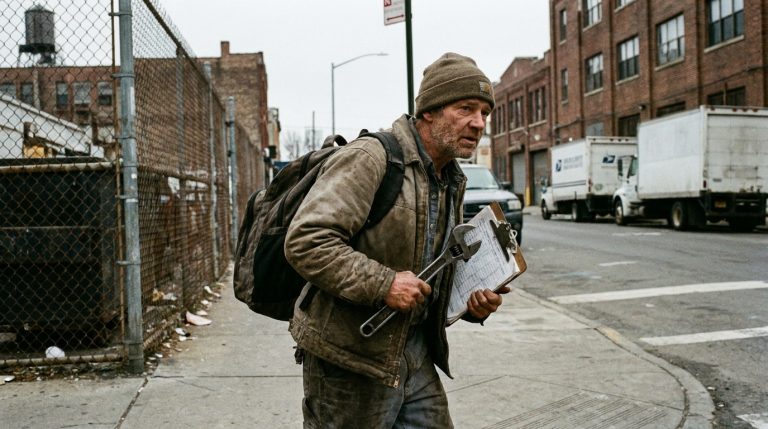
James O’Donnell didn’t fidget. He didn’t apologize. He stood with the quiet, devastating stillness of a mountain that had long ago stopped caring about the wind. His leather jacket was a map of decades, the hide worn soft as velvet, the cuffs frayed into a web of loose threads.
“I’m going to need to see some form of identification,” Evans said. The words were clipped, stripped of warmth, designed to make the man in front of him feel small, temporary, and entirely illegitimate. “And your invitation. This is a private event, Mr… O’Donnell, was it?”
Lily, her hand hovering protectively near her grandfather’s elbow, felt the air in the room turn thin. She saw the way Evans’s gaze snagged on the circular patch on James’s sleeve—a patch so worn the threads were nearly ghost-white. The Captain didn’t see history; he saw an eyesore.
“It’s right here, Captain,” Lily said, her voice strained, vibrating with a nervous energy she couldn’t quite mask. She pushed the card toward him. “General Morrison’s personal guest.”
Evans didn’t even look at the card. He let it sit on the mahogany counter, a piece of paper he had already decided was worthless. He took a slow, measured step into James’s personal space, a predator marking a territory he hadn’t earned. “General Morrison is a busy man,” Evans whispered, loud enough for the small, gathering crowd to hear. “I don’t recall this name on his list. And frankly, this event is for those who understand what it means to carry the weight of this uniform.”
He reached out, his finger hooking into the frayed threads of the circular patch on James’s sleeve. “What is this? A souvenir? A gift shop relic from a war you probably only read about in a textbook?”
The contact was light, but to James, it felt like a sudden tectonic shift. The marble floors of the Grand Majestic seemed to lose their solidity, replaced by the humid, choking density of a jungle floor he hadn’t set foot on in fifty years. He heard the sudden, rhythmic thrum of rotors beating the air into submission, the smell of jet fuel biting at his lungs, and for a heartbeat, he wasn’t eighty-six. He was twenty, and the man touching his sleeve was about to learn that some ghosts are better left undisturbed.
James didn’t pull away. He just looked up, his pale blue eyes clear and utterly hollow of the confusion Evans expected to find. He didn’t look like a victim. He looked like someone waiting for the Captain to realize he had just touched something that could burn him.
“You really want to know?” James asked. His voice wasn’t weak; it was the sound of iron grinding against stone, a low, tectonic hum that made the Captain’s finger hesitate, then pull back as if the fabric were searing hot.
Lily felt the temperature in the room drop. Something was moving under the surface of the lobby, something heavy and old, and the Captain’s smirk began to falter as he stared into the depth of a man who clearly had nothing left to lose.
CHAPTER 2: The Ghost in the Machine
The lobby of the Grand Majestic was supposed to be a place of controlled opulence, but as the Captain’s finger retracted from his sleeve, James O’Donnell felt the room tilt on its axis. The expensive, filtered air of the hotel was suddenly replaced by the heavy, metallic tang of ozone and wet, rotting vegetation.
James stood still, his hand resting almost casually on his thigh, but internally, his mind was a storm of rapid-fire calculation. He wasn’t seeing the crystal chandeliers anymore. He was seeing the jagged silhouette of a Huey gunship against a bruised purple sky, the vibration of the craft humming through his own skeleton. The memory wasn’t a dream; it was an overlay, a persistent, aggressive ghost of the past that refused to stay buried beneath the khaki and the years.
Captain Evans stood before him, looking like a boy who had reached into a hollow tree and found a hornet’s nest instead of the honey he expected. The Captain’s face had lost its arrogant flush; it was pale, tight-skinned, and his eyes darted toward the junior Marines standing behind him, searching for a validation that wasn’t there.
“I… I asked you a question, sir,” Evans stammered, his voice lacking the sharp, metallic snap it had possessed only seconds ago. The authority he wielded had been grounded in the assumption that James was a relic, a piece of furniture that could be moved at will. Now, the atmosphere had thickened, turning viscous. The lobby guests, who had been merely curious moments before, were beginning to sense the shift. The rustle of conversation had died out, replaced by a suffocating, collective intake of breath.
James finally blinked, bringing the hotel lobby back into focus. The smell of the jungle faded, but the phantom weight of a pistol holstered at his hip remained, phantom and cold. He looked at Evans—really looked at him—and saw the fragility behind the stiff, polyester posture. The Captain was terrified, not of physical violence, but of the sudden, inexplicable loss of control.
“You asked about the patch,” James said. His voice was steady, lacking the tremor the Captain had likely hoped to hear. He didn’t move to explain. He didn’t reach for his ID, and he didn’t apologize. He simply let the question hang in the air, allowing the vacuum of his silence to pull the Captain’s anxiety into the foreground.
Lily stepped closer, her hand tightening on James’s arm. She felt the rigid tension in his muscles, a coiled intensity she had never witnessed in all her years of knowing him. She whispered, “Grandfather, let’s just go. Please.”
But James didn’t move. He felt the phantom pressure of the past anchoring him to the spot. If he walked away now, he would be validating the Captain’s worldview—confirming that an old man in a worn jacket was something to be shooed away. If he stayed, he was inviting a confrontation that threatened to tear the thin veil of his quiet, civilian life wide open.
“I served,” James said, his gaze locked on the bridge of Evans’s nose. He spoke softly, but the words carried a distinct, chilling resonance that seemed to travel to the furthest corners of the lobby. “But I don’t think you’d understand the nature of that service, Captain. It wasn’t about parades. It wasn’t about dress blues or polishing brass. It was about standing in a place where the world broke and refusing to let it break any further.”
Evans recoiled, a small, involuntary twitch in his jaw. The Captain opened his mouth to retaliate, to assert his dominance through a threat of removal, but he found his own tongue momentarily paralyzed by the cold, clear indifference in James’s eyes. The Captain was a man trained in the procedures of a peaceful military, a system built on tiers of rank and bureaucratic order. He was entirely unprepared for the raw, unadorned presence of a man who had navigated a world where rank meant nothing and survival meant everything.
As the silence stretched, the air grew heavy with the weight of unsaid things. The junior Marines shifted their weight, their eyes flitting from James to their Captain, then to the floor. The structure of the room—the hierarchies of the hotel, the social norms of the ball, the chain of command—all seemed to tremble.
James took a slow, deliberate breath, the scent of the hotel’s wax and perfume slowly reclaiming the space. The ghost of the jungle retreated, but the intensity in his gaze remained, burning like a pilot light in a dark room. He had not yet revealed the secret, but he had opened the door, and the cold draft of something much older and much darker was beginning to seep into the Grand Majestic.
CHAPTER 3: The Call to History
Gunnery Sergeant Miller did not stand tall, but he occupied his corner of the lobby like a heavy, immovable object. He watched the tableau—the Captain’s faltering arrogance, the girl’s protective stance, and James O’Donnell, a man who possessed a gravity that seemed to pull the very air toward him. Miller felt the familiar, dull ache of a lifetime spent in service, an ache that reminded him of the code he had lived by.
He had seen this brand of posturing before. It was the frantic, hollow noise of a man who equated rank with worth. But Miller’s eyes, seasoned by years of assessing threats that were far more lethal than a disgruntled officer, were fixed on James. There was no fear in the old man, only a weary, patient resignation. It was the look of a wolf that had spent its life protecting a den and was now being barked at by a pampered terrier.
Miller couldn’t intervene directly without compromising the delicate geometry of the lobby’s tension. If he stepped in, the Captain would double down, using his authority to humiliate the old man further. Instead, Miller turned, his heavy, steady footsteps creating a rhythmic counterpoint to the hushed, anxious whispers of the crowd. He retreated into the administrative office, the door clicking shut with a finality that severed the connection to the theater outside.
The office was small, windowless, and smelled of stale coffee and industrial-grade cleaner. Miller crossed the room to the heavy, oak-paneled desk and slumped into the chair, the springs groaning under his weight. He didn’t look at the computer. He reached into his pocket and pulled out his personal phone—a relic compared to the sleek devices the hotel staff carried. His fingers, calloused and scarred, moved with the precision of a man who had navigated life through dark, narrow channels.
He dialed the number. It was a sequence etched into his memory, a series of digits that felt like a key to a vault he had hoped to keep sealed. The first ring was a sharp, staccato sound that pierced the office’s silence. The second ring was longer, an invitation to a confrontation he was no longer prepared to walk away from.
“Colonel Henderson,” the voice on the other end was clipped, efficient, carrying the brittle edge of a man who was mid-sentence in a high-stakes briefing.
“Gunny Miller,” Miller replied, his voice a low, resonant rumble. He kept his eyes on the closed door, imagining the scene beyond it. “The lobby is at a breaking point, Colonel. The Captain is overplaying his hand. He’s pushing a guest of General Morrison, and he has no idea who he’s dealing with.”
There was a pause on the line, a silence so dense it felt like the sudden cessation of movement. “Who is the guest, Miller?”
“James O’Donnell.”
The silence returned, but it was different this time—sharper, colder, like the air before a lightning strike. Miller heard the Colonel’s breathing, measured and controlled, then the sudden, frantic rustle of paper. The Colonel’s detachment had vaporized. “Did you say… James O’Donnell?”
“I did, sir.”
Miller didn’t need to hear the rest. He saw the change in his mind’s eye—the Colonel dropping his pen, the abrupt shift in posture, the sudden, desperate focus that signaled a return to a history the military had spent decades trying to sanitize. Miller set the phone down on the desk, the plastic tapping against the wood, and looked up at the wall. His own reflection stared back from the glass—tired, worn, but still possessing the clarity of a man who knew when the world was about to change.
He didn’t wait for the Colonel to finish his response. He stood, his knees cracking, and walked back toward the lobby. The air outside the office felt different now—charged, expectant. He had opened the gates, and there was no longer any turning back.
CHAPTER 4: The Arrival of Authority
The air in the Grand Majestic lobby had grown thin, as if the oxygen were being siphoned away by the sheer weight of the expectation radiating from the center of the room. Captain Evans, who had been standing with his shoulders braced for a fight, suddenly felt the floor beneath him lose its sturdiness. The rhythm was unmistakable. It wasn’t the casual shuffle of civilians or the hurried gait of staff. It was the deliberate, measured stride of a man who owned the very ground he walked upon.
General Morrison emerged from the service corridor, his appearance less like an arrival and more like an intrusion of reality into a farce. His dress blues were a stark, ink-dark contrast to the shimmering gold of the lobby lights. He didn’t rush. He moved with a predatory, fluid grace that made the junior Marines flanking the Captain look like children playing at soldiers.
Evans, caught in the open, looked as though he had been struck. His face, which had been a mask of stubborn, misguided dominance, disintegrated into a pale, sickly shade of grey. The smirk had vanished long ago, replaced by a frantic, darting gaze as he processed the General’s presence. He tried to straighten, to execute a salute, but his hand moved with the jerky, uncoordinated motion of a marionette whose strings were being pulled by a trembling hand.
“General,” Evans began, his voice cracking, a jagged sound that tore through the stifling quiet. “Sir, I didn’t—I was simply—”
Morrison didn’t stop. He didn’t even glance at the Captain. The General’s focus was a physical tether, drawing a straight, unwavering line from the elevator bank to the man standing before the registration desk. His eyes, usually sharp with the pragmatic exhaustion of high command, were softened by a look that went beyond professional recognition—it was a look of profound, almost painful reverence.
The crowd of guests, initially emboldened by Evans’s performative authority, had effectively vanished, retreating into the edges of the room like shadows pulling away from a light source. The lobby felt vast and empty, the only sound the rhythmic, authoritative clicks of the General’s heels against the polished marble.
James O’Donnell didn’t move. He stood with his hands loosely at his sides, his worn leather jacket a dull, muted stain against the polished grandeur of the decor. His pale blue eyes tracked the General’s approach, his face remaining as unreadable as the surface of a deep, still lake. When Morrison reached the three-foot mark—a distance dictated by protocol, yet filled here with something deeper—he came to a halt with the precision of a guillotine blade hitting its block.
The General took a deep, steadying breath, his chest rising and falling beneath a literal fortress of ribbons and decorations. He lifted his right hand. It wasn’t the snappy, perfunctory salute he gave to junior officers or the respectful nod he offered to visiting dignitaries. It was slow, agonizingly deliberate, and profoundly weighted with the history of everything the Marine Corps claimed to represent. He held the blade of his hand against his brow, his gaze locked into James’s with an intensity that seemed to defy the very architecture of the room.
The silence grew so intense it felt as if it were ringing in the ears of everyone present. It was a bridge being built across time, spanning the gap between the polished, sanitized peace of the present and the chaotic, blood-soaked realities of the past. For a heartbeat, the General wasn’t a two-star leader; he was a subordinate.
James stood there, his frame slightly hunched, the weight of his eighty-six years momentarily forgotten as he acknowledged the gesture. He gave a small, tired, and almost reluctant nod—a permission, not for the General to stand at ease, but for the world to continue spinning.
Only then did Morrison lower his hand. He didn’t look back at the Captain. He didn’t address the silent, gaping crowd. He kept his head tilted slightly, his eyes still studying James as if he were trying to memorize a map that had long since been lost to time. The General’s silence was heavy, a profound acknowledgement of a legend that had been rendered a ghost by the very institution that owed its survival to him.
The Captain remained frozen, his eyes wide and vacant, watching the General ignore his existence with a coldness more devastating than any lecture. The hierarchy had inverted. The authority had shifted. And as Morrison stood there, his presence radiating a controlled, dangerous heat, the real question was no longer about invitations or uniforms—it was about who would be the first to break under the sheer pressure of the truth currently standing in the center of the lobby.
CHAPTER 5: The Unveiling
The lobby of the Grand Majestic had become a pressurized chamber. Every soul present felt the shift in barometric reality as General Morrison, his face a mask of disciplined fury, began the dismantling of Captain Evans. It wasn’t done with a shout or a physical strike. It was done with the slow, methodical recitation of a history that the Captain had been too arrogant to acknowledge.
“For those of you who do not know,” Morrison began, his voice cutting through the hushed room like a razor blade through silk. He did not glance at the crowd, yet every person in the room seemed to shrink, their attention entirely anchored to the General’s measured, cold delivery. “Let me provide some context. During a conflict this nation has tried to forget, there were missions that never made the official records. Missions deep in hostile territory, carried out by small, deniable units that didn’t officially exist. These men were ghosts.”
Evans stood before the General, his frame shuddering. The color had long since drained from his face, leaving behind a pasty, sickly hue that highlighted the hollowness of his own pride. He was a man watching his internal foundation crack, hearing the collapse of every assumption he had built his career upon. He tried to speak—his lips parted, a desperate sound escaping his throat—but the General simply stepped closer, invading his space with the sheer, crushing weight of his rank and his moral outrage.
“These units didn’t have official names,” Morrison continued, his eyes swiveling like gun turrets until they locked back onto James O’Donnell. “They had legends. And the most effective, the most feared, and the most decorated of these clandestine units was a five-man team known in whispers as the Vipers.”
A tremor went through the crowd. Phones that had been recording the confrontation were now held with shaky, uncertain hands. The narrative had pivoted from a petty act of bureaucratic gatekeeping to a public coronation of a man who was, effectively, a living monument to a forgotten war. James remained still, his hand resting lightly on his granddaughter’s arm, his gaze fixed on a distant point past the General’s shoulder. He looked profoundly tired, as if the act of being remembered was more exhausting than the act of surviving.
Morrison’s focus returned to the Captain, his voice dropping to a low, dangerous growl that seemed to vibrate the very air in the lobby. “You, Captain. You stand there in a uniform that men like this bled for. You wear the Eagle, Globe, and Anchor that he honored in ways you can’t even comprehend. And you used it to bully a man whose boots you are not worthy to shine.”
The Captain’s trembling worsened. He looked down at his own polished black shoes, the reflection of the lobby’s opulent ceiling mocking him. The junior Marines behind him had retreated, physically distancing themselves from his sudden, spiraling disgrace. They looked at the floor, their faces etched with the realization that they were witnessing the end of an era, or perhaps just the end of their own blind faith in their leader.
“You mistook his humility for weakness,” Morrison hissed, stepping so close to Evans that the Captain’s head snapped back. “You mistook his dignity for confusion. You failed the most fundamental test of a Marine officer: to recognize greatness, especially when it stands before you without rank or fanfare.”
The General’s hand, rigid and disciplined, reached out and brushed against the faded, fraying patch on James O’Donnell’s sleeve—the very spot the Captain had mocked only minutes ago. The touch was gentle, a stark, insulting contrast to the Captain’s dismissive poke.
“You will report to my office at 0600 tomorrow,” Morrison declared, his tone shifting into the cold, clinical finality of an execution order. “You will surrender your command, and we will have a very long discussion about your future—or lack thereof—in my Marine Corps.”
The finality of the statement hung in the air, a bell tolling for the Captain’s ambitions. Evans didn’t respond. He couldn’t. His world had narrowed down to the General’s boots and the crushing, suffocating realization of his own inadequacy. As the General turned to look at the room, his eyes scanning the crowd with a fierce, protective fire, James reached out and placed a wrinkled, steady hand on the General’s starched sleeve.
It was a small motion, but it stopped the world. The room, which had been reeling from the General’s fury, suddenly fell into an even deeper, more profound silence. James looked at the General, and for the first time, he offered a small, sad smile—the smile of a man who had seen enough wreckage to know that adding more to the pile served no one. The truth had been revealed, the decoy secret of a “lost veteran” had been shattered, but the deeper, more painful reality of what it meant to survive was only just beginning to surface.
CHAPTER 6: The Weight of the Uniform
Captain Kyle Evans remained trapped in the stillness of the lobby, a man standing in the center of an implosion. He could feel the eyes of the gathered crowd, not as individuals, but as a singular, crushing entity. He was a creature of structure, a man who had curated his existence around the polished rigidity of the Marine Corps, and now, that structure had been stripped away by a single, terrifying encounter.
The General’s hand remained on James’s sleeve—a gesture of profound respect that, to Evans, felt like a public execution. The Captain’s internal monologue, usually a well-oiled machine of tactical assessments and procedural certainty, had devolved into a static, discordant mess. He tried to think, to find the protocol for this—what was the regulation for when you were dismantled by a living legend? But his mind provided no response. He had built his world on the assumption that he was the arbiter of “caliber,” and he was now faced with the undeniable, visceral truth that his yardstick had been entirely, laughably wrong.
The junior Marines behind him had retreated further, fading into the architecture of the lobby like ghosts. He couldn’t blame them. He was a radioactive element, and the only path forward was the one the General had already dictated. 0600. The time hung in his mind like a countdown.
General Morrison slowly withdrew his hand, his expressionless gaze shifting back toward the front doors. “Clear the lobby,” the General commanded. His voice wasn’t loud, but it possessed the authority of a law of physics. The hotel security team—Miller among them, his expression a neutral mask of professional indifference—began the work of guiding the crowd away. The guests moved with a strange, hesitant grace, as if they were afraid that touching the marble too heavily might shatter the fragile, heavy silence that lingered in the wake of the revelation.
Evans felt the vacuum left behind. He was alone now, the target of a scrutiny he had spent his entire life avoiding. He walked toward the service elevator, his legs feeling unanchored, his steps heavy and echoing in the vast, emptying space. He didn’t look back at James or the General. He didn’t look at Lily, who was still holding her grandfather’s arm, her face a mixture of relief and bewildered awe. He simply moved, driven by a primitive, biological imperative to escape the gaze of a man he had sought to destroy.
Once inside the service elevator, the sliding doors hissed shut, sealing him into a small, steel-walled cage that smelled of grease and aging carpet. He stared at his own reflection in the brushed-metal door—a man in perfect dress blues, medals gleaming, face pale and eyes hollow. He reached up and touched the collar of his jacket, the sharp, stiff edge of it feeling like a wire cutting into his skin.
He was tasked, the General had said, with developing a program on the history of special warfare units. A penance. He closed his eyes, the memory of his own voice—condescending, sharp, mocking—replaying in the silence of the elevator. He had treated the patch like a souvenir, a cheap imitation of a history he thought he owned. Now, he felt the weight of it, the metaphorical burden of those frayed, white-knotted threads pressing against his own chest.
The elevator ascended, the floor numbers ticking by in a soft, orange glow. Each floor was a degree of separation from the public humiliation below, but there was no escaping the internal audit he was already conducting. He knew what 0600 meant. It wasn’t just a meeting; it was the start of a process, the first day of an education he had spent a lifetime failing to receive.
He stood perfectly still as the elevator dinged, the doors sliding open to the hallway of his own floor. He stepped out, his pace slow, his eyes fixed on the door of his room. He was a man who had built a career on being the smartest person in the room, the most disciplined, the most attentive to detail. And yet, the only detail he had missed—the one that had ultimately broken him—was the humanity of the person standing directly in front of him.
He reached for his keycard, his fingers fumbling in his pocket. He wasn’t thinking about the next chapter of his career anymore. He was thinking about the old man’s eyes, the way they hadn’t held anger, but a profound, unnerving pity. That was the weight. That was the realization that would follow him into the morning.
CHAPTER 7: The Quiet Echo
The lobby of the Grand Majestic had begun to lose its sharp, aggressive edge. As the crowd dispersed, the polished marble floor seemed to dull, the excessive gold-leaf lighting dimming into a more natural, forgiving hue. James stood near the check-in desk, his presence no longer an anchor of tension, but a soft, fading resonance in the architecture of the room. Lily remained beside him, her hand still resting on his arm, but her grip had softened, the frantic energy of the confrontation giving way to a quiet, contemplative bewilderment.
“Are you all right, Grandfather?” Lily asked, her voice barely a whisper. She looked at him—really looked at him—as if seeing a stranger who had been hiding in plain sight for decades.
James didn’t answer immediately. He looked toward the empty lobby, his gaze drifting over the space where the General had stood, where the Captain had postured, and where the ghosts of his own history had briefly manifested. The hotel was a place of artificial, curated comfort, a world away from the humid, visceral survival of his youth. He felt a profound, aching distance between the two—a chasm that had finally been bridged, if only for a few moments, by the General’s salute.
“I’m tired, Lily,” James said finally. His voice was the soft, weathered rasp of paper rubbing against paper. “But it’s a good kind of tired. It’s the kind that reminds you that you’re still here, even when you’ve spent a lifetime trying to be elsewhere.”
They moved toward the exit, the automatic doors sliding open to allow the cool, evening air to bleed into the lobby. The city outside was a blurred, rhythmic symphony of light and motion—a world that had moved on, built on the foundations that the Vipers had laid in the dark. James felt the weight of the night air, crisp and clean, washing away the lingering metallic scent of the hotel’s atmosphere.
They stepped into the quiet streets, the sounds of the lobby fading into the background hum of the city. James walked with a slow, deliberate cadence, his feet finding the rhythm of the sidewalk. He wasn’t thinking about the Captain or the General. He was thinking about the small things: the way the light caught the edge of a storefront, the scent of damp pavement, the simple, miraculous fact that he was walking toward a car, toward home, toward a life that was quiet and unbroken.
He glanced at his sleeve, at the faded serpent and lightning bolt that had caused so much confusion. It was just a patch—a piece of fabric, weathered and worn—yet it carried the weight of everything. He had spent his life trying to shed that weight, to move past the necessity of the “Iron Viper,” but he realized now that you never really shed a past like that. You just learned to carry it in a way that didn’t prevent you from walking.
“We don’t have to talk about it,” Lily said, her voice gentle, sensing the internal landscape he was traversing.
James squeezed her arm, a gesture of gratitude that transcended the need for words. “No,” he agreed, his eyes scanning the street ahead. “We don’t.”
They reached their car, a nondescript sedan that blended into the evening commute. As he climbed into the passenger seat, the leather upholstery soft and yielding beneath him, James felt a final, fleeting image rise to the surface: not the Huey, not the jungle, but a small, quiet moment in a tent long ago, where a soldier had asked a question he was too young to fully understand. He had been a boy playing at war, only to find that the war had no patience for games. He looked out the window as the car began to move, the city lights sliding by in a kaleidoscope of gold and grey, and for the first time in his life, he didn’t feel like a ghost, or a legend, or an asset. He felt like a man, finally heading home, carrying the weight of his own history with a quiet, steady, and entirely earned grace.
CHAPTER 8: The Broken Mirror
The diner was a sanctuary of mundane sounds: the steady hiss of the espresso machine, the clatter of silverware on porcelain, the low, rhythmic hum of a radio playing a song from an era that felt like a different century. James sat in the corner booth, the vinyl worn smooth under his fingers, watching the rain streak the windowpane. Lily sat across from him, her posture relaxed, a cup of tea cradled in her hands.
The bell above the door jingled, a sharp, intrusive sound that forced James to look up.
Kyle Evans stood in the threshold. He wasn’t wearing the dress blues that had once served as his armor. He wore a simple, dark sweater and slacks—clothes that felt entirely foreign on a man who had curated his identity around the rigid perfection of a uniform. He hesitated, his hand lingering on the doorframe as if he were still gauging the terrain of an enemy position. He looked older, the lines around his eyes deepened, his usual, practiced arrogance replaced by a raw, naked vulnerability that was far more unnerving.
James gestured with his chin to the empty seat opposite him. “Sit down, son,” James said, his voice as calm and steady as the morning tide.
Evans moved, his steps deliberate and hesitant. He pulled the chair out, the sound of metal scraping against the floor tiles echoing through the diner. He didn’t look at James. He stared down at the salt shaker, turning it in slow, repetitive circles. The silence between them was not the weaponized silence of the lobby; it was the heavy, contemplative silence of two people who had spent their lives standing on opposite sides of a chasm and had finally met on the bridge.
“I’ve spent the last few weeks going through the files,” Evans began. His voice was rough, barely rising above the hum of the diner. “The redacted ones. The ones that didn’t make the official history books. It’s… it’s not what I thought. It wasn’t about the glory. It wasn’t about the medals.” He paused, his gaze lifting to meet James’s. “It was just survival. It was about making sure that someone, somewhere, made it home.”
James watched him, his pale blue eyes reflecting the dim, amber light of the diner. He saw the shift—not a total transformation, but the beginning of something new. Evans wasn’t a villain; he was a man who had been hollowed out by his own rigid, misplaced pride. “The uniform is heavy, Captain,” James said softly. “Sometimes it takes a while to learn how to carry it with grace. We all think we know what it means to be a soldier, until we’re faced with the cost of that reality.”
“I was wrong,” Evans said, the words clearly painful to vocalize. “About you. About the patch. About… everything.”
James leaned forward, the motion slow and deliberate. He didn’t offer forgiveness as a cheap commodity. He offered it as a mirror. “You weren’t just wrong,” James said. “You were scared. You were scared of a world you couldn’t control, and you used the uniform to build a wall around yourself. But the wall didn’t keep the world out, Kyle. It just kept you trapped inside.”
James reached into his pocket and pulled out the old leather jacket, laying it on the table between them. He traced the frayed edges of the serpent and lightning bolt patch. “The Vipers weren’t heroes. We were just the ones who were left to do the work that no one else wanted to admit existed. I spent fifty years trying to bury that, trying to convince myself that I could be just a man, just a grandfather. But you can’t bury the cost of survival. You have to carry it.”
Evans looked at the patch, then at James’s hands—weathered, scarred, and steady. For the first time, he didn’t see an “old man” or a “relic.” He saw the man who had created the very standard he had failed so spectacularly to uphold. The realization hit him with the force of a physical blow, a sudden, sharp ache in his chest that broke through the remnants of his ego.
“How do I fix it?” Evans asked, his voice breaking. “How do I move forward after this?”
“You stop trying to be the curator of excellence,” James said, a small, tired smile touching his lips. “And you start being a witness to it. You start listening to the stories that don’t fit into your files. You stop looking for rank and you start looking for the weight that people are carrying. That’s how you earn the uniform. You don’t wear it to be seen. You wear it to protect the ones who can’t speak for themselves.”
James pushed the jacket across the table. It was a gesture of trust, a symbolic passing of the burden he had held for half a century. Evans didn’t take it immediately. He looked at the leather, the worn, frayed history of it, and then slowly reached out, his hand hovering over the fabric.
Outside, the rain began to taper off, the clouds thinning to reveal a pale, washed-out sky. Inside the diner, the world felt still, a quiet, atmospheric peace settling over the booth. The conflict that had begun in the Grand Majestic, the arrogance that had shattered a career, the secrets that had been locked in the dark—it was all finally beginning to settle into a new, complex balance.
James sat back, a profound, quiet weight lifting from his shoulders. He felt the ache in his bones, the exhaustion of a long life, but for the first time, he didn’t feel the need to hide the story. He looked at Lily, who was watching them both with a soft, knowing gaze, and then back to Evans, who was now holding the edge of the leather jacket, his eyes fixed on the patch with a quiet, emerging understanding.
The struggle was over. There was no victory to celebrate, no anthem to play, only the simple, profound reality of a lesson learned in the quietest, most human way possible. James picked up his coffee cup, the warmth of it seeping into his hands, and watched as the world outside the window began to stir once more, ready, at last, to move forward.