The Weight of a Single Bolt: A Quiet War of Resilience and the Mechanics of Hope
CHAPTER 1: THE WEIGHT OF THE IRON
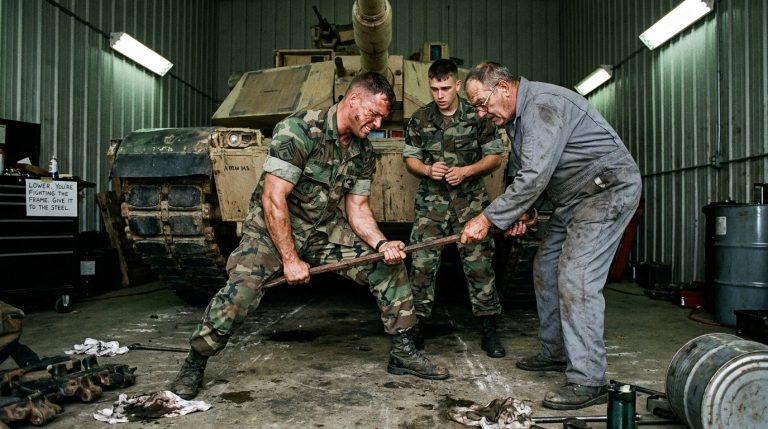
The mud here had a memory. It held the scent of burnt diesel and wet, churning earth—a heavy, suffocating perfume that stuck to the skin and refused to be washed away. Eli Turner stepped into the repair bay, his boots sinking an inch into the muck. Ahead, the M4 Sherman sat like a wounded animal, its turret locked at an awkward, stubborn angle.
Briggs was already off the tank, his hands trembling as he wiped black sludge from his forehead. Behind him, the rest of the crew climbed out, their movements jerky, defined by the specific, jagged energy of men who had spent too long inside a steel box that felt more like a tomb than a weapon.
“She’s dead, Turner,” Briggs said, his voice stripped of hope. “Third time in two weeks. It’s cursed. The whole damned thing is trying to shake itself apart.”
Eli ignored the anger. He moved past the gunner, his eyes scanning the hull. He wasn’t looking at the damage; he was looking at the absence of movement. He pressed a hand against the cold armor. The metal felt tired, vibrating with the residual heat of an engine that had fought for its life and lost.
He didn’t grab a wrench. He grabbed his notebook. It was a battered thing, its edges softened by sweat and constant handling. He opened it to a page marked with oil-stained ink. He didn’t see a “cursed” machine. He saw a sequence.
He walked to the rear, his breath hitching in the cold air as he reached for the latch of the engine access panel. It was hot, stinging his palm, but he didn’t pull away. He held it for a second, feeling the metal groan as he forced it open.
Inside, the engine bay was a chaos of shadows and tangled lines. But as the fog of exhaust cleared, Eli noticed something that shouldn’t have been there. A series of cables, usually tucked neatly along the frame, were pulled taut—stretched like strings on a violin about to snap. They weren’t just misrouted; they were fighting against the very vibration of the engine block.
“You said it felt heavy on the hills,” Eli murmured, his voice barely audible over the distant thud of artillery.
“Every time,” Briggs confirmed, looming over him. “Like the world was trying to hold us back.”
Eli traced the line of a cable with his calloused finger. It wasn’t the engine that was failing. It was the connection. It was a small, almost invisible discrepancy—a design flaw that had traveled hundreds of miles to break right here, under his watch.
He looked back at the engine, then at the horizon, where the faint, grey light of dusk was dying. He knew what the manual would say. Replace the mounts, check the spark, send it back. He knew the supervisor would demand it be finished by morning. But as he looked at the taut cables, Eli felt the heavy, quiet realization settle in his gut.
He wasn’t going to fix this tank the way they wanted. He was going to save it, even if it cost him the only job he had left.
“I need three hours,” Eli said, finally looking up.
“Three hours?” Briggs scoffed, stepping closer, his eyes narrowing. “That thing’s got to be back at the line by dawn. If it doesn’t move, we’re nothing but targets.”
Eli didn’t blink. He reached into his kit and pulled out a small, bent brace he’d scavenged from a wreck weeks ago. It was a piece of junk to anyone else, but in the dim light of the repair bay, it looked like the answer.
“If it doesn’t move, it’s because you’re driving it the wrong way,” Eli said softly. “But if I do this my way, it won’t just move, Briggs. It’ll survive.”
The gunner opened his mouth to retort, but the words died in his throat. He looked at Eli—really looked at him—and saw not a madman, but a man who held the weight of the war in the palm of his hand.
The silence that followed was broken by a sudden, metallic ping from deep within the tank’s hull. Eli didn’t turn around. He just opened his notebook and began to draw.
CHAPTER 2: THE SHADOW OF THE MANUAL
The ping died away, leaving only the sound of the rain tapping a slow, rhythmic beat against the corrugated iron roof of the repair shed. Eli stood frozen, his hand still resting on the rough, cold metal of the Sherman’s hull. He looked at the notebook in his left hand. The ink of his own sketches seemed to pulse in the dim light, the lines of the cable diagrams twisting into a knot that defied the neat, logical structure of the official Army Field Manual.
He had spent two years in North Africa and now here in the mud of the European front, and his mind had become a map of fractures. He looked at the cables again. Were they truly taut, or did his eyes simply need them to be? The pressure of the moment—the expectation of the supervisor, the exhaustion of the crew, the silent, looming threat of the front line—pressed against his temples. He was supposed to be a tradesman, a man who followed the book, yet he felt like a cartographer mapping a land that didn’t want to be charted.
Briggs was still watching him, his breathing heavy. The gunner’s face was a study in raw, unfiltered fatigue. “You going to just stand there staring at it, Turner? Or are you going to give us something that actually works?”
Eli didn’t answer immediately. He stepped back, moving his lantern to get a clearer angle of the junction block. The light flickered, casting long, dancing shadows across the engine bay. It was a dance of textures: the matte finish of the armor, the slick, iridescent sheen of oil pooling on the concrete, the rough, rusted edges of the improvised brace he had held only moments ago. He felt a sudden, sharp spike of doubt. He was a mechanic, not an engineer. If he moved the junction block and it failed, it wouldn’t be a minor inconvenience. It would be a catastrophe for the crew he’d just promised a miracle.
“It’s not just the mounts,” Eli said, his voice raspy, trying to steady the tremor in his hands. He knelt on the wet concrete, the cold seeping through his trousers. He needed the physical contact with the ground to anchor himself. He traced the path of the cables again, his eyes squinting against the harsh glare of the lantern.
“The manual calls for a twelve-inch run,” he murmured to himself, more than to Briggs. “But the factory assembly forced an eleven-inch path. Every time the engine torques on a climb, the block hits the limit of its play. It’s not breaking the engine, Briggs. It’s strangling the electrical feed.”
Briggs leaned over, peering into the dark, oily gut of the machine. He smelled of cordite and stale tobacco—the scent of a man who had spent too many hours in the company of death. “So, reroute it. You said you could do it.”
“It’s against the code, Briggs,” Eli said, looking up. The gunner’s eyes were bloodshot, reflecting the orange flicker of the lantern. “If I move this, and the inspectors come through, they’ll see a non-standard configuration. They don’t look for success. They look for compliance.”
“Compliance doesn’t stop an engine from dying in a trench,” Briggs growled, his voice dropping into a low, dangerous register. “You’re the one they call the Mad Mechanic. You want to be mad? Be mad. Just get us back out there.”
Eli looked at the notebook again. He saw the page where he’d documented the last three times this specific Sherman had returned. The handwriting was his own, but it looked foreign, the frantic scrawl of a man trying to impose a pattern on a chaotic world. He realized, with a jolt of clarity that bordered on the painful, that he wasn’t just fixing a tank. He was challenging the inherent, brittle nature of their survival.
He stood up, his joints popping, and turned toward the back of the shed. The supervisor’s office was a small, partitioned box of plywood and glass, currently bathed in the sickly yellow glow of a hanging bulb. Through the grime-streaked window, he could see the silhouette of the supervisor hunched over a stack of requisition forms. That was the wall. The wall of order, the wall of the manual, the wall that defined what was ‘good enough.’
“I’m going to need the Supervisor’s authorization for the brace,” Eli said, his voice flat.
“He’ll say no,” Briggs said, already turning away to climb back into the tank’s cramped, humid interior. “He’ll tell you to change the mounts and be done with it.”
“He will,” Eli agreed, staring at the silhouette in the office. “But if I don’t ask, I’m just an insubordinate grease monkey. If I ask, and he refuses, I’m an engineer being forced to perform a flawed repair.”
He walked toward the office, his boots making a wet, sucking sound in the mud. Every step felt heavier than the last. He wasn’t just walking across a yard; he was crossing a threshold. He knew that whatever happened in the next five minutes would decide whether he remained a cog in the machine or became something else entirely—a man who, for better or worse, refused to let the system define the limits of what was possible.
He reached the plywood door and raised his hand to knock. His knuckles were raw, stained deep with engine oil that no amount of scrubbing could remove. He hesitated. For a split second, he looked back at the Sherman. It sat silent, a massive, dormant beast in the center of the yard, and for a terrifying, fleeting moment, he saw it not as a pile of steel and cable, but as a living thing, waiting for him to either save it or abandon it to the inevitable.
He knocked on the wood. The sound was sharp, decisive, and final.
CHAPTER 3: THE ANATOMY OF A FAILURE
The door creaked open, revealing the supervisor, a man named Miller whose face was a landscape of deep-set lines carved by too many sleepless nights and too many reports filed in triplicate. He didn’t look up from his desk immediately, the scratching of his pencil against a requisition form the only sound in the cramped, airless room. The space smelled of stale tobacco and the dry, metallic tang of ink—a sterile contrast to the raw, diesel-drenched atmosphere of the yard outside.
“Turner,” Miller said, his voice as dry as the paper under his hand. He didn’t invite Eli in, but he didn’t close the door, either. “I’m busy. If this is about the spare mounts, they’re in the back bay. Take them, install them, and stop making noise.”
Eli stepped across the threshold, his boots barely making a sound on the dusty floorboards. He felt a sudden, strange detachment, as if he were watching himself from the corner of the ceiling. “It’s not about the mounts, Miller. The mounts aren’t the failure. They’re just the symptom.”
Miller paused. He looked up, his eyes narrowing as he took in the smudge of oil on Eli’s cheek and the way his hands were balled into tight, controlled fists. “We’ve been over this. The Sherman is a machine of war, not a precision instrument. It gets pushed, it breaks, we fix it to spec, and we send it back. That’s the cycle. That’s the only cycle.”
“The cycle is a lie,” Eli said, his voice low but steady. He reached into his pocket, pulled out the battered notebook, and laid it on the desk. It looked entirely out of place amidst the crisp, orderly rows of forms and ledgers. “I’ve spent the last three hours tracing the electrical runs on that Sherman. The cables are routed through a compression zone that wasn’t designed for the load this unit is carrying. It’s a factory shortcut. A clean, efficient, wrong-headed shortcut.”
Miller stared at the notebook, his expression shifting from irritation to a kind of weary, guarded skepticism. He didn’t touch it. He treated it like an explosive device. “You’re talking about rerouting an entire junction block, Turner. Do you have any idea what that involves? The time, the labor, the deviation from standard maintenance? If I authorize that, I’m putting my signature on an experimental repair. If that tank fails—and it will, because they all do—the report comes back to my desk.”
“The report is already coming back to your desk,” Eli countered, leaning forward, his shadow stretching long and distorted across the wall. “How many times has that tank been here? Four? Five? It’s not a failure of the machine, Miller. It’s a failure of our process. You’re asking me to patch a wound when you should be treating the infection.”
Miller sighed, a sound that seemed to pull the very oxygen from the room. He stood up and walked to the window, looking out at the yard. In the distance, the Sherman sat under the dim, yellow glare of the perimeter floodlights, a hulking, silent presence. “I have a responsibility to keep this line moving. If I start letting every mechanic with a notebook and a theory redesign the hardware, this yard turns into a scrap pile. I need predictability, Turner. I need to know that when I sign off on a job, it follows the book. The book is the only thing standing between us and total collapse.”
“The book was written for parade grounds and dry workshops,” Eli argued, his frustration finally breaking the surface of his professional reserve. “Not for mud, not for constant traverse under fire, and not for the weight of a thirty-ton machine shifting on a vertical grade. If we don’t adapt the machine, we’re just burying the crew in it.”
The room went silent. A moth fluttered around the unshaded bulb, its wings casting flickering, frantic shadows against the glass. Miller turned back to him, and for the first time, Eli saw the reflection of his own exhaustion in the supervisor’s gaze. It wasn’t malice, and it wasn’t greed. It was fear. Miller was afraid of the very thing he claimed to despise—the chaos of failure.
“You really believe this, don’t you?” Miller asked, his voice softer now, almost conversational. “You really think you can make it last.”
“I don’t think,” Eli said, his voice hardening. “I’ve seen the pattern. The stress points don’t lie. If you give me the authority to brace that junction, I won’t just repair it. I’ll make it reliable. Not ‘field-ready,’ but reliable.”
Miller picked up the notebook, turning it over in his hands as if weighing it. The dust on the cover seemed to sparkle in the harsh light. “If you do this, Turner, you’re working outside the lines. If it works, you’re a genius. If it doesn’t—if that Sherman goes down and I have to explain why the electricals were rerouted against the technical bulletin—I won’t be able to protect you. You’ll be on the front, or you’ll be in a cell.”
“I understand,” Eli said, his heart hammering against his ribs.
Miller opened the drawer of his desk, pulled out a small, red-ink stamp, and looked at the repair order one last time. He didn’t look at Eli. He looked at the tank in the yard. With a sudden, decisive motion, he slammed the stamp onto the page. The red ink bled into the paper, a small, vibrant mark of authority in a world of grey.
“Go,” Miller said, sliding the paper across the desk. “Finish it. But if I hear one word about engine torque or cable slack before that tank leaves this yard, I’m revoking the authorization.”
Eli grabbed the order, his fingers trembling as he tucked it into his pocket. He didn’t thank him. He simply turned and walked out, his steps fast and purposeful, crossing the yard back toward the Sherman. The mud felt different now—less like a prison, and more like the ground he had to hold. He had the authorization, but as he reached the tank and looked up at the towering, dark mass of its hull, he felt the weight of the work ahead. This wasn’t just a repair anymore. It was a test, and for the first time, he realized that he wasn’t just working on a machine. He was preparing to prove that the world could be made to behave, one bolt and one brace at a time.
CHAPTER 4: THE FIRST REROUTE
Eli didn’t return to the tank immediately. He stood at the edge of the repair bay, watching the shadow of the Sherman stretch long and thin across the mud, its turret a jagged silhouette against the bruised, overcast sky. He took a breath, the air tasting of wet ash and ozone. The permission slip in his pocket was a heavy, physical burden. For a moment, the sound of the rain against the metal roof faded, replaced by the ghost-echo of a different machine—a half-track in North Africa, its steering seized in the middle of a retreat. He remembered the smell of hot, weeping transmission fluid and the frantic, hollow look in the driver’s eyes when the vehicle died. He had failed that day. He had followed the manual, and the manual had told him to wait for parts that didn’t exist. He had watched the crew abandon the machine, and he had learned then that a manual is just a piece of paper, but a stalled machine is a death sentence.
He shook the memory away. He couldn’t afford the ghost of that failure now.
He climbed up onto the rear deck of the Sherman. The metal was slick with a thin layer of oil and freezing rain. He navigated the familiar geography of the engine bay, his movements methodical. He stripped off his heavy coat, leaving him in a thin, grease-stained shirt that did little to fight the encroaching cold. He needed the dexterity.
He reached for the junction block. It was positioned deep in the bay, a cramped, unforgiving space where every turn of the wrench felt like a gamble. He began by loosening the protective casing. The bolts were rusted, their heads chewed up by previous attempts at repair. He took his time, applying just enough torque to break the seal without snapping the threading. Steady, he told himself. Listen to the metal.
As he pulled the casing back, the tangle of cables was exposed. They were stiff, coated in a layer of grime that felt like dry skin. He traced them, his fingers finding the exact point where they pressed against the engine block’s vibrating housing. There, where the protective rubber was shaved down to the wire, was the culprit. It was a minuscule, almost poetic point of failure. A quarter-inch of extra slack would have saved it. A simple metal guide would have shielded it. Instead, someone at a factory thousands of miles away had saved a few minutes of assembly time, and those few minutes had compounded into weeks of mechanical agony for the men inside the tank.
He began the reroute. It was delicate work. He had to feed the cable bundle through a new, reinforced path he’d mapped out in his notebook, tucking it behind the cooling intake where the heat wouldn’t fry the shielding, but where the vibration would be dampened by the air-flow. Every time his wrench slipped or his hand cramped, the memory of the North African half-track flared, a hot, prickling sensation behind his eyes. He forced it down. He wasn’t working on that ghost anymore. He was working on this reality.
He installed the brace he’d salvaged—a custom, L-shaped bracket he had filed down to fit the specific contour of the engine frame. He drilled the pilot holes, the whine of the hand drill a high-pitched, insistent sound that seemed to draw all the ambient noise of the yard into itself.
He lost track of time. The sky outside darkened from grey to a deep, impenetrable charcoal. The yard lights hummed, casting a flickering, sickly luminescence over the bay. His hands were raw, the skin split in three places, the blood mixing with the black grease until his palms looked like something forged in the heart of the engine itself.
He felt a presence behind him. He didn’t look up, but he knew the steady, uneven gait. Briggs. The gunner stood on the ground below, looking up at the engine bay.
“You’re still at it,” Briggs said, his voice stripped of the earlier antagonism. There was a quiet, almost reverent curiosity in the way he stood, his hands deep in his coat pockets.
“The routing,” Eli grunted, not stopping his work. He was tightening the final bolt on the brace. “It’s tight. Too tight. It’s been pulling every time you traverse the turret.”
“And the heat?”
“The heat was just a symptom of the electrical feedback. The block was fighting itself. I’m giving it a new road to travel.”
Briggs watched for a long time. The only sound was the clicking of the ratchet and the steady drip of rain from the eaves of the roof. “If this works, Turner, you know what they’re going to say, don’t you? They’ll say you were lucky.”
Eli paused, the wrench hovering in the air. He looked down at the gunner. The man’s face was tired, his eyes reflecting the deep, hollow weariness of the war. “I don’t need them to say I’m smart, Briggs. I just need you to be able to get home.”
He gave the bolt a final, firm turn. It seated perfectly, the metal brace holding the cable bundle in a firm, protective cradle. It looked right. It felt right. The ghost of the North African failure seemed to recede, silenced by the solid, reassuring tension of the brace.
He sat back on his heels, the cold finally seeping into his bones. He was exhausted, but for the first time in weeks, the knot of tension in his chest—the one that usually tightened whenever he looked at a broken tank—began to loosen. He had done the work. He had deviated from the text, but he had followed the truth of the machine. Now, all that remained was to see if the reality would hold.
“Help me close the panels,” Eli said, his voice barely a whisper. He felt a profound, quiet sense of peace. The machine was no longer a mystery, and for tonight, that was enough.
CHAPTER 5: THE SILENCE OF THE ENGINE
The transition from the cramped, oil-slicked darkness of the engine bay to the open yard was jarring. Eli climbed down, his legs rubbery, his muscles screaming from the hours spent contorted in the hull. Outside, the world had transformed. The drizzle that had been falling for hours had given way to a sudden, violent deluge. The yard was a churning mire of grey slush, the sound of the rain drumming against the corrugated roof like a thousand frantic heartbeats.
Briggs was already leaning against the side of the tank, a cigarette cupped in his hand to shield it from the downpour. He looked at Eli, his face unreadable in the harsh, flickering light of the yard lamps.
“She’s buttoned up,” Eli said, wiping the sweat and grease from his eyes with his forearm. “But this weather… it’s not the best time for a climb.”
Briggs took a long drag of the cigarette, the ember glowing intensely in the dark. “We don’t get to choose our weather, Turner. And we certainly don’t get to choose when we head back to the line. If it runs now, it runs anywhere.”
The implication hung in the wet air. This was the moment. The “Mad Mechanic’s” theory was about to be put to the only test that mattered: the cold, unyielding reality of the machine in the mud. Eli walked toward the driver’s hatch, his boots squelching deep into the mire. Every step felt like a negotiation with fate.
“Driver,” Eli called out, his voice cutting through the hiss of the rain. “Start her up. And don’t go easy on the throttle. I want to see how she handles the jump.”
The tank roared to life with a sound that felt more like a growl than a machine. It wasn’t the coughing, hesitant stutter Eli had heard days ago. It was a deep, guttural thrum that vibrated through the mud, rattling the very bones in his chest. He watched the engine exhaust—clear, steady, and devoid of the choking sputter that usually plagued the Sherman.
The tank began to move, its massive tracks biting into the saturated earth. It crawled toward the incline of the rear yard, a steep, rutted slope that had been the graveyard of their previous attempts. Eli followed on foot, his coat drenched, his eyes fixed on the engine deck.
As the Sherman hit the base of the slope, the engine tone deepened, the torque shifting as the tank struggled for purchase in the slick mud. Eli felt his pulse quicken. Come on, he thought, gripping his notebook so hard the corners dug into his palm. Stay connected. Stay true.
Halfway up, the tank lurched. The engine growled—a sharp, high-pitched whine that sent a jolt of cold fear through Eli’s gut. For a heartbeat, he was back in North Africa, hearing the sickening sound of a machine losing its fight. He felt the phantom weight of failure, the bitter, hollow sting of being told ‘no’ by the mechanics of the world.
But then, the sound smoothed out. The engine pitch didn’t drop; it flattened, becoming a steady, relentless hum. The Sherman surged forward, the tracks throwing great plumes of mud into the rainy night. It crested the slope and rolled onto the flat ground on the other side, the engine idling with a calm, rhythmic confidence.
Eli stopped, gasping for breath, the rain plastering his hair to his skull. He stared at the machine. It stood there, a dark, hulking shape against the rain, finally doing exactly what it had been built to do.
“She held!” Briggs shouted from the side, his voice a mix of shock and genuine, unadulterated relief.
Eli didn’t respond. He moved toward the tank, placing his hand on the rear deck armor. It was warm—not burning, not frantic, but the steady, functional heat of a working machine. The brace held. The cables were protected. The theory was, against all the weight of the manual and the bureaucracy, correct.
But as he stood there, letting the rain wash the oil from his skin, a new, cold realization began to dawn. This wasn’t just a win. It was a disruption. He had proved that the system was wrong, and in a war defined by the rigidity of its systems, being ‘right’ against the grain was a dangerous, lonely place to be. He looked back toward the supervisor’s office, the yellow light still burning like a beacon in the storm. He hadn’t just fixed a tank; he had opened a door that the system would likely spend the rest of the war trying to slam shut.
Briggs approached him, his face damp with rain, a small, grim smile playing on his lips. “You know, Turner. For a madman, you’ve got a hell of a touch.”
“It’s not a touch, Briggs,” Eli said, his voice quiet, almost lost in the sound of the rain. “It’s just listening to what the machine is trying to tell us. The question is, is anyone else actually going to listen?”
He looked down at his notebook, the pages now soaked, the ink beginning to bleed into a beautiful, messy watercolor of his own design. The tank was alive, but the path ahead, he realized, was going to be much harder than the climb he had just helped it survive.
CHAPTER 6: THE NETWORK OF WHISPERS
Eli walked through the mire toward the mess tent, his body heavy with the aftermath of the adrenaline. The rain had slowed to a persistent, soul-dampening mist that clung to the canvas of the surrounding structures. He felt the weight of his own notebook in his pocket—a talisman of his deviation—and he kept his hand pressed against it, a nervous, involuntary gesture.
He hadn’t made it more than twenty yards before a man stepped out from the shadow of a supply truck. He was older than Eli, with graying hair slicked back by the dampness and hands that were permanently stained, the skin mapped with tiny, dark scars of tradesmen who had spent a lifetime fighting metal. He stood in the rain as if he didn’t feel it, watching Eli with an intensity that made the mechanic stop in his tracks.
“That Sherman,” the man said. His voice was gravelly, low, and carried the weight of someone who rarely spoke to anyone but machines. “The one you moved the junction on. It took the hill at 0400.”
Eli’s guard went up instantly. “Who are you?”
The man didn’t answer directly. He reached into his jacket and pulled out a small, leather-bound book. It was battered, the corners frayed to white cardboard, and held together by a loop of fraying twine. It looked, to Eli’s startled eyes, exactly like his own. The man opened it to a random page. It was filled with the same cryptic, beautiful geometry of Eli’s own notes—the same sketches of stressed mounts, the same notations on cable slack, the same rebellion against the ‘official’ way.
“My name is Halloway,” the man said. “I work the halftrack line near the southern perimeter. I’ve been watching your section for months. The way your tanks come back… they don’t look like they’ve been beaten into submission. They look like they’ve been taught.”
Eli felt a strange, cold shiver run down his spine, unrelated to the rain. He had thought his work was a private friction against the system, a lonely, necessary madness. To see it mirrored in the hands of another man was both a relief and a terrifying complication. If there were others, if this wasn’t just him, then the system was being undermined in a way that wasn’t accidental. It was structural.
“I just fix what’s broken,” Eli said, though the words sounded hollow even to him.
Halloway offered a tired, knowing smile. “That’s what I tell the officers, too. But we both know that’s not what we’re doing. We’re keeping the machines alive, and in doing so, we’re keeping the men alive. And that… that scares the hell out of people who believe in numbers more than mechanics.”
He took a step closer, his eyes searching Eli’s face. “The maintenance officer—the one who’s been asking about your reports? He’s not looking to commend you, Turner. He’s looking for a way to standardize your ‘madness’ so he can claim the credit while keeping the risk buried in a ledger. He doesn’t want the work to be better. He wants it to be predictable.”
Eli looked past Halloway to the flickering lights of the repair yard. The reality of his situation crashed into him. He hadn’t just changed the reliability curve of a few tanks; he had touched the nerve of a military apparatus that thrived on the very fragility he was working to fix. If he continued, he wasn’t just a mechanic. He was a variable they couldn’t calculate.
“Why tell me this?” Eli asked, his grip tightening on his own notebook.
“Because I need to know if you’re going to hold the line,” Halloway replied. “When they come to ask for your ‘lessons,’ when they try to turn your work into a new, rigid manual that strips the soul out of the repair—are you going to sign it, or are you going to keep it in that book?”
The question hung between them, more dangerous than any incoming fire. Eli looked at Halloway’s notebook, then at his own. He realized then that the decoy secret he had been uncovering—the factory errors and the stress points—wasn’t the point. The secret was the network itself. The thousands of tiny, invisible corrections happening across the front, done by men who were never mentioned in history books, all connected by this same quiet, grease-stained language.
“I’m not a leader,” Eli said, his voice straining against the sudden, crushing weight of the responsibility.
“None of us are,” Halloway said, turning to walk away into the mist. “We’re just the ones who notice the patterns. Just keep watching the machines, Turner. And watch your back. The system doesn’t like it when the machines start behaving differently than they’re told.”
Halloway vanished into the dark, leaving Eli alone in the center of the yard. The rain began to fall harder, washing the mud from his boots, but he barely noticed. He stood there, the notebook burning in his pocket, the realization of what he had started finally taking root. He had set out to make a tank run a little longer; he had ended up becoming a part of something much larger, something that the entire, rigid architecture of the war was currently trying to erase.
He walked to the mess tent, but he didn’t go inside. He turned toward his bunk, his mind racing, the simple logic of his work now twisted into a complex, high-stakes game he never signed up to play. The machine was fixed, but the mechanic, he realized, was now very much broken.
CHAPTER 7: THE INSPECTION OF TRUTH
The night air was a razor, cutting through Eli’s thin shirt as he retreated toward the bunkhouse. He didn’t go inside. He couldn’t face the hollow, expectant stares of the other mechanics, nor the quiet, heavy breathing of men who lived on the edge of exhaustion. Instead, he leaned against the side of a rusted supply truck, his breath hitching in the freezing mist. The notebook was still in his hand, its pages damp, the ink of his observations blurring into the dark.
He had started this as a simple act of repair. He had wanted to make the Sherman breathe, to let it move the way it was designed to move, without the internal friction of a hurried assembly line. But Halloway’s warning—the image of the invisible network—had shattered that clarity. He was no longer just a mechanic. He was a node in an unmapped system of resistance, a man whose work was being tracked, quantified, and eventually, he feared, dismantled.
A flash of light cut through the gloom—the high, piercing beams of a staff car pulling into the yard. It was late, far too late for a standard supply run. The tires crunched rhythmically against the gravel, the sound heavy and deliberate. Eli watched as the car stopped in front of the maintenance office. Two figures stepped out, their silhouettes stark against the blinding glare of the headlights. One was the maintenance officer—the man who had been scrutinizing his reports from a distance. The other was an aide, clutching a briefcase that looked far too clean for the mud of the repair line.
Eli’s instinct was to run, to hide his notebook in the deepest, darkest corner of the machine graveyard, but he forced himself to stay still. If he vanished, he admitted guilt. If he ran, he confirmed the ‘madness’ they were looking for. He watched as they walked toward Miller’s office. He saw Miller emerge, his posture stiff, his hands clasped behind his back in a gesture of forced subordination.
The inspection wasn’t coming in the morning. It was here now.
Eli moved, his boots silent on the wet earth. He circled the far edge of the repair bay, staying in the deep shadows where the yard lights couldn’t reach. He reached the Sherman he had worked on—his “cursed” Sherman. It sat there, a solid, heavy sentinel in the dark. He climbed onto the rear deck, his movements practiced and fluid. He needed to be sure. He opened the access panel, the metal groaning softly under his touch.
He didn’t need to look at the brace; he knew it was there, solid and firm. He needed to look at the cables. He shone a small, filtered penlight into the bay. The light revealed the rerouted wires, the tension perfectly balanced, the path clear. It was a masterpiece of field engineering, a small, stubborn defiance of the factory’s rushed design.
A voice drifted from the yard, sharp and clear over the hum of the rain. “I want to see the Turner logs, Miller. Every single one. I’ve read the summaries, and I don’t buy the ‘field innovation’ nonsense. Either the tank is to spec, or it’s a liability. We’ll find out which tonight.”
Eli froze. The officer wasn’t looking for a better way to fight; he was looking for a reason to revert the system to its safe, fragile baseline. If they found his notes, if they took his notebook—the one he had carried since North Africa—the network of whispers would be silenced, one man at a time.
He looked at the junction block. He could pull the brace. He could reroute the wires back to the “correct,” fragile path. He could make it “standard” before they arrived, and in doing so, he would be safe. He would be just another mechanic, just another cog, and the Sherman would go back to being a machine that broke on every hill.
The weight of the choice was a physical pressure in his chest. To comply was to survive. To resist was to risk everything, including the very machines he had sworn to keep alive. He looked down at the notebook in his hand. He thought of the tank’s movement earlier—the smooth, powerful torque, the absence of the dying stutter. He thought of Briggs, and the others, and the quiet, desperate hope that their steel boxes would hold just one more day.
He tucked the notebook into the deepest recess of the engine bay, behind a fuel line, tucked against the very brace he had installed. It wasn’t hidden; it was integrated. If they wanted the truth, they would have to find it in the heart of the machine itself.
He closed the access panel and slid off the tank just as the light from a flashlight swept across the yard, hitting the side of the Sherman.
“Turner?” Miller’s voice echoed, tight and strained. “Turner, get over here. We have some questions about your… maintenance procedures.”
Eli stepped into the light. He looked directly at the maintenance officer, his face masked in the familiar, blank indifference of a man who spent his life covered in oil and dust. He didn’t look like a revolutionary. He didn’t look like a madman. He looked exactly like what he was: a mechanic, ready to tell them why the machine worked, and more importantly, why they would never understand it.
CHAPTER 8: THE UNBROKEN PATTERN
The flashlight beam wavered, then steadied on Eli’s chest. The maintenance officer—a captain with the crisp, clean uniform of a man who rarely touched anything that wasn’t a requisition form—stepped forward. Behind him, Miller hovered, his face pale, his eyes darting between Eli and the tank as if hoping the machine would suddenly vanish into the mud.
“You’re Turner,” the captain said. It wasn’t a question. He swept the beam toward the Sherman, the light catching the cold, wet armor, the dark interior of the engine bay, and the subtle, gleaming metal of the brace Eli had installed. “I’ve seen the reports on this unit. A persistent failure. And I see your signature on the last three repair logs.”
Eli stood his ground. The rain hammered against his shoulders, a steady, rhythmic pressure that felt like the pulse of the war itself. He kept his hands at his sides, fingers curled to hide the raw, grease-crusted skin. “I fixed the failure, Captain.”
The officer stepped closer, his boots making a soft, squelching sound. He didn’t look at Eli; he looked at the tank. “You didn’t fix a failure, Turner. You created a liability. By rerouting these cables, you’ve invalidated the factory-spec design. If this tank fails now, it doesn’t go back to the depot. It becomes a court-martial offense.”
“The factory design was a death trap,” Eli said, his voice quiet but carrying clearly through the wet air. He didn’t speak with arrogance, but with the flat, unshakeable certainty of a man who had seen the machine’s internal logic. “The cabling was too short. It wasn’t ‘to spec’; it was a mistake. I didn’t change the tank; I fixed what the tank was actually doing.”
The captain stiffened. For a long, agonizing moment, the only sound was the rain and the distant, low thrum of artillery. Then, he motioned to his aide. The aide stepped forward, flashlight in hand, and inspected the brace, running a gloved finger along the metal. He leaned into the engine bay, his face bathed in the beam, and spent a long, silent minute examining the rerouted cables.
“Captain,” the aide finally said, his voice devoid of emotion. “The reinforcement… it’s solid. The cable run has triple the slack of the standard configuration. It’s… it’s not in the manual, sir. But it’s not going to snap.”
The captain let out a long, slow breath. He turned to Eli, his expression shifting from cold scrutiny to a strange, weary kind of appraisal. He didn’t look like a man who wanted a fight; he looked like a man who was tired of the cycle of failure, even if he couldn’t admit it.
“You think you’re the first to see a factory shortcut, Turner?” the captain asked. “You think you’re the first mechanic who’s had a bright idea?”
“I don’t think I’m the first,” Eli said, thinking of Halloway, and the thousands of others like him. “I just think I’m the one who noticed that the tanks were coming back for the same reason every time. The system isn’t failing because it’s slow. It’s failing because it doesn’t know how to adapt to the road.”
The captain stared at him for a long, heavy moment. The silence was thick, pregnant with the possibility of arrest, of reassignment, of erasure. Then, slowly, he reached out and took the flashlight from his aide. He shone it not at the cables, but at the tank itself, tracing the lines of the armor, the scars of previous hits, the mud-caked wheels.
“The order stands,” the captain said, his voice surprisingly muted. “Any deviation from the manual is an offense. But…” He looked back at Eli, his eyes narrow. “The Sherman is a ‘field-adaptable platform.’ That’s in the doctrine, somewhere. If it holds, if it doesn’t come back, I don’t see a modification. I see a successful, standard repair.”
He turned on his heel, signaling his aide to follow. “Miller, keep an eye on his logs. I don’t want ‘mad’ experiments. I want reliable tanks.”
They walked back to the staff car, leaving the yard in a sudden, ringing silence. Miller stood frozen, his eyes wide, then he looked at Eli, let out a short, jagged laugh, and turned back to his office without a word.
Eli stayed on the deck of the tank. The adrenaline finally drained away, leaving him hollowed out, shivering in the cold. He climbed down and reached into the engine bay, retrieving his notebook from behind the brace. He opened it to the very last page. He didn’t write anything. He didn’t need to. The tank sat beside him, steady, silent, and for the first time in his life, complete.
He walked to the shed, the rain finally beginning to let up. He realized then that the system wouldn’t change. It would just keep absorbing the lessons of men like him, slowly, quietly, until the next war. He hadn’t changed the war; he hadn’t saved the world. But he had touched the machine. He had made it whole. He felt the cold iron of the brace under his hand one last time, a small, hidden truth tucked away in the heart of a war-machine. He was a mechanic, not a hero, but as he closed his eyes and let the silence of the yard settle over him, he knew that sometimes, holding a machine together for one more day was the only legacy that mattered. He was home.