The Silent Pulse: A Veteran’s Quiet Restoration of the USS Gerald R. Ford’s Faltering Heart
CHAPTER 1: The Weight of Steel
The wind off the Norfolk harbor carried the scent of low tide and expensive failure. To Harold Miller, the air tasted of stagnant oil and trapped heat, a signature scent he had identified a thousand times across four decades of service. He climbed out of the F-150, his boots hitting the pavement with a heavy, deliberate thud that felt entirely out of place against the gleaming, pristine concrete of the naval station.
Captain Evans did not move to meet him. He stood under the shadow of the supercarrier, his silhouette sharp and jagged against the vast, unresponsive hull of the billion-dollar ship. Beside him, Commander Morgan clutched a tablet as if it were a shield, his knuckles pale.
Harold reached into the bed of his truck. He didn’t rush. He moved with a cadence governed by years of respecting the physics of heavy iron. He pulled the battered leather toolbox toward his chest, the leather groaned—a familiar, grounding sound.
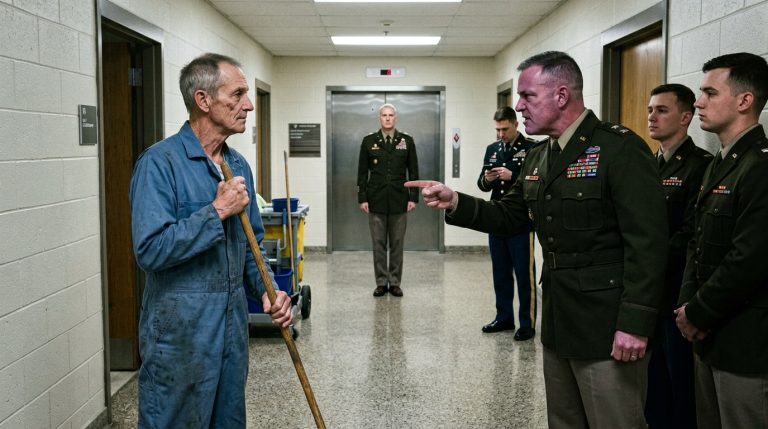
“Admiral Carter’s solution,” Evans said, his voice cutting through the humid air like a serrated blade. He didn’t look at Harold, but he didn’t have to; his disdain was a physical presence, a cold wall between them. “A grandfather with a box of scraps.”
Harold stopped five paces away. He kept his head slightly bowed, not in submission, but in focus. He could feel the carrier behind him. It was a massive, intricate geometry of steel, copper, and soul. Even from the pier, the ship felt wrong. It was “holding its breath,” the rhythmic, low-frequency hum of a healthy vessel replaced by a hollow, strained silence that vibrated in the soles of his boots.
“Captain,” Harold said, his voice like dry leaves underfoot. He didn’t raise his eyes to the captain’s face. Instead, he allowed his gaze to drift up the side of the towering hull. The metal was dull, lacking the vibrant, kinetic energy of a ship at rest between missions. It looked exhausted. “The ship isn’t a problem to be solved. It’s a mechanism that’s lost its rhythm.”
Evans let out a sharp, jagged laugh. “I have thirty engineers, Mr. Miller. Every one of them carries a diploma from an institution that would make your high school look like a sandbox. They have been inside these turbines for seventy-two hours. If there was a ‘rhythm’ to be found, they would have caught it.”
Harold shifted his weight. His knees ached with the humidity, but he barely registered the pain. He was listening to the wind vibrating through the massive ventilation grates near the waterline. It sounded tight, pressurized. Forced.
“Diplomas are for blueprints, Captain,” Harold said softly, finally meeting Evans’ gaze. His blue eyes were clouded with age but unnervingly steady. “But blueprints don’t tell you how a machine sighs when it’s tired.”
Evans stepped forward, his face flushing a dangerous, mottled red. “I am going to make this very simple. If you cannot find what thirty of the finest minds in the Navy missed, you will pack your tools, you will leave this pier, and you will never set foot on a naval vessel again. And I—I will make sure your reputation is left exactly where your tools are. In the dirt.”
Harold looked past the Captain, toward the darkened, silent bulk of the Gerald R. Ford. He felt a sudden, sharp ache in his fingers—the phantom sensation of turning a bolt that had been tightened just a fraction too far.
“May I come aboard, Captain?” Harold asked.
Evans gestured toward the gangway with a hand that trembled slightly, not from anger, but from a profound, terrifying lack of control. “Go. Waste my time. But remember, Grandpa: you aren’t just failing a test. You’re auditioning for your own obsolescence.”
Harold turned and began the walk. His boots hit the metal of the gangway with a hollow, rhythmic beat. As he reached the top, his hand hovered near the threshold, feeling the radiation of the massive steel wall. It was hot—unnaturally so. A fever that the ship shouldn’t have. He didn’t look back at the Captain. He simply stepped into the darkness of the hull, and for the first time in three days, the ship seemed to shudder in anticipation.
CHAPTER 2: The Geometry of Silence
The darkness inside the Gerald R. Ford was absolute, heavy with the smell of ozone, stale air, and the metallic tang of thousands of miles of uncharged copper. Harold stopped just past the threshold, letting his eyes adjust to the dim, emergency lighting that washed the long, vaulted corridor in a jaundiced yellow hue. He didn’t move immediately. He stood still, a single, aging point of friction in a machine that had ground to a halt.
He closed his eyes.
Immediately, the memory of the USS Abraham Lincoln in 1989 flickered to life. He saw the way the deck plates looked when they were bathed in the soft, rhythmic glow of operational turbines—the subtle, vibrant vibration that made the floor feel like it was alive beneath his boots. He remembered the specific, harmonic resonance of the cooling fans, a sound like a steady, deep-chested breath.
Here, there was nothing. The stillness was aggressive, a void that pushed against his eardrums.
He reached out, his calloused fingertips brushing the bulkhead. The metal was feverish to the touch. It wasn’t the heat of operation; it was the stifling, trapped heat of a system that had nowhere to vent its own existence. It reminded him of a closed room with no windows, the air circulating in a desperate, endless loop, growing thicker and hotter with every rotation.
He didn’t need a diagnostic tablet to tell him the ship was in pain. He could feel it in the way the vibrations of his own footsteps didn’t carry through the steel. The ship was dampening its own signal, withdrawing into a shell of metal.
“You’re not broken,” Harold whispered to the empty, shadowed passage. His voice sounded thin, quickly swallowed by the cavernous expanse of the carrier. “You’re just forgetting how to breathe.”
He began to walk, his stride measured and deliberate. He didn’t head for the control room. The data there—the flashing red alerts, the panicked error codes—was merely the noise of a machine crying out for help it couldn’t describe. He moved instead toward the secondary ventilation trunks, his hands constantly sweeping over the steel. He was reading the ship like braille.
The temperature increased as he descended deeper into the bowels of the vessel. The air grew heavy, laden with the dry, sterile scent of filtered atmosphere that had been recycled until it lost its life. It was the same smell he’d encountered in the modern filtration systems he had seen on other ships—efficient on paper, but lacking the necessary flow-rate to handle the sheer volume of heat generated by nuclear-powered turbines.
He reached a junction where the main ventilation ducts branched off into the bowels of the engine room. He paused, placing both palms flat against the riveted steel of the ductwork.
There was a subtle, almost imperceptible tremor in the metal. A hitch in the air’s movement. It wasn’t a mechanical failure; it was a restriction. Like a kink in a garden hose, the air was being forced through a passage that wasn’t designed for this configuration. His mind immediately went to the maintenance logs he hadn’t yet seen, but his gut already knew the story. Someone had upgraded the hardware, prioritized the specifications on a contract over the physical reality of the duct’s diameter, and now the entire billion-dollar heart of the ship was choking on its own exhaust.
He felt a profound sense of pity for the engineers who had spent seventy-two hours staring at screens. They were looking at the symptom—the pressure loss—and trying to fix it with code and calibration. They were trying to talk to the ship in a language of ones and zeros, while the ship was screaming in a language of airflow and thermal dynamics.
He pulled his small flashlight from his pocket, the beam cutting a crisp, white path through the dusty air. He ignored the main control panels and knelt beside a secondary access grate, his knees protesting with a dull, rhythmic ache. He didn’t mind the pain. It was a reminder that he was still made of the same organic stuff as the world around him, a stark contrast to the sterile, untouchable perfection of the warship.
He unscrewed the bolt, the metal resisting slightly before giving way with a sharp, familiar protest of friction. The bolt was tight—too tight. It had been torqued by an air-gun, a machine that had no feel for the life of the metal, only the requirement of the job.
As the grate clicked open, a gust of hot, stagnant air rushed out to meet him. It was thick with the scent of burning dust and the faint, sweet odor of overheating insulation.
Harold didn’t recoil. He leaned closer, closing his eyes once more, and listened.
Behind the wall of silence, he could hear it. A faint, high-pitched whistle. The sound of air being forced through a gap that shouldn’t be there. A leak. A slight, invisible misalignment in the seal that was forcing the entire ventilation system to bleed pressure.
He hadn’t even reached the engine room yet, and he already knew the truth. The ship wasn’t dying; it was simply being smothered by the very things designed to sustain it.
He stood up, his spine popping in the silence. He looked down the long, shadowed corridor, the beam of his light disappearing into the dark. He had a long way to go, and he knew that for the next few hours, he wouldn’t just be an engineer. He would be a surgeon, carefully removing the layers of modern, misguided logic until the giant underneath could finally take a full breath again.
He tucked his flashlight away, adjusted his leather jacket, and began the long, quiet descent into the heart of the ship. He was no longer just a man in a truck; he was a man on a mission of restoration. The silence of the carrier felt less like an ending now, and more like a pause, waiting for someone with enough patience to help it resume its song.
CHAPTER 3: The Discordant Console
Harold navigated the maze of corridors with a rhythmic gait that seemed to shrink the gargantuan scale of the aircraft carrier. Behind him, the secondary access grate he had just examined remained closed, a small, forgotten metal square in an ocean of steel. He didn’t turn back. The sensation of that restricted airflow—the hot, trapped breath of the ship—was already etched into his mind, a diagnostic fact that felt more substantial than the entirety of the digital logs the Navy engineers were currently worshiping.
He reached the propulsion control room. The heavy blast-proof door hissed open, revealing a space that felt less like an engine room and more like a high-tech aquarium. The room was bathed in the harsh, flickering red glow of emergency status screens. They cast long, erratic shadows across the faces of the three young engineers huddled around the central console.
Lieutenant Davis was there, his forehead slick with sweat, his eyes darting frantically between three different monitors that were currently screaming warnings of “Critical Pressure Loss” and “Turbine Lockout.”
As Harold stepped into the room, the sound of his boots on the deck plates caused all three men to jump. Davis spun around, his face a mask of irritation and exhaustion.
“I told you, we don’t have time for a tour,” Davis snapped, not even looking to see who had entered. He turned back to the screens, his fingers flying over the haptic interface. “Everything is red. The turbines won’t engage. The safety protocols are overriding every manual override command we send. We’re being locked out of our own ship.”
Harold didn’t answer. He didn’t rush to the console. He stood near the door, his hands clasped behind his back, letting his eyes sweep across the room. He was observing the engineers, not the machines. He saw their tension—it was sharp, brittle, and defensive. They were so deeply immersed in the digital interface that they had lost their connection to the vessel itself. They were interacting with the ship as if it were a faulty computer program, failing to realize that the code was merely a reflection of a physical, suffering entity.
“The ship isn’t locking you out, Lieutenant,” Harold said, his voice quiet but carrying clearly through the frantic clicking of keyboards.
Davis froze. He turned slowly, his eyes narrowing. “And I suppose you’re going to tell me you know why? Without seeing the internal pressure diagnostics? Without looking at the turbine vibration logs?”
“I don’t need to see the logs,” Harold replied, stepping into the room. The air here was even hotter, smelling sharply of heated electronics and recycled air that had passed through too many micro-filters. “I can feel it.”
He walked toward the console, his movements slow and methodical, contrasting with the nervous energy that seemed to pulse through the room. One of the other engineers, a younger man with wide, anxious eyes, stepped back as Harold approached.
“The sensors,” Harold said, pointing to the wall of screens. “They’re telling you what they think they see. But they’re not telling you why they see it.”
“They’re calibrated to within a micron, Miller,” Davis countered, his voice trembling with a mix of fatigue and professional pride. “We’ve spent three days recalibrating these sensors. If the sensors say pressure is lost, pressure is lost. It’s binary. It’s math.”
“Math without context is just a recipe for confusion,” Harold said, leaning over the console. He didn’t touch the interface. He stared at the flickering red warnings, looking past the digital readouts. “You’re seeing a pressure drop because the turbines are struggling to intake enough air. But they’re not struggling because the pumps are failing. They’re struggling because the air you’re feeding them is fighting itself.”
Davis scoffed, but he didn’t turn away. The raw, quiet certainty in Harold’s voice had clearly pierced the Lieutenant’s armor of arrogance. “Fighting itself? It’s air, Miller. It doesn’t have an opinion.”
“It has weight,” Harold corrected. “It has temperature. And when you squeeze it into a duct that’s been misaligned, it gets hot. When it gets hot, the sensors get paranoid.”
He reached out and placed his hand on the console—not on the glowing touchscreens, but on the cold, recessed metal of the housing itself. He closed his eyes, his breathing slowing.
To the engineers, the silence Harold introduced felt like an insult. But to Harold, it was a necessity. He could feel the pulse of the ship, a subterranean vibration that hadn’t reached the monitors. It was the sound of air hitting resistance, the steady, rhythmic thump of a system trying to push against an invisible wall. It was a mechanical, physical blockage—a ghost in the gears that no software update would ever flush out.
“Check the intake ducts on level four,” Harold said, his eyes still closed. “Specifically, the third section aft of the main turbine. You’ll find the seal is crimped. The air isn’t reaching the turbine intake because it’s being redirected into the auxiliary ventilation space.”
The room went completely still. Even the hum of the auxiliary cooling fans seemed to fade away. Davis stared at him, his face pale in the red glow of the emergency lights.
“That… that would explain why the pressure is stable in the auxiliary lines,” Davis whispered, his voice barely audible. “But the pressure drop in the turbines…”
“It’s not a drop,” Harold interrupted, finally opening his eyes. “It’s a void. You’re sucking the air out of the turbines to feed a system that’s already full.”
Harold turned away from the console. He knew he had said enough. He had planted the seed; now, he had to let the reality take root. He didn’t wait for Davis to order a check. He didn’t wait for the validation of the other engineers. He simply turned and began to walk toward the door.
He had done his part in this room. The rest was up to them, and the pride they were currently struggling to reconcile with the truth. As he reached the door, he paused and glanced back. Davis was already typing, his movements no longer frantic, but deliberate. The young engineer was looking at the schematics again, but for the first time, he wasn’t looking at them as a master—he was looking at them as a puzzle.
The discord in the room had shifted. It was no longer the panic of a failure; it was the quiet, simmering tension of a discovery. Harold smiled faintly. It was a small victory, the first of many. He stepped out of the control room and back into the long, dark corridor, his boots once again finding that steady, confident rhythm on the steel.
CHAPTER 4: The Heart of the Giant
The engine room of the Gerald R. Ford was a cathedral of dead steel. As Harold stepped through the final bulkhead, the temperature spiked, a sudden, suffocating heat that hung in the air like a physical weight. The massive turbines stood silent, their vast, complex networks of piping twisting around them like the limbs of some trapped, metallic deity. There was no hum, no vibration—only the faint, rhythmic ticking of cooling metal, a sound that felt like the labored heartbeat of a dying creature.
Harold walked toward the center of the vast space. He moved slower now, his senses fully tuned to the environment. He ignored the high-tech diagnostic ports that lined the walls; they were useless here, blind to the physical reality of the blockage. Instead, he relied on his hands. He began to trace the main fuel delivery pipes, his palms pressing against the vibrating steel.
The warmth he had sensed earlier was concentrated here. It was a localized fever.
“Mr. Miller?”
The voice came from behind him, soft and hesitant. Harold turned to find Lieutenant Johnson standing by the entrance, holding a digital tablet. The young engineer looked different—less like a man drowning in data and more like a student standing on the threshold of a revelation.
“Lieutenant,” Harold acknowledged, not stopping his inspection. His fingers traced the seam of a massive ventilation duct that ran parallel to the turbine intake. “Did you find the schematics for the six-month maintenance?”
Johnson nodded, moving closer. “I did. You were right about the supplier change. They switched to a high-density filtration system, but the paperwork says the airflow resistance was supposed to be neutralized by the secondary intake pumps.”
“Paperwork is a beautiful fiction, Lieutenant,” Harold said, pausing at a junction where two heavy-duty pipes converged. He tapped the steel with his knuckles; the sound was dull, heavy. “But physics doesn’t read the manual. If you push air through a filter that’s too thick, the pump isn’t neutralizing resistance; it’s fighting a losing battle. And this—” he tapped the junction again, “—is where the fight is happening.”
He pulled a small, silver-backed mirror from his pocket and angled it toward the underside of the ductwork. He wasn’t looking for a broken part; he was looking for the alignment. When he caught the reflection in the dim light, he felt the familiar, cold clarity of a problem identified.
The seal was skewed by less than a quarter-inch, but it was enough. The gasket had been compressed unevenly, creating a microscopic ridge inside the duct. It was acting as a baffle, a hidden obstacle that was churning the air into turbulence instead of letting it flow. It wasn’t a systemic failure. It was human error—a single moment of carelessness during a late-night installation that had spiraled into a billion-dollar catastrophe.
“Look,” Harold said, gesturing for Johnson to step forward. He held the mirror so the young engineer could see the slight, jagged lip of the gasket protruding into the airflow.
Johnson leaned in, his face inches from the metal. The realization hit him, visible in the way his shoulders finally dropped, the tension draining out of his posture. “It’s a baffle. It’s creating a back-pressure wave. The sensors aren’t reading pressure loss—they’re reading the rebound from the turbulence.”
“Exactly,” Harold said, pulling his hand away and wiping a smudge of grease from his palm. “The ship thinks it’s being strangled, so it shuts down to protect itself. It’s not broken, Johnson. It’s scared.”
Johnson looked at the massive turbine, then back at the tiny, overlooked seam. “If we realign the gasket and smooth the seal, the turbulence stops. The airflow balances.”
“And the turbines start,” Harold finished.
He didn’t offer a congratulatory pat on the back. He simply picked up his leather toolbox, the weight of it familiar and grounding. He didn’t need to be the one to fix it. He needed Johnson to understand why it was broken. If he fixed it himself, it would just be another repair. If Johnson fixed it, it would be the beginning of the end for the institutional blindness that had nearly destroyed the ship.
“You have a team of six techs waiting near the access hatch,” Harold said, his voice firm. “Don’t tell them it’s a software fix. Don’t tell them it’s a calibration error. Tell them it’s a physical misalignment. Let them see the seam.”
Johnson looked at him, a flicker of something like profound respect in his eyes. “You’re not going to stay and oversee it?”
“My job is to help you hear the ship,” Harold said, walking toward the corridor. “The rest is yours.”
He left Johnson standing in the heart of the engine room, staring at the seam as if it were the most important object on the ship. As Harold walked away, the heat of the engine room began to dissipate, replaced by the cool, steady air of the corridors. He reached the bulkhead door, and just as he was about to step through, he heard the faint, metallic clink of a wrench striking steel.
It was the most beautiful sound he had heard in years. It was the sound of someone actually working on a ship, rather than working on a screen.
Harold didn’t look back. He kept walking, the steady beat of his boots counting off the seconds of the ship’s impending revival. He had planted the cure; now, he only had to wait for the fever to break.
CHAPTER 5: The Rising Heat
The sound of the wrench hitting the deck was still vibrating in the air when the alarms began. It wasn’t the rhythmic, steady pulse of a machine working correctly; it was a jagged, high-pitched wail that seemed to vibrate the very hull of the Gerald R. Ford. Harold, who had been halfway to the bulkhead door, stopped dead. The air in the corridor, previously cooling with the successful realignment of the ventilation gaskets, suddenly turned heavy and oppressive.
Lieutenant Johnson came sprinting out of the engine room, his face pale and etched with panic. He skidded to a halt in front of Harold, his hands shaking as he clutched the tablet.
“Mr. Miller, the secondary cooling loops,” Johnson shouted over the cacophony of the alarms. “The sensors—they’re spiking! The core temperature is climbing, but the pressure in the primary intake is still reading low. It doesn’t make sense! We fixed the turbulence in the main duct!”
Harold’s mind raced. He turned back toward the engine room, his boots moving with a speed that belied his age. He didn’t ask for the tablet; he didn’t need it. He could feel the shift in the environment. The temperature in the corridor had jumped five degrees in the last minute. The ship wasn’t just struggling to breathe; it was beginning to bake.
“The secondary loops,” Harold muttered, more to himself than to Johnson. “If the main turbine intake is clear, the sensors should be leveling out. Why would the cooling loops fail now?”
They burst back into the engine room. It was a scene of chaos. Technicians were scrambling, their faces smeared with grease and anxiety. Steam—faint, wispy, and smelling of hot coolant—had begun to vent from the overhead pipes. The giant turbines remained still, but the auxiliary systems were thrashing, the metal of the casings groaning under the thermal expansion.
Harold reached the main junction where the secondary cooling lines intersected with the primary ventilation shafts. He didn’t check the electronic readouts. He pressed his palms against the piping, flinching as the heat seared his skin through his jacket.
“It’s not the gaskets,” he said, his voice grim. “It’s the thermal transfer. The ship is trying to compensate for the sudden change in airflow, and the cooling pumps are cycling too fast, creating a cavitation effect in the lines.”
Johnson moved beside him, looking up at the labyrinth of piping. “Cavitation? But the pump speeds are regulated by the automated control system. It should be adjusting for the load!”
“The system is still looking for a ghost,” Harold realized. “It’s still trying to fight a restriction that isn’t there anymore. The automation is lagging behind the reality. It’s cycling the pumps based on the old, restricted-flow data.”
“We have to manually override the pump cycles,” Johnson said, his eyes scanning the controls on the wall. “But the override is locked out by the safety protocols. The system thinks there’s a critical pressure loss, so it won’t let us take manual control of the cooling loop.”
Harold looked at the bank of sealed, tamper-proof control boxes. He knew the theory: keep the humans out, let the computers manage the billion-dollar complexity. He also knew the reality: when the computers panicked, they held the ship hostage.
“Johnson,” Harold said, his voice cutting through the noise. “I need you to bypass the signal from the central control room. If we can isolate the pump control from the central server, the system will default to manual mode.”
“That’s a direct violation of safety protocol, Mr. Miller,” Johnson warned, his voice cracking. “If I jump that signal, I’m effectively cutting the brain out of the engine room.”
“The brain is currently trying to kill the body,” Harold said, his gaze locked with the younger man’s. “Do you trust the code, or do you trust the steel?”
Johnson stared at the monitors—red, screaming, and utterly detached from the physical agony of the ship. He looked at Harold—calm, weathered, and grounded in the reality of the machinery. He took a deep, shaky breath and reached for the wiring panel.
“Hand me your kit,” Johnson said, his voice suddenly steady.
Harold handed him the leather tool roll. He watched as the young engineer worked with a precision that would have made an academic weep. Johnson wasn’t just fixing a connection; he was breaking a cycle of dependency. As he stripped the wires and twisted them together, the shrill, piercing wail of the alarms suddenly stuttered. It shifted pitch, then dropped a full octave, transitioning from a panicked scream to a deep, guttural moan.
The pumps, which had been thrashing, suddenly smoothed out. The vibrating whine of the pipes died away, replaced by the deep, consistent thrum of fluid circulating at the correct pressure. The temperature in the room began to fall as the heat was finally carried away, redistributed, and vented into the cold ocean water outside.
The alarms fell silent.
The silence that followed was absolute, heavier than it had been before. The technicians stood frozen, looking around as if waiting for the room to explode. But there was no explosion. Just the sound of a ship—finally, truly—beginning to cool down.
Harold exhaled, a long, weary sound. He felt every year of his age settling into his bones. He hadn’t just fixed a pump; he had forced the ship to return to its basic, human-managed nature.
“It’s stable,” Johnson breathed, leaning back against the wall, his hands covered in oil. “It’s actually stable.”
Harold nodded, but his relief was short-lived. He looked up at the ceiling, where the main power conduits ran toward the bridge. He knew that by bypassing the central server, he had just painted a target on the engine room. Somewhere, on the bridge, Captain Evans would be seeing the system logs go dead.
The battle wasn’t over. They had saved the ship from heat, but they had just declared war on the command. Harold turned toward the door, his eyes hard. The hardest part wasn’t the maintenance; it was the fight for the right to do it.
CHAPTER 6: The Weight of Authority
The heavy bulkhead door groaned on its hinges as it was forced open from the outside. Harold didn’t move. He stood in the center of the engine room, his hands wiped clean of grease, his posture relaxed but ready. Lieutenant Johnson stood beside him, his expression hardening as a team of three security officers, led by an imposing master-at-arms, swarmed into the space. Their tactical gear looked garish and overly aggressive in the quiet, industrial heart of the carrier.
“Secure the area,” the master-at-arms barked, his gaze sweeping the room before landing on Harold. He didn’t see an engineer; he saw a breach of protocol. “Mr. Miller, you are to cease all unauthorized operations immediately. You are being relieved of your access.”
Johnson stepped forward, his body shielding Harold. “Master-at-Arms, stand down. The propulsion system is stable. We’ve manually bypassed the signal interference in the secondary cooling loops. The ship is ready for start-up.”
The master-at-arms didn’t even glance at Johnson. He stepped toward Harold, his presence a wall of rigid, unthinking authority. “I don’t care about your findings, Lieutenant. I have orders from Captain Evans to secure this sector and quarantine all personnel involved in the unauthorized system override. You’ve bypassed a primary command node. That’s a felony.”
Harold remained still. He felt the familiar weight of institutional stubbornness. It was a texture he knew well—the brittle, cold resistance of a system that would rather fail within its own rules than succeed by breaking them. He looked at the master-at-arms, seeing not an enemy, but a man trapped in the same loop as the ship’s own faulty software.
“The ship was dying, Master-at-Arms,” Harold said, his voice calm, barely carrying over the background hum of the now-stabilized cooling pumps. “If we hadn’t bypassed those nodes, the turbines would have seized within the hour. You wouldn’t be securing a ship; you’d be securing a tomb.”
“My orders are not to debate the ship’s survival,” the officer countered, stepping into Harold’s personal space. “My orders are to maintain the chain of command. You’re coming with us.”
Harold looked at his toolbox—the battered leather, the worn latches. It looked absurdly small in the face of the armored, weaponized reality of the security team. He could have fought back, could have pointed to the stable monitors, could have demanded they call Admiral Carter. But he knew the futility of arguing with a machine that had been set to “lockdown.”
“Johnson,” Harold said, his voice quiet.
The young engineer looked back, his face a mix of fear and defiance.
“The seal is tight,” Harold said, his eyes meeting Johnson’s. “The airflow is corrected. The logic is sound. Regardless of what happens in the next hour, you know what’s true. Don’t let them rewrite it.”
Johnson nodded, a sharp, singular movement of resolve.
The security officers moved in, their grip on Harold’s arms firm and professional. As they escorted him toward the bulkhead, Harold felt the vibration of the deck plates through his boots. It was a deep, steady rhythm—the heartbeat of the ship, finally, truly alive. He had done his part. He had shifted the weight of the giant, even if just by a fraction.
As they walked through the corridors, Harold noted the way the security team moved. They were focused on him, on the prisoner, completely ignoring the humming ventilation ducts, the cool air, and the stable pressure gauges that lined the walls. They were so focused on the rule of the ship that they were blind to the life of it.
They reached the brig sector, a sterile, windowless space that smelled of harsh disinfectant. As the heavy door slammed shut, cutting off the sound of the ship’s engines, Harold didn’t feel defeated. He sat on the edge of the metal cot, his hands resting on his knees. He closed his eyes and listened.
He couldn’t hear the engines anymore, but he didn’t need to. He could feel it in his fingertips—that faint, persistent vibration of a ship under power, cutting through the water. He had played his move. Now, the ship—and the engineers who had finally learned to listen—would have to finish the game. He settled into the silence, the weight of his experience acting as a quiet, internal anchor. He was an old man in a cold cell, but he was also a man who had woken a giant. And for a life that had been built on fixing things that others deemed broken, that was more than enough.
CHAPTER 7: The Final Breath
The brig was a box of brushed steel, sanitized of all humanity. Harold sat on the edge of the cot, his hands resting on his knees. He didn’t pace. He didn’t look for an exit. He simply waited, his internal clock counting down the minutes since the cooling loops had been stabilized. He could still feel it—the faint, lingering vibration in the deck plates, a ghost of the ship’s true potential.
The metal of the cell was cold, a stark contrast to the feverish heat of the engine room. It was a texture he had known before, on other ships, in other times—the feeling of being set aside, of being a tool that had done its work and was now relegated to the shadows. But he didn’t feel abandoned. He felt like a coiled spring.
A sudden, sharp thud echoed through the corridor—the sound of the heavy brig door being manually released.
Lieutenant Johnson appeared in the doorway, his uniform disheveled, his eyes bright with a mixture of exhaustion and manic energy. He didn’t wait for a guard; he had bypassed the security override himself.
“Mr. Miller,” Johnson whispered, his voice trembling. “The cooling loops held. The temperature dropped to operational parameters ten minutes ago. The central server tried to lock us out again, but we kept the signal jumps active. We just initiated the turbine ignition sequence.”
Harold stood up, his knees feeling stiff but his spirit sharp. “And the bridge?”
“Captain Evans is in full lockdown mode in the combat information center,” Johnson said, stepping aside to let Harold pass. “He’s screaming for the security team to retake the engine room. But the turbines—they’re spinning, Mr. Miller. They’re actually spinning.”
Harold didn’t wait. He moved past Johnson, his boots hitting the deck with a renewed, urgent rhythm. As they moved through the corridors, the ship began to change. The oppressive, stagnant air was being replaced by a cool, brisk flow. The lights, which had been flickering in a low-power state, stabilized into a steady, bright glow.
They reached the engine room, and the scene that greeted them was a portrait of focused, quiet competence. The technicians were no longer scurrying; they were standing at their stations, monitoring the readouts with a look of calm concentration. The turbines were no longer dead giants. They were humming—a low, deep, resonant roar that vibrated through the very soul of the ship.
Harold walked to the main console. He didn’t look at the warning lights; he looked at the pressure gauge. The needle was steady, pinned exactly where it needed to be. The ship wasn’t struggling. It was singing.
“It’s breathing,” Johnson whispered, standing beside him.
“Yes,” Harold said, his hand resting on the console, feeling the warm, rhythmic thrum of the ship’s heart. “It’s breathing.”
Suddenly, the intercom crackled to life. Captain Evans’ voice boomed through the engine room, thin and distorted, but still dripping with the venom of his failed authority. “This is the Captain. All personnel in the propulsion control room are ordered to shut down immediately. That is a direct command. Any deviation will be treated as an act of mutiny.”
The room went silent. The technicians looked at Johnson, then at Harold.
Harold didn’t look at the speaker. He looked at the pressure gauge, then at the RPM monitor. He reached out and adjusted the throttle by a fraction of a millimeter. The hum of the turbines shifted, deepening in tone, a perfect, harmonic resonance that promised power beyond the ship’s original specifications.
“Tell the Captain,” Harold said, his voice steady and quiet, “that the ship is currently busy doing what it was built to do. If he wants to talk about mutiny, he can come down here and try to stop the turbines himself.”
Johnson looked at the intercom, then at Harold. A slow, genuine smile spread across his face. He leaned into the mic. “You heard him, sir. The ship is operational. We’re proceeding with full power tests.”
He killed the intercom.
The engine room erupted into a cheer, but it was quickly silenced by the sheer, overwhelming majesty of the ship’s power. Harold looked at the turbine casings, the pipes, the gleaming metal. It was a masterpiece of human ingenuity, finally freed from the shackles of its own mismanagement.
He didn’t need to see the Captain’s face. He knew that somewhere on the bridge, the reality of the ship’s success would be harder to ignore than any order. The giant was awake, and for the first time in his life, Harold felt that he hadn’t just fixed a machine—he had restored a purpose. He pulled his leather toolbox from the corner, the weight of it feeling lighter than it ever had before. He was finished. The ship was sailing.
CHAPTER 8: The Horizon of Dignity
The heavy blast-door slid open with a hiss, and Captain Evans stepped into the engine room. He was flanked by two armed guards, but he moved with the hesitant, hollow pace of a man who realized he had walked into a room where his authority had already evaporated. The deep, rhythmic roar of the turbines filled the space, a physical testimony to the success of the repair.
Harold stood by the main console, his leather toolbox resting on the floor beside him. He didn’t look like a prisoner anymore; he looked like a man who had completed a difficult, necessary task. Lieutenant Johnson stood at his side, his posture firm, his hand resting near the manual cooling bypass he had wired just minutes before.
Evans looked at the gauges. He looked at the steady, green light of the ignition status. He looked at the technicians, who were no longer panicked, but focused and calm. The arrogance that had defined his arrival on the pier days ago had been replaced by a raw, naked bewilderment. He opened his mouth to speak, but the sound of the ship—the massive, unified power of the engines—seemed to drown out any order he could possibly conjure.
“It’s running, Captain,” Harold said, his voice cutting through the roar without needing to be loud. He didn’t sound triumphant; he sounded tired, but satisfied. “The ventilation is balanced. The thermal interference is gone. She’s breathing on her own now.”
Evans looked at the console, then back at Harold. The silence in the room was suffocating. The security guards shifted uncomfortably, their weapons feeling suddenly unnecessary in a space that had achieved its own, machine-perfected peace. The Captain took a step forward, his eyes fixed on the pressure readings. He reached out, his hand hovering near the metal of the housing, and for a moment, he seemed to hesitate, as if he were afraid the metal would burn him.
“You had no authority,” Evans said, though the conviction in his voice was fraying at the edges. “You violated every protocol. You endangered the crew.”
“I saved the ship,” Harold replied, and the simplicity of the statement acted like a weight. “And you, Captain, spent three days trying to save a protocol that didn’t know how to exist without the ship. There is no mutiny here. There is only a ship that is working because it was finally allowed to be what it was built to be.”
Evans looked around the room. He saw the technicians, who were no longer looking at him for instructions, but at the machinery they were now intimately familiar with. He saw Johnson, who stood with the quiet, unyielding posture of someone who had learned the difference between blind obedience and true service. The realization hit him, visible in the way his shoulders slumped—the ship didn’t need his command to function. It needed the truth.
Evans didn’t finish his sentence. He didn’t threaten, and he didn’t command. He stood there for a long moment, the roar of the turbines becoming the only sound in the world, until he finally turned and walked out of the engine room. He left the guards behind, who seemed just as confused by his retreat as he was.
“That was it?” Johnson asked, the adrenaline finally leaving his voice.
“That was it,” Harold said. He picked up his toolbox, the familiar weight settling against his leg.
The next hour was a quiet blur of steady, calculated motion. They monitored the systems until the ship reached cruising stability. Harold walked the length of the engine room one last time, his fingers trailing over the steel. He stopped at the junction he and Johnson had repaired, pressing his palm to the seam. It was cool, smooth, and humming with the perfect, effortless energy of a healthy machine.
He walked to the gangway, the journey quiet, the corridors now alive with the soft, steady hum of a ship in motion. When he stepped onto the pier, the evening sky was a wash of deep violet, the harbor lights twinkling in the distance. The Gerald R. Ford loomed above him, no longer a tomb of steel, but a living, breathing giant ready for the sea.
Johnson met him at the base of the gangway. “You’re really leaving?”
“The job’s done, Johnson,” Harold said, handing the young engineer a small, rusted wrench he’d kept from the repair. “Keep listening. The ship will tell you what it needs, if you’re quiet enough to hear it.”
Harold climbed into his F-150. The engine started with a single turn, a modest, honest rumble that felt like a secret between him and the machine. As he pulled away from the naval station, he glanced in the rearview mirror. The ship was a silhouette against the horizon, cutting through the dark water of the harbor.
He drove in silence, the salt air blowing through the open window of his truck. He wasn’t thinking about the Captain, or the accolades, or the consulting offers that would surely come. He was thinking about the way the turbine had sounded when it finally caught—that first, deep, resonant breath.
He reached the coastal highway and slowed the truck, looking out over the water. The world would move on—new ships would be built, new technologies would be designed—but the Gerald R. Ford was out there, and she was sailing. Harold Miller adjusted his cap, settled his hands on the wheel, and drove toward home. He was just a man with a toolbox, and for the first time in his life, he didn’t need to be anything more. The silence of the night was filled with the rhythmic hum of the road beneath him, and he simply kept moving, listening to the world as he always had.