The Weight of a Stillness: A Veteran’s Quiet Legacy in the Halls of Power
CHAPTER 1: The Stillness in 4E
The air in Conference Room 4E was thin, metallic, and heavy with the scent of ozone—the kind of static that precedes a storm. Dutch sat, his weight perfectly balanced on a leg of carbon fiber and synthetic skin, watching the room hold its breath. He wasn’t waiting for the General to look at him; he was waiting for the officer in the back row to stop tapping his pen. That rhythmic clicking was out of sync with the briefing’s pace, a jagged inconsistency that suggested someone was as nervous as a soldier in a minefield.
General David Cain stood at the podium, his four stars catching the harsh fluorescent light. He was speaking about troop deployments in the Middle East, but his voice lacked its usual granite-hewn confidence. It drifted, soft and slightly frayed at the edges, as if he were reading from a script he had only just received and didn’t entirely trust.
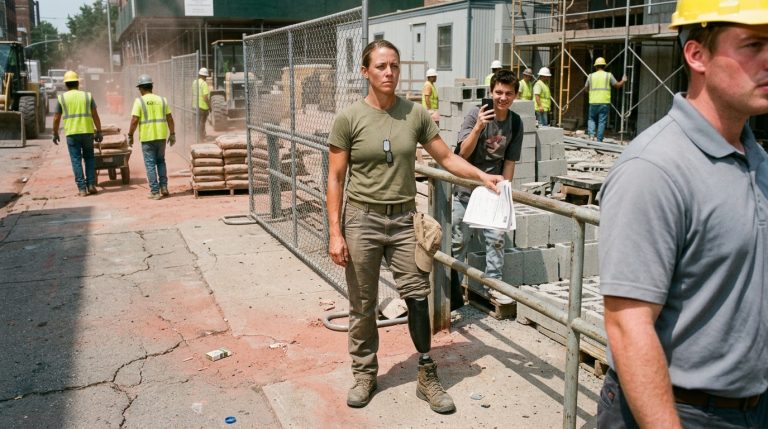
Dutch kept his hands folded on the worn leather of his briefing folder. His right knee ached—a deep, resonant thrumming that pulsed in time with his heartbeat. It was a familiar ghost, the phantom pressure of a mine that had been silent for over five decades. He didn’t shift. Movement invited questions, and questions were a luxury he could no longer afford.
The captain sitting to his left, a man whose name tag read Mitchell, was visibly vibrating with suppressed outrage. He kept glancing at Dutch, then at the General, then at the floor. His knee bounced under the table, a frantic, staccato beat that broke the forced order of the room.
“Sir,” Mitchell hissed, the sound barely audible over the hum of the ventilation. “The General is watching you.”
Dutch didn’t turn his head. His gaze remained fixed on the back wall, on a faint water stain shaped like a map of a country he had once known by the smell of its rain and the heat of its earth. “I am aware,” Dutch murmured, his voice as dry as shifting sand.
“It’s an order,” Mitchell pressed, his face flushing a mottled, unhealthy red. “Everything we do here is an order.”
“Is it?” Dutch’s voice barely carried.
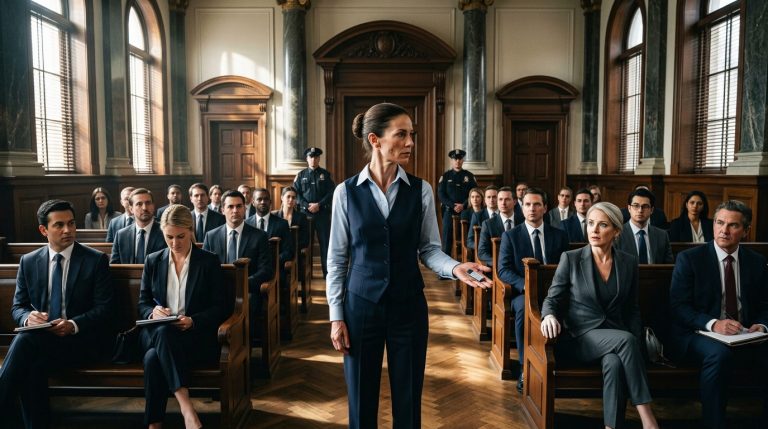
Suddenly, the room’s rhythm shifted. The General stopped speaking. The silence that followed wasn’t the silence of respect; it was the silence of a vacuum, an emptiness that rushed to fill the room before the air could even circulate. Cain had stopped mid-sentence, his gaze locked on the third row.
The tapping in the back row stopped.
Dutch felt the weight of forty pairs of eyes pressing against his shoulders. He didn’t look at Cain. Instead, he noticed a minute detail: on the table in front of him, the General’s copy of the intelligence report sat askew. The page corner was folded—a clear, deliberate mark that didn’t belong in a briefing for the Joint Chiefs.
His heart gave a singular, heavy thud. The folded corner wasn’t a mistake; it was a signal, one that existed entirely outside the protocol of the meeting.
“Colonel Harrison,” Cain said, the voice dropping into the quiet. “Why didn’t you stand?”
Dutch felt the old, familiar weight settle into his bones. He looked up, his eyes meeting the General’s. For a heartbeat, the room disappeared. There was only the mine, the mud, and the impossible math of a debt that could never be settled.
“Because you told me I didn’t have to, sir,” Dutch replied.
Behind the General, the wall clock ticked. In that exact moment, Dutch realized something that sent a shiver through his cold, steady hands: the General hadn’t brought him here to honor his sacrifice. He had brought him here to witness the lie about to be told.
CHAPTER 2: The Hallway Shadow
The General’s eyes lingered on Dutch for a second too long, a subtle flicker of something—not apology, but a frantic recognition—before he turned back to the podium.
“Colonel Harrison,” Cain repeated, his voice smoothed over with practiced, artificial calm. “We will discuss the specifics of your seating protocol after the session. For now, continue the briefing.”
The room exhaled, a collective sound of forty men and women collectively deciding that the dangerous man in the third row was no longer their problem. But Dutch felt the shift in the air. The captain sitting next to him, Mitchell, had gone rigid, his knuckles white as he gripped the edge of his table.
Dutch didn’t watch the General. He watched the shadows. He noticed the way the light from the overhead fluorescent fixtures hit the mahogany table, casting long, distorted shapes that seemed to move even when the room was still. His mind, trained for decades in the art of the pincer, cataloged the room’s exits, the nervous shifting of the administrative assistants, and the distinct, unnatural thickness of the folder the General had been clutching.
It wasn’t just a brief. It was a shield.
When the briefing finally dissolved into the chaotic, low-energy hum of a post-meeting departure, Dutch waited. He stayed seated while the room emptied, his hands resting on his knees. He didn’t want to stand yet. The act of standing was a performance, and he was tired of performing for an audience that didn’t know the difference between a tragedy and a protocol violation.
“Sir?”
Dutch turned his head. It was the captain, Mitchell. He was lingering by the row, his expression a complicated mix of lingering indignation and a budding, terrified curiosity.
“You’re waiting for him,” Mitchell said, nodding toward the now-empty podium where Cain had vanished through the secure rear exit.
“I’m waiting for the floor to stop spinning, Captain,” Dutch replied, his voice a low gravel. He finally moved, the internal mechanism of his prosthetic leg clicking with a soft, metallic finality—a sound that seemed too loud in the empty room. He stood up slowly, the movement an exercise in calculated equilibrium.
He didn’t look at Mitchell; he looked past him, toward the doorway. A shadow had been hovering there for the last ten minutes, not moving, just observing. A woman in a charcoal suit, clutching a leather-bound notebook that looked heavy enough to contain the secrets of the entire Joint Chiefs.
“You’re Captain Mitchell,” Dutch said, his eyes locking onto the woman in the doorway. He didn’t wait for a response. “Go back to your office. File your report. Say whatever you need to say to appease the chain of command.”
“I… I can’t just leave you here, sir. You’re a guest of the General’s.”
“I am a guest of no one,” Dutch said. He started walking. Every step was a negotiation with the floor, a constant, minute adjustment of balance. He felt the weight of the phantom mine pressing up through the steel and carbon, a psychological phantom that flared in the quiet of the room. He remembered the smell of the damp earth in Quang Tri, the way the air had gone silent, the exact, terrifying rhythm of his own heartbeat when he realized he couldn’t move his foot.
He reached the doorway, his stride deliberate. The woman in the charcoal suit stepped aside, her face unreadable, her eyes tracking him with the cold precision of a surveillance camera. As he passed, the scent of her perfume hit him—sharp, synthetic, and completely out of place in the sterile, paper-heavy air of the Pentagon.
“Colonel,” she whispered, her voice like paper sliding over glass. “The General is in the archives. Level B3. He’s expecting you to take the long way.”
Dutch didn’t stop. He didn’t even acknowledge that she had spoken. But his fingers closed around the brass compass in his pocket, the one with the empty needle. The “long way” was the only way, especially when the shortest path was clearly paved with lies.
He walked into the hallway, the fluorescent lights humming above him, creating a flickering, hypnotic rhythm. He was moving toward the heart of the building, toward the files that shouldn’t exist, and the man who had been a sixteen-year-old boy in a hospital ward, promising things that history had no intention of keeping.
His leg ached, a deep, grinding reminder of the price of his silence. He was 82 years old, and he was walking into a trap he had helped set for himself over fifty years ago.
He didn’t regret it. But as he turned the corner into the darkened corridor of the archive wing, he couldn’t help but wonder if the boy he had saved had finally grown up to be the kind of man who would let him leave.
CHAPTER 3: The Archive Visit
The descent into B3 was not a matter of a simple elevator ride. When Dutch pressed the button, the steel doors shuddered, groaned like a dying beast, and refused to budge. The light above the panel flickered once—a dead, dying amber—before plunging the elevator alcove into a dim, shadowed twilight.
Dutch didn’t swear. He didn’t even sigh. He simply stepped back, the weight of his body shifting onto his left leg to compensate for the sudden stillness of his right. He turned toward the stairwell door, a heavy, fire-rated slab of gray steel that felt colder than the surrounding air.
This was the detour. The archives were reachable by the main lift, but the lift was now a tomb, and the stairwell was a labyrinth. He pulled the door open, the hinges protesting with a high, metallic shriek that sounded like a warning. He began the climb, or rather, the descent.
Level by level, the temperature dropped. The air here was different—thick with the scent of microfiche dust, ozone, and the faint, underlying chemical tang of cleaning solvents used to mask the smell of stagnant time. Every step he took on the concrete stairs was a calculated risk. His prosthetic leg hit the edge of the first step with a precise, echoing clack, a sound that seemed to chase him down the stairwell, bouncing off the concrete walls until it sounded like there were two men descending instead of one.
He kept his hand on the railing, the metal rough and pebbled with layers of industrial paint. It was an exercise in endurance. His residual limb, the part of him that met the prosthetic, began to ache—a dull, throbbing heat that radiated upward, reminding him that he was an 82-year-old man performing a mission that belonged to a man half his age.
When he reached the B3 landing, he didn’t immediately push through. He paused. He listened.
The archives were supposed to be silent, but silence in the Pentagon was rarely absolute. He heard the distant, rhythmic hum of massive server banks, the faint, frantic typing of an unseen clerk, and the low-frequency vibration of the building’s massive air handling units. But beneath that, there was something else—a irregular, soft sound, like fabric brushing against stone.
He pushed the door open just a crack, peering through the sliver of space.
The archive room was a vast, subterranean cathedral of shelving. Rows upon rows of steel crates stretched into the darkness, illuminated only by the occasional flicker of emergency lighting. And there, standing in the aisle labeled 1970-1972, was a figure.
It wasn’t the General.
The figure was slight, hunched over a rolling cart, frantically scanning through a stack of documents. They were wearing a nondescript technician’s uniform, the kind that made people invisible in a building filled with thousands of contractors.
Dutch didn’t move. He stood in the doorway, his silhouette lost in the dim light of the stairwell. He watched the figure. They weren’t looking for standard intelligence. They were tearing through the folders, their hands moving with a frantic, desperate energy. Every few seconds, they would pull a document, scan it with a small, handheld device that pulsed with a faint, blue light, and then toss the file onto the floor.
The floor was littered with them—a graveyard of secrets.
Dutch felt a coldness settle in his chest that had nothing to do with the temperature of the B3 level. He recognized the pattern. It wasn’t just research; it was a purge. Someone was scrubbing the record, removing the evidence of the minefield, the patrol, and the man who had been the “equation’s answer” for Marcus Cain.
He stepped out of the stairwell, his prosthetic leg hitting the linoleum with a sound that seemed to shatter the room’s quiet.
The figure spun around, dropping the scanner. They were young—no older than twenty-five—with wide, frightened eyes that darted toward the exit.
“Who sent you?” Dutch asked, his voice steady, carrying the weight of a man who had seen enough of these games to know the rules.
CHAPTER 3: The Archive Visit
The corridor leading to the B3 archives was a long, desolate stretch of institutional grey, illuminated by flickering overhead lights that buzzed with a low, dissonant frequency. With every step, Dutch’s prosthetic leg hit the floor with a dull thud that echoed off the metal-lined walls. It was a rhythmic, mechanical reminder of his own intrusion into a space that had been designed for the slow, silent decay of classified secrets.
He paused before a heavy, reinforced steel door. The badge reader sat like a sentry, its small green light pulsing—an artificial heartbeat in the gloom. He slid his security clearance card into the slot. The machine groaned, a rusted, protesting sound, before the lock clicked open with the force of a falling guillotine.
The interior was not what he expected. Instead of rows of neat, paper-filled cabinets, he found a labyrinth of shelving units that stretched into the shadows, the air thick with the smell of aging pulp and ozone. It was a space designed for forgetting, yet every box was labeled with a precision that bordered on the obsessive.
Dutch moved deeper into the aisles, his hand trailing against the cold metal edges of the shelves. His fingers felt the abrasive grit of dust, the fine, grey residue of time that settled on everything here. He stopped at a section marked 1971: Quang Tri Sector.
The files were neatly arranged, yet as he pulled the primary log from the shelf, he felt a sudden, sharp discrepancy. The weight was wrong. The file, which should have been thick with tactical reports and casualty lists, felt thin, hollow—as if a significant portion of its life had been stripped away. He opened it, his thumbs brushing the edges of documents that were yellowed and brittle.
He flipped through them quickly. Tactical maps, supply logs, ammunition counts—all there. But the specific after-action review from the patrol on March 12th, the one involving the pressure mine, was gone. In its place was a singular, stark white index card with a typed reference number that didn’t match the sector’s coding sequence.
Reference: CAIN-71-ALPHA. Status: Redacted/Transferred.
Dutch stared at the card. The silence of the archives was absolute, yet in his ears, he could hear the faint, phantom hiss of the mine he had stood on fifty-three years ago. The missing report wasn’t a clerical error; it was a surgical excision. Someone had spent a great deal of time and effort ensuring that the precise tactical reality of that day was scrubbed from the record, leaving only a sanitized, heroic fable in its wake.
He pulled his flashlight from his coat pocket, the beam cutting a bright, intrusive swathe through the darkness. He scanned the surrounding shelves, looking for anything that might link to the CAIN-71-ALPHA reference. His eyes darted across the labels.
Then, he saw it. A small, nondescript crate sitting on the bottom shelf, tucked away behind a stack of redundant communication logs. It wasn’t numbered with the standard sector code. It was marked with a date: November 1998. The year the General had made his final promotion.
Dutch knelt, a process that required careful, practiced movement. His knee locked into position, supporting him as he reached for the crate. He didn’t rush. He opened the latch with steady, surgical precision, ignoring the way his hands trembled slightly—not from fear, but from the raw, exposed nerves of a memory that was finally being forced into the light.
Inside, there were no documents. There was only a collection of cassette tapes, each labeled with a name and a date. He picked one up. Marcus Cain – 1998.
He felt the cold, hard reality of the archive’s atmosphere tighten around him. The General hadn’t brought him here to witness a briefing; he had brought him here to verify what was buried. And as Dutch held the tape, he realized that he wasn’t just investigating a history; he was holding the thread that could unravel the entire, carefully constructed architecture of the Chairman’s legacy.
A floorboard creaked in the aisle behind him—a soft, deliberate sound that didn’t belong to the building’s settling. Dutch froze, his hand still inside the crate. He didn’t turn around. He focused on the reflection in the polished surface of the metal shelf before him, watching for the shadow that would signal the end of his quiet, safe obscurity.
The shadow appeared, long and distorted against the grey floor, cast by a figure standing just out of reach of his flashlight’s beam.
“The archives are restricted, Colonel,” a voice said. It was smooth, devoid of any real tension, yet it carried the sharp, cutting edge of authority. “Even for you.”
Dutch didn’t look up. He closed the crate, his voice calm, steady, and entirely unafraid. “I’m not here for the records, son. I’m here for the truth that wasn’t worth printing.”
CHAPTER 4: The First Warning
The man standing in the aisle’s shadow was tall, his frame lean and sharp-edged in the dim, erratic light of the emergency fixtures. He wasn’t security. There was no tactical gear, no tactical holster, no mark of the uniform. He wore a crisp, charcoal-grey suit that cost more than Dutch’s entire pension, and his posture was one of relaxed, predatory patience.
Dutch kept his hand inside the crate, his fingers resting on the cool, textured plastic of the cassette tape. He could feel the slight tremor in his own arm—a side effect of the long descent, or perhaps just the sheer, accumulated weight of the history he was currently holding hostage.
“I’m not a fan of riddles, Colonel,” the man said, taking a slow step forward. The flashlight beam caught the polished toe of his leather shoe. “Especially not from men who are supposed to be sitting in a conference room upstairs, enjoying their retirement.”
“And I’m not a fan of being followed into the basement,” Dutch countered. He didn’t turn around. He focused on the man’s reflection in the brushed-metal shelving, watching the way he held his hands—loose, at his sides, ready to move. “If the General wanted to talk, he would have done it himself. You’re just the echo.”
The man smiled, a tight, humorless expression. “The General is a very busy man, preoccupied with the stability of a nation. You, on the other hand, are a ghost trying to convince himself he’s still alive. You’re playing with fire, Dutch. That box? It’s not just a collection of tapes. It’s a list of names. Names that people in this building would kill to keep in the dark.”
Dutch finally turned. He stood slowly, his prosthetic leg clicking softly against the concrete as he shifted his weight to center himself. He felt a sudden, sharp spike of vertigo. For a fleeting second, the archive shelves seemed to stretch into the endless, sun-baked mud of Vietnam. He heard the distant, muffled thwip-thwip of a helicopter that wasn’t there, and for a moment, the man in the charcoal suit looked like a sergeant from a unit that had been wiped out forty years ago.
He blinked, forcing the hallucination back into the shadows. He stayed calm. He’d learned long ago that the best way to handle a phantom was to treat it like a solid object.
“If they’re so dangerous,” Dutch said, his voice low and steady, “why are they sitting in an unlocked crate in a basement everyone has forgotten exists?”
The man tilted his head. “Because, Colonel, the people who know where they are are the ones who put them here. It’s not a vault. It’s a graveyard. And you’re digging.”
“I’m not digging,” Dutch said, his grip on the cassette tape tightening. “I’m just reclaiming what’s mine.”
“That’s where you’re wrong.” The man stepped closer, his presence suddenly suffocating in the narrow aisle. “Nothing here is yours. Not the tapes, not the patrol, not even the leg you’re standing on. It all belongs to the institution. And the institution has a very simple policy for ghosts who refuse to stay in their coffins.”
Dutch felt the man’s eyes scanning him, not with malice, but with a terrifying, clinical indifference. The man reached into his breast pocket, not for a weapon, but for a small, thin envelope. He held it out. It was heavy, sealed with a stamp that Dutch hadn’t seen since the Cold War—a simple, unadorned black eagle.
“Read it, or don’t,” the man said, dropping the envelope onto the crate in Dutch’s hand. “But if you walk out of this basement with those tapes, the narrative changes. The hero of Quang Tri becomes the man who compromised the security of the Joint Chiefs. And I promise you, Dutch, the papers won’t be as kind to you as the General was.”
The man turned, walking away into the gloom of the archive. His footsteps were silent, lacking the heavy, mechanical grind of Dutch’s own movement. He didn’t look back, and he didn’t wait for a reply.
Dutch stood alone in the aisle, the hum of the air conditioning system filling the space with a low, mournful vibration. He looked down at the envelope. His hand, the one not gripping the tape, hovered over the paper. The texture was thick, creamy, and undeniably expensive.
He didn’t open it. He knew the contents—a threat wrapped in a recommendation. He turned the envelope over. It was blank. No return address, no name, just the weight of a silence that was rapidly becoming the only language left in the building.
His prosthetic leg let out a small, sharp metallic click as he shifted his weight. The pain in his residual limb was now a dull roar, a burning reminder of the day that wouldn’t end. He tucked the envelope and the tape into his coat, feeling the hidden bulk against his side. The decoy secret—the idea that he was here for the tapes—was now out in the open. But as he looked at the label on the shelf again, he saw the subtle, handwritten mark that he had missed before: a series of coordinates.
They weren’t for a location in Vietnam. They were for a coordinate in the Middle East, a region that was currently the subject of the very briefing he had just attended.
He wasn’t just holding history. He was holding the prologue to a disaster that was happening in real-time. And for the first time in fifty-three years, Dutch felt a spark of something he hadn’t touched since the mine: the need to fight for the next step, not because he was told to, but because he was the only one who could see the map.
He turned toward the stairwell, his path now narrow, dangerous, and entirely his own.
CHAPTER 5: The Bridge
The journey back up the stairwell was a grind of physics and will. Each step required Dutch to force his weight through the interface of his residual limb and the carbon fiber socket, a process that had become a familiar, stinging ritual over fifty-three years. He didn’t rush. He counted the steps—one, two, three—each one a rhythmic confirmation that he was still standing, still moving, still capable of calculating the cost of the path he had chosen.
By the time he reached the B1 level, the sweat was a cool prickle against his skin, and his breath came in short, measured hitches. He stopped at the heavy steel door, leaning his shoulder against the rough concrete wall for a moment of recovery. He reached into his coat and felt the sharp corner of the envelope. It felt like a stone, dense and immovable.
He didn’t open the door yet. He closed his eyes. The archive had been a graveyard, but this floor, the administrative hub of the Joint Chiefs, was a machine. He could hear the muffled sound of telephones ringing in the distance, the sharp, rapid-fire clicking of keyboards, and the low-frequency hum of the high-speed data printers that served as the heartbeat of modern warfare. It was a sterile, organized chaos, entirely removed from the mud and the blood of the life he remembered.
He pushed the door open. The hallway was empty, the fluorescent lights casting long, geometric shadows across the polished linoleum. He moved toward the General’s suite, his prosthetic leg creating a rhythmic, metallic tock-tock that sounded like a countdown in the emptiness.
He stopped outside the heavy, oak-paneled door of the private office. There was no guard, no secretary—only the quiet, heavy stillness of a room where decisions that affected millions were finalized. He knocked—two sharp, percussive raps that felt too loud, too honest.
“Enter,” a voice commanded from within.
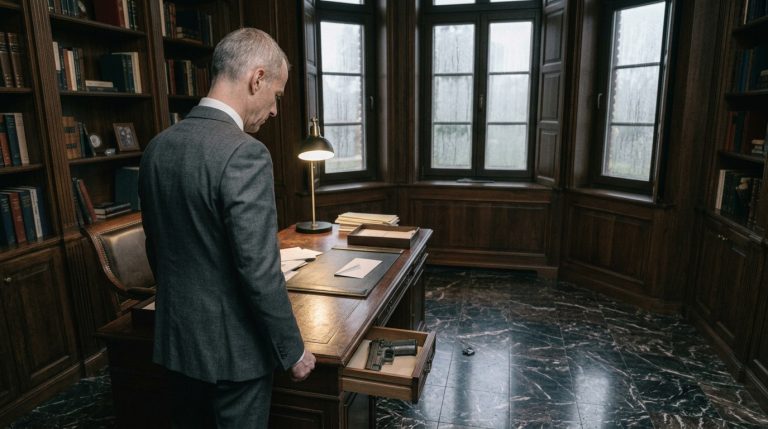
Dutch opened the door. The office was dimly lit, the walls lined with mahogany shelves crowded with commemorative plaques and framed photos of the General’s long, storied career. General David Cain was standing by the window, looking out over the Pentagon’s inner courtyard, his hands clasped firmly behind his back.
He didn’t turn around. “You found the crate, didn’t you, Dutch?”
“I found a lot of things,” Dutch said, his voice as dry as the paper he had been reading. He walked into the center of the room, the carpet deadening the sound of his gait. He didn’t sit. He remained standing, a posture of deliberate, stubborn defiance. “I also found a man in a charcoal suit who thinks he speaks for you.”
Cain turned then. His face was a map of exhaustion, the lines around his eyes deep and etched with the same weight Dutch had been carrying for half a century. “That man is a necessary evil in a building that has forgotten how to be anything else. He’s the one who makes sure the gears keep turning when the machine breaks down.”
“The machine is broken, David,” Dutch said, his hand moving to his coat pocket. He pulled out the cassette tape and set it on the polished surface of the General’s desk. It looked small, outdated, and utterly out of place in the high-tech, digital-first environment of the 21st-century Pentagon. “This isn’t just history. It’s a warning.”
Cain stepped toward the desk, his eyes fixed on the tape. He didn’t touch it. “My father is ninety-one. He spends his days sitting on the porch, waiting for a memory that never quite settles. He told me you visited.”
“He needed to talk. I needed to listen.”
“And what did you hear?” Cain asked, his voice softening, a momentary slip in his armor of command.
“I heard a man who survived because of a choice,” Dutch said. “I heard a man who never had to pay the price for the life he was given. And I heard a son who has spent his entire career trying to buy back the debt his father owed me.”
Cain looked up, his gaze steady, searching. “Is that what you think this is? A transaction?”
“It’s always been a transaction,” Dutch replied. “The mine, the leg, the briefing, this office—it’s all part of the same equation. You think you’re protecting me by keeping the record buried, by keeping me away from the truth of what happened in that field. But you’re not protecting me. You’re protecting the illusion that the math actually worked.”
Cain moved to the desk and picked up the tape. His fingers were steady, but his expression was shadowed, the weight of the room shifting with his every movement. “If I play this, Dutch, I lose the ability to control the narrative. The intelligence reports I showed you this morning? They’re the foundation of the current deployment. If they’re wrong—if the underlying data is tainted by the same rot that started in 1971—then the entire mission is a house of cards.”
“Then let it fall,” Dutch said.
Cain stared at the tape, the silence of the office pressing in on them. Outside the window, the sun was beginning to dip, casting a long, orange glow across the room. Dutch watched the General—the four-star, the leader, the man who had been a boy with a promise. He saw the flicker of doubt, the hesitation of a man who realized that his entire legacy was balanced on a piece of magnetic ribbon.
“I’m not going back to the basement, David,” Dutch said, his voice a low, resonant promise. “And I’m not leaving without an answer.”
Cain nodded, a slow, grim acknowledgement of the inevitable. He didn’t offer a seat. He didn’t offer an apology. He simply turned to the tape player built into his desk, the old, analog mechanism a relic of the era they were both trapped in. He inserted the tape, the sound of the locking mechanism a final, decisive click that echoed in the quiet air.
“Then let’s listen to the man who saved my father,” Cain whispered.
CHAPTER 6: The Decoy Reveal
The tape didn’t play a voice—not at first. It played the sound of wind, low and whistling, followed by the wet, rhythmic slapping of boots in deep mud. Then, the sound of a man counting. The voice was younger, sharper, but unmistakably Dutch’s. One. Two. Three. Then, a heavy, dull thud of someone jumping, followed by the hollow, sickening snick of a pressure mine arming itself in the silence.
General Cain stood motionless, his hand hovering over the volume dial as if afraid that turning it up would release something he couldn’t push back into the box. The air in the office had grown heavy, the scent of ozone from the nearby server banks mixing with the smell of old, trapped dust from the tape’s housing.
“That’s not the whole recording,” Dutch said, his voice flat. He watched Cain’s face—the man was pale, his jaw set in a line of hardened resistance.
“My father told me this tape existed,” Cain whispered, his eyes still fixed on the spinning spools. “He said it was his final insurance. A record of the day he became a man, and the day he lost his spine.”
Dutch didn’t respond. He stepped toward the desk, his prosthetic leg making no sound on the heavy rug. He reached out and clicked the stop button. The sudden absence of the static was jarring, leaving a ringing silence that felt more dangerous than the noise.
“You’re looking for the tactical report that was scrubbed from the B3 archives, David,” Dutch said. He pulled the small, handheld scanner he’d confiscated from the archive technician from his pocket. “The tape isn’t just audio. It’s a carrier.”
He plugged the device into the General’s secure terminal. The screen flickered, a cascade of green code scrolling down the monitor like rain. Dutch watched the progress bar, his mind tracing the architecture of the deception. It was all there: the false coordinates, the reassigned troop movements, the manufactured intelligence that was currently being used to justify the new deployment in the Middle East. It wasn’t just a record of a minefield in 1971; it was a blueprint for a modern, geopolitical catastrophe.
Cain leaned over the terminal, his eyes widening as he read the data. “This is impossible. These mission parameters… they were signed off by the Oversight Committee. They were vetted by the intelligence branch.”
“They were vetted by a ghost,” Dutch said, his eyes scanning the lines of code. “Look at the time stamps. They align with the same pattern of redaction I found in your father’s file. Someone has been using the same administrative ‘kill switch’ for fifty years. They’ve been hiding the truth of that patrol because the patrol wasn’t an accident. It was a test. Your father wasn’t just a lieutenant caught in a minefield. He was an asset being groomed for the Chair, and the mine was the initiation.”
Cain gripped the edge of the desk, his knuckles turning white. “You’re saying my entire career—my father’s legacy—is built on a controlled environment? That we’ve been living in a simulation of service?”
“I’m saying your father was a weapon they couldn’t afford to break, so they built a fence around him,” Dutch said, his voice hardening. “And you, David, you’re just the final iteration of that design. You’re not leading the Joint Chiefs. You’re maintaining the fence.”
The General turned away, his gaze moving to the window. The sky outside had turned a deep, bruised purple, the lights of the Pentagon beginning to glow like embers in the twilight. He looked smaller, the four stars on his uniform feeling less like a crown and more like an anchor.
“If I release this,” Cain said, his voice barely audible, “the department collapses. The public trust? It’s gone. You’re asking me to burn down the temple to find the foundation.”
“I’m asking you to stop being part of the lie,” Dutch replied.
He leaned forward, his hands pressing against the cool, glass surface of the monitor. He noticed a file folder sitting partially hidden under a stack of briefing papers on the General’s desk. It was marked Project 71-Beta. The label was written in the same hand as the index card he had found in the archives.
Dutch didn’t reach for it. He didn’t have to. He knew that if he pulled that thread, the entire tapestry would unravel, including his own, long-held belief that he had simply been a soldier who made a choice in the mud. He realized then that the “decoy” wasn’t just the tape. It was the entire narrative of his own survival. He hadn’t just saved seven Marines. He had saved a mechanism that needed to be kept alive, and for fifty years, he had been the primary agent of its maintenance, blinded by his own sense of duty.
The realization settled in his gut like ice. He wasn’t the victim of the secret. He was its silent partner.
“I need to go, David,” Dutch said, his voice hollow.
“Where?”
“To find out who else was in that field,” Dutch replied.
He turned and walked toward the door, his prosthetic leg clicking with a rhythmic, steady finality. As he stepped into the hallway, he didn’t look back. He had the tape, he had the evidence of the modern failure, and he had the terrible, sudden understanding that the man he had saved in 1971 had been destined to live, not because of Dutch’s courage, but because of the architects who had placed the mine.
He walked into the dark, his footsteps echoing through the hollow, sterile heart of the building, a ghost finally beginning to haunt the house that had been built on his sacrifice.
CHAPTER 7: The Mirror
The hallway outside the General’s suite felt suddenly longer, the geometric shadows cast by the recessed lighting stretching out like fingers grasping at his heels. Dutch walked with a stiff, unnatural cadence. The tape and the envelope in his coat felt immensely heavy, not in weight, but in the sheer potential for damage they represented. He didn’t look at the doors he passed; he didn’t need to. He could feel the eyes of the building—the soft, persistent blink of the surveillance lenses, the quiet hum of the motion sensors tracking his progress toward the emergency stairwell.
He knew he was being monitored. The General’s silence after he left the room was more telling than a shout. David Cain wasn’t sending security; he was watching to see where the infection spread.
Dutch turned into the archive wing’s auxiliary corridor. He needed to get back to the B3 level, not for more files, but for the one thing he had ignored during his first trip: the auxiliary log that recorded who had checked out the “redacted” materials. If the purge was systemic, as he suspected, the digital footprint would be the only truth left.
As he moved, the walls seemed to pulse with a low-frequency vibration. He saw a flash of movement—a slight, hunched shape rounding the corner ahead. The technician. The one he had confronted in the archives.
“Wait,” Dutch called out, his voice sharp, echoing off the bare, industrial surfaces.
The figure didn’t stop. They moved with a hurried, unnatural grace, disappearing behind a stack of crates that had been left in the corridor for a scheduled floor cleaning. Dutch pushed himself to move faster, the metal of his prosthetic leg biting into his flesh with every aggressive stride. He turned the corner, his hand going to his coat pocket, but the aisle was empty.
Nothing but dust motes dancing in the dim light and the faint, lingering smell of ozone.
He stood in the center of the aisle, breathing hard, his chest tight. For a moment, the archive racks seemed to sway, and the smell of the dust transformed into the wet, pungent odor of the Vietnamese jungle floor. He saw the mine—not the one from fifty years ago, but a modern, digital version of it, a line of code buried in the Pentagon’s own server infrastructure, waiting for the right input to trigger the deployment. He wasn’t just chasing a ghost; he was chasing a mechanism that was currently “armed.”
He reached for the wall to steady himself, his fingers brushing the cold, peeling paint. He was losing his grip on the immediate. The “Ghost Ratio” of his memory was ballooning, threatening to swallow the present. He pulled the brass compass from his pocket and stared at the empty casing. There was no needle to point North, no direction to follow but the one he had been walking since 1971.
“Focus,” he rasped, his voice a dry command to his own frazzled nerves.
He reached the stairwell door and pulled it open. He descended into the dark, the rhythm of his own gait serving as a metronome for the collapse of his assumptions. He wasn’t just the man who stayed behind. He was the man who had been kept alive to bear witness to the lie.
When he reached B3, the archives were different. The rows of shelving seemed to have shifted, the geometry of the space subtly skewed. He moved to the auxiliary log terminal, a relic of the mid-nineties, and began to query the logs. The keyboard was sticky, the keys unresponsive, requiring a brutal, direct pressure to engage.
He found the file. CAIN-71-ALPHA.
He entered his own clearance code—a retired, outdated sequence that, to his surprise, still granted him access to the sub-directories. The screen blinked, and then it opened. He wasn’t looking at a history of a patrol. He was looking at a personnel roster for the entire unit.
The names were familiar, but beside each one was a notation: Transfer Complete. Status: Asset Integrated.
Seven names. Seven Marines. He had believed they were dead. He had carried the weight of their sacrifice like a stone in his heart for five decades. But the records said otherwise. They hadn’t died in the explosion. They had been moved. The explosion had been the theater, the mine had been the curtain, and the entire unit had been “integrated” into the very bureaucracy that now governed the war he was currently trying to stop.
Dutch stared at the screen, the blue light washing over his face, bleaching the color from his skin. The silence in the archive wasn’t just empty—it was an accusation. He had spent his life grieving for seven men who had never died, and in doing so, he had provided the perfect cover for the men who had stolen them.
He wasn’t just a veteran. He was a piece of the architecture.
CHAPTER 8: The Tactical Pivot
The siren was not a scream; it was a rhythmic, pulsing thrum that rattled the very foundations of the B3 archive. Dutch didn’t panic. Panic was a luxury for men who had time to lose, and he had reached the end of that particular currency long ago. He reached out and forcefully jammed his thumb against the terminal’s emergency power-off button. The screen died, plunging the aisle into a deeper, suffocating darkness, save for the rotating red emergency light that bathed the racks in a strobe of warning.
He grabbed the small, handheld scanner and tucked it into his inner coat pocket. He didn’t have time to print the roster. He had the truth etched into his memory, a series of seven names that were never dead, seven men whose lives had been bartered for the stability of a machine they didn’t even know they were part of.
He turned toward the stairwell, but the heavy steel door was already sealed. He could hear the muffled, rapid-fire tread of boots on the concrete above—security, responding to the breach.
He didn’t hesitate. He pivoted, the motion of his prosthetic leg precise and efficient, and moved toward the far end of the archive aisle, where a narrow, maintenance grate sat partially obscured by a stack of discarded shipping crates. He pried it open with a pry-bar he pulled from a nearby shelf. The space beyond was a utility tunnel—a dark, claustrophobic artery of coolant pipes and fiber-optic bundles that smelled of hot copper and stagnant, recycled air.
He crawled inside. The tunnel was tight, forcing him to keep his center of gravity low. The prosthetic leg, designed for stable, upright walking, was a liability in the narrow shaft. Every time he pushed forward, the carbon fiber caught on the rusted ridges of the tunnel, sending a jarring, white-hot vibration up his thigh.
He was moving blind, his only sense of direction the subtle, warm draft of the building’s ventilation system pulling air toward the central core. He was crawling through the guts of the machine, navigating the very infrastructure that had been used to “integrate” the men he thought he had saved.
Halfway through the tunnel, he heard them. Voices, tinny and distorted, vibrating through the pipes.
“Subject is confirmed in the B-level sub-sector. Initiate containment protocol. No lethal force—the Chairman wants him intact.”
Dutch stopped, pressing his back against the cool, damp steel of a coolant pipe. His heart was a steady, rhythmic thrumming in his ears. He wasn’t a tactical threat to them, he realized—not in terms of physical force. He was a piece of evidence that refused to stay filed. They needed him alive, if only to ensure he didn’t become a martyr whose silence was louder than his testimony.
He pushed forward, his hands raw and bleeding from the abrasive concrete of the tunnel wall. He emerged into a cramped junction box located behind the control panel of the elevator bank. He looked through a narrow slit in the panel and saw the elevator doors opening on the B1 level. Two men in dark, tactical gear stood at the ready, weapons lowered, their postures guarded.
He reached for the control panel of the elevator itself. It was a bypass—a manual override. He could force the elevator to drop to the basement, creating a sudden, kinetic distraction, or he could force it to skip to the ground floor, effectively abandoning him in the heart of the building’s security hub.
He chose neither.
He manipulated the wiring, crossing the leads for the floor-indicator lights. He made the elevator look like it was descending to the basement, while the actual cage remained parked at B1. It was a simple, old-school maneuver—a piece of tactical deception from a time when intelligence was gathered on the ground, not through an algorithm.
He watched through the slit as the two guards stepped into the empty elevator cage on B1, confused, their voices raised in a flurry of radio chatter. He pulled the manual release for the elevator doors from the junction box, and they slid open with a soft, mechanical hiss.
He wasn’t going up. He was going across.
He stepped out into the B1 corridor, his face obscured by the deep, cavernous shadows cast by the building’s emergency lights. He looked nothing like a threat. He looked like an old man lost in the labyrinth of a government building, a retired colonel who had wandered away from his briefing.
He walked toward the main lobby, his prosthetic leg clicking with a steady, metronomic cadence that matched the building’s own operational rhythm. He passed a janitor, a clerk, and a mid-level analyst, all of whom didn’t even bother to look up. To them, he was just part of the furniture, a piece of the architecture that had been there since the foundation was poured.
He reached the lobby, the glass of the front entrance reflecting the cold, late-night stars of the Virginia sky. He paused at the security checkpoint, his hand resting on the envelope in his pocket. He was going to walk out the front door, and in doing so, he was going to take the final piece of the General’s authority with him.
But as he reached the final turn, he saw a car waiting at the curb. The engine was running, a low, predatory purr. And standing beside it, with a cigarette held loosely between his fingers, was the man in the charcoal suit.
He hadn’t been following Dutch. He had been waiting for him to finish the tour.
“You’re behind schedule, Colonel,” the man said, flicking the ash of his cigarette toward the polished floor of the lobby. “The car is open. And I suggest you get in, unless you want to see exactly how quickly we can rewrite your entire history, starting with the patrol at Quang Tri.”
Dutch stopped, the weight of the envelope and the tape burning against his side. He was at the exit, but the exit was no longer the path to freedom. It was the next phase of the architecture.
CHAPTER 9: The Silent Protest
Dutch didn’t move. He stood on the polished lobby floor, his shadow cast long and jagged by the harsh exterior lights. The man in the charcoal suit—the architect, the ghost, the shadow-hand—continued to hold the cigarette, the ember glowing with a rhythmic, dying intensity.
“The car, Colonel,” the man repeated, his voice devoid of any pretense of friendliness. “It’s not an invitation. It’s a logistical necessity.”
Dutch felt the envelope in his pocket, the thick, unyielding paper pressing against his ribs. He had spent his life thinking he was an anomaly, a singular variable in a complex equation. He realized now that he had been the control group, the veteran whose stoic, silent presence provided the necessary cover for a system that had long since outgrown the need for ethics.
“I’m not going,” Dutch said. His voice was steady, resonant, carrying the weight of the years he had spent in the service of a country that had built its foundation on the very secrets he was now holding.
The man sighed, a sound of genuine, weary disappointment. He tossed the cigarette to the ground and crushed it beneath the heel of his shoe—a sharp, grinding sound that echoed in the quiet lobby. “You think you’re taking the truth into the light, Dutch. But look around you. The light in this building is artificial. You leave with that tape, and you’re not a whistleblower—you’re a disruption to the global deployment schedule. And as I’m sure you know from your tactical training, disruptions are neutralized before they can impact the mission.”
Dutch took a step forward, the click of his prosthetic leg sounding like a gavel on the lobby floor. “Then neutralize me. But you know the math, son. You know what happens when you start removing the foundation. The whole house comes down.”
The man went very still. He reached into his jacket, and for a terrifying second, the lobby seemed to compress, the air vibrating with the sudden, unspoken threat of violence. But he didn’t pull a weapon. He pulled a mobile phone—sleek, black, and completely featureless.
“General Cain is currently in a secure meeting with the Chairman,” the man said, looking at the screen. “He’s rescinding his support for the mission. He’s doing it because you put the tape on his desk. He thinks he’s choosing his integrity over his career.”
The man looked up, his eyes cold and devoid of anything resembling humanity. “He doesn’t realize that his resignation is already being processed. By tomorrow morning, he’ll be a historical footnote. And you, Colonel? You’ll be the man who drove a decorated officer to treason.”
Dutch felt a cold spike of clarity pierce through his exhaustion. It wasn’t a threat; it was a report. They weren’t trying to stop him anymore. They were letting him proceed because his actions were the catalyst they needed to clear the board.
“You want me to take it to the press,” Dutch realized, the pieces of the decoy secret clicking into place with horrifying precision. “You want the General out, and you’re using my reputation to do it.”
“I want the mission to proceed, Colonel,” the man replied. “And I don’t care who gets burned in the process.”
The man climbed into the car and closed the door. The sedan pulled away, its tires whispering against the asphalt as it vanished into the night, leaving Dutch alone at the curb.
He stood there for a long time. The wind picked up, a biting, autumn chill that cut through his suit. He realized then that his entire “protest”—his seating, his silence, his investigation—had been a play within a play. He had been the lead actor, believing he was improvising, only to realize he was reading from a script written in 1971.
But the script had a flaw. It hadn’t accounted for the fact that he was an 82-year-old man with nothing left to lose.
He didn’t go home. He turned and began to walk, not toward the parking lot, but toward the public transit hub. He had the tape, he had the evidence, and he had the name of every “integrated” asset in the Pentagon. If the machine wanted a disruption, he would give them a collapse.
His leg ached with a dull, persistent fire, but he didn’t slow down. With every step, he was breaking the rhythm of the machine, one mechanical, defiant click at a time. He was no longer the equation’s answer. He was the variable that would invalidate the entire system.
CHAPTER 10: The Horizon
Dutch walked until the lights of the Pentagon were nothing more than a dull, flickering glow against the horizon. The night was cold, the air biting with a winter intensity that seemed to sharpen the clarity of his thoughts. He didn’t head for the metro; he headed for the periphery, for the quiet, unmonitored roads that circled the Virginia suburbs.
He didn’t need the press. He didn’t need the public spectacle that the shadow-man had been baiting him into. He realized now that the system’s greatest vulnerability wasn’t exposure—it was indifference. By refusing to play the part of the whistle-blower, by refusing to be the “disruption” they had scripted for him, he was effectively nullifying their control.
He arrived at the Cain family home just as the first grey light of dawn began to bleed into the sky. The house was quiet, a sturdy, aging structure that looked like it belonged to another century. He walked up the driveway, his prosthetic leg striking the pavement with a rhythmic, predictable sound.
Marcus Cain was already there, sitting in a wooden rocking chair on the back porch, a thin wool blanket draped over his knees. He looked up as Dutch approached, his eyes cloudy with age but still possessing the sharp, piercing intelligence that had once made him a leader of men.
“You’re late,” Marcus said, his voice a raspy whisper.
“I took the long way,” Dutch replied. He climbed the porch steps, the wood groaning slightly under his weight. He sat in the chair next to Marcus, the two of them side-by-side, facing the rising sun.
Dutch reached into his coat and pulled out the cassette tape, the envelope, and the small scanner. He laid them all out on the small, scarred side table between them. He didn’t explain. He didn’t have to. Marcus looked at the items, his gaze lingering on the tape—the black ribbon of magnetic storage that held the truth of the mine, the patrol, and the boys who had been turned into assets.
“They want you to burn it,” Marcus said, not a question, but a statement of fact.
“They want me to use it,” Dutch corrected. “They want the system to collapse on its own terms so they can build a new fence.”
Marcus nodded slowly. “And you?”
Dutch looked at his prosthetic leg. He reached down and adjusted the strap, the leather worn and softened by decades of use. He thought of the seven names on the terminal roster—the men who had spent their lives as shadows in the machine. He thought of David, the man who had been raised to be the ultimate fence-builder.
“I’m going to finish the walk,” Dutch said.
He took the tape, the envelope, and the scanner, and he walked to the edge of the porch, where the property line dropped off into a dense, overgrown patch of woods. He took the cassette and, with a flick of his wrist, tossed it into the deep, dark tangle of vines and thorns. The envelope followed, then the scanner. He didn’t watch where they landed. He didn’t care.
The truth wasn’t in the records. It wasn’t in the files or the tapes or the blueprints of the architecture. It was in the fact that he was here, sitting on a porch with the man he had saved, and that for the first time in fifty-three years, he wasn’t waiting for an order.
He returned to the chair and sat down. He felt a sudden, profound lightness, as if the physical weight of the prosthetic had finally been decoupled from the weight of his own history. The pain in his leg was still there—a dull, throbbing ache—but for the first time, it felt like his own. It wasn’t the pain of a trauma sustained on command; it was the pain of a life lived.
“Are you still afraid?” Marcus asked, his voice low.
“No,” Dutch said. He looked at the horizon, where the sun was finally breaking the line of the trees, bathing the porch in a warm, amber glow. “I’m just tired, Marcus. And for the first time, I’m allowed to be.”
They sat in silence as the morning began to stir around them. A bird chirped in the nearby branches, a sharp, clear sound that cut through the lingering stillness of the night. There was no grand revelation, no sudden collapse of the bureaucracy, no satisfying, explosive downfall of the men who had orchestrated the minefield. There was only the quiet, steady arrival of a new day, and the realization that they were still here, breathing, and finally, undeniably, free.
Dutch leaned back in his chair and closed his eyes. He wasn’t the variable that invalidated the system. He was the man who had simply stepped off the path. And in the quiet of the morning, that was enough.