The Weight of Iron and Honor: A Master Sergeant’s Silent Legacy in the Dusty Modern Hangar
CHAPTER 1: THE GEOMETRY OF FRICTION
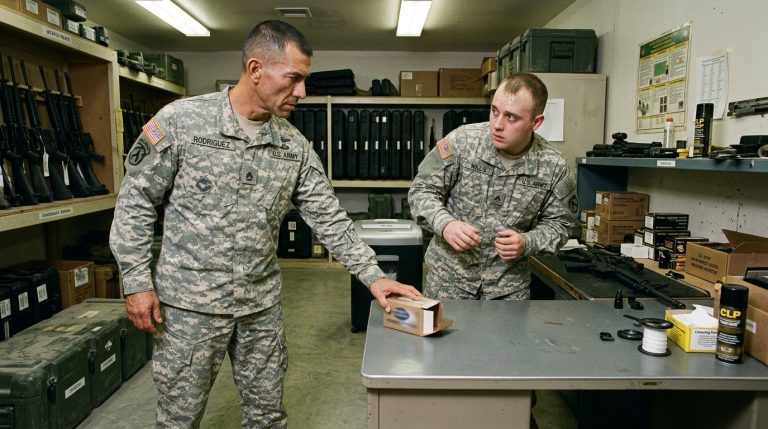
The air inside Maintenance Bay 4 didn’t move; it just thickened with the scent of aerosolized grease and the acrid sting of hot hydraulic fluid. The sixty-ton M1 Abrams sat dead center on the cracked concrete, its left track thrown wide like a split iron skin, the heavy steel links pooling uselessly in the grit. It was 11:30, the sun beating down on the corrugated roof until the metal groaned, and the ghost of General Sterling’s impending 1400-hour inspection hung over the crew like a descending blade.
Sergeant Miller wiped a slick of black grime from his forehead with the back of a bruised forearm, his glare fixed on the digital display of the automated tensioning unit. The screen pulsed a steady, mocking red: Error Code: Alignment Parameter Exceeded.
“Try the secondary lines again,” Miller barked, his voice raw from three hours of fighting the dead machine. “Max pressure. We aren’t waiting for a heavy-lift crane that’s backlogged until sixteen-hundred.”
“The manual says maxing the pressure on a twisted tooth will blow the seals, Sarge,” Corporal Harris said, his fingers hovering hesitantly over the pneumatic control valves. Sweat cut pale tracks through the dust on the young man’s cheeks. “The geometry is completely locked.”
“The manual didn’t account for the concrete slab being uneven,” Miller snapped, his pride chafing against the rigid boundaries of his training. He had aced the tech courses at Aberdeen, knew every torque specification by heart, yet the massive beast before him remained stubbornly indifferent to his digital commands. “Force it.”
The hydraulic pump whined, a rising, sharp shriek that vibrated through the soles of Miller’s boots. The thrown track shuddered, lifting a mere fraction of an inch before a high-pressure line bulged dangerously, hissing a mist of synthetic oil into the air.
“Cut it! Cut it!” Harris yelled, diving away from the flank of the hull.
The pump died. The three-ton length of track slammed back into the dirt with a hollow, metallic thud that signaled total defeat. In the heavy silence that followed, the rhythmic, scraping drag of a wide push broom continued uninterrupted from the far corner of the bay.
Bill didn’t look up immediately. He moved with a slight, rhythmic favor to his right leg, his faded gray civilian coveralls dusted with the silver shavings of lathe turnings. His hands, thick and gnarled like weathered oak roots, held the wooden handle with an easy familiarity. He paused just past the tank’s rear sprocket, his watery blue eyes narrowing behind thick lenses as he studied the specific angle of the jam.
“You’re fighting the tension,” Bill said. His voice was low, gravelly, a sound shaped by decades of breathing in turbine exhaust and desert sand. “You need to release the idler arm and use a pivot point. The crane takes four hours. You can fix this in five minutes with a crowbar if you know where to push.”
Miller turned, his patience completely spent. He saw the gray hair, the heavy hearing aid tucked behind a scarred ear, and the civilian badge that labeled the old man as simple facility maintenance. “Excuse me?” Miller said, his tone dripping with the defensive arrogance of a man running out of time. “Stick to the sweeping, Grandpa. We don’t fix sixty-ton war machines with guessing games anymore. This is the twenty-first century.”
Bill didn’t argue. He didn’t even blink against the heat. He simply turned back to his broom, pushing the pile of dust toward the perimeter wall. But as his boots shifted, the hem of his gray jumpsuit hitched upward, briefly revealing a jagged, pale puckered scar running deep into the side of his right ankle—a mark left by something far heavier than a misplaced hand tool.
CHAPTER 2: THE SOUND OF THE SHIFT
“Pick that iron bar up, Harris,” Miller said, his voice dropping an octave as the echo of the janitor’s words settled into the sweltering heat of the bay. He didn’t look at the corporal. His eyes remained fixed on the rear sprocket of the Abrams, where the massive steel track lay twisted like a fractured spine.
“Sarge?” Harris hesitated, wiping a streak of gray sludge from his knuckles onto his trousers. “The diagnostic suite is still throwing a red flag on the tensioner circuit. If we bypass the hydraulics with a manual lever, the digital log will record an unauthorized override. The tech rep at battalion will—”
“The tech rep isn’t standing here under a two-hour clock with General Sterling’s staff car inbound,” Miller cut him off, the words sharp but devoid of his previous anger. The frustration had burned itself out, replaced by a cold, pragmatic clarity. He looked down at his own hands, clean compared to his crew’s, save for the smudge of soot across his thumb from testing a diagnostic lead that had told him absolutely nothing. “The old man is right. The sensors are reading the load on the arm, not the physical binding in the third link. We’re fighting the hull.”
Miller walked past the console, ignoring the persistent amber blink of the automated error codes. He reached the heavy iron tool rack against the concrete wall, where the six-foot crowbar sat tucked behind a row of gleaming, chrome-plated pneumatic wrenches. The steel felt cool at first, then rapidly absorbed the ambient ninety-degree heat of his palm. It was pitted, scarred with decades of impact, its edges worn smooth by the friction of thousands of calloused hands.
When he turned back to the tank, Bill was already at the far side of the bay, his faded gray jumpsuit blending into the shadows near the oil disposal drums. The old man didn’t watch them with malice or triumph; he simply leaned against his broom handle, the fraying straw at the base resting in a shallow pool of grey water. His presence felt like a faded texture in the room—an old photograph left in the sun until only the starkest lines remained.
“Get in the hatch, Harris,” Miller commanded, stepping toward the rear idler wheel. “Don’t touch the automated sequences. Throw the transmission into manual backup. When I give the word, I want a single bump on the left sprocket. Neutral steer. Just enough to rock the tooth.”
Harris scrambled up the front slope of the hull, his boots making a dull clatter against the anti-skid coating before he disappeared into the dark opening of the driver’s compartment. The turbine engine didn’t roar to life with its usual confidence; inside the enclosed metal hangar, the low, thrumming whine felt heavy, pressing against Miller’s eardrums until the dust on the floor began to dance in tiny, geometric patterns.
Miller knelt in the grit, his knee pressing into a patch of earth warm from the engine’s heat. Up close, the tank wasn’t a pristine collection of digital schematics; it was a mass of worn surfaces, scarred paint, and micro-layers of desert silt trapped in every seam. He slid the hooked tip of the crowbar into the narrow gap between the end connector and the sprocket tooth, searching for the exact fulcrum Bill had described.
For a second, the iron slid against the smooth metal, finding no purchase. Miller shifted his weight, his muscles straining as he pushed the bar deeper into the shadow of the track. Then, the tip bit into a small, hand-machined groove on the underside of the housing—a modification that wasn’t listed in any modern manual he had studied. As the metal locked, his fingers brushed against a small, non-standard retention pin tucked into the assembly. It was stamped with a faint, crude serial number, completely unlike the laser-etched barcodes of the factory parts.
“Ready, Sarge?” Harris’s voice echoed through the open hatch, sounding distant and metallic.
“Hold,” Miller muttered, his thumb tracing the rough edges of the unauthorized pin. It didn’t belong on a modern M1A2 fleet vehicle. It looked older, hand-filed, like something pulled from an old M60 depot in the nineties.
He didn’t have time to decipher the discrepancy. The minute hand on his watch jumped another notch toward fourteen-hundred.
“Now, Harris! Just a bump!” Miller yelled.
The sprocket twitched. The massive steel links groaned as the turbine’s torque rippled through the drivetrain, the tension building instantly until the crowbar vibrated violently against Miller’s palms, the friction burning through his mechanics’ gloves. He didn’t try to pull against the machine; remembering the old man’s stance, he threw his entire weight downward, using his body as a counterweight against the twisting steel.
The sound that followed wasn’t the clean snap of a digital latch resetting. It was a vicious, mechanical crack that sounded like a gunshot echoing within the metal walls.
The crowbar jerked, nearly tearing itself from Miller’s grip as the three-ton length of track sprang upward, guided by the leverage of the iron bar. The heavy links caught the teeth of the sprocket perfectly, seating themselves into the guide rollers with a deep, resonant thud that shook the concrete floor.
“Kill the power!” Miller shouted, his breath coming in short, ragged gasps as the sudden silence rushed back into the bay.
The track was aligned perfectly, the tension uniform from the drive sprocket to the front idler. Miller stood up slowly, his forearms trembling from the brief, intense exertion. He looked down at the iron bar, then toward the corner where the old janitor had been sweeping.
Bill was gone, but the wide push broom remained propped against the corner wall, its handle still warm from the touch of gnarled hands. Before Miller could even wipe the fresh oil from his brow, the heavy chain-link mechanism of the main bay doors began to rattle, slowly rolling upward to reveal the bright, blinding glare of the midday sun—and the low, black silhouette of a command Humvee pulling onto the apron.
CHAPTER 3: THE BROKEN LINEAGE
The dust raised by the heavy tires of the command Humvee swirled into the maintenance bay, catching the harsh beams of midday light like a cloud of ground glass. Sergeant Miller snapped to attention, his spine rigid, though his palms were still stained with the slick grease of the override he had just committed. Beside him, Corporal Harris stood frozen, his breath hitching as the rear passenger door of the staff car swung open with a heavy, armored thud.
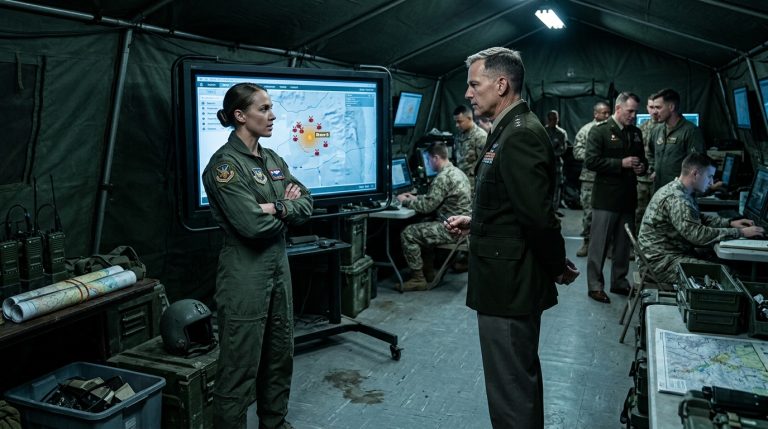
General “Iron Mike” Sterling stepped onto the oil-spotted concrete. He was a mountain of a man, his starched utility uniform bearing three silver stars that gleamed against the dim background of the hangar. His face looked as though it had been hewn directly from granite, weathered by campaigns that the young recruits in the bay had only read about in tactical manuals. Behind him flanked a colonel and the battalion sergeant major, their eyes sweeping the facility with systematic, unblinking discipline.
“At ease,” Sterling rumbled, his voice a low vibration that seemed to rattle the metal storage lockers. He marched directly toward the M1 Abrams, his boots striking the floor with rhythmic finality. He stopped inches from the left track, kneeling slightly to inspect the alignment. He reached out with a gloved hand, pressing a thumb against the end connector to check the tension. “Good tension. Ready for the field exercises. I received a report at headquarters that this unit was completely locked down with a drive-sprocket failure.”
Miller swallowed hard, his throat dry as parched canvas. “Yes, sir. We encountered a structural bind during the automated diagnostic cycle.”
“And yet, it is aligned perfectly,” Sterling said, straightening up and turning his piercing gaze onto Miller. “Your digital diagnostic suite must have cleared the anomaly quickly. Who was the lead technician on the override?”
The silence in the bay grew heavy, suffocating. Miller looked down at the diagnostic tablet resting on the workbench; its screen was still pulsing that stubborn, amber error code, completely unaware that the physical machine had already been mended. He could take the credit. It would wipe away the stain of the morning’s delays, solidify his standing, and guarantee the promotion he had been chasing through every air-conditioned classroom at Aberdeen. He looked back at the tank, its flanks covered in the matte, chalky finish of worn desert camouflage, and then toward the back of the hangar.
The old janitor’s locker stood slightly ajar in the dark corner—an unlisted, rusted steel box that didn’t belong to the official inventory. Through the gap, the edge of a custom-machined metal component peeked through, its hand-filed finish identical to the strange retention pin Miller had found hidden inside the track housing. Beside it lay a frayed, oil-soaked canvas rag and the corner of a vintage blueprint, its edges yellowed and fragile with age.
“Sir,” Miller said, his voice tightening as he made his choice. “The digital equipment failed us. The automated systems couldn’t identify the bind. It wasn’t my crew that resolved it. It was the facility caretaker, Bill.”
The colonel shifted his weight, his brow furrowing in immediate disapproval. “A civilian custodian was authorized to handle a fleet vehicle under inspection parameters?”
General Sterling didn’t answer the colonel. His gaze drifted past Miller, focusing on the dim perimeter of the bay where the old janitor had just reappeared from the break room, carrying a fresh trash liner. The general’s granite features suddenly twitched. The rigid line of his jaw slackened, and for a fraction of a second, the formidable commander looked entirely undone.
“Bill?” Sterling called out, his voice losing its parade-ground bark, replaced by an unsettling, raw familiarity. “Bill Williams?”
The old man stopped, the plastic liner rustling in his gnarled hands. He squinted through his thick glasses, his faded blue eyes taking in the stars on Sterling’s collar without a hint of deference. “Hello, Mike,” Bill said softly.
The entire detachment froze. Miller felt his own breath trap itself in his chest. The general did not command security to remove the man; instead, he stepped forward, completely ignoring the oil slicks on the floor, and reached out to grasp Bill’s shoulder in a tight, fierce grip that bordered on an embrace.
“What in God’s name are you doing pushing a broom in a motorpool, Top?” Sterling asked, his eyes scanning the faded gray coveralls.
“Keeps the joints from locking up,” Bill replied, a faint, melancholic smile touching the corners of his mouth. “The silence is good for the head.”
Sterling turned back to Miller and the gathered mechanics, his face dark with an intensity that made the room feel even smaller. “Do any of you have any idea who is clearing away your trash?” he demanded, his voice dropping into a dangerous, quiet register. “This is Master Sergeant William Williams. He was my tank commander at 73 Easting in ’91. When our platoon was cut off and the Republican Guard had us zeroed in, we had three vehicles down in the burning sand. The manuals said abandon the assets. This man refused. He kept those turbines turning with nothing but duct tape, sheer grit, and bare hands under direct mortar fire.”
The general looked at the iron crowbar still resting against Miller’s workbench. “And let me guess. He reset this track using the old wedge method.”
Miller could only nod, his mind racing as he looked at the old man in the gray jumpsuit. The faded textures of the hangar—the rust, the dust, the frayed edges—suddenly took on a profound, heavy significance.
“The Williams Wedge,” Sterling murmured, shaking his head with a bitter laugh. “The engineers at the depot swore it was too dangerous to standardize. They wanted everything reliant on their automated systems. But systems don’t know the weight of the iron when the ground starts shaking.” The general’s expression hardened as he looked back at Bill. “But something isn’t right here, Top. A man with your record doesn’t just disappear into a maintenance contract. What are you really doing out here in the dirt?”
Bill’s eyes flicked momentarily toward the rusted locker in the corner, his expression closing off like a hatch slamming shut. “Just watching over the herd, Mike. Making sure the kids don’t break the tools.”
Before Sterling could press further, a sudden, piercing alarm began to blare from the command vehicle outside—a high-priority tactical alert that instantly shattered the quiet reunion.
CHAPTER 4: THE TOUCH INHERITED
The tactical siren wailed overhead, a rhythmic, mechanical shriek that tore through the stagnant heat of the maintenance bay. On the dashboard of General Sterling’s command vehicle, a red light strobed, casting frantic shadows against the corrugated metal walls. The colonel immediately lunged toward the radio console, his fingers flying across the input keys as static hissed from the speakers.
“All units, this is Command Liaison,” a voice cracked through the interference, breathless and sharp. “Alpha Company’s lead elements report widespread drivetrain freeze on the ridge line. The diagnostic network has locked the transmissions. Repeat, three separate hulls are dead in the dirt. Software override is unresponsive.”
Miller felt the air leave his lungs. He looked at the diagnostic suite resting on his own workbench—the soft, amber glow still pulsing its standard, meaningless error report. The very same error that had nearly cost them his own tank.
General Sterling didn’t move. His face looked older, the lines around his eyes deepening as he stared out the open bay doors toward the dry, dusty ridge line where his combat teams were stranded. “The telemetry systems,” he murmured, his voice laced with a cold, devastating clarity. “The upgrade we pushed last winter. It’s checking the digital tolerances, but it’s completely missing the thermal expansion of the mechanical linkages under high friction.”
“Sir, the manufacturer’s rep said the code was ironclad,” the colonel stammered, his face turning an ash-gray in the dim hangar light. “They said the automated fail-safes would protect the components from structural fatigue.”
“The code didn’t live through the sandbox,” Bill said softly. He stepped forward from the shadows of his locker, his boots clicking softly against the concrete. In his hand, he held a faded canvas rag, wiping a fresh layer of charcoal-colored grease from his thick palms. His voice carried no anger, only the profound, heavy weight of a man who had seen this exact tragedy play out before. “The software ignores the pressure because the sensor is placed outside the main sleeve. It thinks the temperature is fine until the internal pin shears completely. That’s what happened to my boys at Fort Hood. The computers said they were green to go right up until the transmission tore itself apart in the field.”
The silence that followed was suffocating. Miller looked from Bill to the general, the pieces of the puzzle clicking into place with a sickening finality. The unauthorized parts in the back of the rusted locker, the hand-stamped retention pins—Bill hadn’t been hiding away out of laziness or simple nostalgia. He had been quietly retrofitting the station’s trainer tank with manual overrides, keeping a silent, watchful vigil over a flaw the military bureaucracy refused to acknowledge.
Sterling closed his eyes for a brief second, his chest rising and falling beneath his starched utility jacket. When he opened them, the old commander was back, his gaze locking onto the gray-haired master sergeant. “How many manual replacement pins do you have in that locker, Top?”
“Enough for a platoon,” Bill said, a flicker of guarded vulnerability passing through his faded blue eyes. “I’ve been machining them on the night shifts. Standard tool steel. They don’t talk to the diagnostic suite, but they don’t break when the iron gets hot.”
The general turned his gaze sharply onto Miller. “Sergeant.”
“Sir,” Miller responded, stepping forward without hesitation. The anxiety that had paralyzed him all morning was gone, replaced by a strange, calm focus. He looked at his own hands, now covered in the same dark grease as the old man’s. He didn’t look at the diagnostic tablet anymore.
“Grab the tools,” Sterling commanded, his voice echoing with absolute authority. “Take your crew and load every manual asset Bill has into the back of my vehicle. We are heading to the ridge line. And you are going to help Master Sergeant Williams show those young mechanics how to bypass the software before we lose the entire fleet to the sand.”
“Understood, sir,” Miller said. He turned to Harris, who was already running toward the rusted steel locker in the corner, throwing the door wide to carefully retrieve the heavy, oil-filmed components Bill had spent months preparing in secret.
As the crew scrambled into action, the frantic energy of the motorpool transformed from chaotic panic into a synchronized, deliberate rhythm. Miller walked over to the workbench and picked up the old iron crowbar Bill had used to reset the track. It felt heavy in his hands, its pitted surface a stark contrast to the sleek, fragile tech he had relied on for so long. He slipped it into the vehicle’s equipment rack alongside the custom steel pins.
Bill walked beside him, his slight limp evident but his posture straight, his shoulders square beneath the faded gray coveralls. He patted the side of the Abrams’ hull one last time, a quiet gesture of farewell to the machine he had kept alive through sheer intuition. “You’ve got the touch for the leverage, son,” the old man said quietly to Miller, his voice barely audible over the idling turbine. “Just remember to listen to the metal. It tells you what it needs long before the screen does.”
“I won’t forget, Master Sergeant,” Miller said, using the title with a deep, unforced humility that had been entirely absent three hours prior.
The command vehicle accelerated out of the bay, its tires kicking up a thick wall of red dust that hung in the air, slowly settling over the empty hangar. Inside Maintenance Bay 4, the diagnostic screen on the workbench continued to blink its red error code into the empty room, completely useless, while far out on the ridges, the manual work began.