The Steel Tension Protocol: A Chronicle of Calculated Blood, Mud, and Silent Warfare
CHAPTER 1: THE GAUGE OF MUD AND RUST
The wire hummed.
It was a low, ugly vibration, passed through two loops of rusted steel wire wrapped tight around the handle of an entrenching tool. Dalton kept his palm flat against the cold iron blade buried twelve inches deep in the Liri Valley mud.
Sixteen inches to the right, across eighteen feet of rutted dirt, the second shovel handle groaned under the tension.
Fog clung to the ditch like wet cotton. Cold. Thick. Smelling of burnt diesel, wet wool, and old rot.
At 6:47 a.m., the engine rumble broke through the mist. A Maybach HL 45 six-cylinder. Straight-six diesel. Running in second gear at roughly fifteen miles an hour.
Dalton didn’t breathe. His thumb rolled over the coarse, pitted surface of a 6-inch rail yard coupling pin in his coat pocket. Calculation, not prayer.
Fifteen miles an hour was twenty-two feet per second. The front axle of an SDKFZ 222 sat exactly fourteen inches off the deck when loaded with thirty rounds of 20 millimeter ammunition and three hundred rounds of MG34 belt-fed.
If the wire was an inch too high, it bounced off the sloped nose armor. An inch too low, the tires rolled over it like a dead branch.
The gray snout of the armored car pushed through the white fog three hundred yards out.
The commander’s hatch was open. A helmeted head protruded, scanning the treeline with Zeiss optics. The 20-millimeter autocannon barrel pointed lazily toward the ditch where Dalton crouched.
Two hundred yards.
Dalton’s knuckles went white around the coupling pin in his pocket. He didn’t look at the gun. He looked at the front right tire. Mud-caked. Spinning.
One hundred yards.
Fifty yards.
The driver goosed the throttle to clear the open stretch. The engine whined. Twenty feet per second.
The front right wheel struck the taut line at 6:47 a.m.
The wire didn’t snap. It bit.
The steel line slid up the rubber tread, caught the axle housing, and locked the right wheel instantly. Twenty-two feet per second of forward momentum met zero feet per second of rotational clearance.
The pivot was violent.
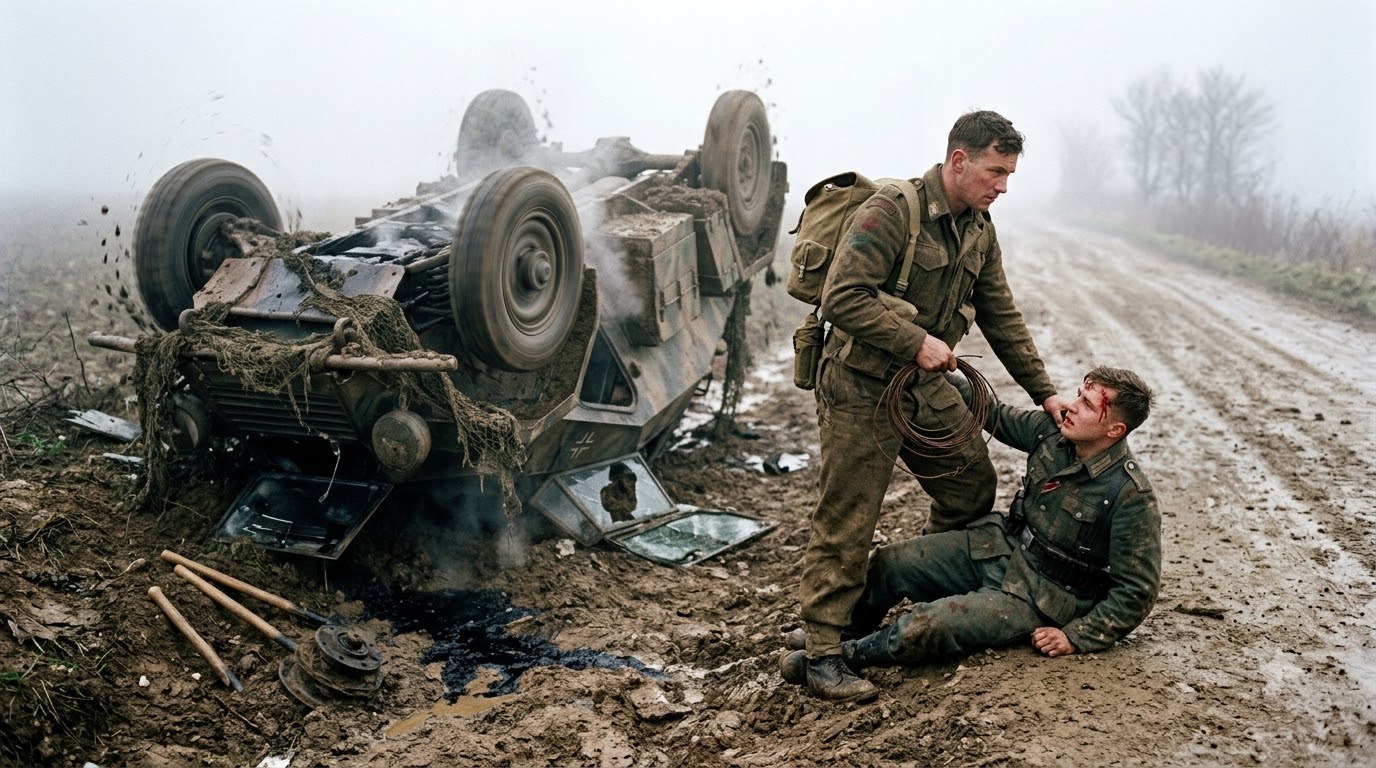
The rear end of the two-ton armored car lifted into the air. The commander was launched three yards into the mist before his vehicle completed its first full vertical flip.
The sound was a crushing thud of frame meeting rock, followed by the screech of tearing sheet metal as the 222 rolled twice more down the embankment, coming to rest upside down with its wheels spinning in the dead air.
Engine oil dripped onto hot exhaust pipes. Hissing.
Dalton was out of the ditch before the dirt stopped falling. He didn’t check the sky for artillery. He didn’t look for cover. He ran straight for the twisted axle.
The driver was crawling through the shattered windscreen, bleeding from the hairline, gasping for air in short, wet pops.
Dalton grabbed the German by the collar of his tunic, dragged him clear of the leaking fuel tank, and shoved him hard against the embankment.
“Move and you’re dead,” Dalton said. His voice was flat. No heat. No adrenaline. Just Gary, Indiana rail yard logic.
He turned back to the wreck, unhooked the wire from the seized hub, coiled the rusted strands around his arm in four quick loops, and stuffed it into his canvas pack.
He pulled the two shovel handles out of the torn earth, shoved them under his webbing, and smoothed the mud over the tire tracks with his boot.
Six minutes later, boots crunched on the gravel behind him.
Captain Morrison stepped through the fog. His uniform was clean. Division headquarters clean. He looked at the smoking, upside-down wreck, then at Dalton standing over the dazed German driver.
“What happened here, Corporal?” Morrison asked. His eye twitched as he scanned the road for cratering. “Bazooka? Mine?”
“Vehicle flipped, sir,” Dalton said. He wiped grease off his palm onto his trousers. “Hit a bad spot in the road.”
Morrison walked a slow circle around the carcass. He knelt, checking the frame. No blast marks. No penetration holes. Just twisted steel and torn tires.
“Armored cars don’t flip on flat dirt, Dalton.”
“This one did, Captain.”
Morrison stood up, his face inches from Dalton’s nose. He smelled like mint soap and cold wool. “The field manual lists sixteen authorized anti-armor methods. None of them look like an act of God.”
“Field manual isn’t out here at 6:00 a.m., sir.”
Morrison stared at him for five long seconds. Then he noticed something in the mud at Dalton’s feet—a single, clean silver scrap of fresh metal, sheared off a wheel hub, half-buried in the clay.
Morrison didn’t touch it. He looked at Dalton’s pack, bulging at the side.
“Get this prisoner to the rear,” Morrison said quietly. His voice dropped an octave, weaponized and low. “And clean your gear, Corporal. You look like a damn scrap collector.”
Dalton didn’t answer. He kicked the German driver in the calf to get him moving.
As he turned, he felt the heavy weight of the coiled wire in his pack pressing against his spine. The trap had worked. The scout car was dead.
But as Dalton glanced back over his shoulder, he saw Morrison quietly drop to one knee, scoop the sheared metal fragment from the mud, and slip it into his coat pocket without writing a word in his official logbook.
CHAPTER 2: COLD FRICTION
The oily rag made a dull, wet dragging sound across the bolt of the M1 Garand.
Dalton didn’t lift his head. He kept his eyes locked on the receiver, his thumb pressing three drops of rifle oil into the steel track. Between his boots, the canvas pack rested on the frozen mud, the stiff coil of barbed wire wrapped inside two pairs of wool socks, silent and heavy.
A shadow broke the weak grey light behind the command tent.
Captain Morrison didn’t speak immediately. He stopped three feet away, the toes of his polished trench boots stopping just short of the mud line. His right hand was shoved deep into his overcoat pocket, the fabric stretched tight around a small, heavy object.
The sheared silver metal scrap from the scout car’s wheel hub.
“You’re using too much oil,” Morrison said. His voice was low, clipped, stripped of any formal authority for the men working twenty yards away at the supply truck. “It attracts grit. Clogs the action when the frost hits.”
“Keeps the rust off,” Dalton replied. He pulled the rag through the floorplate, his knuckles raw and black with carbon. “Rust eats the tolerance. A weapon with slop in the bolt jams when you need it to slide.”
“Like an axle.”
Dalton stopped wiping. He looked up slowly, meeting Morrison’s eyes.
Morrison wasn’t looking at the rifle. He was staring directly at the canvas pack wedged between Dalton’s combat boots.
“The driver had a map case in his lap,” Morrison said, stepping an inch closer. The wind shifted, carrying the sharp scent of mint soap overriding the stink of burnt diesel from the road. “Marked in red grease pencil. Standard grid overlays for the Liri Valley. But there was a notation on the margin. A three-letter routing code.”
Dalton’s left thumb slid into his coat pocket, feeling the cold, rectangular edge of the steel coupling pin. “Grid references aren’t my job, Captain. I dig ditches.”
“Vanguard Directive,” Morrison whispered.
The words dropped into the space between them like a lead weight. Dalton didn’t flinch, but his grip tightened on the coupling pin until the iron edges bit into his palm. Vanguard Directive. A proper noun that meant nothing to a corporal from Gary, Indiana—and yet Morrison spoke it like a military secrets clause.
“I don’t know what that means,” Dalton said flatly.
“Neither do I,” Morrison retorted, his jaw setting hard. “Because division intelligence didn’t put it in our briefing packet. But when an armored scout car rolls into our sector carrying high-level transit clearances, it means they aren’t just looking for mortar pits. They’re looking for an open door.”
Morrison withdrew his hand from his pocket. He didn’t produce the silver scrap. Instead, he reached out, caught the strap of Dalton’s canvas pack with the toe of his boot, and flipped the flap back half an inch.
The frayed, rusted wire gleamed dull brown under the damp canvas.
Morrison’s eye twitched. “You were ordered to stand down on field modifications.”
“The modified line killed the vehicle, sir,” Dalton said, his voice dropping into the same dangerous register as the captain’s. “Kowalski’s dead. Brennan’s dead. Vargas is dead. The field manual didn’t stop the 20-millimeter rounds from ripping Vargas in half while he was running for the trench. My wire stopped the car.”
“You’re a corporal. You don’t calculate the tactical balance of this division.”
“I calculate the distance between a shovel handle and an axle,” Dalton said, standing up. He stood six feet straight, the M1 held loosely in his right hand, barrel pointed at the earth. “Which is more than battalion is doing from their dry tents in Naples.”
Morrison stepped into Dalton’s physical space, his chest almost touching the cold steel of the Garand’s receiver. He was shorter than Dalton, but his eyes were hard, fixed with the cold, unyielding authority of a man who believed order was the only thing keeping chaos from swallowing them whole.
“If I log this report,” Morrison said, leaning in so close Dalton could smell the coffee on his breath, “you’re in a brig at Oran by Sunday. Court-martial for destruction of unauthorized ordnance and endangering personnel.”
“Then log it,” Dalton spat. “Or give me more wire.”
Silence stretched between them, taut as the line Dalton had buried in the road at 6:00 a.m.
A truck backfired on the main road, the sharp crack causing two privates near the fuel dump to duck instinctively. Neither Morrison nor Dalton moved a muscle.
Morrison reached into his coat. For a fraction of a second, Dalton thought he was reaching for a sidearm. Instead, Morrison pulled out a yellow requisition slip, folded into a tight square. He didn’t hand it to Dalton; he tossed it onto the wooden crate next to the oil rag.
“Supply dump three,” Morrison said, his voice dropping to a harsh whisper. “Behind the motor pool. There’s forty yards of damaged telephone cable and two coils of signal wire marked for scrap. The supply sergeant is a drunk from Chicago. He doesn’t count spools.”
Dalton looked at the paper, then back at Morrison. “Thought it violated protocol.”
“It does,” Morrison said. He turned on his heel, taking two steps toward the command tent before stopping. He didn’t look back. “The German driver is being moved to division headquarters at noon. If anyone asks how his car overturned, you tell them he hit a washout in the road. You say one word about a wire, Dalton, and I’ll personally sign the papers for your execution.”
Morrison walked away, his boots cutting sharp, rhythmic impressions into the freezing mud.
Dalton waited until the flap of the command tent fell shut. He reached down, picked up the folded requisition slip, and smoothed it out against his thigh.
Written in Morrison’s tight, precise handwriting were two lines:
Dalton’s eyes narrowed on the word. Vanguard.
He folded the slip, slid it into his pocket alongside the steel coupling pin, and snatched his canvas pack off the ground. The wire inside clinked softly—iron against iron, cold, heavy, and ready for the next road.
CHAPTER 3: THE MECHANICS OF SILENCE
The yellow requisition paper felt slick between Dalton’s thumb and index finger.
The wet ink from Morrison’s fountain pen hadn’t entirely dried in the damp Liri air. It smeared slightly, staining the ball of Dalton’s thumb with a blue mark that looked like an old bruise.
Dalton shoved the slip into his breast pocket, zipped the wool lining of his field jacket over it, and swung the canvas pack onto his shoulder. The coiled wire clanked once against his mess kit—a flat, metallic tink that sounded louder than artillery in the dead calm between mortar barrages.
He didn’t head for his squad’s foxholes. He walked north, along the rutted supply corridor that bypassed the battalion mess tent.
Supply Dump Three sat behind the motor pool under a canopy of rotten pine boughs and water-logged camouflage netting. It smelled of sulfur, sour grease, and burnt kerosene. A six-ton Dodge weapon carrier was parked in the mud with its hood propped open, steam rising from the cracked radiator block in thin, rhythmic huffs.
Sitting on a stack of dry-rotted cedar ties near the tool shed was Private First Class Miller. Gary, Southside.
Miller had his sleeves rolled up to his elbows despite the thirty-four-degree chill. His forearms were thick, mapped with grease scars from three years on the assembly floor at E.J. & E. Railroad before the draft board caught up to him. He was scraping the carbon off a carburetor jet with a broken hacksaw blade, his teeth clamped tight around an unlit Chesterfield stub.
“Morrison sent me,” Dalton said, stopping three feet from the stack of cedar ties.
Miller didn’t look up from the brass jet. “Morrison sends a lot of people. Mostly guys who think oil comes out of a can by magic.”
Dalton reached into his pocket and pulled out the folded yellow paper. He didn’t offer it to Miller’s hands. He laid it flat on the wooden workbench next to a rusted socket wrench.
Miller’s eyes flicked over the ink. He didn’t pick up the paper. His thumb, raw and split from cold iron, rubbed against his chin.
“Signal wire,” Miller grunted, spitting a shred of tobacco into the slush. “Twisted copper core with galvanized steel braiding. Four-hundred-pound tensile before it stretches. Six-hundred before it snaps.”
“I don’t need copper,” Dalton said. “I need the galvanized spools.”
Miller finally stopped scraping the carburetor. He looked at Dalton’s eyes, then down at the heavy canvas pack resting against Dalton’s left boot. The shape of the coiled wire inside stretched the fabric into sharp, telltale ridges.
“You’re the guy from the ditch,” Miller said quietly.
“I’m the guy who wants fifty feet of scrap line.”
Miller picked up the hacksaw blade and tapped it twice against the cedar tie. Clack. Clack.
“They dragged that 222 into the motor pool an hour ago,” Miller whispered, leaning forward so his breath fogged the air between them. “Axle housing looked like a crushed tin can. Front hub sheared clean off at the mounting studs. Division mechanics said it hit a boulder.”
“It hit a wire,” Dalton said.
Miller let out a dry, breathy cough that might have been a laugh. He stood up, wiping his grease-blackened hands on a grease-soaked rag. He walked to the back of the tool shed, pushed aside a stack of waterlogged crate lids, and hauled out two heavy iron spools.
The wire wound around them wasn’t standard signal line. It was thick, three-strand steel cable, rusted to a dull orange, salvaged from a destroyed pontoon bridge rig.
Stenciled in white paint across the side of the wooden spool flange was a crate tracking code: SVC-88 / IRON SIEVE.
Dalton’s eyes lingered on the letters. Iron Sieve. The second proper noun from the background files, buried on a scrap spool in a motor pool dump. He didn’t ask what it meant. In the rail yards, you didn’t ask what was inside the boxcars; you checked the brake shoes and cleared the track.
“This stuff doesn’t stretch,” Miller said, rolling one spool toward Dalton’s boots with his toe. “It doesn’t yield, either. You string this across a road at fifteen miles an hour, and whatever hits it isn’t going to flip. It’s going to split.”
“How much?” Dalton asked.
“Morrison’s slip covers the weight,” Miller said. He stepped closer, his jaw working as he looked toward the command tent three hundred yards down the ridge. “But I want in.”
Dalton paused, his hand hovering over the iron spool. “In on what?”
“My brother was in the 141st at the Rapido,” Miller said. His voice lost its rough, greasy rasp, dropping into a flat, stony register. “German scout car caught his platoon in the open marsh while they were laying footbridges. Twenty-two men in five minutes. My brother didn’t make the medic boat.”
Miller looked down at the iron spool, his knuckles white against his thighs.
“You show me how to anchor the lines,” Miller said. “I’ll make sure you never run out of spools.”
Dalton looked at the heavy iron spool. He thought of Kowalski’s blood in the mud, Brennan’s silent dog tags, and Vargas dying before the medic could unroll a bandage.
He reached down, grabbed the iron center of the spool, and lifted it. Sixty pounds of dead weight.
“Meet me at the logging trail behind Ridge 40 at midnight,” Dalton said. “Bring two entrenching shovels with reinforced handles. Not the standard issue folding junk. Find the solid iron T-handles from the engineer trucks.”
Miller nodded once. No handshake. No oath. Just two Gary switchmen locking a coupler pin into place.
Dalton turned and carried the spool toward the tree line, the heavy steel line biting into his shoulder through his jacket, every step sinking three inches deep into the frozen Italian mud.
CHAPTER 4: THE SOUND OF SEIZING METAL
The iron flange bit through the canvas of Dalton’s jacket, grinding against his collarbone with every stride.
Thirty yards past the supply dump, the pine branches sloped low, heavy with wet slush. Dalton shifted the sixty-pound spool to his left hip, his boot soles slipping sideways on an exposed patch of frozen slate. He didn’t drop it. He wedged his hip against an oak trunk, breathing hard through his nose, cold air burning his windpipe like raw lye.
Behind him, the motor pool vanished into the fog. Ahead, the logging trail dipped into the ravine behind Ridge 40.
Jackson was already waiting in the shadow of a abandoned timber rig. Jackson was a skinny farm kid from Iowa who spoke once every three days, but he handled a wire cutter like an armorer handles a micrometer. Beside him stood Private First Class Miller, his hands wrapped in greasy rags, two solid T-handle engineer shovels leaning against his knee.
“This is the line from the bridge dump,” Jackson whispered. He touched the braided steel on the spool, his thumb tracing the dull orange rust. “This won’t flex.”
“It’s not supposed to,” Dalton said. He dumped the spool into the mud. The impact sent a dead shock up his calves. “The logging road narrows two hundred yards up. Between the bridge abutment and the stone culvert. No room for a driver to swerve.”
Miller picked up one of the T-handle shovels and drove the iron blade into the clay. The frozen crust cracked with a sound like a pistol shot.
“Deeper,” Dalton ordered, dropping to his knees beside the ditch. “Twelve inches minimum. Angle the shaft twenty degrees back toward our ridge. If the ground gives before the axle locks, the wire just drags.”
For forty minutes, nobody spoke. The only sound was the wet, rhythmic thunk of iron blades striking frozen earth and the sharp scrape of braided steel cable unrolling from the wooden flange.
Dalton measured the height himself using his thumb and the seam of his combat boot. Exactly fourteen inches. Taut.
Jackson finished anchoring the second shovel on the opposite side of the culvert. He pulled the line until the steel hummed—a tight, high-pitched pitch that vibrated through the mud into the soles of their boots.
“Cover it,” Dalton said.
They scattered dead pine needles and wet gravel over the line. Not a blanket—just enough to break the straight line across the ruts. To an optic lens at fifty yards, it looked like a fallen branch half-buried in the wash.
A sudden rumble rolled down the valley from the north.
Not the distant thunder of heavy 155s at Cassino. The sharp, metallic clatter of an eight-cylinder Maybach engine coming fast down the logging route.
“They’re early,” Miller hissed, reaching instinctively for his Springfield rifle.
“Leave the rifle,” Dalton growled, grabbing Miller’s webbing and dragging him flat into the ditch water. “You shoot, they drop the hatch. Let the road do it.”
The scout car wasn’t an SDKFZ 222 this time. It was an armored half-track—an SDKFZ 250—rolling at nearly twenty miles an hour to clear the exposed gap before daylight. The steel tracks chewed through the gravel, throwing sparks against the stone culvert.
Through the fog, Dalton watched the front steering wheels. Unarmored rubber. Riding high over the center rut.
The vehicle hit the culvert at 05:10 a.m.
The braided steel line didn’t slide up the tread. Because of the three-strand weave Miller had pulled from the bridge dump, the teeth of the wire bit directly into the rubber casing of the front left tire and wrapped twice around the steering spindle in less than a tenth of a second.
The result wasn’t a roll. It was a structural disintegration.
The six-ton half-track’s front axle sheared cleanly off its mounting bolts with a deafening CRACK that sounded like a boiler explosion. The left wheel assembly violently detached, bouncing twenty feet into the ravine. The heavy vehicle’s nose dropped straight into the mud, its momentum driving the armored hull forward until the frame slammed against the stone culvert.
The rear tracks kept spinning, grinding against empty air as the vehicle stood tilted at a forty-five-degree angle, steam and boiling coolant erupting from the shattered radiator in a roaring white cloud.
“Move,” Dalton barked.
They scrambled out of the ditch before the dust settled. Jackson had his wire cutters out. Miller had his T-handle shovel raised like an axe.
The German driver was slumped over the wheel, unconscious, his face smashed against the vision port glass. In the rear compartment, two recon officers were scrambling over the folded canvas hood, dazed, their hands clawing for their MP40 submachine guns.
Dalton reached the side door first. He didn’t fire his M1. He slammed the butt of his rifle into the latch, jamming the mechanism shut from the outside, then grabbed the canvas document satchel slung over the commander’s seat rail.
He ripped it free just as a stick grenade dropped from the commander’s hand onto the floorboards.
“DOWN!” Dalton roared.
He tackled Miller into the mud an instant before the blast blew the rear canvas cover to shreds. Shrapnel whistled over their helmets, slicing through the pine branches above.
When the smoke cleared, the half-track was silent except for the crackle of burning oil.
Dalton sat up in the freezing slush, coughing out sulfur smoke. His shoulder throbbed where the spool had bruised it earlier, but his hands were steady. He unbuckled the leather flap of the captured German satchel.
Inside were three items: a pair of blood-stained Zeiss field glasses, a sheaf of map overlays stamped with red grease pencil, and a black bakelite cipher wheel attached to a metal mounting plate.
Imprinted on the brass frame of the cipher mechanism were five stamped letters: CPH-88.
Cipher-Key 88. The primary seed noun.
Miller leaned over Dalton’s shoulder, wiping a line of blood from his cheek where a wood splinter had cut him. “What is that? Code machine?”
“It’s not for artillery,” Dalton said, his eyes scanning the German overlay map. The grease pencil didn’t mark the American front lines. It marked a path through Sector 4—right past Captain Morrison’s command post, heading straight for the division supply depot in the rear.
A path that was completely cleared of minefields on the German map.
Jackson sprinted back from the culvert, holding the severed end of the braided steel wire. “Dalton! Look at the shovel handle!”
Dalton stood up, stepping around the burning oil slick.
The T-handle shovel anchored in the left embankment hadn’t been pulled from the dirt. The iron handle was bent at a forty-five-degree angle, but around the blade, someone had tied a second, smaller wire before the half-track hit—a thin copper strand that ran straight back toward the American lines.
Someone on their side had mapped the exact location of Dalton’s trap before the German half-track ever left its base.
CHAPTER 5: THE FALSE BLUEPRINT
The fine copper strand vibrated in Dalton’s gloved hand.
He didn’t pull it. He didn’t drop it. He traced the thin wire with his index finger, feeling the smooth lacquer coating under the grime. Standard field telephone line. The kind signal corps units unreeled from leather hip spools during night movements.
It ran eighteen inches beneath the mud line, routed straight through the drain culvert toward the American perimeter behind Ridge 40.
Jackson dropped to his knees in the slush beside him, his wire cutters hovering an inch above the copper core. “Do I clip it?”
“No,” Dalton said. His voice was quiet, hard as a cold rail. “If you cut a live wire, whoever’s holding the handset on the other end feels the drop in line resistance. They know the line went cold.”
“Dalton,” Miller said, stepping out of the smoke with his T-handle shovel resting against his hip. “The fire’s reaching the half-track’s fuel cell. We’ve got two minutes before this whole ravine lights up like a locomotive firebox.”
Dalton snapped the flap of the leather document satchel shut over the bakelite CPH-88 wheel. He shoved the satchel under his coat, wedging it against his ribs alongside the steel rail yard pin.
“Jackson, cover the copper wire with loose silt. Don’t disturb the tension,” Dalton ordered. “Miller, help me drag the driver’s body into the brush. Make it look like he dragged himself out before the tank blew.”
They worked without speaking, their breathing harsh and fast in the freezing fog. Forty seconds later, the fuel cell ruptured. A sheet of dull orange flame burst through the half-track’s engine housing, illuminating the jagged rock walls of the culvert and sending thick, oily smoke billowing into the pine canopy.
Dalton didn’t run away from the explosion. He walked directly toward the smoke, using the heat of the fire to dry his mud-soaked sleeves as he made his way up the embankment toward the command perimeter.
The company post was quiet.
At 05:40 a.m., the dawn guard shift was changing. Two sentries stood near the water trailer, their hands wrapped around steaming tin mugs of chicory coffee, their eyes unfocused as they stared into the grey mist. Neither of them looked twice at Dalton as he slid between the supply trucks.
The flap of Captain Morrison’s blackout tent was tied open three inches to vent the fumes from a small kerosene stove.
Dalton stepped inside without knocking.
Morrison was sitting at a folding field desk, a tin cup resting beside a wooden crate filled with company casualty logs. He had a pencil behind his ear and his field tunic was unbuttoned at the collar.
He didn’t look up when the canvas flap rustled. “I told you to clear your gear, Corporal. If division mechanics find more wire in the motor pool—”
“The half-track at Ridge 40 is burning,” Dalton said.
Morrison’s hand froze over the logbook. The pencil fell from behind his ear, bouncing once on the plywood desk before rolling into the dirt.
Slowly, Morrison leaned back in his folding chair. The canvas creaked under his weight. “An SDKFZ 250 isn’t a light scout car. It carries armor plate on the nose.”
“It hit thirty feet of three-strand bridge cable,” Dalton said. He reached into his coat, pulled out the leather document satchel, and dropped it onto the center of Morrison’s desk. “And it carried this.”
Morrison looked down at the leather satchel. His eyes narrowed when he saw the brass mounting plate stamped with CPH-88.
He didn’t reach for the satchel. His right hand drifted toward the drawer of his desk where his Colt .45 sat in its leather holster.
“Where did you get that?” Morrison asked. His voice was devoid of the cold, dismissive tone he used behind the supply tent. It was flat, cautious, and calculating.
“In the commander’s locker,” Dalton said, stepping closer to the desk until his boots touched the wooden crate. “Along with a grease-pencil map. A map that shows every mortar pit in Sector 4 marked with German target grids. And a route through our lines that bypasses every minefield battalion laid down last week.”
Morrison let out a slow, deliberate breath. He picked up the pencil from the dirt, wiped the dust against his trousers, and set it on the desk.
“You think you found a leak,” Morrison said quietly.
“I found a copper wire tied to the shovel holding my line,” Dalton replied, leaning his forearms on the edge of the desk. “Run from inside our perimeter. Someone gave them the exact coordinates of the culvert so they could avoid the trap. But they were moving too fast to read the markers in the fog.”
Morrison stared at Dalton for three long seconds. Then, a faint, bitter smile twitched at the corner of his mouth.
“You’re a good mechanic, Dalton,” Morrison whispered, reaching out to unbuckle the satchel’s leather strap. “You see two gears turning, and you assume they belong to the same engine.”
Morrison pulled out the sheaf of grease-pencil maps. He didn’t hide them. He spread them out under the kerosene lamp, revealing a second document hidden underneath—an American mimeographed order stamped with a blue clearance seal: Vanguard Directive / OSS Tactical Transit Zone 4.
Dalton’s eyes scanned the blueprint. It wasn’t an infiltration route for enemy armor. It was an unauthorized, unmonitored corridor designated by high command to allow Allied intelligence teams to pass through the front lines into German territory without logging their movements with division staff.
The German scout cars weren’t raiding the sector. They were hunting the transit corridor.
“Battalion knows about the scout cars, Dalton,” Morrison said, his voice dropping into a harsh, weaponized whisper. “They’ve known for three weeks. They aren’t stopping them because every time a German recon car uses this road, our intelligence teams track their return route back to their division headquarters in Cassino.”
Dalton felt a cold knot tighten in his chest. “You let them run down this road? You let Kowalski die? You let Vargas get cut in half by an autocannon so some suit in Naples could map a road?”
“We are fighting a war of numbers, Corporal,” Morrison said, his eyes cold and unyielding as he tapped the blueprint. “A corporal sees his squad. A captain sees the company. Division sees the peninsula. If stopping three scout cars alerts the German high command that we’ve cracked their transit sector, they close the door, change their cipher keys, and we lose visibility on two Panzer divisions.”
Morrison closed the folder with a sharp clack.
“Your wire didn’t save the company, Dalton,” Morrison spat, standing up and towering over the desk. “You just broke a trap that took four months to set. You forced their hand.”
Dalton didn’t back down. He reached into his coat pocket, his thumb wrapping firmly around the cold iron of the rail yard coupling pin.
“Then explain the copper wire, Captain,” Dalton said, his voice deadly quiet. “If division is running a game on the Germans… why is someone in your command post tapping my line to warn them where the wire is laid?”
Morrison’s face went pale. The cold authority in his eyes vanished, replaced by a sudden, jagged shock as he looked down at the satchel, then back at the canvas tent flap behind Dalton.
CHAPTER 6: SHADOWS ON THE LIRI
Morrison didn’t deny the tap.
He stared at the blank reverse side of the mimeographed order, his lower lip tight, his breathing shallow enough that the steam from his tea cup barely stirred. His right hand remained stationary on the desk, inches from the brass plate of CPH-88.
“If there’s a wire in the culvert,” Morrison said, his voice dropping so low the hum of the stove nearly drowned it out, “it wasn’t laid by my signals detail.”
“It’s field cable,” Dalton said, keeping his eyes locked on Morrison’s collar insignia. “Standard quarter-inch copper core. The insulation is scarred with gray grease from Supply Dump Three. The spool Miller gave me came from the same rack.”
Morrison slowly brought both hands to the desktop, lacing his fingers together until his knuckles turned yellow. “Miller doesn’t run field lines. He turns wrenches.”
“Miller isn’t the one listening,” Dalton said. “Someone used his scrap pile to drop a tap right into the drainage ditch before I anchored the shovels. They didn’t want the German half-track destroyed. They wanted it to pass.”
Morrison turned his head toward the blackout flap. Outside, fifty yards north across the supply road, a single lantern flickered in the mechanics’ shed where the wreckage of SDKFZ 237 sat under a tarp.
“The driver from the first car,” Morrison whispered. “The one you dragged out of the ditch two days ago.”
“He didn’t have a cipher wheel,” Dalton said. “He was light recon. This half-track had three officers, a hard-coded transit log, and a machine built for division-level transmissions. They weren’t probing our lines. They were meeting someone.”
Morrison stood up smoothly. He pulled a brass key from his waistcoat pocket, unlocked the bottom iron drawer of his field chest, and pulled out a leather-bound logbook marked with a red diagonal stripe.
He flipped past three weeks of troop counts, stopping at the entry for March 10th.
“At 02:00 hours,” Morrison said, pointing a trimmed fingernail at a pencil line, “battalion routed an officer through Sector 4. No name. Authorization code Vanguard / 09. He spent twenty minutes in the signals tent behind Ridge 40 before moving toward the river.”
Dalton leaned over the desk, his shadow falling across the yellowed paper. “Who took the watch?”
“Lieutenant Richter,” Morrison said quietly. “German 29th Panzer Grenadier Division. He commands their forward recon group.”
“Not Richter,” Dalton corrected, his voice flat as iron. “Richter’s on the other side of the river. Who logged the code inside our post?”
Morrison closed the logbook with a dry, muffled snap. “The entry isn’t signed by my duty clerk. It’s signed by division intelligence.”
A distant mortar shell detonated along the riverbank—a dull, thudding wump that rattled the tin stovepipe hanging from the tent ceiling. A fine dusting of soot fell onto the open map overlays.
Dalton reached down, picked up the CPH-88 satchel by its canvas strap, and slung it over his shoulder under his coat.
“Where are you going, Corporal?” Morrison asked, his tone shifting back toward the stiff line of command, though his eyes lacked their sharp edge.
“Back to the culvert,” Dalton said. “Miller’s still out there covering the track. If someone’s listening on that copper strand, they’re going to reel it in before dawn.”
“Dalton,” Morrison called out as Dalton reached for the canvas flap.
Dalton stopped, his hand resting on the heavy, damp weave of the entryway.
“If you find an American name at the end of that wire,” Morrison said, his voice stripped bare of every manual regulation, “you bring it to me before you use that Garand.”
“Depends on who holds the handset, Captain,” Dalton said.
He pushed through the flap into the biting 04:00 a.m. fog. The air smelled of wet slate and burnt diesel from the smoldering half-track up the ridge.
He kept his right hand inside his jacket pocket, his thumb rolling the cold, rectangular edge of the rail yard coupling pin over his knuckles, calculating the physical weight of an iron line pulled too tight.
He didn’t take the main road. He cut behind the field kitchen, his boots stepping silently in the deep, waterlogged ruts left by the supply trucks, moving toward the dark shadow of Ridge 40 where the copper wire lay hidden in the mud.
CHAPTER 7: THE INTERROGATION AT RIDGE 40
The mud in the drainage ditch had turned to black sludge.
Dalton dropped onto his hip behind the stone culvert, the cold water soaking through his trousers in three seconds. Five feet away, the copper tap wire pulled taut against the silt, vibrating with a high, almost silent hum that only an ear pressed to the earth could catch.
Miller was crouching in the shadows beneath the ruined timber rig, his hand clamped hard over the mouth of the German driver captured from the first scout car.
The driver wasn’t struggling. His face was gray under the grease and dried blood, his eyes wide, reflecting the dull flicker of the burning half-track up the ridge.
“He tried to chew his sleeve,” Miller whispered, his voice barely cutting through the hiss of the smoldering tires fifty yards out. “Found a piece of paper sewn into the wool lining.”
Dalton dragged himself across the culvert, his rifle lying flat on his thighs. He pulled the satchel from under his coat, set the bakelite CPH-88 cipher wheel on a flat slate rock, and reached for the scrap of wool Miller held out.
It was a strip of stiff oilcloth, four inches long, marked with three rows of handwritten numbers and a single name in block capitals: M. BRENNAN.
Dalton’s breath hit the cold air in a sharp, ragged burst.
Mike Brennan. Twenty-four years old. Brooklyn. Dead three weeks ago on the dawn patrol because an autocannon caught him running for cover.
“He had Brennan’s name,” Dalton said. His voice dropped into a register so flat and empty it didn’t sound like speech at all.
He reached down, grabbed the German driver by his collar, and yanked him forward until their foreheads almost touched. The German gasped, his boots scraping uselessly against the wet gravel.
“Where did you get this?” Dalton asked.
The driver shook his head, his teeth chattering against the cold. “No… no English… Ich weiß nicht…”
Dalton didn’t argue. He pulled the 6-inch iron coupling pin from his coat pocket, held it in front of the German’s eyes, and pressed the heavy, square end against the driver’s fractured collarbone. He didn’t slam it. He just applied steady, crushing pressure, using his body weight to drive the iron into the bone.
The German’s eyes rolled back. His fingers clawed wildly at the mud, but Miller held his arms pinned against the stone wall.
“The line,” Dalton whispered, leaning in until the German could feel the freezing air coming off his coat. “Who gave you the grid coordinates for Ridge 40? Who tied the line?”
“The… the sergeant,” the driver gasped in broken, high-pitched English, his chest heaving as the iron pin bit deeper into his shoulder. “The sergeant… at the depot… he gives the paper… before the patrol…”
“Which depot?” Dalton demanded.
“The supply dump… Sector 4…” The driver choked, spitting a drop of red foam onto Dalton’s sleeve. “He… he uses the field telephone… every night at four…”
Dalton froze.
04:00 a.m.
He looked down at the copper strand running through the mud at his boots. It wasn’t running to the command tent. It bypassed Captain Morrison’s post entirely, snaking past the supply trucks, straight into the signal shed behind Supply Dump Three.
Where the drunk sergeant from Chicago managed the scrap wire.
Dalton released his grip on the driver’s collar. The German collapsed against the stone culvert, coughing violently into his knees.
“He’s lying,” Miller whispered, his face pale under the soot. “Sarge has been in the division since North Africa.”
“He doesn’t run field lines,” Dalton said, standing up and wiping the iron coupling pin against his trousers before shoving it back into his pocket. “He just controls who gets the spools. If someone wants to lay hundred-yard lines without logging the wire, they go through the scrap dump.”
Jackson came sliding down the embankment, his boots sending a spray of loose shale into the ditch. “Dalton! Someone’s on the line!”
Dalton dropped back into the mud. He reached down and touched the copper wire with his bare fingertips.
The line was moving.
Not vibrating from the wind. Someone on the other end, three hundred yards back at the perimeter, was slowly, rhythmically reeling the copper strand in, pulling it back through the silt inch by inch before the morning sun could burn off the fog.
Dalton stood up, his face set in hard, cold lines. He didn’t check his Garand. He didn’t look back at the dazed German driver.
“Jackson, stay on the culvert. If anyone comes down this track, drop them,” Dalton said. “Miller, come with me. We follow the wire.”
He turned and stepped out of the ditch, his boots cutting through the frozen clay as he tracked the thin copper line back toward the heart of the American camp.
CHAPTER 8: THE LEAK IN THE TRENCH
The copper wire slid through the wet pine needles with a faint, rhythmic hiss.
Dalton stayed six paces behind the moving line, his boots stepping in Miller’s tracks to keep their footfalls aligned. The fog was thinning, turning from a dense wall into a patchy, yellow-grey film as the first light hit the smoke over the Liri Valley.
The wire didn’t lead to Supply Dump Three.
It veered fifty yards south, skirting the perimeter sandbags, and disappeared under the canvas flap of the auxiliary signals trench—a dugout dug five feet into the earth, covered by waterlogged timbers and oilcloth.
Miller crouched behind an overturned mess crate, his hand resting on the iron T-handle of his shovel. “That’s the battalion switchboard line. Only two guys have authorization to sit in that pit after midnight.”
“The duty clerk and the signals officer,” Dalton said.
Inside his coat, the leather satchel containing the CPH-88 cipher wheel pressed hard against his ribs. He unbuttoned two brass fasteners on his field jacket, giving his right hand clear access to his M1 Garand.
He didn’t rush the trench. He waited twenty seconds, watching the copper wire pull tight against the dirt lip of the entrance.
A hand reached out from inside the dark opening.
The hand was wearing an American issue wool glove, the thumb reinforced with green canvas tape. It caught the copper strand, unhooked it from a hand-cranked brass spool, and began coiling the wire around an empty field telephone spindle.
Dalton stepped over the sandbag wall and dropped silently into the five-foot trench.
The man in the pit spun around, his left hand dropping instinctively to a brass-bound field phone on the bench. His right hand froze around the copper spool.
It wasn’t the drunk sergeant from Chicago. It was Corporal Henderson—the company chief clerk. A kid from Ohio who typed battalion casualty lists and logged supply manifests for Captain Morrison.
Henderson’s eyes went wide. His mouth opened, but no sound came out. On the wooden table beside his switchboard lay a sheet of carbon paper and a lead pencil, both marked with the stencil Vanguard Directive.
“Don’t move the hand, Corporal,” Dalton said. His voice was barely a rasp, the M1 Garand raised until the front sight post rested squarely between Henderson’s eyebrows.
Henderson’s fingers twitched against the copper spool. “Dalton… what are you doing out here? The sector is under blackout order—”
“You’re reeling in the line,” Dalton said, stepping closer until the rifle barrel was six inches from Henderson’s nose. “You tied it to my shovel before the half-track hit.”
Henderson swallowed hard, his throat making a dry, clicking sound. “I don’t know what you’re talking about. I was checking line continuity for division—”
“You have Mike Brennan’s name in your log,” Dalton interrupted. He didn’t raise his voice. He reached into his coat with his left hand, pulled out the oilcloth strip taken from the captured driver, and dropped it onto the carbon paper. “Along with three grid coordinates for the Liri road.”
Henderson stared at the oilcloth. The color drained from his face, leaving his skin the shade of wet lime.
“They’re taking the casualty lists,” Henderson whispered, his body trembling so hard the switchboard cords rattled against the wooden wall. “They aren’t just hunting scout cars, Dalton. They’re matching the names of the dead to the dog tags on the bodies we don’t bring back.”
Dalton’s jaw tightened. “Who is?”
“Division,” Henderson said, his voice cracking into a desperate plea. “Not the Germans. Our own intelligence group. Operation Iron Sieve. They’re using the dead men’s papers to send operatives across the river under false identities. They needed the scout cars to cross our line so the exchanges looked real!”
The decoy secret shattered.
Dalton felt a cold shock ripple down his spine. The transit corridor wasn’t an intelligence trap to hunt German recon cars. It was a factory for stolen identities—using the names of fallen American soldiers like Brennan and Kowalski to clear unauthorized crossings.
“And the copper wire?” Dalton demanded, his finger tightening on the trigger of his Garand.
“The wire wasn’t to warn the Germans!” Henderson cried out, tears cutting clean tracks through the soot on his cheeks. “It was to tell the operative when your trap was set! So he didn’t get killed in the wreck!”
Before Dalton could process the words, a shadow fell across the trench opening behind him.
The heavy, iron T-handle shovel Miller was carrying didn’t strike Henderson. A sharp, metallic click echoed from the top of the sandbag wall.
Captain Morrison stood at the lip of the trench, his Colt .45 drawn and leveled directly at Dalton’s back.
“Put the rifle down, Corporal,” Morrison said. His face was entirely devoid of emotion, his voice cold as the mud under their boots. “You’ve dug far enough.”
CHAPTER 9: THE TACTICAL CHOKEHOLD
The iron hammer of Morrison’s Colt clicked back into its notch.
The sound was small, dry, and flat against the roar of the river artillery, but inside the narrow mud pit, it filled the air like a snapping bone.
Dalton didn’t lower his M1 Garand. His index finger remained wrapped around the trigger bow, his sight post locked on the bridge of Henderson’s nose.
“Lower the muzzle, Corporal,” Morrison repeated. His voice didn’t shake. It was the same dead tone he used when reading the breakfast casualty lists. “You’re six inches away from a military execution.”
“Henderson has Mike Brennan’s name on oilcloth,” Dalton said. He didn’t turn his head. He kept his heels wedged into the clay wall behind him, anchoring his footing. “And he’s tapping my line to clear German armor through Sector 4.”
“I know what Henderson’s doing,” Morrison said.
Henderson gasped, his hands trembling so hard he dropped the copper spool. It fell into the slush with a wet plop. “Captain… I didn’t tell him… I only ran the continuity line like you ordered—”
“Shut up, Henderson,” Morrison snapped. He didn’t look at the clerk. His eyes stayed locked on the back of Dalton’s neck. “You think this is a treason case, Dalton? You think some clerk is taking German gold to sell out his squad?”
“I think Brennan’s dead,” Dalton growled, his thumb slipping into his jacket pocket, feeling the square, rusted corner of the steel coupling pin. “And Kowalski’s dead. And someone in this camp gave the 29th Panzer Division the exact clearance times so their scout cars wouldn’t get hit by our mines.”
“Division gave them the clearance times,” Morrison said.
The silence that followed was heavy, wet, and freezing.
A shower of dirt rattled against the oilcloth overhead as a six-inch shell detonated two sectors north. A drop of muddy water dripped from the timber beam above, landing squarely on the hot barrel of Dalton’s Garand. It hissed and evaporated.
“Division,” Dalton repeated.
“The intelligence detachment doesn’t just run operatives,” Morrison said, his voice dropping into a harsh, weaponized rasp. “They run bargains. To keep Vanguard Directive alive, to keep the Germans believing Sector 4 is a blind spot, division feeds them real unit positions. Real movement schedules. They let two scout cars through every week so the German high command trusts the corridor.”
“They sacrificed my squad,” Dalton said. Cold fury burned through his chest, hot and bitter as raw battery acid. “They traded Brennan for a wire tap.”
“They traded three men for two divisions’ worth of movement plans!” Morrison barked, his boot stepping down onto the top log of the trench frame. “And you, with your damn railroad wire and your shovels, you broke the trade. You killed two scout cars they were expecting. You proved to Lieutenant Richter that Sector 4 isn’t blind!”
“Richter knows,” Dalton whispered.
“Richter knows someone is setting traps,” Morrison said. “And right now, a full reconnaissance company from the 29th—three armored cars, two half-tracks, and an infantry platoon—is rolling down the Liri road to clear Ridge 40. They aren’t probing, Dalton. They’re coming to burn this sector to the ground to cover their retreat.”
Behind Morrison, the brush rustled sharply.
Private First Class Miller stepped out of the grey fog, his heavy iron T-handle shovel gripped in both hands like a club. He didn’t raise it at Morrison, but his eyes were black with fury, his teeth bared in a silent, savage snarling expression. Behind him stood Jackson, holding a two-foot pair of wire cutters.
Morrison didn’t turn around, but he heard the boots in the mud. “You brought your whole mechanics crew, Corporal?”
“We brought the guys who dig the graves,” Dalton said.
Slowly, deliberately, Dalton lowered the muzzle of his rifle. He didn’t put the safety on. He turned around in the narrow pit, looking up at Morrison’s face. The captain looked older, his eyes sunken, his clean uniform finally stained with black soot from the burning half-track up the ridge.
“If Richter’s coming with a full company,” Dalton said, “your paper clearances don’t mean a damn thing. They’re going to overrun the command post in twenty minutes.”
“Battalion ordered a retreat to the river,” Morrison said.
“And leave the guns?” Miller spat from the top of the trench. “Leave the supply dump?”
“We leave everything we can’t carry,” Morrison said, though his hand holding the Colt lowered an inch. “That’s the order.”
“No,” Dalton said. He stepped up out of the mud pit, his boots gripping the slippery clay until he stood level with Morrison. He reached into his coat, pulled out the satchel containing the CPH-88 cipher wheel, and jammed it against Morrison’s chest.
“You take Henderson and the paperwork to battalion,” Dalton said, his voice hard as rail steel. “You give them their cipher machine. But Miller, Jackson, and I stay on Ridge 40.”
Morrison stared at the satchel, then at Dalton’s eyes. “There’s forty feet of wire left in the dump, Dalton. It won’t stop an armored platoon.”
“It won’t stop them,” Dalton said, his fingers wrapping tight around his Garand’s receiver. “It’s going to funnel them. Right into the stone culvert.”
CHAPTER 10: CHECKMATE AT THE RAVINE
The diesel vibration didn’t just carry through the fog. It shook the mud lip under Dalton’s boots.
Morrison looked down at the satchel containing the CPH-88 wheel pressed against his ribs. His hand holding the Colt lowered another inch, the hammer still cocked, but his gaze shifted over Dalton’s shoulder toward the logging trail where the engine noise was multiplying.
“Two half-tracks,” Morrison said, calculating the pitch of the exhaust. “And Lieutenant Richter’s lead scout car.”
“He came himself,” Dalton said. “Because the continuity line went cold when Jackson clipped it.”
Morrison let out a slow, ragged breath. He unbuckled his holster, shoved the Colt back into the leather sheath, and took the satchel from Dalton’s grip.
“If battalion loses this cipher wheel, the entire sector gets court-martialed,” Morrison said, his voice flat, stripped of authority, leaving only the hollow core of a man who knew his blueprint had collapsed. “I’ll haul Henderson to the rear. But if you don’t hold them at the culvert for fifteen minutes, none of us reach the river.”
“We’ll hold them,” Dalton said.
Morrison didn’t offer his hand. He grabbed Henderson by his collar, dragged the pale clerk out of the mud pit, and turned south toward the supply road without looking back.
Dalton turned to Miller and Jackson. “Grab the two spools from the motor pool dump. The heavy three-strand cable from Operation Iron Sieve. We don’t anchor single lines this time.”
“Double grid?” Miller asked, his hands already gripping the iron shaft of his T-handle shovel.
“Cross-weave,” Dalton said
CHAPTER 8: Cold Mechanics
The heavy steel hatch snapped shut with a hollow, concussive thud, locking the chill inside the concrete bunker. Below us, through the reinforced observation glass, the massive turbine shaft spun in a violent, vibrating blur.
Director Vance didn’t turn around right away. He stood with his fingers resting lightly on the cold brass railing, his shoulders square beneath his tailored wool coat. The silver pocket watch—the one he’d habituated to flipping open whenever a board meeting dragged late— rested on the ledge beside a stack of red-stamped schematics.
“You always had an eye for the small things, Arthur,” Vance said, his voice flat, stripped of the booming warmth he usually reserved for city council tours. “Most men look at the whole dam. They see power. They see authority. You look at the grout.”
“I look at where it leaks,” I said, my voice rasping from the sulfur dust in the lower tunnels. My hand hung near my side, fingers stiff from the subterranean freeze, still carrying the grease stains from the sub-level bypass. “You didn’t just ignore the stress fractures in Section C, Vance. You scheduled the pressure tests during the freeze on purpose.”
Vance slowly turned. The light from the turbine floor cast sharp, upward shadows across his face, accentuating the deep lines around his mouth. “A failure due to an ‘unprecedented act of God’ yields a ninety-percent insurance payout on capital equipment. A failure due to deferred maintenance yields a criminal indictment and bankruptcy.” He reached out, his thumb tracing the dull brass casing of the silver pocket watch. “The math isn’t complex.”
“And the four men on the midnight shift?” I took one deliberate step forward, the rubber soles of my boots gripping the ice-filmed concrete floor. “They were down there when you opened the pressure relief.”
“They were collateral in an enterprise that was already bleeding to death,” Vance replied quietly, no raised voice, no dramatic grandstanding—just the cold, calculated arithmetic of a man who had decided long ago that human life was merely an operating expense.
He moved suddenly, his right hand slipping toward the emergency valve controls mounted on the wall—a manual override that would flood the observation gallery with high-pressure nitrogen to suppress any potential electrical fire, suffocating anything inside within ninety seconds.
I didn’t wait to see if he’d turn the dial.
I closed the distance between us in two heavy, lunging strides, driving my shoulder straight into his chest. We slammed against the heavy control panel, the collision jarring the brass railing and sending the silver pocket watch skittering across the floor. Vance fought with a frantic, desperate strength, his fingers clawing at my coat, trying to reach the red valve stem mounted on the wall.
“It’s over, Vance,” I grunted, wrapping my forearm around his chest, forcing his weight back against the panel until the iron lever dug into his ribs. “The sub-level bypass isn’t sealed. I didn’t come up here to confront you. I came up here to hold you in place.”
Vance froze, his breath hitching, eyes widening as he looked past my shoulder toward the glass deck.
Through the observation window, the amber emergency lights of the city inspector’s vehicles were already sweeping across the icy staging ground outside. Beside them, the heavy regional transport trucks carrying the state engineers rolled to a halt. On the central table between us, Ledger 4-B lay wide open—its waterlogged, hand-written pressure logs matching the precise digital discrepancies logged in the main frame.
The struggle left Vance’s limbs all at once, the sudden deflation of a man whose calculations had finally run out of variables. He slumped back against the console, his chest heaving, his tailored coat torn at the shoulder where it had caught on a steel bolt.
“They won’t fix it,” Vance whispered, staring down at his boots, his voice barely audible over the low rumble of the slowing turbine below. “They’ll just find someone else to balance the books.”
“Maybe,” I said, taking a slow step back, my lungs burning with the frost-bitten air. “But they won’t be using your ledger.”
I knelt down on the cold concrete. My hands were shaking—not from fear, but from the bone-deep exhaustion that had been accumulating since the first leak was detected three months ago. I picked up the rusted valve stem handle I’d carried out from the sub-basement—the crude, handmade patch job that had saved the lower town from flooding—and set it down beside the silver pocket watch on the control desk. Two pieces of metal: one built to disguise a lie, the other built to force the truth.
Outside, the heavy mechanical thrum of the emergency response teams began to drown out the lonely whine of the cooling tower. The heat in the room was slowly returning as the automated systems rebalanced the floor. I sat on the wooden bench against the back wall, pulling my jacket tight around my shoulders, watching the red tail-lights reflect off the thick frost covering the window pane, waiting for the doors to be opened from the outside.