The Anatomy of a Quiet War: How a Single Violation Notice Dismantled a Suburban Tyrant’s Empire
CHAPTER 1: THE PERIMETER BREACH
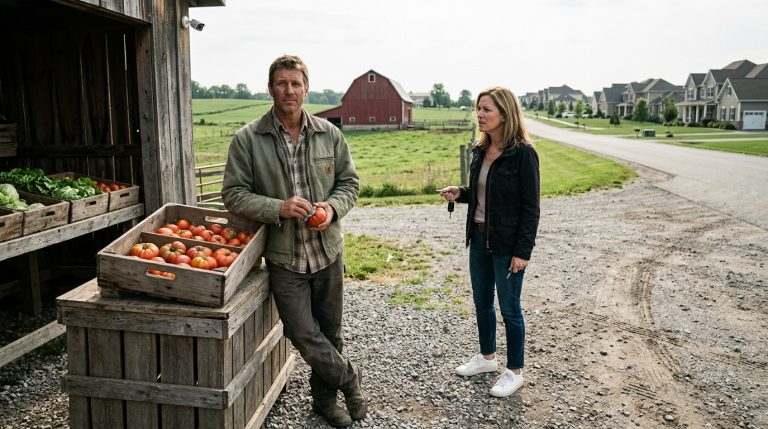
The paper felt thick, heavy with the weight of someone’s calculated arrogance. Karen stood on my lawn, her presence an intrusion as jarring as a siren in a library, her peroxide helmet holding steady against a breeze that barely stirred the oak leaves. She wasn’t just standing on my grass; she was occupying it, her posture reflecting the rigid, defensive geometry of a woman who viewed the world as a series of infractions waiting to be logged.
Five thousand dollars. The number hung between us, greasy and absurd. My German Shepherd, General, shifted behind me in the run, the sound of his claws against the gravel soft and rhythmic, a counterpoint to the bureaucratic shrillness rising in Karen’s throat. I felt the heat of the humid afternoon press against my neck, but inside, I was already pulling back, creating the distance I’d learned to maintain in the dusty, forgotten corners of the world where public health was not a matter of lawn height, but of survival.
My hand tightened on the doorframe. The wood was solid, cool beneath my grip—a tactile anchor. I could see the disappointment flickering in her eyes. She wanted the shout, the frantic defense, the public display of weakness that would validate her authority. I gave her the exact opposite: a flat, dead-eyed silence that mirrored the blank surface of the fluorescent notice in her hand.
“A lean, Doctor,” she repeated, her voice rising in a practiced, melodic lilt. “Don’t think we won’t.”
I looked at the notice, not at her. The orange was aggressive, almost violent against the muted greens of my property. It was designed to trigger a fight-or-flight response, a psychological trap wrapped in legal jargon. I checked my own breathing. Shallow, controlled, rhythmic. The same way I’d checked the vitals of a bomb-sniffing dog in the back of a Blackhawk while the world tore itself apart outside the metal hull.
“Is there a problem with the drainage?” I asked, my voice devoid of the outrage she craved.
She paused, her mouth forming a narrow, impatient line. “It is an unapproved modification. You didn’t file the plans.”
“I see.” I looked at the dog run. The gravel was perfectly graded, the wire mesh taut, the stainless steel hardware catching the afternoon sun with a sharp, piercing brilliance. “It’s a freestanding structure, Karen. Not a modification.”
“It’s a nuisance.” She tapped the notice against her palm. “You have thirty days.”
She turned and retreated toward the golf cart, the rubber tires digging a deep, ugly trench into my turf. I watched her go, not as a neighbor, but as a target. She thought she was the apex predator here, playing a game of social chess she had already rigged. She had no idea that she hadn’t just insulted a veterinarian; she had just challenged a man who knew exactly how to find the structural weakness in any system, no matter how reinforced it appeared to be. The door clicked shut behind me, isolating me in the cool, dark quiet of my hallway, and for the first time, I noticed a strange discrepancy: a small, dark smear of grease on the bottom corner of the orange notice that looked suspiciously like industrial lubricant from a golf cart’s steering column—and that was, I realized, the first loose thread in a very complex weave.
CHAPTER 2: THE DIAGNOSIS
The house was silent, but it wasn’t the peaceful quiet I had bought into when we signed the papers for this cul-de-sac. It was a pressurized, expectant stillness. My hands were steady, though the rage in my gut had cooled into the sharp, precise focus of a scalpel. I set the orange violation notice on the dining room table—that centerpiece of bureaucratic fiction—and turned it under the overhead light.
The grease smear was small, a dark thumbprint of industrial lubricant. It was a detail Karen would never have noticed, let alone cared about, but it was a physical fact. It meant she hadn’t just printed this notice in a sterile office; she had been handling it while sitting in that golf cart, likely while she was still patrolling the neighborhood, marking targets. It was sloppy. Or perhaps, it was just the arrogance of someone who never expected to be scrutinized.
“Alex?” Sarah’s voice drifted from the kitchen, fragile and thin. I didn’t look up. I was busy cataloging the paper, the specific weight of the cardstock, the font choices that screamed faux-officialism.
“I’m fine, Sarah,” I said, my voice measured. “I’m just reading.”
I pulled the thick binder from the title company—the Covenants, Conditions, and Restrictions—out of my desk drawer. It was a heavy, leather-bound artifact of suburban law. I opened it to the section on structural modifications. The language was intentionally dense, a labyrinth of legal clauses designed to obscure rather than clarify. But I wasn’t reading for content anymore; I was reading for cracks.
I traced the lines with my index finger. Permanent structure. Affixed to the primary residence. Concrete foundation.
My dog run was none of these things. It was a tactical, modular enclosure. The base was compacted, leveled gravel—not concrete. It was set four feet away from the rear wall of the house to allow for the exterior HVAC line maintenance, a gap that by definition meant it was not affixed. Karen hadn’t just misinterpreted the rules; she had fundamentally failed to observe the physical reality of the site. She was operating on a presumption of power, not a foundation of fact.
The realization brought a sudden, hollow clarity. This wasn’t a misunderstanding. It was a diagnostic error. She had diagnosed a “nuisance” without ever examining the patient.
I stood up and moved to the back window. General was there, pacing the perimeter of the run, his golden-brown eyes tracking a squirrel that had dared to enter his territory. He was quiet, focused, and efficient. A professional. He looked back at me, his ears pricking up, sensing the shift in my posture.
I looked beyond him to the neighborhood. The fence lines were orderly, the lawns trimmed to a uniform height, the houses standing like rows of identical, unblinking observers. It was a manicured trap. Karen’s “Oakwood Estates” wasn’t a community; it was a laboratory, and she was the head researcher, testing how much pressure each unit could withstand before it shattered.
I went to my home office and logged into my clinic’s database. I needed the data, not just the emotions. I spent the next hour cross-referencing the property records I had downloaded from the county site with the HOA’s mailing list. I was looking for the pattern. The outliers. The new homeowners who hadn’t yet learned the rhythm of the cul-de-sac, the elderly neighbors who didn’t know how to challenge a fine.
The pattern emerged with chilling speed. The violation notices were not random. They were clustered around the periphery of the neighborhood, in the houses with the most vulnerable residents. It was a classic predatory strategy: isolate the prey, apply pressure, and collect the “compliance fees.”
I opened a blank document. My fingers moved over the keys with a rhythm I hadn’t tapped into since I left the service. This wasn’t a rant. It wasn’t an appeal to sympathy. It was a clinical report, a document that would, when finished, be as hard and cold as an operating table. I broke down the bylaw definitions. I cited the physical impossibility of her claims regarding the dog run. I documented the sanitization logs I had kept since day one.
The house creaked around me, the cooling metal of the HVAC unit sighing in the dark. I didn’t feel the stress anymore. Stress was for people who didn’t have a plan. I had a plan. I was going to dismantle the legitimacy of her authority, one clause at a time. And if she wanted a war over procedure, I would give her a masterclass in it.
I saved the draft, staring at the screen as the blinking cursor waited for the next sentence. My mind was already moving to the next tactical necessity: finding out who, exactly, was the anonymous neighbor. Because a bully as lazy as Karen didn’t invent complaints; she sourced them. And in a neighborhood this small, the source was always closer than she wanted to admit. I needed to know who was watching from the fence line, and I needed to know what they had been promised in exchange for their silence.
CHAPTER 3: THE ARCHITECT OF EVIDENCE
The cursor blinked, a steady, rhythmic pulse that felt like a countdown. I didn’t look away from it for a long time. The office air was stagnant, heavy with the scent of old paper and the sharp, metallic tang of the laser printer’s ozone. Outside, the neighborhood was dark, the streetlights casting long, distorted shadows across the cul-de-sac. It was a perfect, quiet suburban night—the kind of night where secrets were usually kept.
I stood up, my chair scraping against the hardwood with a sound that felt unnecessarily loud. I moved to the garage, the concrete floor cool against my feet. The garage was my sanctuary of order. Every tool had its place, every bolt was categorized in steel drawers. This was where I had built the run, and this was where I would build the case.
I reached for the heavy binder where I’d stashed the original hand-drawn schematics. As I pulled the folder from the shelf, a memory flickered—a sudden, sharp intrusive thought—of a base camp in the Hindu Kush, the smell of dust and cordite, and the way we used to map out the tactical parameters of a compound before a sweep. Back then, it was about finding entry points to save lives; here, it was about finding the exits to save my own. The phantom sensation of a heavy radio handset in my palm made my fingers twitch. I pushed the memory down, locking it away behind the same mental bulkhead I’d used to survive the deployment. I wasn’t there anymore. I was here, in Oakwood Estates, and the stakes were just as absolute.
I laid the schematics out on the workbench. They were precise, clean, professional. I’d used a grid ruler. I hadn’t just built a dog run; I’d engineered a structure that followed the exact specifications of the HOA’s own guidelines, right up to the edge of the definition. I grabbed a fresh highlighter and a stack of receipts.
Phase one of the counter-offensive wasn’t just about the dog. It was about the foundation. I began to assemble the packet. Each receipt for the gravel, the fencing, the high-tensile wire, was meticulously clipped to the corresponding section of the bylaw it satisfied. I was creating a document that was physically impossible to ignore, a dossier that carried the unmistakable weight of a professional standard.
Sarah appeared in the doorway, her silhouette framed by the dim light of the hallway. She looked exhausted, the lines around her mouth deeper than they had been when we moved in.
“Still working, Alex?” she asked softly.
“Documentation,” I replied, not looking up from the steel bolt I was measuring. “Everything has to be perfect. If I leave a single gap, they’ll exploit it.”
She stepped into the garage, her presence softening the rigid geometry of the workspace. “Is it really worth this? The hours? The anger?”
“It’s not about the money, Sarah,” I said, my voice quiet but firm. I looked at her, really looked at her, and saw the worry that had become a constant in her eyes. “If we pay that fine, we’re admitting we’re wrong. And once you admit you’re wrong to people like Karen, you never stop paying. This is about establishing a boundary.”
She nodded, though I could see she still carried the weight of it. She turned to leave, but stopped at the door. “Just be careful, Alex. You’re fighting someone who doesn’t play by the rules. Don’t become like her in the process.”
Her words hung in the air long after she had gone. I looked down at the schematic. I was using the rules as a weapon, yes, but I was also using them as a shield. I checked my work again, the precision of it satisfying a deep, primal need for order.
I turned my attention to the list of residents I’d compiled. I had to find the source. If Mr. Henderson was indeed the “anonymous neighbor,” I needed to understand why he’d been pushed into it. I pulled up the HOA’s public budget reports again, the ones I’d downloaded in a fit of late-night pique. There was a peculiar trend in the enforcement of the “nuisance” bylaws—specifically, a spike in citations during the months where the landscaping contract renewal was up for debate.
I leaned back, the metal chair digging into my spine. It wasn’t just individual bullying. It was a system of leveraging. If someone stood in the way of a contract or a pet project, they were suddenly burdened with a violation. The “consultant” fees, the mysterious administrative costs—it was all beginning to map out. Karen wasn’t just a tyrant; she was a ledger keeper who had found a way to turn the neighborhood into a personal profit center.
I realized then that my “dog run” wasn’t the target. It was the catalyst. It was the moment where she had miscalculated, where she had assumed I would be just another Miller or Mrs. Gable. She had brought a toothpick to a structure fire.
I reached for my phone, scrolling through the contacts until I found David’s number. He was the one person who would understand the logic of what I was building. I needed a legal opinion on the “consultant” payments, something that wouldn’t set off alarms at the management company but would lay the groundwork for a future audit.
As the phone began to ring, I stood in the center of the garage, the cold concrete beneath my feet, the sharp edges of the workbench framing my reality. I felt a surge of focus—the kind of clarity that only comes when the objective is singular and the path is clear. I was going to turn the light on this entire cul-de-sac. And when I did, Karen was going to find out exactly what happens when you try to force a man who has already seen the worst of the world to defend his own backyard.
CHAPTER 4: THE TRIBUNAL
The clubhouse was a beige, low-ceilinged room that smelled of industrial floor wax and stale coffee—a sensory shorthand for institutional indifference. As I pushed the heavy glass door open, the sound of my own footsteps felt unnaturally loud, clicking sharply against the linoleum. The room was already filling with the hushed, anxious energy of people who knew they were about to be put on display.
I saw them at the front of the room, seated at the long, folding table that served as the dais of their petty empire. Karen was dead center, her posture as rigid and unyielding as a steel rod. To her right, Barry was fussing with a stack of papers, his hands trembling slightly, his eyes darting toward the door every few seconds. To her left, Sheila sat with her arms crossed, her expression a mask of practiced, cold-blooded neutrality. They looked like a triumvirate of bureaucrats, oblivious to the fact that their foundation was already beginning to fracture.
I walked toward them, my document packet held firmly against my side. It wasn’t just paper; it was a calibrated response. My gaze stayed locked on the dais, refusing to acknowledge the pitying looks of the other homeowners scattered in the folding chairs. I could feel the ambient tension in the room—a prickly, static charge that grew as I approached.
“Doctor Hayes,” Karen said, her voice dripping with an affected, honeyed condescension that didn’t reach her eyes. She didn’t look at the packet I was carrying. “We’ve all read your little novel. And we are not persuaded.”
The room went deathly quiet. I stopped in front of the table, the sharp, cold light from the recessed ceiling fixtures glinting off the polished surface. I didn’t rush. I placed the packet down, the thud of the heavy Manila envelope sounding like a gavel in the silence.
“Persuasion isn’t the objective, Karen,” I said, my voice measured and low. I kept my posture relaxed, a sharp contrast to her rigid, defensive stance. “These aren’t arguments. They’re facts. Bylaw section 7.4A. Federal Fair Housing Act. My diagnostic logs for the run. These are the rules this board claims to uphold. I suggest you read them.”
Karen sneered, but I caught the flicker of uncertainty that crossed her face—a subtle twitch of her eyelid, a slight tightening of her jaw. She was used to being the loudest person in the room, the one who defined the reality of the situation. She wasn’t prepared for someone who refused to play by her emotional rules.
“We don’t need a lecture on the bylaws, Doctor,” Sheila snapped, leaning forward. “We have a complaint. A neighbor has documented excessive noise and odors. We have a duty to the community.”
“Who?” I asked, my voice flat, direct, and unyielding.
Sheila recoiled slightly, taken aback by the bluntness of the question. “That is confidential. It’s for the protection of our residents.”
“Protection from what?” I asked, looking around the room. I could see the heads of the other residents turn. “From having the truth tested? If a nuisance exists, it can be verified. If it can’t be verified, it’s not a nuisance—it’s harassment.”
Karen tapped a pen against the table, a rhythmic, irritating sound. She was trying to regain her tempo. “This is not a court of law, Dr. Hayes. This is an HOA board. And we have already determined that your structure is a violation. The fine stands.”
I didn’t argue. I didn’t raise my voice. I simply stood there, my hands clasped loosely in front of me, a calm, centered presence in the middle of her manufactured storm. I could see the frustration building in her, the way her composure was being stripped away, inch by inch, by the simple refusal to engage in her theater of power.
Suddenly, a voice piped up from the back of the room—a man, hesitant and thin. “I… I think there’s been a mistake.”
All eyes turned. It was Mr. Henderson, his face pale, his hands gripping the back of the chair in front of him. He looked like he wanted to vanish into the beige floorboards.
Karen whipped her head around, her eyes flashing with a sharp, predatory warning. “Mr. Henderson, this is not the time for interruptions.”
Henderson flinched, but he didn’t sit down. He looked at me, then at the envelope on the table. He looked like a man who had reached the limit of his own capacity for fear.
“I just meant,” Henderson stammered, his voice gaining a fraction of volume, “the doctor’s yard… it’s never been a problem. I’ve seen it every day. It’s just a dog run.”
The room erupted into a low murmur, a sudden wave of sound that seemed to catch the board off guard. Karen’s mask of absolute control slipped, her face flushing with a blotchy, mottled red. She slammed her hand down on the table, the sound dull and pathetic in the large, hollow room.
“This is out of order!” she screamed, her voice cracking, losing that smooth, bureaucratic veneer. “We have voted. The hearing is concluded.”
She grabbed the tiny, ridiculous gavel from the table and banged it once, twice, three times, but the authority was gone. It was just a woman hitting wood against laminate. I watched her, the cold, sharp focus in my mind sharpening further. She had made a grave error in assuming she was the only one playing the game. She had forced a confrontation, and in doing so, she had provided the perfect stage to reveal the rot at the center of her power. As I walked away from the table, leaving her to the murmuring, rebellious crowd, I knew I had exactly what I needed: the first public crack in her armor.
CHAPTER 5: THE NETWORK
The parking lot was a concrete slab under the harsh hum of orange-tinted streetlights. My footsteps felt heavy, each impact a rhythmic reminder that the board had officially ignored the evidence. I didn’t head straight for my truck. I lingered near the perimeter, letting the cooling night air settle against the heat of the confrontation. Behind me, the clubhouse door clicked shut, the sound final and hollow.
I had come expecting a hearing; I was leaving with a declaration of war. They hadn’t just denied my evidence—they had dismissed it with a contempt that suggested they were already anticipating a broader failure on my part. They were too comfortable in their power, too reliant on the assumption that everyone else played by the same, muted rules of suburban etiquette.
I walked to the edge of the lot where the shadows were deep. I pulled out my phone and checked the spreadsheet I had been building for weeks. It was a cold, digital ledger of the neighborhood’s silent suffering. The Millers. The Gables. The Hendersons. Every name I had added felt like a thread in a tapestry of coercion.
I needed to move beyond the individual. I needed to see the architecture of the scheme. I walked along the sidewalk, moving from the commercial sterility of the clubhouse toward the residential streets. The neighborhood was quiet, the houses looming like sleeping giants behind their perfectly manicured hedges.
My first stop was the Millers’. I didn’t approach the front door—that would be too visible. I slipped into the shadows of their side yard, the grass damp with evening dew. Their swing set sat in the moonlight, a silent, cedar-framed testament to their own petty humiliation. I pulled a small digital recorder from my pocket, the one I used for clinical notes, and spoke into it. The data point was small—a violation of a minor aesthetic rule—but when connected to the Miller’s story, it formed a pattern.
I found myself moving toward the back of the cul-de-sac. It was a route I had traveled a dozen times in the last few weeks, but tonight, the perspective felt different. I wasn’t a resident walking a dog anymore; I was a field researcher mapping the distribution of influence.
I saw a light flicker in Mr. Henderson’s garage. He was still up, likely stewing in the aftermath of his public stumble. I stood in the darkness for a long moment, watching the silhouette of him moving back and forth, the shape of a man who was clearly out of his depth. He had been a pawn, and in the aftermath of the hearing, he was likely now a liability to Karen.
The weight of the situation began to settle in. It wasn’t just about me. If Karen was using Henderson to spy on me, she was likely using others in the same way. The neighborhood wasn’t a community; it was a spiderweb of forced allegiances.
I turned away and began the walk back to my own home, the silence of the night feeling increasingly strained. I had expected a struggle, but I hadn’t fully grasped the scale of the surveillance. Every street, every driveway, every twitch of a curtain seemed to carry the weight of Karen’s influence.
When I reached my own porch, I paused. The dog run looked different in the dark—a simple, functional structure that had somehow become the focal point of a systemic collapse. I looked at the lock on the gate, the heavy-duty steel I’d installed myself. It was secure, but tonight, it felt like an invitation to someone to test it.
I went inside and sat in the dark kitchen for a long time. I realized then that my tactical error hadn’t been in my preparation; it had been in my underestimation of the antagonist’s reach. They weren’t just administrators; they were operators. And if they were willing to coerce a neighbor to maintain the appearance of control, there was no telling what they were prepared to do once that appearance started to fail.
I opened my laptop. The blue light washed over my face, the only source of clarity in the room. I needed to reach out to the others, but I had to be careful. The system wasn’t just a bureaucracy—it was a network. And the only way to break a network was to introduce a variable that they couldn’t control.
I began to draft a new kind of message—not a defense, but an inquiry. I addressed it to the neighbors whose stories I had documented, framing it as a community audit. It was the next logical step. If I could get them to share their own experiences in an open, undeniable way, the board would no longer be able to hide behind the veil of “confidentiality.”
My fingers moved with clinical speed. I felt a cold, sharp thrill of progress. The more I looked at the data, the more the entire HOA setup felt like a fragile, hollow shell. It was built on the fear of the residents, and that fear was predicated on the belief that there was no way to fight back.
I was about to show them that there was. And as I hit send on the first of the messages, the silence of the house seemed to shift. It was no longer the silence of a victim waiting for the next blow. It was the silence of a structure that had been compromised, waiting for the final push to bring the whole thing down.
CHAPTER 6: THE TROJAN HORSE
The morning sun didn’t bring warmth; it brought a stark, unforgiving light that exposed the dust motes dancing in the air of my office. I had spent the night waiting for replies, but the silence from the neighborhood felt heavy, like the stillness before a pressurized line bursts. I grabbed my bag, the weight of the neatly filed permit applications pressing against my side—a paper-thin arsenal designed to hold up under the most intense bureaucratic scrutiny.
I arrived at the management company’s office ten minutes before they opened. It was a soulless, glass-and-steel cube in an industrial park downtown, the kind of place where dreams of suburban autonomy went to die in filing cabinets. The receptionist, a woman whose face was a study in practiced disinterest, looked up as I approached.
“I’m here to file the permits for the Community Pet Health and Safety Day,” I said, placing the triplicate forms on the counter with the precision of a surgeon.
She didn’t smile. She took the packets, her fingers flipping through the pages with a rhythmic, irritating thud. “These have to be submitted ten business days in advance, Dr. Hayes. You’re cutting it close.”
“They were submitted on the exact schedule required by the bylaw 12.2,” I said, my voice steady, unyielding. “The receipt of submission is attached to the back of the third copy.”
She sighed, a sound of profound annoyance, and began the process of stamping the pages. I watched her, my pulse a quiet, steady beat. This was the first physical barrier. If she found a reason to reject these, the entire operation would stall. I had leveraged every ounce of my military logistics training to ensure that every “t” was crossed, every “i” was dotted, and every regulation—no matter how obscure—was addressed.
As she stamped the final page, my eyes drifted to a stray sheet of paper sitting on the corner of her desk—a printout of the latest maintenance expenses for our development. It was an anomaly, a breach in the corporate sterility. I leaned in, my gaze locking onto a specific line item: Consulting Services – Phase 4. The amount was $1,500. It was the same shell corporation name I had traced back to the PO box earlier that week.
“Is there an issue?” the receptionist asked, noticing my focus.
“Just admiring the efficiency,” I said, pulling back, my face a perfect, placid mask. “It’s interesting how many consultants it takes to manage a few acres of grass.”
She didn’t answer, just pushed a copy across the counter. “You’re all set. But don’t expect the board to be happy about this.”
“I don’t expect them to be happy,” I said, taking the papers. “I expect them to be compliant.”
I walked back to my truck, the air outside smelling of exhaust and hot pavement. The win felt small, almost insignificant, but it was a bridgehead. I had forced the system to acknowledge the event. Now, I had to ensure the neighborhood showed up.
I drove toward the cul-de-sac, the familiar streets feeling increasingly alien. I wasn’t just a resident anymore; I was a catalyst. I could feel the change in the atmosphere—the way curtains shifted as I passed, the way the neighborhood seemed to be holding its breath. Karen and her board were already on the back foot, but a cornered predator is never more dangerous than when it realizes it has been outmaneuvered.
When I pulled into my driveway, I saw a familiar silhouette standing near the entrance to my dog run. It was Mr. Henderson. He was staring at the fence, his shoulders hunched, his hands buried deep in his pockets. He looked like a man who had lost his moorings.
I stepped out of the truck, the sound of the door slamming echoing in the quiet street. He turned, his face tightening with a mix of fear and desperate resolution.
“Doctor,” he said, his voice barely audible. “They know you’re going to the board again. They’re… they’re preparing a response.”
“What kind of response, Mr. Henderson?” I asked, walking slowly toward him.
“They’re talking about an emergency injunction,” he whispered, glancing nervously at the surrounding houses. “They’re claiming the clinic is a security risk. They’re saying you’re bringing ‘outside elements’ into the neighborhood.”
I stopped a few feet from him, the cold steel of the truck bed beneath my hand. It was the classic move of a cornered regime—criminalizing the opposition to justify the use of force. It was crude, it was desperate, and it was exactly the kind of overreach that would prove to be their undoing.
“They’re trying to scare you, Mr. Henderson,” I said, my voice steady. “But fear only works if you have no other options. You have options. You just haven’t looked at the ledger yet.”
He looked at me, confused, his eyes darting to the dog run, then back to my face. “I don’t understand.”
“You don’t need to understand right now,” I said, moving past him to check the perimeter of the run. “You just need to decide whether you want to keep paying the price for their comfort, or if you want to stand on the right side of the facts. The health clinic is happening. And you’re invited, just like everyone else.”
I didn’t wait for his answer. I stepped inside the enclosure, the gate latching shut behind me with a sharp, metallic ring. I was in the eye of the storm now, and the only way forward was to keep the pressure on. They thought they could stop the momentum with a few words and a manufactured fear, but they had forgotten one fundamental truth: once you expose the lie, you can’t put it back in the dark.
CHAPTER 7: THE EXPOSURE
The morning of the pet health clinic broke with a heavy, oppressive humidity that clung to the skin like a second layer. I stood under the central tent, watching the early trickle of neighbors arrive. They were hesitant, clutching their leashes as if they were lifelines, their eyes darting toward the perimeter where the HOA board members—Karen, Sheila, and Barry—had arrived to “observe.”
They stood near the park entrance, a small, hostile delegation. Karen was holding her miniature poodle, Precious, the animal’s small frame shivering in the damp air. It was a perfect, tactical setup: they were trying to maintain the facade of civic concern while radiating a palpable, freezing intimidation.
“Dr. Hayes,” Tina whispered, coming up beside me. She was holding a tablet, the screen flickering with the active records. “The turnout is higher than we anticipated. And the board… they’re watching every arrival.”
“Let them watch,” I said, my voice steady, eyes scanning the crowd. “That’s exactly what they’re supposed to do.”
I walked toward the check-in area. The crowd parted slightly, a mix of curiosity and fear. I wasn’t just a veterinarian today; I was a flashpoint. I saw Mr. Henderson in the line, Buster the Labrador tethered tightly at his side. He looked at me, his expression caught between a desperate need to fade into the background and the weight of the secret he carried. I gave him a slight, knowing nod. He had made his choice.
As I reached the check-in table, Karen stepped forward, her heels clicking aggressively against the paved path.
“Doctor,” she said, her voice dripping with that familiar, synthetic sweetness. “I trust everything is in accordance with the permits?”
“Everything is documented, Karen,” I replied, my gaze locked on hers. “As always.”
She thrust the poodle toward me, her eyes glinting with a sharp, predatory challenge. “Precious is due for a check. I expect the same level of… professional scrutiny you’ve promised everyone else.”
I took the dog, the animal soft and trembling against my chest, and moved to the table where the large 32-inch monitor was stationed. Tina tapped the keys, the display glowing bright and clear under the shade of the tent. It was a digital ledger, an open book of community health, and today, it was the stage for the final act.
“Precious Richards,” Tina announced, her voice projecting clearly. “Rabies vaccination current. Expiration: November 15th.”
Karen exhaled, a small, smug smile playing on her lips. “Satisfied?”
“Entirely,” I said, handing the dog back. I didn’t turn away. I stepped into the path between the check-in tent and the main assembly, my voice rising just enough to carry over the ambient chatter.
“Since we’re all here, I’d like to thank everyone for this incredible turnout. Community health starts with transparency.” I paused, my eyes scanning the crowd until they landed on Henderson. “A few weeks ago, I was fined $6,000 for a dog run that the board claimed was a biohazard. I was told the complaint came from an anonymous neighbor regarding noise and odors.”
The crowd went silent. Karen stiffened, her hand tightening around the poodle’s leash.
“Mr. Henderson,” I continued, turning to face him. “Would you care to tell the community if those odors or noises were real?”
Henderson looked at the ground, then at the board, and finally, his voice came out, strained but clear. “No. There wasn’t anything. I… I was told to say it. By Karen. She said she’d overlook the compost bin fine if I filed the report.”
The silence that followed was heavy, a vacuum being filled by the sudden, sharp intake of breath from the surrounding neighbors. Karen’s face drained of color, her poise shattering into a look of pure, unadulterated panic.
“That’s a lie!” she shrieked, the sound sharp and grating. “He’s a disgruntled resident—”
“I have the ledger,” I said, my voice cutting through her panic like a knife. I pulled the printout from my pocket—the one I’d traced back to the shell corporation. “This wasn’t about health, Karen. It was about profit. Payments marked as ‘consulting fees’ paid by this community, to a corporation registered to your personal PO box. You were bleeding this neighborhood dry and using these ‘fines’ as the cover.”
The effect was instantaneous. The neighborhood, once paralyzed by the fear of her bureaucratic reach, surged forward. The board members—Sheila and Barry—looked around with the frantic expressions of people who had suddenly realized the ground beneath them was gone. Barry was already retreating, backing away into the crowd, his nervous throat-clearing lost in the rising tide of murmurs.
Karen stood paralyzed, the weight of the realization hitting her as she looked at the faces of the people she had bullied. It wasn’t the law that was going to destroy her; it was the sheer, collective weight of the truth she had tried so hard to hide. I stood there, watching the mask fall away, the sharp edges of the suburban nightmare dissolving into the cold, hard reality of exposure. The war was nearing its end, and for the first time, the air in the park felt clean, stripped of the deceit that had choked it for so long.
CHAPTER 8: THE COLLAPSE OF THE LEDGER
The days following the exposure were not marked by a sudden, clean resolution. Instead, they were defined by the slow, grinding noise of a machine that had finally lost its lubrication. Karen didn’t vanish. She fought back with the same desperate, ugly persistence she had used to harass the neighbors. The injunction she had threatened arrived on my doorstep in the form of a thick legal packet—a scorched-earth attempt to smear my professional credentials and freeze my assets, claiming my clinic was a liability to the neighborhood’s “aesthetic integrity.”
I didn’t panic. Panic was a luxury I had burned through months ago. David met me in my kitchen, the table covered in the same binders and spreadsheets I had been using to map the rot. He laid out the injunction, his finger tapping the signature line where Karen’s name appeared, now shaky and erratic compared to the bold, ink-heavy signatures on the initial violation notices.
“She’s bleeding, Alex,” David said, his voice quiet. “This isn’t a legal strategy. It’s a frantic grab for control. She knows the audit is coming, and she knows that once they dig into the shell corporation, the ‘consultant’ fees are going to be impossible to justify.”
I looked at the paperwork. Beneath the dense legal jargon, I saw the truth of the embezzlement laid out in the cross-referenced bank records I had finally obtained from the new board’s interim treasurer. The “Phase 4 Consulting” payments were linked directly to a personal mortgage account in Karen’s name. It was so blatant, so aggressively simple, that it felt like an insult to the complexity of the war we had been fighting.
“Let her file it,” I said, a cold, hard satisfaction settling in my chest. “The injunction will force a discovery phase. If she wants the court to look at my clinic, they’re going to have to look at her bank statements first.”
The final confrontation didn’t happen in the park or the clubhouse. It happened in the quiet, sterile office of a county investigator three weeks later. Karen had been summoned to provide a sworn statement regarding the “administrative discrepancies” found during the initial audit. I wasn’t allowed in the room, but I stood in the hallway, watching through the glass door as her face crumbled. It wasn’t the dramatic, cinematic breakdown of a villain—it was the quiet, hollowed-out collapse of a person who had finally run out of lies. She sat there, her perfectly helmeted hair looking stark and artificial under the fluorescent lights, clutching a handbag that looked suddenly, painfully small.
When she emerged, she didn’t even look at me. She walked past, her gaze fixed on the floor, the predatory gleam completely extinguished. She was just a woman, tired and broken, stripped of the manufactured power that had once seemed so absolute.
The months that followed were a long, slow cooling-off period. The HOA was overhauled, the bylaws stripped of the subjective, weaponized clauses that had allowed her to thrive. The Miller’s swing set remained, a silent symbol of the restoration. Mrs. Gable’s garden gnomes had been joined by a few more, a quiet rebellion of aesthetics.
I returned to the rhythms of my life. My clinic felt lighter, the space uncluttered by the shadow of the legal threats. One Saturday morning, I walked out to the dog run. It was a beautiful day, the air clear and crisp, the scent of autumn leaves carrying through the yard. General was sitting in the shade of the enclosure, his head resting on his paws. He looked up as I approached, his eyes steady, loyal, and calm.
I reached for the gate. The latch was slightly stiff—the result of a missing bolt I’d neglected for too long. I pulled a wrench from my pocket and tightened it, the metal resisting, then giving way with a clean, solid click. It was a small act of maintenance, a restoration of order. I stood there for a long time, listening to the quiet of the neighborhood—a true, unforced silence. The war was over. The structure was sound. And for the first time in a long time, the cul-de-sac felt like a home, not a battlefield. I knelt down and rested my hand on General’s back, the steady, warm rhythm of his breathing a reminder that the only things worth defending were the ones that could actually feel the weight of your protection.