A Sanctuary of Smoke and Shadows: Reclaiming the Lost Heart of a Fragmented Suburban Neighborhood
CHAPTER 1: THE WEIGHT OF THE WOOD
The silence of the afternoon was thick, held together by the drone of a distant lawnmower and the hum of insects in the overgrown oak trees. Karen Miller stood on the precise edge of my property, a floral-patterned barrier to my peace. She held that plastic clipboard against her chest as if it were a shield, her knuckles white against the dark backing.
Your little hobby shed is a public nuisance and a fire hazard, Mr. Callahan, she said, her voice cutting through the humid air with the precision of a scalpel. I’m having it condemned. Consider this your final warning.
I didn’t answer immediately. I let the silence settle, a tactic I’d mastered years ago when the world was made of dust and uncertainty rather than manicured grass. I watched her weight shift from one orthopedic sandal to the other, the plastic of her clipboard creaking under her tightening grip. She wanted a reaction—a flinch, a protest, a sign of fragility. I gave her only the slow, rhythmic sip of my iced tea.
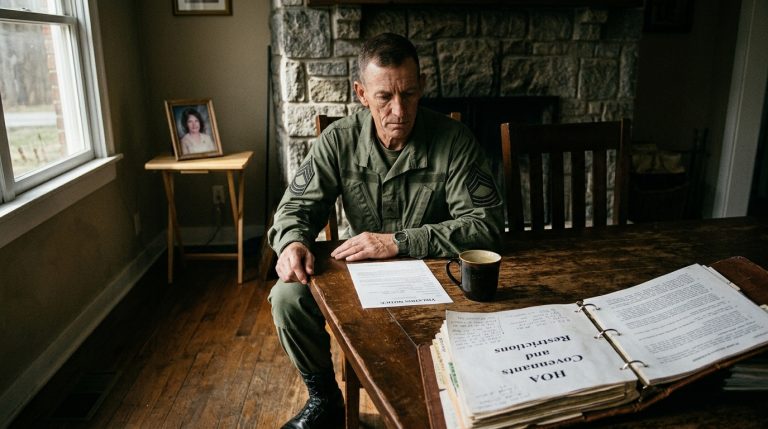
The smokehouse sat a hundred yards behind me, a structure of dark-stained cedar and riverstone that stood on the original 1950s concrete slab. To Karen, it was a nail that needed to be hammered down into the conformity of Willow Creek Estates. To me, it was a living memory. It was the place where the air always smelled of deep, slow-burning oak and the quiet patience of a man who had seen too much and wanted only to remember what remained of his wife, Sarah.
Did you hear me, Mr. Callahan? she pressed, her pitch climbing. The board has voted. Section 4, subsection B, paragraph 7. Unapproved detached structures.
I set my glass down, the condensation leaving a dark ring on the porch railing. I heard you, Karen, I said, my voice low. It was the voice of a man who had delivered briefings to men who held the power of life and death; it was soft, but it carried the weight of experience. You can tell the board they’ve acted on bad intelligence.
Her face soured, the smug certainty cracking just enough to reveal a flicker of something sharper—fear, perhaps, or merely the petulant rage of the entitled. That’s President Miller to you. And this isn’t a debate. The fines will start tomorrow. Fifty dollars a day. If it’s not gone in thirty days, we’re placing a lien on your property. We’ll hire the contractor ourselves and bill you for the demolition.
She turned on her heel, her floral muumuu billowing like a flag of conquest. As she walked away, the wind shifted, carrying the faint, lingering scent of hickory from the smokehouse. I saw her pause, her shoulders stiffening as the aroma caught her, then she quickened her pace toward her own house—a structure that looked like every other in the neighborhood, devoid of history, devoid of breath.
I looked back at the smokehouse. It wasn’t just wood and nails. It was a shelter for the parts of me that hadn’t yet learned how to live in a world without Sarah. She hadn’t left me a note, but she had left me the capacity to build something that lasted.
I stood up, my knees popping, and walked inside. The house was quiet, but it wasn’t empty. I picked up my phone to call Gus, the old-school butcher downtown who understood that some things—like a perfect brisket or a legacy—couldn’t be measured by the bylaws of an association. I needed to document the truth, and I needed to do it before Karen could make her next move. But as I sat at the dining table, I saw an envelope sitting in the corner, partially hidden under a stack of old bills. It wasn’t from the HOA. It was a foreclosure notice from the bank, addressed to the association, sitting in my mailbox by mistake, misdelivered and damp from the morning dew.
The association wasn’t just being difficult; they were bleeding money, and Karen was trying to burn the neighborhood down to stay warm.
CHAPTER 2: THE PAPER TRAIL
I didn’t pick up the phone immediately. I let the damp envelope rest on the oak table, its edges curling as it dried. The address was clear: Willow Creek Estates HOA, attention to the Board of Directors, care of the management firm. It was a formal notice from the bank, a precursor to legal action.
I looked at the house around me, then toward the back yard where the smokehouse stood, a dark silhouette against the deepening purple of the evening sky. Karen Miller’s obsession with “property values” and “unapproved structures” suddenly took on a sickening, logical clarity. She wasn’t just being a petty tyrant; she was a drowning captain rearranging the deck chairs on a sinking ship. If the association was insolvent, if the reserve funds were being siphoned off or simply exhausted by mismanagement, her campaign of fines wasn’t just spite—it was a desperate, grasping attempt to pad the coffers.
The thought sent a cold shiver through my chest. I had spent years using this smokehouse as a sanctuary for my grief, a place to process the silence Sarah left behind. To find out that the person trying to tear it down was doing so to mask a financial shipwreck… it shifted my perspective from tactical annoyance to a cold, focused resolve.
I reached for the phone. My fingers moved with the practiced ease of years in the service, pulling up the number for the local planning office. I didn’t need to shout or threaten; I needed information.
“City Planning, this is Miller speaking,” a tired voice answered.
“I’m looking for the public record of the Willow Creek Estates infrastructure audit from the last two years,” I said, my voice steady, stripped of all emotion. “I’m a resident at 112 Willow Creek Lane.”
The clerk sighed, the sound echoing through the line. “That’s a matter of public record, but you’ll have to come in to the office for the physical file. The digital system is down for maintenance until Monday.”
“I’ll be there at eight,” I replied.
I hung up and stood, walking to the window. The house was quiet, but my mind was beginning to race with the mechanics of the situation. I needed to see the plat maps again. I walked to the filing cabinet—a heavy, steel relic from my time in the service—and pulled out the thick folder. I laid it out on the table, side-by-side with the bank’s notice.
As I stared at the lines and the dates, a memory surfaced, sharp and intrusive—the image of Sarah’s hands, soil-stained and steady, helping me set the first stone of the foundation. She had always said that if you build something on a solid enough base, the wind can’t touch it. Karen Miller was trying to change the rules of the game, but the foundation of this property—and the truth of its legal standing—was written in ink that dated back half a century.
I went to the kitchen and put on a kettle. The act was mundane, but it grounded me. I needed the coffee. I needed the clarity. I heard a soft click at the front door—Emily coming home from her shift at the school. I moved to the hallway, but I didn’t greet her with the usual warmth. The weight of the evening was etched into my posture.
“Jack?” She paused, her keys jingling in her hand, her eyes searching my face. She saw the stack of papers on the dining table, the stern set of my jaw. “What is it? Did she call again?”
“No,” I said, stepping into the dim light of the entryway. I took her coat, my movements precise. “It’s worse, Emily. And it’s better. She’s not just a bully. She’s someone who has nowhere left to run.”
I guided her to the kitchen, the soft, faded texture of her cardigan a stark contrast to the sterile, hard reality of the foreclosure notice. I sat her down and pushed the damp paper toward her.
“She’s been trying to fine us because the association is bankrupt, Em. Or close to it,” I explained, the words feeling heavy, like stones I was placing on the table one by one. “She’s been trying to extract ‘revenue’ from the residents to keep the lights on for the association’s management company, maybe even to pay off debts we don’t even know about.”
Emily read the notice, her hand going to her mouth. “Jack, if the association goes under, what happens to us? To our home?”
“Nothing,” I said, and for the first time that day, a genuine, calm confidence filled me. “Because our home isn’t part of their collapse. I’ve checked the annexation documents. We’re protected by the original plat status. But if we want to stop her, we have to pull the rug out from under her before she burns everything else down.”
I looked at the smokehouse through the kitchen window. The moon was rising, casting long, silver shadows across the lawn. The smokehouse was solid. It was real. And tomorrow, I was going to find out exactly how much of the neighborhood’s foundation Karen Miller had already compromised.
I didn’t tell Emily about the planned trip to the city office. She was a teacher—she dealt with children, with growth, with the future. She didn’t need to know the dirty details of bureaucratic warfare yet. I had enough of that for both of us.
I walked back to the table and began to organize my notes. I felt a phantom ache in my shoulder—a reminder of an old injury—but I pushed it down. The work was only beginning. The smokehouse was the decoy, the target Karen was fixated on. But the real secret was hidden in the books, in the ledger, in the quiet, dusty archives of the county office. I would be there at eight, and by the time I walked out, I would know exactly how to dismantle the structure she had built to keep us all under her thumb.
The silence of the house returned, but it was no longer heavy. It was the silence of a soldier waiting for the sun to rise. I didn’t sleep well that night. Every time I closed my eyes, I saw the smokehouse burning—not by fire, but by the slow, corrosive neglect of a system built on lies. I realized then that my grief for Sarah had been my armor. Because I had already lost the most important thing, I had nothing left to fear from Karen Miller.
And that made me dangerous.
CHAPTER 3: THE BUREAUCRATIC FRONTIER
The drive to the county office at 7:30 a.m. was a study in stillness. The suburban streets of Willow Creek Estates were still waking up, sprinkler systems hissing to life in a synchronized, mindless dance. I kept my pickup truck at a steady pace, my eyes catching the occasional movement in a front window—a neighbor peering through the blinds. They were watching, wondering. The word of Karen’s “final warning” had likely rippled through the neighborhood like a stone dropped in a stagnant pond. I ignored them, keeping my focus on the road ahead.
When I reached the county administration building, the air inside was different. It didn’t smell of fresh-cut grass or the sweet, heavy scent of oak smoke. It smelled of ozone, old toner, and the dusty, stale breath of institutional stagnation. I walked to the clerk’s desk, the soles of my boots clicking against the linoleum with an authority that seemed to startle the young woman behind the counter.
“I’m Jack Callahan,” I said, my voice cutting through the hum of the overhead fluorescents. “I spoke with someone yesterday regarding the infrastructure audit for Willow Creek Estates.”
The clerk, a woman with glasses balanced precariously on the end of her nose, looked at me as if I were speaking a foreign language. She shuffled through a stack of folders, her movements slow and mechanical. “The maintenance is finished, but we’re backed up. Name again?”
“Callahan. 112 Willow Creek Lane.”
She typed, the sound of the keyboard rattling like loose gravel. After a moment, her brow furrowed. She typed again, faster this time. “That’s strange,” she muttered. “The file for that development… it’s restricted.”
I leaned in, just an inch, but enough to make the air between us feel suddenly thin. “Restricted? It’s a public infrastructure audit, miss. There is no reason for an HOA development file to be restricted from a property owner.”
“I’m just the clerk, sir,” she said, her voice dropping to a whisper. She looked over her shoulder toward a closed office door at the end of the hall. “But that file hasn’t been accessed in six months. And it’s marked as ‘Pending Review by Board Executive.’ That’s unusual.”
“Who’s the executive?”
“I can’t say.”
I didn’t press. I’d seen this before—the wall. People hiding behind titles and protocols because they were too afraid of what might happen if the curtain were pulled back. I looked toward the office door. The nameplate on the wall said Director of Planning.
“Thank you,” I said, my tone shifting to something softer, more disarming. I stepped back, appearing to walk away toward the lobby exit, but instead, I circled around a row of filing cabinets and ducked into the public records kiosk. I had spent thirty years learning how to find the cracks in a system, and every system had them. If the infrastructure file was locked, the annexation file was usually kept in a different directory.
I tapped the screen, navigating through the legacy database—an archaic, clunky interface that hadn’t seen a patch since the mid-nineties. I searched for “Willow Creek,” then filtered by “Annexation 2005.”
The screen flickered. A list of documents appeared. There it was: Development Agreement 2005-B.
I pulled up the file. It was a digital scan of a typed contract. My heart hammered a slow, rhythmic beat against my ribs as I read. The clause was still there—the grandfathering of pre-existing structures. But as I scrolled down, I noticed a second, attached addendum, dated only a year ago. It was a “Restructuring of Community Obligation.”
I read it twice. It wasn’t just an audit. It was a debt-swapping arrangement. The HOA had effectively leveraged the entire community’s common area assets—the park, the clubhouse, the entrance gates—as collateral for a private loan. The interest rates were predatory, clearly designed for an entity that had no intention of paying it back. This was the source of the financial hemorrhage. Karen wasn’t just managing an HOA; she was presiding over a controlled demolition of the neighborhood’s equity.
I heard the heavy, rhythmic thud of footsteps behind me. I quickly closed the screen and straightened my back, but I didn’t turn around. I felt the familiar, paranoid prickle on the back of my neck—the sensation that someone was watching, not just me, but the screen, the data, the hole I had just ripped in their facade.
“Can I help you, sir?”
The voice belonged to a man in a gray suit, his face a landscape of sharp, bureaucratic indifference. He wasn’t the clerk. He held a tablet with the county seal, and his eyes were cold.
“Just looking up local zoning for a fence,” I said, keeping my tone perfectly flat. “I like to know where I stand before I start building.”
The man didn’t move. He stood there for a long moment, the air heavy with unspoken suspicion. He was waiting for me to break, to flinch, to look guilty. I simply looked him in the eye and held the gaze. I had spent years under the scrutiny of men who had far more power than a county planning official.
“Zoning is under the ‘Municipal Codes’ tab,” he said, his voice dropping an octave. “The rest of the database is for administrative use only.”
“Good to know,” I replied, turning away with deliberate, casual movements.
I walked out of the building, my breath catching in my throat as I hit the humid morning air. My mind was already piecing it together. The foreclosure notice, the “restricted” files, the secret debt restructuring—it was all connected. Karen was a small-time operator, but she was deep in business with someone who knew exactly how to extract value from a property.
As I climbed into my truck, I saw a car parked at the end of the lot—a dark, nondescript sedan that hadn’t been there when I arrived. It was idling. Just as I started my engine, the sedan pulled out, keeping its distance. I turned onto the main road, and the car followed.
It wasn’t a coincidence. It was a confirmation.
I drove, my hands tight on the wheel. I didn’t go home. I drove toward the edge of town, toward the industrial park where the older, forgotten sections of the county met the sprawling, new developments. I needed to lose the tail, and I needed to call Marcus.
The weight of the truth felt like a physical burden now. I had the core of the mystery—the Layer 1 decoy was no longer a decoy; it was a symptom of a much larger, darker reality. I wasn’t fighting for my smokehouse anymore. I was fighting for the survival of every home in that cul-de-sac.
I took a sharp turn down a side street, then another, my eyes fixed on the rearview mirror. The dark sedan kept pace, its presence an unwavering, cold shadow. I reached for my phone, but then paused. If they were tracking me, they were listening to my comms. I tucked the phone away and felt the cold, hard reality of my situation settle in.
I was being hunted in my own county, and the only person who knew the truth was me.
CHAPTER 4: THE HARVEST OF SECRETS
I took the long way around the distribution center, my heart rate steady, my hands locked onto the wheel at the quarter-to-three position. It was a maneuver I hadn’t executed since a lifetime ago, in a theater where the stakes were measured in casualties, not property liens. I waited until I hit a stretch of road flanked by high, rusted chain-link fencing before accelerating, then immediately braking into a narrow, unpaved alleyway between two decaying warehouses.
The sedan didn’t follow. It slowed, hesitating at the intersection, before disappearing into the morning traffic. I didn’t stop. I kept moving until I found a secluded lot where the smell of wet earth and oxidized iron was thick enough to taste. I killed the engine and sat in the quiet, the silence ringing in my ears like a physical weight.
I needed to make that call to Marcus. I pulled the phone from my pocket—it was still dark, the screen reflecting my own grim expression. I dialed the number, waiting through the long, hollow pulses of the connection.
“Jack?” Marcus’s voice was as steady as a heartbeat, cutting through the static. “You’re off the grid. What’s going on?”
“I’m at the industrial park,” I said, keeping my voice low. “I went to the county office. The annexation files were locked. There’s a restructuring addendum, Marcus. They’ve leveraged the entire neighborhood. It’s not just about fines—it’s about debt service.”
There was a long silence on the other end, the kind of silence that happens when a lawyer realizes the scope of the problem has just shifted from civil to criminal. “Leveraged? By whom?”
“That’s what I don’t know yet. But someone’s watching. I had a tail leaving the county office.”
“Listen to me, Jack,” Marcus said, his tone shifting into the sharp, no-nonsense register of a tactical advisor. “If they’re using debt-swapping instruments against a residential community, they’re looking for a foreclosure-to-liquidation play. They want to force the neighborhood into receivership, sell the land to a developer, and pocket the difference. Karen isn’t the architect; she’s the foreman.”
“What’s my move?”
“Stay out of sight. I’ll pull the corporate filings for the management company. If they’re leveraged, there has to be a creditor of record. Once we have the name on the loan, we have the leverage. But Jack, if they’re following you, they’re desperate. Don’t go home.”
“I have to, Marcus. Emily’s there.”
“Then go armed with something better than a service record. I’ll have the data by noon. Get to the cul-de-sac potluck tonight—the grassroots one. Don’t hold a meeting. Just listen. If there’s an insider, someone who knows about the financial shifts, they’ll be there. They’ll be scared.”
I hung up, the phone feeling heavier than before. The logic held: Karen was the face, but the money had a master. I drove back toward Willow Creek, not using the main artery, but navigating through the labyrinth of backroads that threaded behind the manicured veneers of the suburb.
When I pulled back onto my street, the afternoon sun was beginning to slant through the oaks, casting long, fractured shadows across my lawn. Everything looked the same, yet the entire landscape felt like a stage set—painted, hollow, a thin layer of normality stretched over a deep, structural rot.
I didn’t go inside immediately. I walked to the smokehouse. I unlocked the heavy steel door, the hinges groaning, and stepped into the dim, cool air. The smell of hickory and aged wood was a comfort, a tactile reminder of why I’d fought this hard. I reached for a loose stone in the back corner of the interior—a hidden compartment I’d built during the long, sleepless nights after Sarah passed. I reached in and pulled out a small, leather-bound journal.
It was my personal logbook, but not for the meat. It was my record of every interaction, every perceived threat, and, more importantly, every small detail I’d overheard from the neighbors over the last year. I sat on the low prep stool, the concrete slab cold beneath my boots, and began to flip through the pages.
I stopped on an entry from three months ago. A note about a conversation I’d overheard between Karen and a man in a gray suit—the same man I’d seen in the county office that morning. At the time, I’d thought he was an inspector. Now, I saw the name I’d scrawled at the bottom of the page: Vanguard Equity.
I closed the journal, the leather worn soft from use. I had a name, a tactic, and a deadline. The community potluck was only hours away. I wasn’t just going to bring brisket. I was going to bring the truth to the table, one slow-cooked, carefully prepared revelation at a time. I could hear Emily moving in the kitchen of the main house, the sound of her humming a quiet, hopeful tune. She deserved more than this—she deserved the home we’d built, not the hollowed-out asset Karen was trying to sell.
I stepped out of the smokehouse and into the golden hour light. I was no longer playing their game. I was defining the terrain.
CHAPTER 5: THE STORM BREAKS
The first heavy drops of rain hammered against the roof of my truck with the force of ball bearings. I sat in the driveway, my hands gripping the wheel, watching the community cul-de-sac transform into a theater of chaos. Plastic folding tables were tipping over, paper plates were being whipped into the air, and the few neighbors who had already arrived were scrambling to their cars.
I knew this wasn’t just weather. It was a complication, a shift in the environment that Karen’s faction would use to their advantage. They had already been monitoring the turnout, waiting to see if the “dissenters” would show up in force. Now, with the event effectively washed out, the visibility of the group was compromised.
I checked the backseat. The cardboard box containing the copies of the annexation addendum and the corporate filings Marcus had sent over was tucked securely beneath my tactical vest. I couldn’t let that get wet. I couldn’t let it be seen.
I grabbed the box, pulled my hood up, and stepped out into the deluge. The wind was ferocious, a cold, biting gust that tore at my clothes and threatened to pull the box from my grip. I moved toward Mrs. Gable’s garage—the designated backup location for the potluck—my eyes scanning the shadows of the streetlights. I saw a familiar shape standing under the awning of a neighbor’s house: Gerald, the board vice president, his golf cart idling nearby. He was watching the cul-de-sac with a smug, satisfied expression, his phone pressed to his ear.
He’s reporting the cancellation, I realized. He’s documenting the ‘failure’ of our attempt.
I reached the garage just as Dave arrived, his arms full of heavy, water-logged catering bags. He looked exhausted, his hair plastered to his forehead.
“Jack! We’re moving it inside,” he shouted over the roar of the wind. “The garage is the only place with enough power for the hot plates.”
We hustled into the cramped, oil-stained space, the air inside smelling of old motor oil, damp concrete, and the faint, sweet scent of Mrs. Gable’s apple pies. A dozen people were huddled in the corners, shivering. It wasn’t the open, community-wide forum I had envisioned, but it was a core group—the ones who had been hurt, the ones who had lost the most.
I set the box down on a workbench and looked at them. They weren’t just neighbors anymore. They were the ones who had signed the petition, the ones who had been pushed to the edge.
“Listen up!” I called out, my voice booming against the metal walls. The room quieted, save for the rhythmic drumming of the rain on the roof. “The weather might have moved us, but it hasn’t stopped us. Karen thinks she’s won because the event is scattered. She thinks she can ignore us if we aren’t standing in a group.”
I pulled the documents out of the box. I didn’t need to be eloquent; I needed to be precise.
“I went to the county office today,” I said, laying the papers out under the harsh, flickering overhead light. “I found the document she tried to hide. The association isn’t just mismanaged. They’ve signed away our common areas as collateral for a private loan. They’re effectively cannibalizing this neighborhood to pay for their own debts.”
A collective, sharp intake of breath circled the room. Mrs. Gable stepped forward, her eyes wide, her hand trembling as she touched the edge of the printed addendum.
“Is this… is this why she made me rip out the roses?” she whispered. “Was it about the land?”
“It’s about the value of the dirt underneath your feet, Mrs. Gable,” I said, my voice hardening. “They want the land, not the house. They want the neighborhood empty so they can liquidate it.”
Suddenly, the garage door light flickered and died. A heavy, weighted silence descended on the room, punctuated only by the distant, muffled sound of a vehicle door slamming shut in the driveway.
“Dave,” I said, my voice barely a whisper. “Check the breaker.”
Dave stepped toward the wall, but before he could reach the switch, the garage door rattled—once, twice—as if someone were testing the lock from the outside. The handle turned, a sharp, metallic grind in the darkness.
My pulse quickened, but I didn’t panic. I moved toward the workbench, my hand finding the heavy, cold iron of a tire iron I’d left there during a repair job months ago. I wasn’t going to let them take this. I wasn’t going to let them silence this room.
“Stay behind me,” I instructed the others, my posture shifting into the stance of a man who had stood his ground on far less hospitable turf.
The door began to rise, the mechanical whirring masked by the heavy thunder of the storm outside. A figure stood in the threshold, illuminated by the flashing strobe of lightning. It wasn’t Gerald. It was a man in a gray suit—the same man I had encountered in the county building. He stood there, dripping wet, holding a tablet like a weapon. Behind him, the dark sedan sat idling, its headlights cutting through the rain like the eyes of a predator.
He didn’t speak. He just looked at the papers on the workbench, his face impassive, his silence more threatening than any shout. He knew exactly what I had. And he knew that he was too late to stop the spread of the information.
The failure I had been anticipating—the moment the plan would be tested—had arrived. I wasn’t ready to resolve this. I was ready to endure it.
CHAPTER 6: THE SILENT COUNTEROFFENSIVE
I didn’t step back. I tightened my grip on the tire iron, the weight of the steel a familiar, grounding presence against my palm. The man in the gray suit remained motionless, a dark silhouette framed by the strobe-like flash of lightning. He looked past me, his gaze lingering on the annexation addendum with a clinical, detached appraisal.
“You’re out of your depth, Mr. Callahan,” he said, his voice smooth, devoid of malice or emotion. It was the voice of someone who viewed the world as a balance sheet, where people were merely fluctuating assets. “That information is proprietary to the association. You’re in possession of stolen property.”
“It’s public record,” I countered, my voice low and steady. I didn’t take my eyes off him. “And you’re trespassing on private property during a storm. I suggest you walk away before I involve the local sheriff’s department.”
He offered a thin, ghost of a smile. “The sheriff? He’s well-acquainted with our firm’s commitment to community improvement. You’re fighting for a dying neighborhood, Jack. We’re just the ones facilitating the inevitable decline.”
He stepped forward, the water from his coat pooling on the oil-stained concrete. I shifted my weight, prepared to intercept him, but he didn’t reach for me. Instead, he reached into his jacket pocket and pulled out a single, stark white envelope. He placed it on the edge of the workbench, right on top of the documents I’d retrieved.
“This is a formal offer to buy out your property at twenty percent above market value,” he said. “Take it, and the liens against your smokehouse vanish. You move, you walk away, and you keep your life intact. Stay, and you’ll find that the legal system is a much more efficient weapon than a rusted piece of steel.”
He didn’t wait for a reply. He turned, his silhouette swallowed by the rain, and walked back toward the sedan. The heavy thud of the car door echoed through the garage before the engine roared to life, its tires spraying gravel as it vanished into the storm.
I stood there for a long moment, the silence of the garage rushing back in, punctuated by the ragged breathing of the people behind me. Mrs. Gable stepped forward, her hand reaching toward the white envelope.
“Don’t,” I said, catching her wrist. I opened the envelope. Inside was a contract—a standard buyout agreement, but tucked behind it was a photograph. It was a picture of me, taken inside the county office earlier that day, standing at the kiosk.
My stomach turned. They weren’t just monitoring the neighborhood; they were monitoring me.
“Jack,” Dave whispered, his face pale in the dim light. “What do we do? If they’re offering a buyout, they know we’re onto them. Does that mean we’ve won?”
“No,” I said, the word coming out like a razor blade. “It means we’ve become a nuisance they’re ready to remove. He wasn’t here to negotiate. He was here to measure the level of resistance.”
I looked at the group—my neighbors, terrified but expectant. I felt the phantom ache of an old wound, a memory from a mission that had gone south in the desert years ago. We had been cornered then, too, facing an adversary who knew the terrain better than we did. But I remembered the lesson: you don’t break a cornered beast; you force them to move into a space where their own weight works against them.
“They want this neighborhood liquidated,” I said, addressing the room, my voice firming. “They’re betting that we’re weak, that we’ll scramble for the first offer that promises us safety. But look at this garage. Look at the people who showed up, even in a storm.”
I crumpled the contract into a ball and dropped it onto the oil-stained floor.
“We don’t take their money,” I continued. “We take their leverage. If they’re using the neighborhood as collateral, then the neighborhood is the only thing that can stop them. We need to go to every homeowner, not just the dissenters. We need to show them the foreclosure notices. We need to show them that Karen is a puppet, and her masters are about to clear the board.”
Dave nodded, his initial fear replaced by a brittle, growing anger. “What’s the plan?”
“The monthly board meeting is in forty-eight hours,” I said. “We don’t just present the petition. We demand an audit, led by Howard, with a representative from the county oversight committee. If we force a public record of the loan, Vanguard Equity won’t be able to foreclose without a massive legal headache. We make the neighborhood too expensive to dismantle.”
I looked around the room, meeting their eyes one by one. The fear was still there, but beneath it, I saw the hard, cold steel of necessity. We were tired, we were wet, and we were afraid—but we were also standing together.
“Go home,” I said. “Prepare your statements. We meet at the community center, not the garage. We make this as public as possible.”
As they began to file out into the rain, I stayed behind, the garage suddenly feeling vast and empty. I looked at the annexation files one last time. I had moved from defense to offense, but the cost was becoming clearer by the second. I was no longer an observer in my own life. I was a target.
I picked up the tire iron and set it back on the workbench, my hands steady. The storm was still raging, the thunder shaking the very foundations of the building. I didn’t fear the rain. I feared the quiet, calculated stillness that came after.
I was ready.
CHAPTER 7: THE AFTERMATH
The walk to Karen’s house felt like walking into a crime scene. The neighborhood was quiet, the houses looming like ghosts in the gray, post-storm light. The “For Sale” sign was already skewed, knocked over by the wind, and the front door stood ajar, swinging on its hinges with a soft, mournful creak.
I didn’t hesitate. I had told the others to meet at the community center, but I needed to see the place where the machinery of our displacement had been operated. I pushed the door open, the wood scraping against the foyer tile. The house was empty, stripped of its curated warmth, leaving behind only the cold, sterile scent of industrial-grade cleaner and the lingering, faint perfume of Karen’s obsession.
I moved through the hallway, my boots silent on the hardwood. I didn’t go to the living room or the kitchen. I went straight to the study—the room where she had wielded her clipboard like a sword.
It was a shambles. Papers were scattered across the floor, a chaotic mosaic of violation notices, financial ledgers, and threatening correspondence. It looked as if she had left in a hurry, perhaps panicked by the legal pressure or the sudden dissolution of her influence. I knelt, my hands moving methodically through the detritus.
The layer of insolvency I had tracked—the debt-swapping instruments and the predatory loans—was laid bare in a ledger sitting on the desk. But as I flipped through the final pages, I found something else. A file, thick and bound in heavy blue plastic. I opened it.
It wasn’t a record of the association. It was a dossier on me.
There were photos—grainy, long-distance shots of me in the smokehouse, of Emily walking the dog, of us sitting on our porch in the early morning light. And at the bottom of the stack, a document: a private contract between Karen Miller and Vanguard Equity, detailing a performance bonus tied to the “expedited vacation” of certain properties. I wasn’t just a nuisance; I was a line item.
The realization hit me with the force of a physical blow. The personal vendetta, the fines, the harassment—it was all a calculated performance, designed to justify the clearing of our land.
I heard a floorboard creak in the hallway.
I didn’t reach for a weapon. I stood up slowly, the dossier tucked firmly under my arm. A figure stood in the doorway. It was Gerald, his usual nervous, fawning posture replaced by a cold, hollow rigidity. He held a phone in his hand, his thumb hovering over the screen.
“You shouldn’t be here, Jack,” he said, his voice devoid of its usual sycophantic tremor. “The association is officially in receivership as of this morning. You’re trespassing on Vanguard property.”
“Vanguard doesn’t own this house yet, Gerald,” I said, my voice steady. “And they don’t own me.”
I walked toward him, not with aggression, but with the quiet, devastating clarity of a man who held the final piece of the puzzle. I held up the blue folder.
“I have the contract. I have the bonus structure. I have the evidence of the misappropriation. If you think this ends with a simple foreclosure, you’re not as smart as you pretend to be.”
He looked at the folder, his eyes widening. The bravado he’d carried, the borrowed authority of his position, vanished. He was just a small man who had bet on the wrong horse, and he knew it. He took a step back, his shoulders slumping.
“They’ll destroy you,” he whispered. “You have no idea who you’re fighting.”
“I’ve fought plenty of people who thought they were gods,” I replied, moving past him into the hallway. “And they all fell for the same reason: they didn’t know how to look at the foundation.”
I walked out into the cool, damp air of the evening. The storm had left the streets slick and reflective, mirroring the gray, heavy clouds above. I had everything I needed for the board meeting. I had the truth, documented and ready for the light of day.
I didn’t look back at the house. I walked toward the community center, the sound of my own steady breathing a comfort in the silence. The neighborhood was quiet, the houses standing like sentinels in the dusk. I felt a strange, detached peace—not the peace of a victory already won, but the peace of a man who knows exactly what he must do to end a war.
The community center was illuminated, a single beacon of warmth in the deepening night. I could see the silhouettes of my neighbors moving through the windows, their shapes shifting and blending as they prepared for the final, necessary reckoning.
I walked toward them, the weight of the dossier a small, manageable burden. For the first time in months, the future didn’t feel like a threat. It felt like a consequence—a result of actions taken, of truth spoken, and of a foundation finally restored to its rightful, honest shape. I was ready to close this chapter. I was ready to go home.
CHAPTER 8: THE HEALING HARVEST
The room was packed. People stood shoulder to shoulder—the dissenters, the fearful, the silent majority—all of them looking toward the front where Howard, the treasurer, stood at the podium with a stack of documents that carried the weight of a thousand grievances. When I entered, the chatter faded, replaced by an expectant, heavy stillness. I didn’t head for the podium; I moved to the side, leaning against the wall, my hand still resting on the blue plastic folder tucked under my arm.
Karen was seated in the front row, isolated. She looked smaller than she had a week ago, her posture lacking its usual rigid defiance. She didn’t look at me. She stared at the floor, a woman whose entire architecture of power had been dismantled by the very rules she’d weaponized against us.
“We have an audit to discuss,” Howard began, his voice clear, amplified by the hall’s acoustics. “And we have a contract that needs to be voided.”
I stepped forward. I didn’t need to shout. I opened the blue folder and laid the contract from Vanguard Equity on the table. It was the moment of revelation, the methodical unpacking of the rot. I spent the next twenty minutes speaking not of malice, but of record. I traced the money from the initial fines to the “consultancy” fees, to the shadow entity that had orchestrated the neighborhood’s debt-swapping. I didn’t need to lean into rhetoric; the cold, hard numbers on the page did the work for me.
The room remained deathly quiet, the information settling over the audience like dust after a demolition. When I finished, I didn’t look at Karen. I looked at the neighbors.
“This was never about a smokehouse,” I said, my voice resonating in the quiet. “It was about a collective belief that our homes were assets to be stripped, not places to be lived in. We were divided so we could be conquered. But the contract is voided, the audit is underway, and the leverage they held over us? It only existed as long as we were afraid to look at the paperwork.”
The resolution didn’t happen in a single, roaring cheer. It happened in the slow, agonizing exhales of a hundred people finally letting go of a year of tension. Howard called for the vote—a formal dissolution of the board, a restructuring of the bylaws, and an immediate severance of ties with Vanguard Equity. It was unanimous.
The payoff was not a violent explosion, but a quiet, structural shift. Karen stood up, her face a mask of bitter, defeated silence, and walked out of the community center, the sound of her heels clicking on the tile fading into the rainy night. She wasn’t just defeated; she was irrelevant. The Poetic Justice was complete: she had tried to force the neighborhood into a box, and in the end, she was the one left on the outside.
The cool down lasted for hours. The meeting dissolved into something entirely different—a disorganized, chaotic, wonderful mess of people talking, sharing stories, and for the first time in years, truly seeing one another. The denouement was marked by the gradual retreat of the official nature of the night, leaving behind a group of neighbors who were, against all odds, becoming a community.
I found Mrs. Gable by the refreshments table. She was still holding the small, potted rose bush she’d brought to the potluck—the one she’d intended to give me before the storm broke.
“I thought I’d lost it,” she said, her voice soft as she handed it to me. The leaves were a deep, rich green, vibrant against the dim light of the center. “It’s a hardy variety. It needs the right soil, but once it takes root, it stays.”
I took it, the weight of the ceramic pot grounding me. It was a simple, symbolic closure—a physical act of repair for the garden she’d been forced to destroy. I carried it out to the car, the cool, fresh air of the night washing away the staleness of the meeting.
Driving home, the streets of Willow Creek looked different. The manicured lawns, the uniform siding, the rows of mailboxes—it no longer felt like a prison of rules. It felt like a foundation.
I arrived back at 112, the silence of the house welcoming, no longer heavy with the threat of foreclosure. I walked to the back, to the smokehouse. I unlocked the door, the familiar scent of hickory greeting me like an old friend. I set the rose bush down on the concrete slab, right beside the foundation where Sarah and I had started it all.
I sat on the prep stool and looked out at the dark silhouette of the oaks. The grief was still there, a soft, dull ache in the center of my chest, but it was no longer a wound. It was a part of the landscape—a quiet, enduring truth that lived alongside the joy of the life I had reclaimed. Emily came out a moment later, walking quietly through the grass. She didn’t say anything; she just leaned against the doorway, her presence filling the space with a warmth that felt like home.
I looked at my hands—calloused, stained with a bit of oil and ink—and felt the weight of the work behind me. I had protected the hearth, not by force, but by truth. The neighborhood was secure, the debt was gone, and for the first time since Sarah had passed, I didn’t feel like I was building a monument to the past. I was building a future.
I took a deep breath, the air clean and crisp, and listened to the distant sound of a neighbor’s wind chime—a bright, crystalline note in the velvet dark. The mission was complete. The ground was solid. And for the first time in a long, long time, I was ready to just rest.