The Iron Churn: How One Woman Dismantled the Sanctioned Cruelty of Camp Sentinel
CHAPTER 1: THE IRON YARD
The transport truck smelled of diesel exhaust and old canvas, a stale heat that had settled into the metal bed during the three-hour crawl through the Arizona flats. When the tailgate dropped with a heavy, ungreased clang, the dust rose in a gray shroud, coating Staff Sergeant Jordan Rivers’s boots before she even stepped onto the hard pan.
Camp Sentinel didn’t look like a military base; it looked like an industrial yard where the machinery had been left to rust under a white-hot sky. The air conditioning units along the concrete barracks were silent, their copper guts stripped or dead since the last administration, leaving the buildings to weep condensation in the high summer glare. Rivers adjusted the strap of her duffel bag, the heavy nylon digging into her shoulder, her dark hair pinned tight enough against her skull to ache. She had two combat tours in Helmand and a Bronze Star in her file, but as her boots crunched against the sunbaked gravel of the main courtyard, she knew the paperwork meant nothing here.
Sergeant Marcus Blake stood by the edge of the circular fighting pit, his shadow stretching across the dark-stained sand like a blot of spilled oil. He was built like an unpeeled log, his green utilities tight against shoulders that had spent eight years breaking recruits in the dirt. He didn’t look at her service stripes; he looked at her frame, his eyes scanning for the slight tilt of a defensive stance, the hidden giveaway of a lingering injury.
“Listen up, meat puppets,” Blake roared, his voice cutting through the dry drone of the desert wind. Twelve infantry Marines stood at attention in the center of the yard, their faces already desaturated by sweat and dust into identical stone masks. “You think because you survived boot camp you’re hard? You’re nothing. You’re the garbage somebody forgot to clear out.”
He stepped out of the shadow, his boots kicking up small puffs of gray powder as he closed the distance to Rivers. He stopped an inch from her nose, the heat radiating off his uniform like an engine block.
“What do we have here?” Blake’s smile was small, sharp, and entirely devoid of heat. “The secretary’s late. This is advanced combat conditioning, princess. Not a typing pool.”
Rivers kept her gray eyes fixed straight ahead, tracking a distant pair of training jets cutting silent silver lines through the sky. She felt the skin of her jaw tighten, the dry air sticking to the back of her throat. She had heard the same words in infantry school, in the staging bays at Camp Leatherneck, from men who used noise to cover the space where their competence should have been.
“Ready to train, drill instructor,” Rivers said. Her voice was flat, bedrock steady, carrying no weight of anger or appeal. “Same as everyone else.”
Blake let out a dry, gravelly chuckle that caught in his throat. He turned his back to her, gesturing toward the twelve men who hadn’t broken formation. “You hear that, boys? She thinks she’s the same. Today, we find out who’s a shark and who’s a guppy. Full contact. No safety gear. No time limits.” He turned back to Rivers, his thumb hooked into his belt. “And since our visitor wants to belong so bad, she gets the gate. All twelve of them. Let’s see how long the experiment lasts before it breaks.”
In the silence that followed, a lone buzzard drifted on a thermal overhead. Rivers let her duffel bag slide from her shoulder to the gravel, the heavy thud marking the boundary of the yard. She rolled her shoulders once, her hands staying loose at her sides, feeling the dry friction of the sand beneath her boots as the twelve Marines began to circle the pit.
CHAPTER 2: THE FRICTION OF THE MEAT LINE
“Two days,” Corporal Thompson’s voice dropped across the metal table like a wet sandbag. “I give her forty-eight hours before she asks for the transport truck back to the world.”
Staff Sergeant Jordan Rivers didn’t look up from her tray. The mess hall at Camp Sentinel smelled exactly like the rest of the base—scorched grease, old lime wash, and the heavy, metallic tang of the well water that always tasted like it had been sitting in a rusted tank since the Gulf War. The institutional yellow paint on the walls was peeling in long, brittle curls that drifted down onto the empty tables whenever the overhead fans shuddered into motion.
She picked up her fork, her knuckles raw where the desert wind had split the dry skin during her intake processing. The food was gray, transactional carbohydrates designed to keep rubber moving inside boots, but she forced herself to chew every bite with deliberate slowness. In the infantry, you didn’t eat for flavor; you ate for maintenance.
“The truck’s full on Friday,” Martinez said. He was sitting two tables over, his massive, low-slung frame leaning over a mug of coffee that looked thick enough to stain concrete. He didn’t look at Rivers directly, but his voice was pitched to carry above the low rattle of the industrial dishwashers. “Maybe they can squeeze her duffel between the spare tires.”
Rivers kept her gaze fixed on the corner of her aluminum tray. A micro-mystery caught her attention—tucked into the side pocket of her utility shirt was the spent brass shell casing she’d picked up near the gravel pit that morning. Her thumb traced the neck of the casing. It wasn’t standard training ammunition. There was a deep, uneven notch filed into the rim, and the headstamp didn’t bear the usual factory markings; instead, it carried a crude, double-struck number 4 within an unpolished circle. A non-standard inspection mark. A field modification.
She let her mind catalog the detail, filing it behind the immediate tactical map of the room. Twenty-three Marines total in the hall. Twelve belonged to her training group—hardened infantrymen with combat patches and the cautious, heavy-footed stride of veterans who knew how to save their strength. The other eleven were support staff, mechanics from the motor pool, and the permanent party instructors who looked like they had been left out in the sun until their skins turned to leather.
At the head table, elevated slightly on a concrete platform that overlooked the rows of benches, sat Sergeant Marcus Blake. He was cutting his steak with the precise, rhythmic movement of a butcher, his fork tracking the red grain of the meat without a single wasted motion. He hadn’t spoken since entering the hall, but his presence was a heavy, low-frequency vibration that kept the rest of the room quiet. Every few minutes, his eyes would drift down toward Rivers’s table, cold and calculating, measuring the weight of her shoulders against the bench.
Cooper slid onto the bench directly across from her without asking. His movement was fluid, too quiet for a man his size, his boots making no sound against the greasy concrete floor. His pale eyes were dry, his face completely smooth except for the thin white scar that ran from the corner of his mouth down into his collar.
“You should’ve taken the transfer, Staff Sergeant,” Cooper said, his voice barely louder than the hum of the broken air compressor outside the window. He didn’t have a tray, only a small plastic bottle of water that he rolled back and forth between his palms. “This place don’t have the stomach for experiments anymore. Blake ain’t just an instructor. He’s the landlord.”
Rivers set her fork down with a small, metallic click that didn’t carry past the edge of the table. “I’ve seen landlords before, Corporal. Most of them are just people who don’t want to fix the plumbing.”
Cooper’s hands stopped rolling the bottle. The water inside settled, perfectly clear against his dark, calloused skin. “The plumbing here goes down to the bedrock. You start digging, you’re just going to find a lot of old iron that’s too heavy to lift.”
“I like old iron,” Rivers replied, her voice remaining low, level, and empty of inflection. She met his stare, her remaining good eye unblinking beneath the faint shadow of her cap. “It doesn’t break when you hit it.”
Across the room, Blake set his knife down. The sound was sharp enough to cause three recruits at the center table to look up from their trays. He stood up slowly, his green utilities crisp despite the ninety-degree heat inside the building, and began walking down the center aisle between the tables. His boots made a rhythmic thud-crunch on the sand-gritted floor, a sound every Marine in the room had learned to track by ear.
He didn’t look at Cooper. He didn’t look at Martinez. He stopped at the edge of Rivers’s table, his hip leaning against the corner of the wood, his shadow completely blotting out the light from the small, high window behind her.
“Enjoying the hospitality, Staff Sergeant?” Blake asked, his voice dripping with a dry, ironic sweetness that made the skin on Rivers’s neck prickle. “We don’t get many visitors from the real Marine Corps out here. We like to make sure they get the full experience before they go home.”
Rivers didn’t rise. She kept her hands flat on the table, her fingers loose, her mind already calculating the distance from his knee cap to the iron brace under the bench. “The breakfast is adequate, drill instructor.”
“Good,” Blake said, leaning forward until she could smell the cold grease on his shirt. “Because tomorrow morning, the kitchen closes early. And we’re going to see if that confidence looks just as good when you’re choking on the sand.”
He turned and walked toward the exit, the heavy screen door slamming twice behind him in the hot wind. Cooper looked back down at his water bottle, his fingers starting their slow, rhythmic roll once more.
“He’s going to kill you out there,” Cooper said quietly. “And nobody’s going to write a report about it.”
Rivers reached into her pocket, her fingers closing around the cold, notched brass casing, feeling the sharp edge of the non-standard stamp press into her thumb. “Let him try,” she murmured. “I’ve got my own pen.”
CHAPTER 3: THE BROKEN CIRCLE
The sand was deep, loose, and hot enough to bake through the leather soles of Rivers’s boots. The morning sun had passed its crest, hanging over the combat conditioning arena like a flat brass disc that turned the sky a bruised, desaturated gray. Every breath tasted of pulverized stone, alkaline dust, and the stale, industrial grease that lingered around the perimeter fence.
“Form up!” Blake’s roar was closer now, vibrating through the dry heat of the arena floor. “Circle them in. Let’s see how much steel is actually left under that starch.”
Twelve men shifted in unison, their heavy frames forming an unbroken line of faded green utilities against the desaturated concrete walls of the pit. They moved with a slow, coordinated momentum, cutting off the northern quadrant where the sand ran deepest. Thompson was the first to close the distance, his massive shoulders hunched low, his boots dragging through the dirt with an intentional, rhythmic heavy friction. He didn’t offer a traditional combat stance; his hands were down, fingers curved like rusted iron rebar, counting on sheer mass to anchor the perimeter.
Rivers didn’t drop her weight until Thompson’s lead boot breached her immediate radius. Her ribs—already bruised from the previous day’s gear haul—ached with a dull, grinding heat, but she pushed the sensation behind the calculations running through her mind. She tracked the geometry of the circle: Martinez was angling hard to her left to catch her blind side, while Cooper stood perfectly still on the opposite rim, his pale eyes measuring the cadence of her breath.
“Nothing personal, Staff Sergeant,” Thompson muttered, his chest heaving under a sweat-blackened undershirt. He launched a heavy, unvarnished right hand aimed directly at the bridge of her nose.
The punch carried the weight of a sledgehammer, but it lacked lateral velocity. Rivers stepped inside the arc of the strike, the rough fabric of Thompson’s sleeve brushing her shoulder with a sharp hiss of friction. She didn’t waste energy on a counter-strike to his head; instead, she drove her heel directly into the soft flesh behind his lead knee. The joint buckled with a dry, crunching thud, his massive frame shifting forward into the deeper sand. Before he could recover his balance, she spun away, using his forward momentum to carry herself clear of Martinez’s incoming tackle.
“Don’t let her isolate!” Martinez yelled, his face turning an angry shade of copper as his boots skidded through the loose dirt. “Close the gaps!”
The circle tightened instantly, the coordination transitioning from casual hazing into a mechanical, high-tension engagement. They weren’t fighting like individual recruits anymore; they were operating like an infantry squad clearing a bunker, covering every sightline, reducing her operational floor to a ten-foot square of churned earth.
Rivers gave ground systematically, her back approaching the western concrete wall where the old iron rebar protruded from the crumbling masonry like black teeth. She felt the abrasive stone scrape through the back of her utility shirt, the cold heat of the wall serving as a solid boundary. Three fighters came at once—Jackson from the left, Torres from the center, and Williams from the right.
She blocked Williams’s direct jab with her forearm, the impact vibrating straight through her bone to her shoulder joint like an electric shock. The physics of the encounter were shifting hard against her; twelve trained veterans fighting simultaneously meant every minor victory was instantly undone by the secondary line of attack. She took a sharp, clipping blow from Jackson across her split lip, the copper taste of fresh blood filling her mouth instantly.
“Time’s up, sweetheart,” Martinez grunted, lunging forward with his arms spread to lock her against the masonry.
Rivers didn’t attempt to duck or retreat. She went down into a hard, sudden crouch, her palms hitting the hot sand to steady her base. Using the weight of Martinez’s own charge against him, she caught the heel of his boot and drove her shoulder into his pelvis, flipping his balance over her head. His back slammed into the concrete wall with a hollow, metallic ring that seemed to come from the old iron reinforcing bars inside the structure itself.
Through the rising dust, her good eye caught a glimpse of something half-buried near the base of the arena wall—a rusted metal strongbox, its lid warped and secured by a non-standard padlock bearing the exact same double-struck number 4 she’d found on the brass shell casing. The lock was scratched, the iron around it freshly chipped as if someone had been trying to clear the sand away from it before the exercise began.
Cooper stepped into the space Martinez had left open. He didn’t rush. He moved with a cold, professional economy, his hands raised in a tight, tight box guard that left no obvious targets.
“You’re running out of air, Rivers,” Cooper said, his voice flat and unhurried as he forced her toward the center of the pit where the rest of the squad was resetting their line. “You can’t fight the whole base. The math don’t work.”
“The math works fine,” Rivers said, spitting blood into the sand between them, her gaze remaining fixed on the tiny, notched mark on the padlock behind him. “You just forgot to count the cost of the repair.”
In the distance, the low hum of the base generator faltered, leaving only the sound of twelve men breathing heavily in the blistering noon heat, their shadows locking together like gears in an old, ungreased machine.
CHAPTER 4: THE FALSE BOTTOM
The padlock gave way with a sharp, dry crack that sounded like a small-caliber round detonating against the concrete. Rivers’s knuckles were raw, the skin flaking away where the oxidized iron of the heavy latch had scraped her hand during the final leverage pull. She didn’t have the key, but the rusted reinforcement bar she’d pried from the western wall had provided just enough torque to snap the corroded internal pin.
Inside the base infirmary, three doors down from where she knelt in the administrative annex, the low hum of a cooling unit droned. The building smelled of sulfurous well water, isopropyl alcohol, and the stale, sharp tang of iron-heavy blood drying on twelve sets of discarded PT gear. The base was in a state of silent friction; the twelve Marines she had dismantled were currently being processed by Dr. Martinez, their cover stories about a collective rope-climb failure already buckling under the sheer volume of fractured bones and precise nerve-cluster trauma.
Rivers pulled the heavy lid of the strongbox open, the ungreased hinges shrieking as flaking pieces of rust rained onto her boots. Her left eye was swollen into a dark, hot slit, and every movement of her diaphragm felt like broken glass dragging across her lung tissue. But she didn’t slow down. Her active tracking was locked onto the contents within the false bottom of the box.
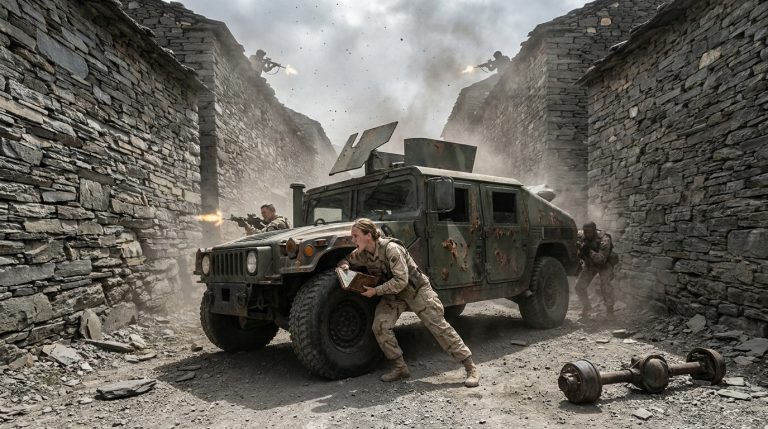
Beneath a stack of standard training manuals, she found it: a leather-bound tactical ledger labeled Stress-Ex Initiative Framework.
She flipped the crisp, yellowing pages with her blood-streaked thumb. Her fingers left dark smudges across rows of neatly logged names, dates, and non-standard inspection stamps that matched the double-struck 4 on the brass shell casing in her pocket. This wasn’t a standard training log. It was a secondary, off-the-books accounting network detailing an initiative implicitly designed to push transfers and recruits to physical collapse to artificially inflate deployment readiness scores for the region.
“You shouldn’t be reading that, Staff Sergeant.”
The voice came from the dark doorway behind her. It was cold, precise, and completely empty of surprise.
Rivers didn’t snap the ledger shut. She turned her head slowly, her one good eye adjusting to the dim light of the annex. Corporal Cooper stood against the doorframe, his arm wrapped tightly in a thick white compression bandage that smelled of fresh iodine. His pale eyes were fixed on the document in her hands. He wasn’t reaching for a weapon; his posture was heavy, weighted down by a deep, defensive pragmatism.
“It’s an authorized framework,” Cooper said, his voice dropping into a transactional whisper that barely cut through the drone of the air compressor outside. “The past base commanders signed off on the readiness metrics. Blake’s just the mechanic running the engine.”
“The engine’s throwing rods, Corporal,” Rivers said, her voice gravelly, hardened by the alkaline dust she’d swallowed in the pit. She pointed to a column of names at the bottom of the page. “These aren’t transfers. Five of these Marines were listed as medical discharge anomalies within a three-month window last year. They didn’t transfer out. They broke permanently.”
Cooper didn’t move from the frame, but his jaw tightened until the thin white scar near his mouth turned gray. “You think you’re the first one to look at the ledger? You think you’re going to take this to Quantico and play the hero? The system doesn’t want heroes, Rivers. It wants scores that look good on paper so the funding stays locked.”
“This isn’t about the funding,” Rivers said, her fingers tracing a discrepancy in the signature lines—the medical clearances weren’t signed by Dr. Martinez, but by an external administrative authority that didn’t exist on the active base roster. The realization hit her with the dull weight of an impact: the decoy secret of an unauthorized training exercise was just the surface layer. The ledger was a systematic record of fatalities that had been scrubbed from the active duty log and hidden under the guise of training accidents.
Suddenly, the heavy metal door at the end of the hall rattled. The distinct, rhythmic thud-crunch of Blake’s boots echoed against the greasy concrete floor, approaching fast. He wasn’t alone; the metallic clatter of base security guards carrying standard-issue gear vibrated through the thin drywall.
“She’s in the administrative block!” Blake’s roar carried through the corridor, laced with an sharp, erratic desperation that had nothing to do with training discipline. “Secure the perimeter and lock down all digital recorders!”
Cooper looked from the hallway back to Rivers, his hand remaining steady on the doorframe. For a second, the math of the entire base hung between them like a taut wire.
“The back window leads to the motor pool wash bays,” Cooper muttered, his voice dropping below the sound of the approaching boots. “The latch is rusted, but if you hit it hard enough with the bar, it opens.”
Rivers stood up, her bruised ribs flaring with a white-hot spike of agony as she tucked the ledger firmly beneath her utility shirt, alongside the cold, notched brass casing. She didn’t thank him. In this yard, alliances weren’t built on gratitude; they were paid for in shared survival.
She gripped the rusted iron reinforcement bar, her eyes locked on the frosted glass of the rear window as the first heavy boot kicked against the outer office door.
CHAPTER 5: THE WEIGHT OF JUSTICE
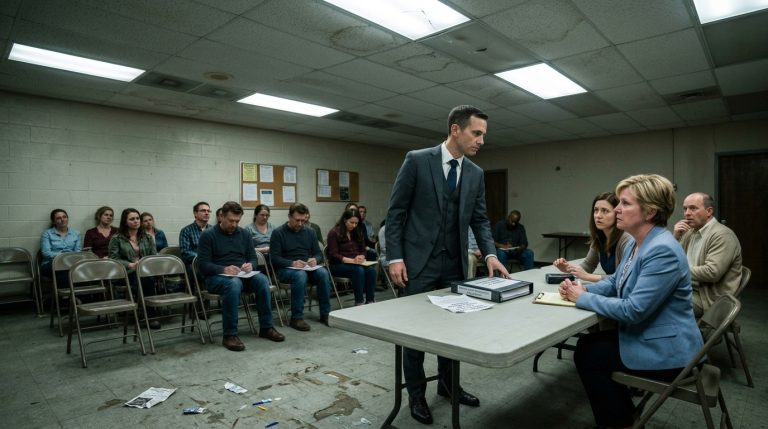
“The data on that drive doesn’t exist in the official logs, Staff Sergeant,” Colonel Rebecca Stone said. Her voice carried the cold, sharp precision of a surgical blade cutting through frozen meat. She didn’t look up from the leather portfolio open on the polished oak table, her fingers tracing the crisp edge of a sheet of unredacted courier text. “And according to the administrative registry at Quantico, the training casualties you’ve logged were discharged under standard medical attrition guidelines.”
Rivers stood at attention in the center of the tribunal room. The air conditioning was high, dropping the temperature to a dry, artificial chill that made the split skin on her lip stiffen and ache. The smell of lemon wax and brass polish hung heavy in the room, a stark contrast to the alkaline dust and grease she had spent days inhaling at Camp Sentinel. She didn’t shift her weight; her posture remained locked, her vertical alignment matching the high back of the empty leather chairs behind her.
“The registry is wrong, ma’am,” Rivers said. Her voice was thin, raspy from the desert dust, but it carried no tremor. Her good eye was locked onto the silver eagles pinned to the Colonel’s collar. “The signatures on the internal clearances don’t match the medical staff roster at Sentinel. They were generated by an external routing key.”
To Stone’s right, Lieutenant Colonel James Park from the Judge Advocate General’s office steepled his fingers, his polished signet ring clicking against the wood with a slow, rhythmic cadence. The room was structurally designed to enforce authority—the high ceilings, the oil portraits of past commandants watching with stern disapproval, the heavy brass fixtures that caught the harsh fluorescent light.
“You’re alleging command-directed forgery, Staff Sergeant,” Park said, his tone flat, indicating a legal calculation rather than skepticism. “That’s a heavy lever to pull. If the data on that body camera and the leather ledger can’t be verified by an independent server, this panel is required by regulation to limit the scope of the inquiry to Sergeant Blake’s immediate tactical misconduct.”
“The verification is inside the binding,” Rivers said.
She reached down, her bruised knuckles making a dry, scraping sound against the fabric of her utility shirt as she produced the ledger she had carried out through the wash bay window. She placed it on the oak table. With a deliberate movement of her thumb, she pressed against the inner seam of the leather cover, pulling back a strip of unstitched lining. Tucked into the recess was a small, flat brass seal—a high-level routing stamp bearing the insignia of the Department of Defense Inspector General’s field office, dated three years prior. It wasn’t an item Blake could have fabricated; it was a structural tool used to lock files away from the standard military database.
Major Walsh from the Inspector General’s office leaned forward, her pen pausing mid-line over her pad. She didn’t look at Blake, who sat two chairs down under the guard of two base security officers, his face the color of old cement, his eyes fixed on the floor.
“That’s a classified routing key,” Walsh murmured, her fingers tipping the ledger to catch the light. “It belongs to a closed investigation into logistics tracking at the western depots. It shouldn’t be within five hundred miles of Camp Sentinel.”
“It was used to clear the transport manifests,” Rivers said. She let her gaze drop to Blake, whose shoulders were hunched low, his standard-issue utilities looking loose and deflated without the shadow of the arena pit to give him mass. “The Marines who didn’t transfer out weren’t just anomalies. Their bodies were processed through the civilian sector using the depot’s transport loop to avoid the internal casualty reporting sequence.”
Blake didn’t move, but a small, wet drop of sweat fell from his chin, spotting the dark grain of the oak table. The two security guards beside him remained perfectly still, their gloved hands resting on their gear belts with a heavy, professional neutrality.
“Staff Sergeant Rivers,” Colonel Stone said, finally closing the leather portfolio with a heavy thud that sounded like a hatch sealing. She stood up, her uniform crisp, her silver eagles catching the white glare from the ceiling panels. “The evidence you’ve brought forward shatters the scope of this tribunal. This is no longer an inquiry into a training exercise gone sideways. This panel is dissolving its authority and transferring the material directly to the civilian federal prosecutor’s office.”
Park stood up beside her, his face completely smooth, his eyes reflecting nothing but the immediate legal protocol. “Sergeant Blake will remain in maximum pretrial confinement at the brig in Quantico. The twelve Marines from the training squad will be held as material witnesses under protective administrative isolation.”
Rivers didn’t offer a salute until Stone reached the door. The Colonel paused, her hand on the brass handle, looking back over her shoulder at the bruised, swollen side of Rivers’s face.
“You did your job, Staff Sergeant,” Stone said quietly. “But the system you just broke isn’t going to fix itself overnight. There’s a lot of old iron left in the ground.”
“I have a shovel, ma’am,” Rivers said.
The door clicked shut, leaving the room in a sudden, heavy silence, broken only by the dry hiss of the air vents. Rivers turned toward the exit, her hand slipping back into her pocket, her fingers closing around the notched brass shell casing, feeling the cold weight of the iron truth she had finally brought out into the light.
CHAPTER 6: THE NEW BLUEPRINT
The Pacific breeze carried the cold, sharp scent of salt spray and wet kelp across the hills of Camp Pendleton, cutting through the heavy smell of diesel exhaust that always lingered near the staging areas. It was a completely different air than the stagnant furnace of the Arizona flats. Here, the moisture stuck to the skin not as sweat, but as a clean, cool film that evaporated almost as soon as it settled.
Staff Sergeant Jordan Rivers stood on the concrete apron of the newly designated Advanced Combatives Training Center. The skin around her left eye had settled completely over the last six months, leaving nothing but a faint, pale line that tracked across her brow like a thread of silver wire. Her ribs no longer ground against each other when she drew a full breath; the tissue had mended into something thick, heavy, and silent.
Below her, twenty-four Marines stood in a perfect, open-ordered rectangle on the freshly laid blacktop. The formation was quiet, but it lacked the defensive, terrified stillness of Camp Sentinel. There were no peeling layers of yellow paint or rusted reinforcement bars jutting from the masonry here. The equipment racks were clean, the canvas straps supple and oiled, and the regulatory plates bolted to the training towers bore the crisp, unblemished serial stamps of active-duty Marine Corps logistics. The old iron had been dug out, broken down, and hauled away.
“Good afternoon, Staff Sergeant,” Corporal Cooper said, his boots clicking in a steady, even cadence against the asphalt as he approached from the administrative shack.
He didn’t wear a compression bandage anymore. His arm moved naturally at his side, his green utilities pressed and clean, the silver non-commissioned officer emblems on his collar catching the pale California light. He was no longer looking for traps or watching the corners of the room for a sudden shift in command metrics.
“The integrated rotation is assembled,” Cooper continued, handing her a plastic-bound clipboard containing the training manifest. “Twenty-four volunteers from the infantry battalions. All medical clearances verified through the division surgeon’s database. No external routing keys.”
Rivers took the clipboard, her thumb brushing the textured plastic. “And the transfers from Sentinel?”
“Sergeant Jackson and Corporal Peterson are already at the northern pit setting up the mats,” Cooper replied, his voice dropping into a level, pragmatic tone that carried no remaining trace of the old anxiety. “They spent the morning checking the torque specs on the safety rigs. They don’t skip the maintenance anymore.”
Rivers walked down the concrete steps, her stride measured, her eyes scanning the faces in the front rank of the formation. They were young faces, lined with the initial grit of field deployments, but their eyes tracked her movements with an unblinking, professional curiosity rather than the sullen hostility she had faced in the desert yard. Among them were men and women who had watched the news from Quantico filter down through the ranks over the winter—the dismantling of the regional readiness scores, the court-martial transcripts published in the official journals, and the federal indictments that had reached all the way to the logistics depots.
She stopped in the center of the formation, her hands resting loosely behind her back, her fingers closed near her utility belt.
“Listen up,” Rivers said. Her voice didn’t rise to a roar, but it carried across the open blacktop with the flat, heavy clarity of bedrock. “For the next six weeks, this facility is going to test the limits of your structural endurance. You will be cold, you will be exhausted, and you will learn exactly how much pressure your joints can handle before the alignment fails.”
She paused, letting her gaze rest on a young lance corporal whose knuckles were taped in standard infantry style.
“But you will not be broken for the sake of a spreadsheet,” Rivers continued, her words cutting through the steady roar of the distant surf. “We are not here to filter out the weak by destroying the engine. We are here to learn the physics of the engagement—how to use leverage when the ground is moving, how to manage friction when the gear is wet, and how to maintain the line when you are outnumbered. Every piece of data you gather here will be paid for in sweat, but the receipt will be signed in your own name. Not a shadow log.”
She turned back toward the training pit where Jackson and Peterson stood by the equipment lockers, their shoulders straight, their movements synchronized as they distributed the heavy combative pads. They didn’t look back at the past; they were focused entirely on the immediate weight of the work in front of them.
Rivers reached into her pocket one last time, her fingers brushing against a smooth, empty space. The notched brass shell casing was gone, buried three weeks ago in the dry earth behind the administrative court at Quantico, a piece of old iron left exactly where it belonged. She drew her hand out, her palm empty, her fingers cold and steady in the salt air.
“Corporal Cooper,” Rivers said, her voice level and final. “Open the gate. Let’s see what they can build.”