The House That Love Built: A Forgotten Home, Three Brave Orphans, and an Old Man’s Last Chance
CHAPTER 1: THE GATHERING AT THE PORCH
The black Mercedes settled into the deep ruts of the dirt lane, its tires crunching over dry grass that hadn’t seen a lawnmower in thirty years.
Richard Morrison killed the engine. He didn’t step out right away. He just sat there in his dark wool suit, gripping the leather-wrapped steering wheel until his knuckles turned as white as his hair.
Through the cracked windshield, the old farmhouse looked like a carcass. The white paint hung off the cedar siding in long, curled strips. The front porch sagged toward the mud, held up by little more than memory and rotted pine.
Then he saw the red.
Bright, stubborn crimson blooming right along the cracked foundation. Yellow roses, too. They didn’t belong in the weeds. Someone had cleared the dead thistles away from the root beds, banking dark, damp soil neatly around the stems.
Richard opened the car door. The summer heat hit his face like a warm wool blanket, smelling of wild sage and damp earth.
A child’s laugh drifted around the corner of the house.
He walked around the driver’s side, his expensive dress shoes sinking two inches into the dirt. Rounding the rotted edge of the back porch, he stopped dead.
Three children were knelt in what used to be his mother’s kitchen garden.
The oldest—a boy no older than twelve with soil caked across his knees—was holding a small wooden bucket. Beside him, a younger boy in a faded green shirt arranged cut stems into a wicker basket. The smallest was a little girl in a blue hand-me-down dress, her tiny fingers carefully untangling a weed from a yellow rose stem.
“You have to be gentle with the taproot,” the oldest boy murmured, his voice low and steady. “Mama said if you snap it now, it won’t come back when the frost hits.”
Richard felt a cold spike run straight through his ribs. “What are you doing here?”
All three children bolted to their feet. The youngest girl grabbed the back of the older boy’s shirt, hiding her face against his spine. The boy in green dropped his shears into the dirt with a sharp clatter.
The oldest boy stepped directly between Richard and the younger two. His chin came up, square and stubborn, even as his shoulders braced for a blow.
“This is private property,” Richard said, his tone sharper than he intended.
“We aren’t breaking anything,” the boy said. His chest heaved once, fast and nervous, but his feet stayed planted. “Inside isn’t safe. We don’t go inside the house. We just work the garden.”
“Who put you up to this?” Richard looked past them toward the empty treeline. “Where are your parents?”
The boy didn’t answer right away. He reached into his pocket and pulled out a dull brass pocket knife, thumbing the closed casing until his knuckles turned red. “It’s just us. I’m Marcus. This is Deshawn and Kesha.”
“That’s not an answer, son.”
“Our mama died eight months ago,” Marcus said, his voice dropping an octave, flat and hard as dried oak. “The county people came to the apartment. They had clipboards. They said they were going to split us up because nobody takes three at once. So we left.”
Richard stared at the boy. “You ran away.”
“We found a place where nobody was looking,” Marcus replied. He pointed a dirt-stained finger toward the rose bushes. “We’re keeping it alive. We aren’t stealing.”
The little girl, Kesha, peeked out from behind Marcus’s hip. She looked at Richard’s tailored suit, then down at his shining shoes, and finally up at his face.
“Homes need flowers,” she whispered. Her voice was barely louder than the wind in the dry grass. “Mama said flowers mean somebody cares.”
Richard turned his head toward the overgrown field, forcing his mouth into a straight line so the kids wouldn’t see his jaw tremble.
Forty-seven years ago, his mother had stood in that exact spot, shaking the garden soil off her apron while his father shouted from the kitchen window. If you leave for that city college, boy, don’t you ever bring your face back to this valley.
He had turned his back then. He had built an empire out of concrete, steel, and ledger books.
And now, three barefoot orphans were standing in his mother’s dirt, doing the job he had been too proud to handle.
CHAPTER 2: THE RUST OF TIME
“We don’t need your pity, old man,” Marcus said. His voice was too thin for the weight he was trying to put behind it, but he didn’t back down an inch. “We work for what we take. I fix the fences down at Miller’s farm when he lets me. I haul wood. We pay our way.”
Richard’s left hand closed around his father’s brass pocket watch deep inside his coat pocket. The casing was cold, heavy, and dead. The internal spring had snapped in 1979, the exact afternoon he’d boarded a Greyhound bus bound for Chicago with sixty dollars and a scholarship letter in his shoe. He thumbed the frozen winding stem, feeling the sharp, worn ridges bite into his skin.
“You’re twelve years old,” Richard said quietly. “You shouldn’t be hauling anything.”
“I’m thirteen next month,” the boy shot back, taking half a step forward to shield Deshawn, who was now clutching his wicker basket like a shield. “And age don’t buy groceries. You left this place to turn to dust. We kept the roof from leaking over the back porch. We kept the water running from the well pump.”
“Marcus,” Deshawn whispered, tugging at his brother’s faded shirt sleeve. “Don’t.”
Richard looked past the boy’s defensive posture, down at the ground where the yellow rose bush met the foundation. The soil was banked perfectly, sloped to let the summer rain drain away from the rotting wooden sill. It was an old farmer’s trick. His mother had taught him that when he was eight years old, dragging heavy buckets of creek mud in the July heat while his palms bled.
He didn’t have his legal team here. He didn’t have his corporate security detail, his private bank accounts, or the political leverage that usually made small-town problems vanish with a single phone call. Out here, on thirty acres of dead weeds and unpaid property taxes, Richard Morrison was just an old man in an expensive suit that was getting ruined by the dirt.
“I didn’t leave it to rot because I hated it,” Richard said. The words tasted like iron in his mouth—dry, heavy, and old. “I left because I was stupid. And I stayed away because I was too proud to come back and admit I’d made a mistake.”
Marcus stared at him, his dark eyes searching Richard’s face for a trick, a threat, or a lie. “You brought paperwork.”
Richard shifted his weight, his dress shoe crunching on a dried branch. “I did.”
“To tear it down,” Marcus stated. It wasn’t a question.
Kesha stepped out from behind Marcus’s hip, her small blue dress covered in faded yellow flower pollen. She held up the pink rose she’d clipped earlier, the stem carefully wrapped in a wet leaf so the thorns wouldn’t prick her fingers. She didn’t say a word. She just extended her arm, offering the bloom across the three feet of weeds that separated them.
Richard took his hand out of his pocket, leaving the stopped watch behind. His fingers were spotted with age, the skin thin over his veins. He reached out and accepted the flower. The petals were cool and damp against his callous-free palm.
“My mother planted these,” Richard murmured, his voice dropping into the quiet space between them. “Forty-seven years ago.”
“We know,” Kesha whispered. “We found her name on the box inside.”
Before Richard could ask what box she meant, a sharp, metallic rattle echoed from the top of the dirt driveway. A white pickup truck with a rusted utility bed was pulling in, kicking up a cloud of dry, tan dust that drifted over the weeds. Painted on the driver’s side door in faded black stenciling were the words: COUNTY BUILDING & CODE ENFORCEMENT.
The truck door slammed shut with the heavy, ungreased clatter of bad iron. A thick-set man in a tan work shirt stepped out, carrying a heavy clipboard under his arm and wearing an off-duty deputy’s badge clipped carelessly to his belt loop.
Marcus’s jaw went slack. He instantly grabbed Kesha by the wrist and shoved her behind his back. “It’s Him,” the boy hissed under his breath. “It’s Vance.”
Richard turned slowly, holding the single pink rose in his right hand, watching the county inspector march down the overgrown path with the absolute, unearned confidence of a man who owned the paperwork.
CHAPTER 3: SHADOWS ON THE PROPERTY LINE
“You’re trespassing, kids,” Vance said, his boots heavy on the gravel as he rounded the front fender of his truck. He didn’t even look at Richard at first, his narrow eyes fixed entirely on Marcus. “I told you last Tuesday if I caught you lurking around this condemned structure again, I was calling Child Protective Services to haul you straight to the shelter in the county seat.”
“We aren’t in the structure,” Marcus said, his teeth clenched so tight his jaw muscles twitched. “We’re in the yard.”
“It’s all one parcel, boy,” Vance barked. He finally turned his head, his eyes sweeping over Richard’s tailored trousers and dirt-smudged leather shoes with open contempt. “And who are you supposed to be? Some hotshot buyer looking to scoop up tax-delinquent acreage?”
Richard didn’t answer immediately. He slowly slid the pink rose into his suit jacket pocket, leaving the stem resting against his lapel. His thumb slipped back into his trouser pocket, finding the cold, dead weight of his father’s brass watch.
“I’m the owner,” Richard said. Plain. Quiet.
Vance paused, his metal pen hovering an inch above his paperwork. A oily smile cracked the corner of his mouth. “Owner? This parcel’s been in county limbo for twenty years. The Morrison estate defaulted on back taxes back in ’04. The county’s preparing it for commercial auction at the end of the month.”
“The taxes were paid through a trust in Chicago every December,” Richard said, staring directly into Vance’s eyes. “I know because the receipts came to my office.”
Vance’s smile faltered for a fraction of a second. A drop of sweat rolled down his thick neck, staining the collar of his tan shirt. He tapped the clipboard harder. “Well, paperwork says different. The structure is declared a structural hazard under Ordinance 41. Condemned. Demolition permit is issued and stamped.”
“I signed that demolition order,” Richard said, stepping forward until he stood directly between Vance and the children. “And as the sole titleholder, I am revoking it.”
“You can’t just revoke a county order on the dirt, old man,” Vance snapped, his voice rising as he tried to regain control of the space. “This property is scheduled for clearing. A developer already put down a earnest deposit with the board. If these vagrants aren’t off the dirt by sundown, I’m having the sheriff clear them out.”
“They aren’t vagrants,” Richard said softly. “They are staying here. With me.”
Marcus shot a fast, desperate look at the back of Richard’s coat. Deshawn pulled Kesha closer, both of them staring at the inspector’s deputy badge with wide, terrified eyes.
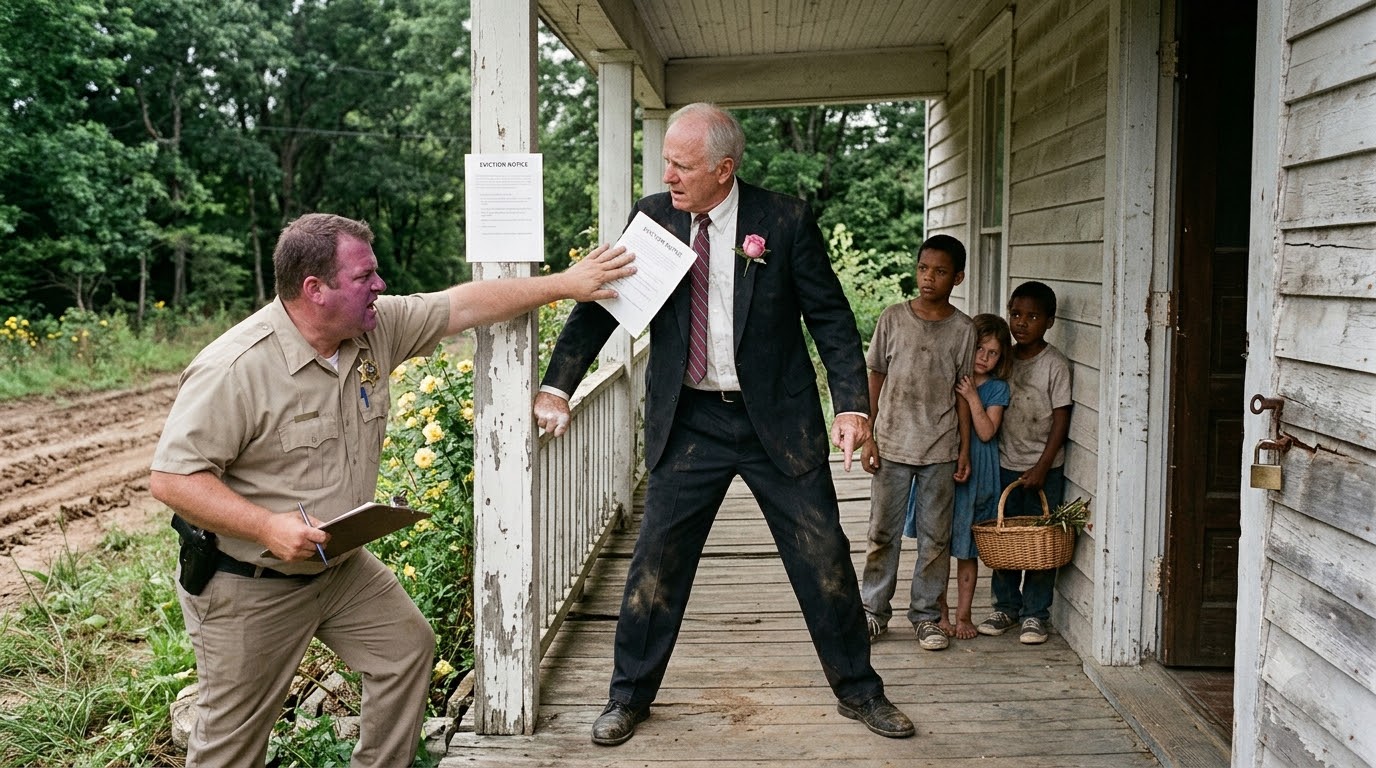
“With you?” Vance let out a dry, rasping laugh. “You think you can just rock up in a fancy car and claim three wards of the state? You don’t have custody. You don’t have a habitability permit for this dump. You have thirty seconds to step aside so I can post this eviction notice on the door, or I call the transport unit.”
Vance lunged forward, reaching past Richard’s shoulder to slap a yellow notice onto the rotted porch pillar.
Richard didn’t push him. He didn’t throw a punch. He simply pivoted his frame, placing his hip against the sagging porch handrail and blocking the doorway with his body. Vance slammed right into Richard’s shoulder, the momentum shoving the inspector back a full step onto the loose gravel.
Vance’s face turned deep purple. “Touch an officer of the county again and see what happens to you!”
“I didn’t touch you. You tripped on the roots,” Richard said, his breath steady despite the hard impact. He pointed a finger down at the doorframe just behind him.
Near the bottom of the jamb, carved deep into the oak siding, was a hand-carved notch—a clean, three-inch mark in the wood, filled with decades of dark grime. It sat right at knee height.
Richard’s eyes locked onto it. He knew that mark. His father hadn’t carved it. His mother hadn’t carved it. It was fresh enough that the grain beneath the grime wasn’t completely rotted—and right next to it, tucked into a split in the cedar siding, was the corner of a rusted iron latch that didn’t belong to the original house.
“Vance,” Richard said, his voice dropping an octave, cold as well water. “Why is there a commercial padlocks keyhole hidden under the siding of a house you claim has been abandoned for twenty years?”
CHAPTER 4: THE HIDDEN CACHE
The white truck backed down the lane at speed, tossing stones against the dry brush until the dust cloud swallowed the red taillights.
Silence collapsed over the yard again, thick and heavy.
Marcus let out a slow, shuddering breath, his hands finally dropping from his sister’s shoulders. “He’ll be back,” the boy said, staring at the empty road. “He always comes back when the sun starts going down.”
“He won’t be back today,” Richard said, his hand still resting against the cedar post right above the hand-carved notch. “And he won’t be putting a lock on this door.”
“We didn’t touch anything inside,” Marcus insisted, his chin coming up again, defensive by muscle memory. “We only went upstairs once when the rain came through the roof last month. That’s where we found the box.”
“Show me,” Richard said.
Marcus hesitated, looking down at Kesha and Deshawn. Then he nodded once, turning toward the sagging front steps. He bypassed the rotted middle board with a practiced step, pushing open the screen door that hung by a single rusted hinge.
The inside of the house smelled of cedar, dry dust, and decades of trapped heat. Sunlight cut through the cracked window glass in narrow, sharp beams, highlighting decades of settled soot on the wide-plank oak floors.
Marcus walked straight past the empty parlor toward the hallway stairs. He didn’t ask permission. He climbed the creaking steps, stepping over the fourth riser where the wood had split straight through.
Richard followed, his leather shoes loud on the bare treads. In his pocket, he thumbed the edge of his father’s watch, feeling the smooth brass case warm against his fingers.
At the end of the second-floor hall, Marcus stopped in front of a small closet door built under the eaves. He reached inside, his small arm disappearing into the dark space, and dragged out a heavy cedar box bound in rusted iron straps.
“It was behind the chimney brick,” Marcus whispered, setting it down on the floorboards between them. “It was covered in canvas. We didn’t break the lock. It was already open.”
Richard knelt on the dusty oak floor, his knees popping softly in the quiet house. He reached out with a hand that shook despite fifty years of corporate boardroom discipline.
He lifted the heavy cedar lid.
Inside lay a stack of yellowed envelopes tied with faded seam binding. Beneath them were old land tax receipts, a set of hand-drawn survey maps, and a thick legal document stamped by a county notary in 1984.
Richard pulled the top envelope free. The ink was faded to a pale brown, but the handwriting was instantly recognizable—his mother’s small, neat cursive.
To my son, Richard Morrison.
His chest felt tight, the air suddenly thin in the small hallway. He slipped his finger under the paper flap, breaking a seal that had remained intact for twenty-seven years.
Inside was a carbon copy of a legal notice dated six months after his father’s death—and a letter written on cheap lined notebook paper.
Richard unfolded the letter.
My dearest Richard, he read, his thumb brushing over the brittle paper. Your father was a hard man, and he said things he shouldn’t have, but he never sent that letter to your college. The lawyer from town, Mr. Miller, brought a paper for your father to sign when he was sick in bed. They said it was a loan. It wasn’t a loan, Richard. It was a lien.
Richard’s eyes tracked across the faded blue ink, his jaw tightening until his teeth burned.
Your father tore up their contract right in front of them. He told them his boy was going to be a big man in the city and nobody was taking the farm. After he passed, they told me you sold your share to Vance’s father. I knew my Richard wouldn’t do that. I planted the roses again this spring so you’d know I was still waiting.
Richard sat back on his heels, the letter resting in his lap.
There had been no family feud over the land. His father had never signed the release. The “default” Vance kept citing wasn’t an unpaid tax debt—it was a thirty-year-old fraud concocted by local land brokers who had waited for an old woman to die so they could grab thirty acres of prime valley soil for pennies.
Marcus leaned in, his voice barely a whisper against the quiet hum of the summer cicadas outside. “Is it bad?”
Richard looked up at the boy. The dirt on Marcus’s forehead was smeared with sweat, but his eyes were wide, clear, and steady.
“No,” Richard said, his voice flat and hard as cold steel. “It’s the truth.”
CHAPTER 5: THE TRAP AT THE COURTHOUSE
The county commissioner sat behind a scratched mahogany desk, his glasses resting on his nose as he shuffled through a stack of yellow tax notices. Beside him stood Vance, his arms crossed over his chest, his off-duty deputy badge glinting under the hum of fluorescent lights.
“Mr. Morrison,” Commissioner Hayes said, his tone dry as bone. “This hearing was called for a emergency abatement. The county building department has filed a priority demolition order for Parcel 402. You don’t live in this county. You haven’t paid local utility fees in forty-seven years. You have zero legal standing to halt an administrative order.”
“I hold the original deed,” Richard said. He didn’t raise his voice. He reached into his coat pocket, took out his father’s dead brass watch, and set it flat on the wooden rail between them.
Vance let out a sharp, wet laugh. “A deed means nothing when thirty years of back assessments are tied up in a municipal lien, old man. I told you yesterday on the dirt. The property is condemned. The welfare office has already dispatched an emergency transport van to pick up those three vagrants from the site.”
Marcus, sitting on the hard wooden bench behind Richard, stood up so fast his chair legs screeched against the linoleum. “We aren’t vagrants! We took care of the house!”
“Sit down, boy!” Vance barked, slamming his fist onto the commissioner’s desk. “You’re a minor living in an unmapped hazard with no legal guardian.”
“He isn’t sitting down,” Richard said. He didn’t look back at Vance. Instead, he reached into his leather portfolio—not to pull out a checkbook or name-drop a high-priced corporate firm, but to pull out the brittle, yellowed paper from his mother’s cedar box.
Richard slid the 1984 carbon copy across the mahogany desk, right over Commissioner Hayes’s tax notices.
“That’s a fraudulent lien notice signed by Inspector Vance’s late father,” Richard said, his voice quiet, flat, and absolute. “And right under it is a notarized affidavit from my mother, Sarah Morrison, proving the county clerk never recorded the original refusal.”
Hayes picked up the paper. His eyes tracked down the faded blue carbon ink. As he read, the color slowly drained from his cheeks. He looked up at Vance. “Where did this come from?”
“It’s a fake!” Vance spat, his neck flushing dark purple as he lunged toward the desk to grab the paper. “He brought a box of old junk from an attic! That paper isn’t in the county database!”
“It isn’t in your database because your father hid it behind the chimney bricks when he tried to force my mother off the land,” Richard said. He stepped forward, his frame blocking Vance’s path to the desk. “The original deed is valid. The taxes were paid into escrow in Chicago every year since 1979. The bank holding that escrow has the stamped receipts.”
“You think you can just come back here after half a century and call me a thief?” Vance roared. He reached down to his belt, his fingers curling around his radio casing. “I have a signed warrant for immediate physical clearing of that parcel! Hayes, sign the transport authorization now or I’ll clear the property myself under emergency code!”
Hayes didn’t touch his pen. He stared at the yellowed signature from 1984, then at Vance’s shaking hands. “Vance. Back off the desk.”
“No!” Vance screamed, his face contorting into an ugly, desperate mask of pure entitlement. “That land was written off! My family put thirty years into managing this township while he was playing big shot in the city! You don’t get to take it back with a piece of dead paper!”
CHAPTER 6: THE GARDEN RECLAIMED
“The demolition warrant is stayed,” Hayes said, his voice flat, dry, and unyielding. “Pending a full review of the county clerk’s archive by the district attorney. The property remains under the title of the Morrison estate. Mr. Vance, step out of this room.”
Vance glared at the paper, then at Richard, his jaw working as if he were trying to chew through iron. He didn’t offer an apology. He didn’t drop his head in shame. He simply grabbed his radio, shoved past the wooden railing, and let the heavy glass door slam behind him so hard the frame rattled.
Richard didn’t watch him go. He reached down and picked up his father’s brass pocket watch from the rail, slipping it back into his jacket pocket.
Marcus let out a ragged breath beside him, his shoulders dropping two inches as he looked up at Richard. “Is it over?”
“It’s over,” Richard said softly.
Late afternoon sun was spilling across the valley when the car turned back down the dirt lane. The dust had settled. The white truck was gone.
Richard stepped out onto the overgrown grass, his dress shoes dusty, his dark jacket unbuttoned. He walked slowly around to the side of the house where the garden lay under the amber light of the setting sun.
Deshawn and Kesha were already down on their knees by the foundation, untangling dried thistles from the roots of the yellow rose bush. Kesha looked up, holding a pair of rusted hand shears in her small dirt-stained fingers.
“We didn’t let them cut them,” she whispered.
Richard knelt in the dirt beside her, not caring about the wool fabric of his trousers. He took the shears gently from her hand, thumbing the dull steel edge.
“We need to clear the dead wood first,” Richard said, his voice steady as he reached into the base of the bush to snip a withered branch. “Then the new stems get light. That’s how my mother did it.”
Marcus walked over, dragging a heavy wooden bucket of fresh well water he’d pulled from the back pump. He set it down near the root bed, wiping his forehead with the back of his arm. He didn’t say anything, but he didn’t move away either. He just stood there, watching the water settle in the bucket.
Richard reached into his pocket, pulled out the dead brass watch, and held it out toward Marcus.
The boy looked at it, then up at Richard’s face. “What’s this for?”
“My father gave it to me when I was twelve,” Richard said, placing the cold metal case into Marcus’s palm. “The spring’s broken. It doesn’t tell time anymore. But it reminds you where you started.”
Marcus closed his fingers around the brass, thumbing the worn ridges just as Richard had done all week. He tucked it carefully into his shirt pocket, right over his heart.
The front door of the house stood open, the cool evening air moving through the hall, carrying out the stale scent of soot and dust. Inside, on the second-floor floorboards, the open cedar box rested in the shade, its contents finally cleared.
Richard took the pink rose Kesha handed him and set it on the bottom porch step, right beside the hand-carved notch in the doorframe.
He sat down on the wooden step, resting his elbows on his knees, watching the three children work the dark dirt under the warm summer sky.