An Eighty Four Year Old Veteran Stands Tall Against Corrupt Authority To Teach A Hard Lesson In Grace
CHAPTER 1: THE MOCKERY ON THE BENCH
The question laced with casual disdain echoed in the cavernous silence of the courtroom.
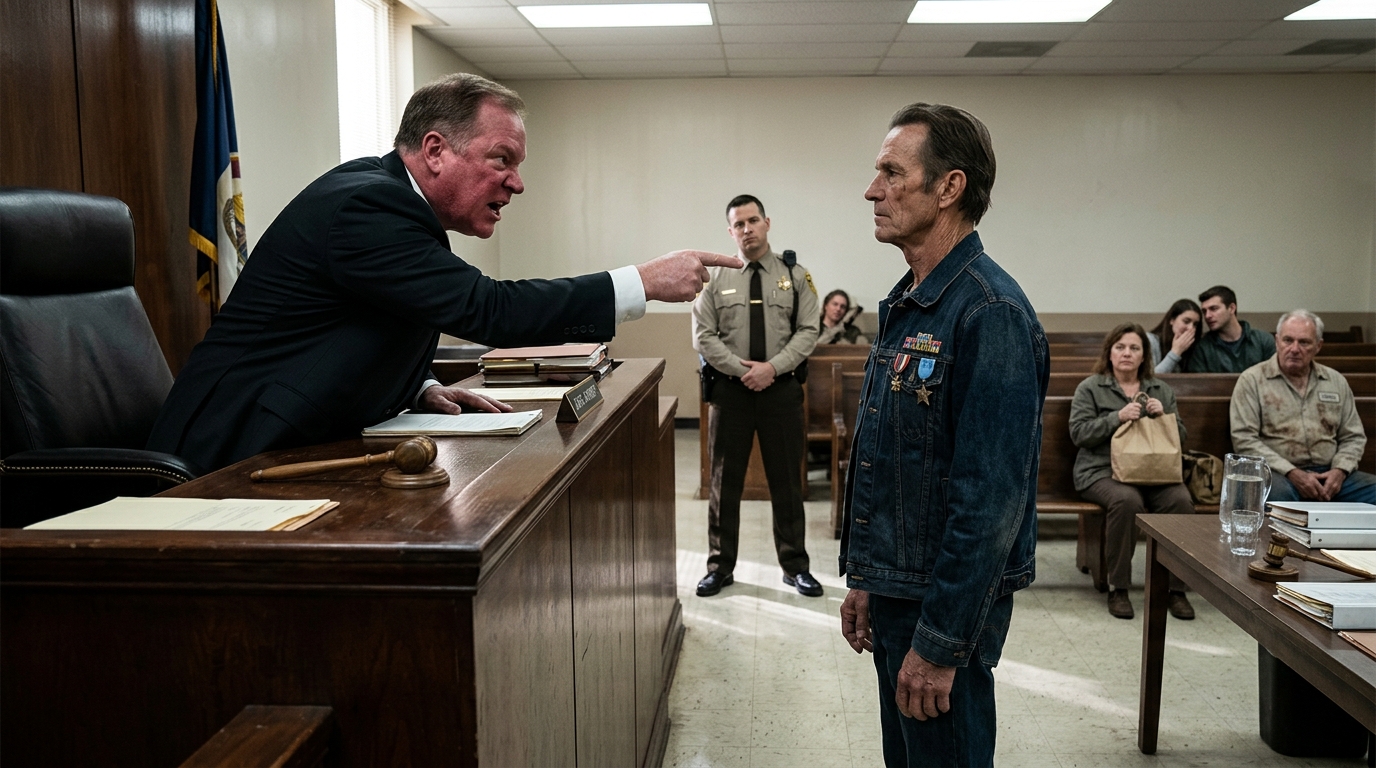
Judge Albbright leaned forward over his polished dais, a sharp smirk playing on his tailored lapels.
Fred Hudson stood perfectly still, his back straight beneath a faded denim jacket that had seen decades of weather.
Pinned to the left breast were three rows of ribbons and a single star hanging from a pale blue ribbon.
The judge peered down with amusement, enjoying the petty authority of his position.
Let me guess, you bought those at a surplus store, Albbright said, his voice carrying easily across the wooden benches.
Fred said nothing, his gray eyes fixed steadily on the state flag hanging behind the bench.
He didn’t fidget, letting the quiet friction of the room settle around him like heavy dust.
Sarah Jenkins stood up at the defense table, her face flushed with frustration.
Your honor, my client’s service record has no bearing on a simple traffic infraction, she said.
Albbright waved a dismissive hand, keeping his gaze locked on the old man’s chest.
I am just curious, counselor, because tin badges don’t give anyone a free pass on county roads.
CHAPTER 2: THE WEIGHT OF MEMORY
The silence in the room stretched thin, strained by the quiet rhythm of Fred’s fingers tapping against the worn wooden edge of the defense table.
It was a steady, measured beat that seemed entirely disconnected from the sharp, mocking gaze fixed upon him from the raised bench.
Judge Albbright shifted his weight, the heavy leather chair creaking in protest as he waited for a defense or an apology that clearly was not coming.
Instead of panic, the old man’s mind drifted away from the polished linoleum floor and the sterile scent of floor wax.
A sudden, sharp memory flickered—the suffocating humidity of a distant jungle canopy where every shadow held a hidden threat.
He wasn’t standing under the glare of fluorescent courtroom lights, but knee-deep in sucking mud, carrying the crushing weight of a wounded kid whose breathing sounded like dry leaves scraping together.
The heavy thud of a distant mortar round echoed faintly in his ears, blurring the boundary between the past and the cold present.
Back in the room, Sarah Jenkins watched the old man’s expressionless face with a growing knot of anxiety in her stomach.
She looked down at the case file open before her, noting the blank spaces where his service history should have been detailed, stripped down to a bare minimum by his own humility.
Fred didn’t blink as the judge leaned forward again, the authority of the small-town court pressing down like an iron weight.
You seem remarkably comfortable ignoring the gravity of these proceedings, Mr. Hudson, Albbright snapped, his voice sharp enough to cut glass.
Fred’s fingers stopped their rhythmic tapping against the wood.
He raised his gaze, meeting the judge’s angry glare with eyes as calm and unreadable as a winter morning.
CHAPTER 3: THE ESCALATION OF CONTROL
Judge Albbright leaned back into the worn leather of his high-backed chair, his face flushing a mottled, irritated red.
The silence of the room was no longer just empty air; it was a wall of quiet defiance coming straight from the old man’s motionless posture.
Take the jacket off, the judge commanded, his voice cracking slightly with the strain of suppressed frustration.
A murmur rippled through the small gallery of spectators near the back row, people shifting uncomfortably in their seats.
Sarah Jenkins stood up sharply, her hands gripping the edges of the defense table until her knuckles turned white.
Your honor, you cannot be serious about this order, she said, her voice shaking with righteous indignation.
Albbright pointed a thick finger across the mahogany bench, his patience completely evaporated.
This is my courtroom, counselor, and that display of costume jewelry is a deliberate distraction from the law.
The bailiff took a heavy, hesitant step forward, his boots scraping loudly against the polished floorboards.
Fred did not look at the approaching officer, nor did he look up at the elevated bench.
Instead, his gaze remained steady on the blue ribbon pinned over his heart, a quiet anchor in a room spinning out of control.
His refusal to move hung heavier than any spoken word, transforming his silence into an immovable obstacle that the court’s authority could not break.
Fine, add a charge of contempt of court and a heavy fine to his docket, Albbright snapped, slamming his gavel down with enough force to rattle the water pitcher.
CHAPTER 4: THE INTERNAL STAND
Sarah Jenkins slammed her case file down onto the scarred wooden table, the slap of cardboard echoing louder than intended.
You cannot order a psychiatric evaluation over a routine traffic dispute and a bruised ego, your honor, she said, her voice dropping into a dangerous, level register.
Judge Albbright leaned forward, his face dark with the absolute certainty of unchecked power.
Try me, counselor, because the bailiff is already waiting to clear the docket, he snapped back, refusing to yield an inch.
Fred remained seated, his hands resting quietly on the edge of the table, feeling the cold grain of the wood beneath his palms.
He did not raise his voice, nor did he look around for an escape that wasn’t there.
There were no generals coming to pull him out of this room, no outside rescue to rewrite the rules of this small-town bench.
He had only his own endurance, forged decades ago in circumstances that made this petty courtroom look like a child’s game.
If you want to lock an old man up for wearing his history, you will have to look at the room while you do it, Fred said, his voice quiet, steady, and heavier than the judge’s hammer.
Albbright’s jaw tightened, a muscle jumping in his cheek as he realized the old man was not breaking.
CHAPTER 5: THE COLLAPSE OF ARROGANCE
Judge Albbright shifted uncomfortably in his high leather seat, the earlier bluster draining into a harsh, defensive glare as the old man refused to break.
You think your silence makes you clever, old man, but it only digs a deeper hole for your defiance, Albbright snapped, slamming a pen against the desk.
Sarah Jenkins held her ground beside the defense table, watching the judge’s composure fracture under the sheer weight of public observation from the gallery.
The small crowd had stopped shifting, their eyes locked entirely on the bench, realizing the sheer absurdity of punishing a veteran for wearing his history.
Fred met the angry gaze without flinching, his voice carrying a quiet, rasping authority that didn’t need a gavel to command attention.
A gavel doesn’t make a man right, your honor—it just makes him loud when he has nothing else left.
Albbright’s face mottled into a dark shade of crimson, his mouth opening to double down on the contempt charge before he caught the collective murmur rising from the back row.
CHAPTER 6: THE QUIET AFTERMATH
Weeks after the courtroom doors closed on Albbright’s tenure, the daily routine of a quiet local diner offered a different kind of justice.
The bell above the entrance chimed, letting in a draft of cool morning air as a man stepped inside with hesitant, heavy steps.
It was Albbright, stripped of his tailored suits and imposing robes, wearing a simple polo shirt that hung loosely on his frame.
He spotted Fred sitting alone in the corner booth and walked over slowly, his eyes fixed on the linoleum floor.
Mr. Hudson—can I sit down? the former judge asked, his voice drained of all authority.
Fred gestured simply to the empty vinyl seat across from him without a word of mockery or triumph.
Albbright slid into the booth, his fingers nervously working the edge of the laminate table.
I wanted to say I am sorry for what happened—there was no excuse for my arrogance back then, he muttered, finally meeting the old man’s gaze.
Fred took a slow, measured sip from his white porcelain coffee mug, letting the silence settle between them like old dust.
I hear you aren’t on the bench anymore, Fred said, his tone entirely neutral.
No, I am not, Albbright admitted, a heavy weight visible in the slump of his shoulders.
Good—a man shouldn’t hold a post he doesn’t have the heart to respect, Fred replied, pushing the spare menu across the surface.
The coffee is good here.