The Weight of a Warm Plate: How One Quiet Waitress Stood Against a Cold Town and Ignited a Movement
CHAPTER 1: THE COLD SIDEWALK
The rain didn’t fall; it drove sideways, hissing against the cracked neon sign of Billy’s Diner like water hitting a hot skillet. Clara shifted the cardboard box in her arms, the wet cardboard biting into her knuckles. Her canvas shoes were soaked through, turning every step onto the pavement into a squelch of cold mud. Behind her, the heavy glass door swung shut, locking with a dull, final click that echoed over the empty street.
Wayne Becker didn’t watch her leave from the window. He had already turned back toward the grill, his broad back a wall of indifferent grey flannel. The few customers inside stared straight down into their coffee mugs, their spoons clinking against ceramic with careful, rhythmic precision. Nobody raised a hand. Nobody met her eye.
Clara kept her spine straight, lifting her chin just enough to keep the water out of her eyes. Her grandfather’s voice was a steady hum beneath the roar of the storm: Stand tall, Clara. Even when you feel small. She stepped off the curb, her breath pluming white in the chill air, and began the long walk toward the auto garage.
The room above the garage smelled permanently of stale motor oil and damp cedar. When she pushed the door open, Smokey the cat didn’t even lift his head from the frayed corner of the rug, merely twitching one scarred ear at the sound. Clara set the box down on the wobbly laminate table and peeled off her sodden brown apron, wringing it out over the small plastic sink. The water ran grey with dish soap and grease.
She checked her pockets, pulling out the damp, frayed dog tag Eli Turner had pressed into her palm. The metal was icy against her skin, etched with the numbers that the world had apparently decided to forget. F472. She set it gently beside her remaining sixty-four dollars and thirty-eight cents, the absolute limit of her earthly security.
Downstairs, a heavy truck engine sputtered, choked on the damp air, and died with a metallic cough. The single overhead bulb in her room flickered once, plunging her into sudden, absolute darkness. Clara didn’t reach for a candle. She simply sat down on the edge of the iron cot, wrapped her arms around her ribs, and listened to the rain beat a relentless, heavy rhythm against the glass.
CHAPTER 2: THE LOCKED DOOR
The cold bite of the iron bedframe against her shoulder blades faded as the morning frost painted intricate, brittle ferns across the inside of the cracked window glass. Clara pulled her thin blanket tighter around her shoulders, her eyes burning from a night spent staring at the water-stained plaster ceiling. Downstairs, the heavy rattle of the auto garage’s main shutter signaled the start of another day, shaking the floorboards beneath her cot.
She reached into the dark drawer where Smokey slept, her fingers brushing against the cold, worn edges of Eli Turner’s dog tag.
Sixty-four dollars and thirty-eight cents.
That was the exact distance between keeping the oil heater running and walking out into the freezing March slush to find a meal. Clara slid her arms into her damp coat, the fabric stiff and smelling faintly of old fryer grease, and stepped down the creaking wooden stairs into the grey morning light.
The wind off the river carried the sharp tang of coal smoke and wet asphalt. Main Street looked much as it always did, a stretch of peeling paint and faded storefronts that time had quietly bypassed. But today, the air felt different. Doors clicked shut just a fraction faster as she walked past.
At the local hardware store, the brass bell chimed softly as Clara pushed the door open to drop off an application.
Old man Henderson didn’t even look up from his ledger. He just kept sweeping his gray broom across the splintered floorboards, the straw making a dry, rhythmic scratch against the wood.
—We aren’t hiring, Clara, he muttered without turning around.
—I can help with the inventory on Saturdays, she said, her voice steady despite the dry tightness in her throat.
Henderson stopped sweeping. He leaned his weight on the broom handle, staring down at a knot in the floorboards as if it held the secrets of the universe.
—Wayne Becker was by here yesterday, Henderson said softly, his voice dropping an octave. He told the block you brought trouble inside. Said anyone taking on stray hands would find their commercial lease doubled by next month.
Clara felt the words settle into her chest like a handful of wet gravel. She didn’t argue. She didn’t beg. She simply laid the folded application on the counter, turned on her heel, and walked back out into the cold.
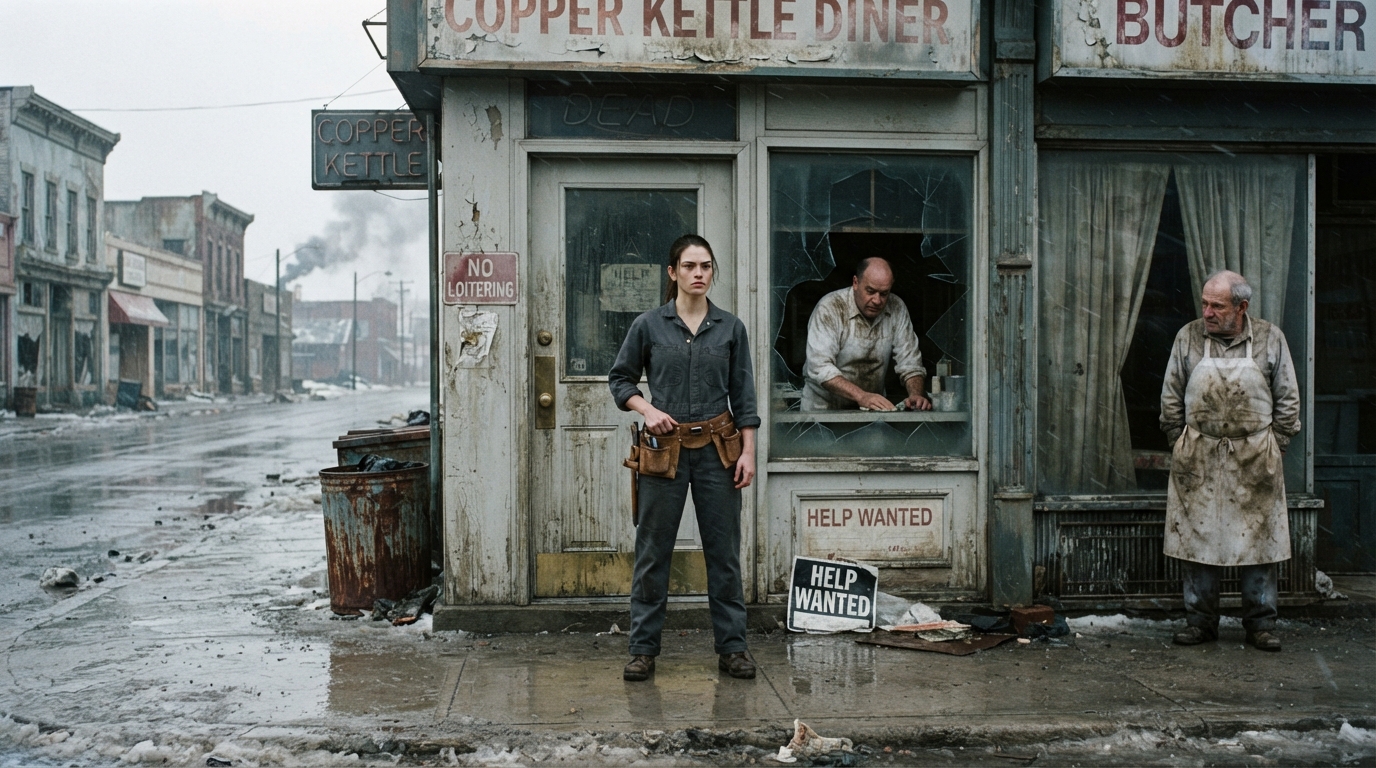
The second diner down the road, a grease-spotted joint called the Copper Kettle, had a handwritten sign taped to the glass: HELP WANTED – INQUIRE WITHIN. Clara paused by the window, her reflection ghosting over a stack of greasy pie plates.
Inside, the manager was wiping down the counter, but the moment he saw her face through the rain-spattered pane, his hands froze mid-wipe. He looked past her toward the empty street, his eyes darting nervously toward the corner where Billy’s Diner sat under its dead neon sign.
He didn’t shake his head. He didn’t even mouth an apology. He simply reached out, ripped the paper sign off the glass, and flipped the door’s deadbolt with a loud, final click.
Clara stood alone on the pavement, her breath pluming white in the freezing air. The dog tag in her pocket felt heavy, like a lead weight pulling her down into the mud.
CHAPTER 3: THE ALLEY SHELTER
The slick, muddy edge of the rusted dumpster bit into Clara’s knuckles as she balanced against it to keep her footing in the driving sleet. Beneath the tattered plastic sheet of the bus shelter, Eli Turner was coughing, a dry, rattling sound that shook his narrow shoulders beneath his soaked military coat.
She dropped to one knee in the slush, extending a small, grease-stained brown paper bag containing the last half of a dry turkey sandwich.
—Here, she said, her voice cutting through the hiss of passing traffic.
Eli didn’t take the food right away. His swollen, callused fingers trembled as he fumbled with the inner flap of his pocket, pulling out a stiff, yellowed document folded into a tight square.
—They locked the doors, didn’t they? he wheezed, his eyes clouded with fever and exhaustion.
—They’re listening to Wayne Becker, Clara replied, keeping her tone flat and grounded.
She reached out to steady the trembling paper bag, her thumb brushing against the edge of Eli’s coat lining. A thick, unusual ridge caught her skin—something sewn deep into the heavy wool lining, completely separate from the lining’s normal seams.
Eli noticed her hesitation and clutched the coat tighter to his chest.
—Not just a coat, miss. My father carried this out of the old Ridgefield Foundry when they padlocked the gates in seventy-four, he muttered, his breath pluming white. They thought they burned every record.
He didn’t give her time to ask. He thrust the folded paper into her palm before pulling the plastic sheet lower over his face.
Clara slipped the damp packet into her apron pocket, the stiff paper crackling against her thigh as she stood back up in the freezing rain. The sleet stung her cheeks, but her mind was entirely clear of the morning’s despair.
CHAPTER 4: THE UNSEEN LEDGER
The cold metal of the lamp post bit into Clara’s shoulder as she pressed back against it, shielding the crackling paper deed inside her coat from the freezing drizzle. Across the street, the neon sign of Billy’s Diner flickered erratically, casting a sickly green glow over the wet pavement where Wayne Becker was locking the front entrance.
Wayne gave the heavy brass handle an aggressive jerk, testing the latch twice before turning around to survey the quiet block with an air of smug ownership.
He didn’t know about the paper folded against Clara’s ribs. He didn’t know that the land underneath his commercial kitchen had never truly belonged to his grandfather’s estate.
Clara stepped out from the shadow of the overhang, her canvas shoes making a steady, deliberate sound against the flagstones.
Wayne caught sight of her movement and stopped dead in his tracks, his thick arms crossing over his chest as he puffed out his grey flannel vest.
—Still hanging around, Clara? he barked, his voice carrying easily across the empty street. Thought I made it clear the health board doesn’t like vagrants loitering near licensed entries.
—You’re standing on ground you don’t own, Wayne, Clara said, her voice entirely flat, stripped of all the old deference she used to wear like a shield.
Wayne let out a sharp, grating laugh that echoed off the brick storefronts.
—I hold the title, sweetheart, he sneered, stepping forward with his chin jutting out. Every square foot of this block is locked down tight under my family name since nineteen eighty.
—Nineteen seventy-four, Clara corrected, her hand sliding into her pocket to brush against the rough edge of the yellowed document. Before the foundry records were sealed.
Wayne’s smug expression tightened, a sudden bead of sweat breaking out along his hairline despite the freezing air.
—You’re talking nonsense, he snapped, though his eyes darted nervously toward the municipal office down the block. Get off this property before I call the county sheriff and have you hauled away for trespassing.
CHAPTER 5: THE GATHERING STORM
The gritty texture of gravel ground beneath Clara’s boot heels as a convoy of heavy, olive-drab utility trucks rolled around the corner, their diesel engines rumbling through the damp morning air. They didn’t stop at the municipal office or the closed gates of the old factory. One by one, the vehicles pulled in tight formation along the curbside directly outside Billy’s Diner.
Car doors clicked open in unison.
Men and women in worn service jackets and heavy boots stepped out onto the wet pavement, their faces set with quiet, unbreakable resolve. There were no cameras flashing, no internet streamers shouting for attention, and no digital recordings to save the moment. Just dozens of veterans standing shoulder to shoulder in the freezing morning drizzle.
Wayne Becker yanked his diner door open, his face flushed dark red with sudden, uncontained fury.
—I called the county! Wayne screamed, his voice cracking over the low idle of the trucks. You’ve got no business blocking my entrance! This is private property!
Colonel Matthew Turner stepped forward from the front rank, his shoulders squared, his eyes locked dead on the diner owner.
—It never was, Wayne, Matthew said, his voice carrying an absolute, heavy calm that cut through the street noise.
Clara stood quietly near the back of the formation, her fingers resting on the yellowed foundry deed in her pocket.
Wayne’s chest heaved as he frantically searched the crowd for an ally, finding only the silent, unyielding wall of veterans staring him down.
—You can’t do this! Wayne roared, his hands clawing at the wooden doorframe as he realized every loophole had just evaporated.
CHAPTER 6: THE UNYIELDING STAND
The cold, rough grain of the wooden counter pressed against Clara’s palms as the rhythmic ticking of the wall clock marked the exact moment Wayne Becker’s commercial leverage finally shattered. He gripped the edge of the register, his knuckles turning white as he stared down at the yellowed foundry deed spread flat across the laminate.
—This is forged, Wayne snarled, his voice pitching high and frantic. You can’t just pull scrap paper out of a gutter and claim ownership of a licensed building!
—It’s registered with the county archives under the original 1974 cooperative trust, Colonel Matthew Turner said calmly, laying a certified municipal seal beside the document. Your grandfather signed away the commercial rights as a tax lien waiver forty years ago.
Wayne lunged forward, his face mottled red, attempting to swipe the papers off the counter.
Clara didn’t flinch. She simply stepped into his path, her spine straight, using her shoulder to block his reach with unyielding, quiet strength.
—You’re finished here, Wayne, Clara said plainly.
The diner door stood wide open to the morning light, letting in the steady, orderly hum of the community gathering outside. Wayne looked frantically from the crowd of veterans blocking the entrance to the empty register, his blustering fury collapsing instantly under the weight of his own miscalculated greed. He didn’t confess, and he didn’t apologize—he simply dropped his head, turned on his heel, and pushed his way through the kitchen service door into the back alley, never to return.
By the following week, the old diner sign had been taken down, replaced by a fresh wooden board above the doorway: Ridgefield Community Kitchen.
Clara stood behind the counter, her brown apron clean and neatly tied, pouring a cup of black coffee for a regular who had walked in out of the morning chill. Smokey the cat slept peacefully on a folded plaid blanket by the front window, bathed in warm spring sunlight.
She reached into her apron pocket, her fingers brushing against the cold, worn metal of Eli Turner’s dog tag.
No cameras flashed. No internet trends chased the quiet room.
She just wiped the counter clean, set the steaming mug down with a steady hand, and welcomed the next person through the door.