Salt Stains and Stolen Slips: A Veteran’s Quiet Stand Against Corporate Greed on the Coast
CHAPTER 1: THE NEW SLIP ORDER
The salt crust on the mahogany toe rail was thick enough to flake off under a fingernail. Walter Briggs rolled a scarred brass pocket compass between his thumb and forefinger, feeling the cool, familiar drag of the metal against his skin. Around him, the early morning air of Bayfield Shores smelled of diesel exhaust and low tide mud. He stepped off the bow of the Horizon Bell, his rubber-soled work boots hitting the weathered cedar planks with a dull, heavy thud. He reached out to grab the mooring line, but his hand stopped short.
A fresh aluminum plate was bolted directly into the piling where his slip number had lived for fifteen years. The black stamped lettering glared back at him in the cold morning light. Reserved for Platinum Members Only. No notice had crossed his porch, and no phone call had broken the static of his old kitchen landline. Walter did not sigh. He simply adjusted the canvas duffel bag on his shoulder, his joints popping with the quiet stiffness of seventy-seven years on the water, and walked down the pier toward the glass-fronted marina office.
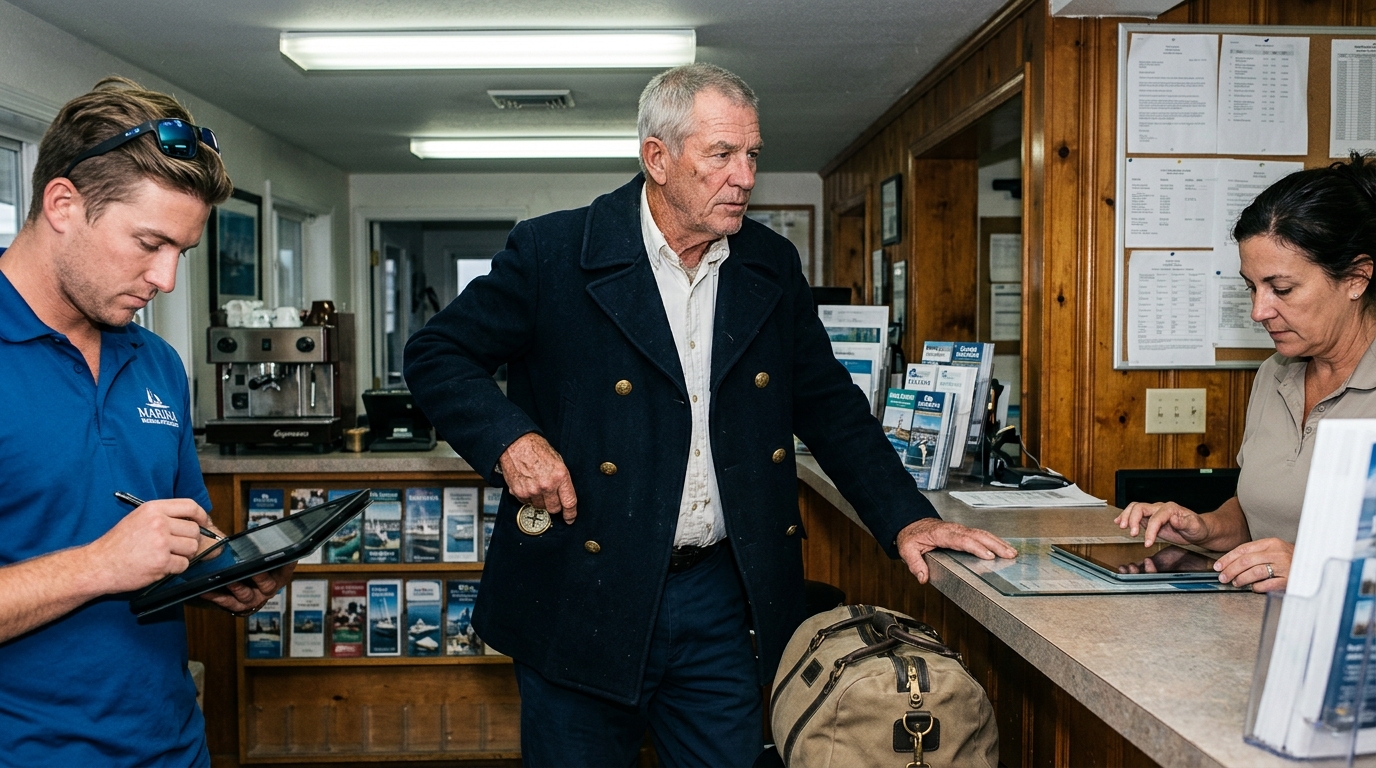
Inside, the carpet was thick, and the air smelled of artificial citrus and roasted espresso beans. A young clerk with immaculate hair tapped away at a sleek glass tablet, refusing to look up as the screen door squeaked on its hinges. Walter dropped his canvas bag onto the polished vinyl floor with a soft, heavy thud. The clerk finally raised her eyes, her expression tightening into a practiced, customer-service smile that reached nowhere near her brow.
“If you are looking for transient parking, the visitor slips are down past the fuel dock,” she said, her voice bright and hollow.
Walter set both palms flat on the slick composite counter, leaning his weight forward. “Slip twelve has been my berth since two thousand nine,” he said, his voice level and raspy like dry timber. “The plate on the piling just changed.”
The clerk tapped her tablet twice, her synthetic fingernails clicking against the screen. “Oh, we have updated our layout. You have been reassigned to dock six near the fuel station.” Walter did not blink. He stared at the smooth glass of her screen, watching her reflection drift as she scrolled past his name without a second glance.
CHAPTER 2: THE MARINA MANAGER WARNING
The glass door of the marina office swung open with a soft, pneumatic hiss. A sharp scent of expensive cologne cut through the smell of citrus spray. Chad Ellison strode across the plush carpet, a white marina-branded polo stretched tightly over his chest, his polarized sunglasses resting casually atop his styled hair. He glanced at the clerk, then down at Walter, his gaze lingering on the worn fabric of the old denim shirt.
“Is there an issue here, Carrie?” Chad asked, not bothering to look at Walter directly.
“Mr. Briggs was just reviewing our updated berth assignments,” the clerk replied, her voice dropping an octave into professional smoothness.
Walter slipped the compass back into his pocket, the metal click muffled by the wool lining. “Slip twelve has held my boat for over a decade,” Walter said, his voice flat and steady. “The power line at six is dead, and the crude oil buildup from the pumps fouls the hull within three days.”
Chad tapped a sleek black tablet against his thigh, the plastic casing catching the fluorescent overhead glare. “We are curating a specific visual standard for this harbor, Mr. Briggs. That wooden hull of yours is past its prime.”
“She floats better than your paperwork,” Walter answered, his eyes fixed on the younger man’s expression.
Chad’s smile thinned into a hard, white line. He stepped closer, the smell of cologne growing heavy in the small room. “You received the compliance notice on your windshield two days ago. If your vessel does not meet our aesthetic guidelines by the end of the week, we initiate towing protocols under commercial lease clause twelve.”
Walter did not blink or step back. He reached down, picked up his canvas duffel bag by the frayed strap, and let the heavy brass hardware clink against the counter. “I’ll be seeing my students on Wednesday morning,” Walter said. “Make sure the gate code works.”
Chad tapped his tablet screen with a sharp, aggressive motion, his thumb hovering over the glass. “You can bring whatever children you like, old man, but they won’t be boarding anything in the main basin.”
CHAPTER 3: TEACHING THE QUIET KIDS
The morning breeze carried a damp chill off the inlet, rippling the surface of the dark water against the wooden pilings. Walter laid out eight orange life vests along the varnished cabin roof of the Horizon Bell, aligning the buckles with methodical precision.
A yellow school bus wheezed to a halt in the tarmac turnaround near the gate, its brakes hissing in the salt air. Eight fifth-grade students spilled out onto the pavement, clutching brown paper lunch bags and blinking against the glare of the morning sun. Their teacher, Laya Jennings, hurried ahead of them, her clipboard tucked under her arm as she scanned the unfamiliar layout of the modernized marina.
Walter walked up the gangway to meet them at the gate, wiping his palms clean on his denim trousers. “Morning, Miss Jennings,” Walter said, his voice cutting cleanly through the murmur of traffic behind them.
Laya offered a tight, polite smile, her brow furrowed as she looked past him toward the sleek speedboats lining the central slips. “Good morning, Walter. The school board had a few calls about the new parking rules, but we made it through.”
One of the smaller boys in the group stared wide-eyed at the weather-beaten hull of the Horizon Bell, his fingers tightening around the strap of a faded blue backpack. “Is that really the boat?” the boy asked, pointing a small finger at the polished brass fittings.
Walter knelt down on one knee, ignoring the dull ache in his joints, and unlatched a small brass tackle box. “She’s seen more water than these glass boats ever will,” Walter said. “Come on aboard, one at a time, and mind your step on the wet cedar.”
The children filed down the narrow pier, their sneakers tapping rhythmically against the wooden planks. Walter stood at the gunwale, offering a steady hand to each student as they stepped onto the deck, his grip firm and unyielding against the rolling tide.
CHAPTER 4: THE PUBLIC DOCK EVICTION
Chad Ellison strode briskly down the center of the pier, his tablet clutched in one hand while his other hand adjusted the sunglasses perched atop his gelled hair. He did not look at Walter, keeping his eyes fixed on the small children standing nervously near the gunwale.
“You cannot dock here, Mr. Briggs,” Chad said, his voice carrying clearly across the quiet water toward the handful of tourists sipping coffee on the nearby patio. “This isn’t your assigned slip anymore.”
Walter let go of the rail, his joints stiff as he straightened to his full height. “I’ve had a birth agreement here for fifteen years, and these children have a scheduled trip,” Walter replied, his voice raspy and measured.
“That was before the rebrand,” Chad snapped, tapping his tablet screen with an aggressive motion that made the glass glare in the sunlight. “We are a platinum-tier destination now, and this vessel violates our revised visual standards.”
Laya Jennings stepped forward from the cabin entrance, her clipboard clutched tightly against her chest. “These students have permission forms, and we booked this excursion weeks ago,” Laya said, her tone sharp with disbelief.
Chad waved a dismissive hand toward the gate. “I don’t care about your paperwork. This marina serves a high-end clientele, and we don’t serve people like you.”
A dead silence fell over the wooden pier, broken only by the lapping of water against the old pine pilings. Walter’s fingers tightened around the worn papers in his pocket, but he did not raise his voice or step toward the younger man. Instead, he looked past Chad’s shoulder at the children, gave a quiet, steady nod, and reached down to untie the bow line.
CHAPTER 5: SILENCE ON THE WATER
The vintage diesel engine muttered to life with a low, metallic cough, vibrating through the mahogany deck plates under Walter’s work boots. He adjusted the throttle lever with a scarred thumb, keeping the bow pointed steadily toward the open inlet away from the rows of luxury yachts.
Laya Jennings stood near the cabin housing, her hands resting lightly on the shoulders of two quiet students who watched the receding docks with wide, unblinking eyes. “We didn’t have to leave, Captain Briggs,” Laya said, her voice strained against the rising slap of salt spray against the hull.
“The dock isn’t the water,” Walter replied, his eyes fixed on the gray line where the horizon met the bay. “Let them have their concrete.”
There was no phone call to save them, and no sudden broadcast of outrage to turn the tide. The harbor office behind them shrank into a distant white blur against the green coastline. Walter reached into his jacket pocket, his fingers brushing the cold, smooth metal of the brass pocket compass. He guided the vessel out past the breakwater into the deep, choppy swells, letting the steady rhythm of the engine drown out the frustration of the morning.
By midday, the children were leaning over the gunwale with wooden handlines, watching the green depths for signs of migrating bass. Walter stood at the helm, his posture rigid and unyielding, enduring the cold wind without a word of complaint.
CHAPTER 6: THE RUSTED TRUTH SETTLES
The municipal office door remained locked, its sleek glass panels darkened against the twilight. Inside, the glowing display of the management terminal flashed an unheeded system warning regarding expired commercial zoning filings.
Chad Ellison slammed a cardboard box onto the edge of his mahogany desk, his knuckles turning white as he shoved his personal belongings into the tight space. “This town doesn’t understand high-end growth,” Chad muttered, his voice echoing off the empty walls of the corporate suite.
Walter stood outside on the weathered timber planks, his boots planted firmly against the grain of the dock. He reached into his pocket and pulled out the folded, unsigned zoning notice he had retrieved from the office trash bin days earlier, sliding it smoothly into the metal box of service records inside his cabin.
The out-of-state development board’s property devaluation scheme lay exposed in black and white, stripped of corporate euphemisms and left bare to the salt air. There were no flashing cameras or cheering crowds to mark the collapse of the artificial luxury mandate.
Instead, the old commercial dock simply remained where it was, bolted to pilings that had weathered fifty years of northern gales. Walter turned his back on the glass office, stepped down into the cockpit of his boat, and began winding the heavy mooring line into a clean, tight coil.