Rusted Nickel and Burned Steel: How a Quiet Waitress Held Her Ground Against Corporate Arrogance
CHAPTER 1: THE MORNING GRIDDLE
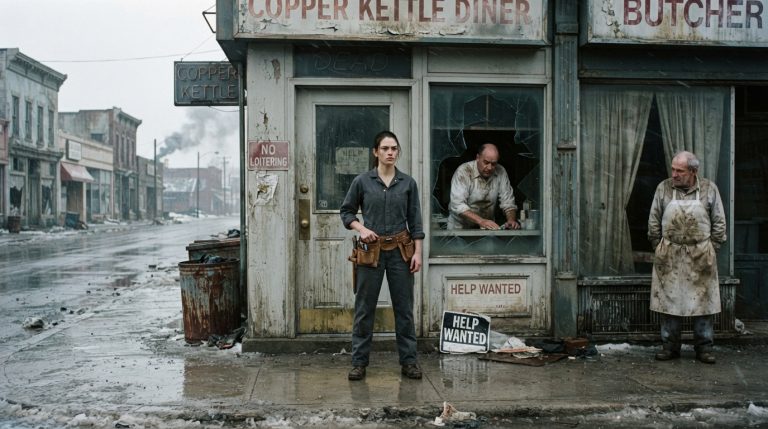
The neon open sign flickered once before settling into a dull red hum that cast long shadows across the linoleum floor. Isabella Cruz pulled her faded blue apron tight around her waist, the cloth catching slightly against the raised, uneven tissue of her right hip.
She did not rush her movements. Every step across the worn floorboards was deliberate, measured by years of muscle memory that predated the diner by a decade.
Outside, Highway 12 remained a gray ribbon stretching through the pre-dawn mist, silent except for the occasional distant rumble of an 18-wheeler downshifting past the county line.
Inside, the air tasted of stale coffee grounds, bleach, and old grease. Isabella reached out and gripped the handle of the dented stainless-steel coffee pot, her thumb pressing firmly against the worn metal hinge until her knuckle turned white.
The weight of the pot grounded her, anchoring her attention entirely to the immediate physical task of wiping down counter number four.
A floorboard groaned near the swinging kitchen door, and Margaret Benson poked her graying head out from the back office with a tired smile.
“Coffee’s smelling strong this morning, Izzy,” Margaret said, her voice raspy from decades of cheap cigarettes and early shifts.
“Strong enough to wake the dead,” Isabella replied, her tone flat, dry, and entirely devoid of complaint.
She set a clean mug down beside the salt shaker with a soft, dull clink, keeping her eyes fixed on the spotless Formica surface.
She didn’t think about the past, and she didn’t think about what the day might drag across the threshold. There was only the heat of the flat top, the rhythm of the rag, and the steady pulse of her own breathing in the quiet dark.
CHAPTER 2: THE ARROGANT INTRUSION
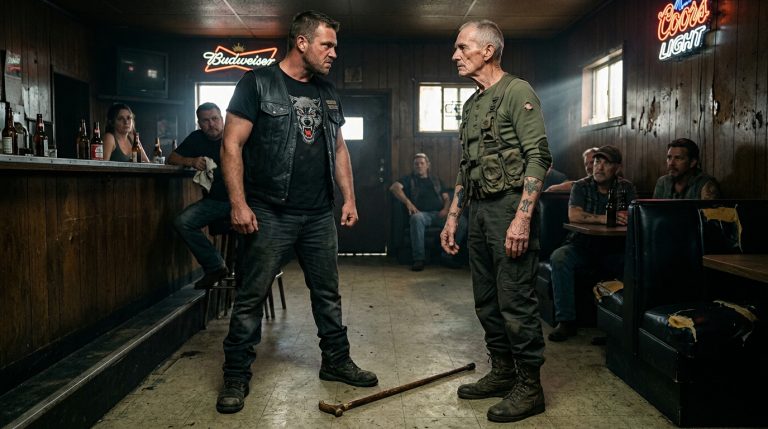
The three men did not wipe their boots. They moved with the loose, unchallenged swagger of men who believed every room they entered belonged to them by default.
Their suits were tailored, charcoal-gray wool that looked entirely out of place against the faded Naugahyde booths and grease-stained walls of May’s Diner.
Margaret stepped out from the kitchen doorway, her hand instantly smoothing down her apron with a defensive tuck.
“We’re open, but seating is self-service,” Margaret said, her voice tight, holding a professional edge that didn’t quite mask her irritation.
The leader of the trio—a tall man with slicked-back hair and a sharp, narrow jaw—ignored her entirely.
His eyes swept over the worn tables, his nose twitching slightly as if he had just smelled something offensive on the bottom of his shoe.
“This place smells like a grease trap from the Eisenhower administration,” the lead man said, not bothering to lower his voice as he slid into the corner booth by the window.
His two companions laughed on cue, a dry, synchronized sound that hung heavy in the stale air.
Isabella didn’t look up immediately. She kept her thumb pressed against the edge of the service counter, her eyes fixed on the dirty coffee mug she was wiping.
She felt the old familiar tension settle across her shoulders, tightening the skin around her neck where the scars ran deep beneath her collar.
It wasn’t fear; it was the cold, flat recognition of an old enemy wearing a different uniform.
The leader snapped his fingers toward the counter, a sharp, metallic sound that echoed off the acoustic tiles.
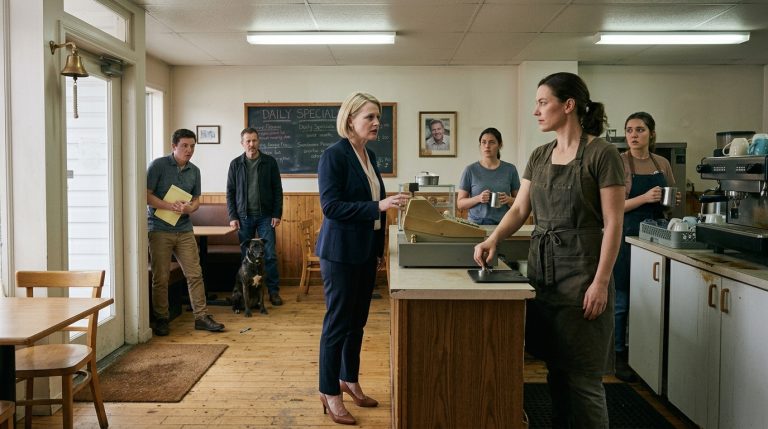
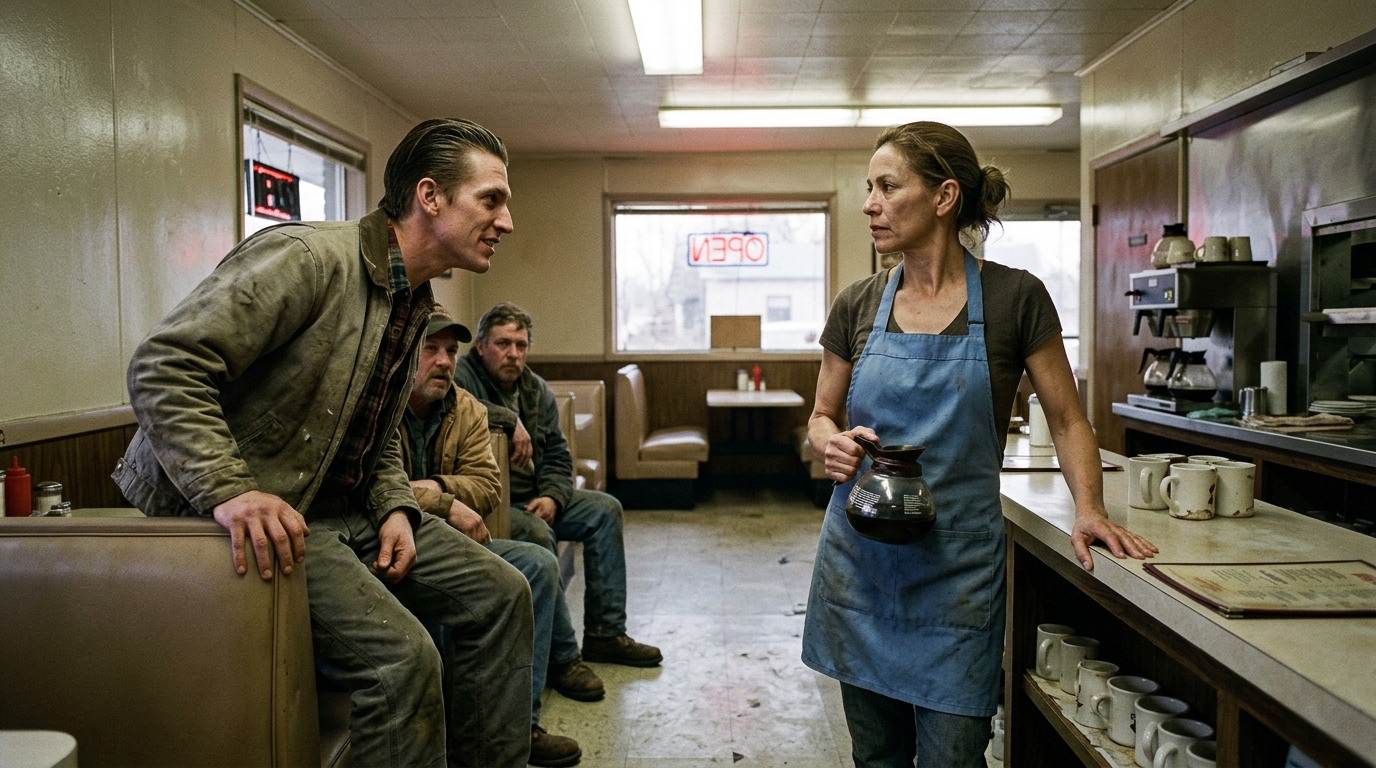
“Hey. You with the face,” the man called out, his gaze locking directly onto the raised tissue tracing Isabella’s jawline. “Bring us three black coffees and your breakfast menu. And make it quick. Some of us have actual business in this county.”
CHAPTER 3: THE SNIDE REMARK
The silence in the diner stretched thin, held together only by the hum of the old refrigerator near the pie case.
The truck drivers in the front booths lowered their coffee cups without making a sound, their eyes fixed squarely on the floorboards.
The tall man in the charcoal suit leaned forward, crossing his arms over the Formica table and letting a dry, humorless chuckle escape his lips.
“I’m serious,” the man said, lifting his chin toward Isabella’s neck where the scars branched out beneath her collar. “You really think someone like you belongs out here serving people? Wouldn’t dishwashing in the back be more appropriate?”
The words hung in the stale air like dropped ironware.
Isabella did not flinch, nor did the slight tremor in her fingers betray her.
Instead, a sharp, distant flash of dust and diesel smoke flickered behind her eyes—a sensory phantom of a ruined transport vehicle in Fallujah—before vanishing back into the cold reality of Highway 12.
She kept her breathing even, drawing a quiet measure of control from the familiar weight of the coffee pot.
“I’ve served men like you before,” Isabella said, her voice steady, low, and completely devoid of heat. “But in far worse places.”
The man blinked, his smirk faltering for a single beat as his companions shifted uncomfortably in their seats.
CHAPTER 4: THE STEADY RETORT
The lead man’s face flushed a dull, mottled red under the fluorescent lights of the diner.
He shifted his weight in the booth, his expensive wool sleeve catching on the sticky edge of the laminate table.
“You think you’re tough because you worked a kitchen?” the man snapped, his voice rising sharply in an effort to reclaim the room’s attention. “People like you don’t dictate how business gets run in this county.”
Isabella did not blink. She lowered the pot an inch, keeping the spout pointed safely toward the empty ceramic mug.
“If business meant walking over people who built this town, you wouldn’t last five minutes out here,” Isabella said, her tone entirely even, carrying the heavy weight of a quiet truth.
The truck driver in booth two let out a low, gravelly grunt of approval that rattled the bottom of his saucer.
The second and third executives began staring intently at the water stains on their menus, suddenly finding the laminated paper fascinating.
The lead man opened his mouth to retort, but the sheer wall of her unyielding composure stopped the words in his throat.
Isabella turned away without waiting for an answer, her boots clicking evenly against the floor as she carried the pot back toward the service station.
CHAPTER 5: THE SURVEYORS STAKE
The afternoon sun beat down flat and merciless against the cracked asphalt of Highway 12.
Isabella pushed through the heavy back exit door, carrying a plastic crate filled with empty glass bottles toward the outdoor bins.
The cool metal handle bit into her calloused fingers as she stepped past the grease trap and into the narrow gravel alley behind the building.
Something caught the toe of her work boot—a sharp, unyielding resistance that scraped against hard iron.
She paused, looking down past the edge of the rusted dumpster where the diner’s gravel lot met the overgrown brush of the county line.
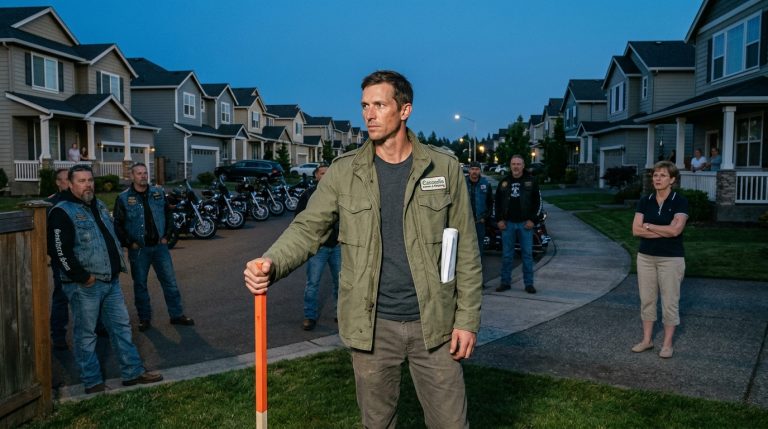
Driven deep into the packed dirt was a bright orange surveyor’s stake, topped with fluttering plastic ribbon and a small aluminum tag stamped with corporate registration numbers.
A cold, methodical realization settled over her chest.
This wasn’t just about three arrogant men mocking a scarred waitress over morning coffee; the arrogant intrusion was a distraction from a coordinated land seizure.
She crouched down, her fingers brushing the cold metal of the stake, feeling the exact boundary marker of a silent buyout designed to push May’s Diner off the map.
CHAPTER 6: THE QUIET LINE
Margaret stopped beside the open back door, her graying hair catching the pale morning light as she looked down at the bright plastic ribbon fluttering in the wind.
“They didn’t come for breakfast yesterday, did they?” Margaret asked, her voice dropping into a raspy, flat realization.
Isabella stood up slowly, her knees popping with the stiffness of old injuries, and brushed the dry dirt from her faded blue apron.
“No,” Isabella replied, her tone calm and steady as she looked past the property line toward the highway. “They came to measure what they thought they already owned.”
The lead executive stepped out from the side path two hours later, his charcoal suit jacket unbuttoned, flanked by his two associates and carrying a thick leather briefcase.
He marched straight toward the back door with an arrogant stride, stopping short when Isabella stepped out onto the gravel threshold to block the path.
“Listen here,” the executive sneered, pointing a manicured finger toward the orange marker in the brush. “This property transfer was filed and approved by the county board. Your little diner is sitting on land earmarked for commercial development. You have forty-eight hours to clear out.”
Isabella did not raise her voice, nor did she flinch under his glare.
She simply reached into her pocket, pulled out the small aluminum tag she had unscrewed from the stake, and dropped it into the man’s open palm with a sharp, heavy clink.
“This county is full of people who try to take what isn’t theirs without looking at who’s standing in the way,” Isabella said, her eyes locking onto his with the immovable weight of an old veteran holding a frontline. “And I’ve survived worse fires than a corporate desk job.”
The executive blinked, his face turning pale as he looked down at the metal tag, then up at the gathering crowd of local truckers and regulars stepping out from the front entrance.
Without another word, he snatched his hand back, turned on his heel, and hurried his associates back toward their sedan, tires spitting gravel as they tore down Highway 12.
Margaret watched them vanish down the road, letting out a long, slow breath before a genuine, unguarded smile broke across her weathered face.
“Coffee’s fresh, Izzy,” Margaret said softly, turning back toward the kitchen.
Isabella followed her inside, untying her apron, hanging it on the hook, and picking up her own mug of black coffee as the neon open sign hummed quietly in the morning light.