The Quiet Man With The Broken Broomhandle And The Unforgiving Gate That Refused To Stay Closed
CHAPTER 1: THE YELLOW LINE
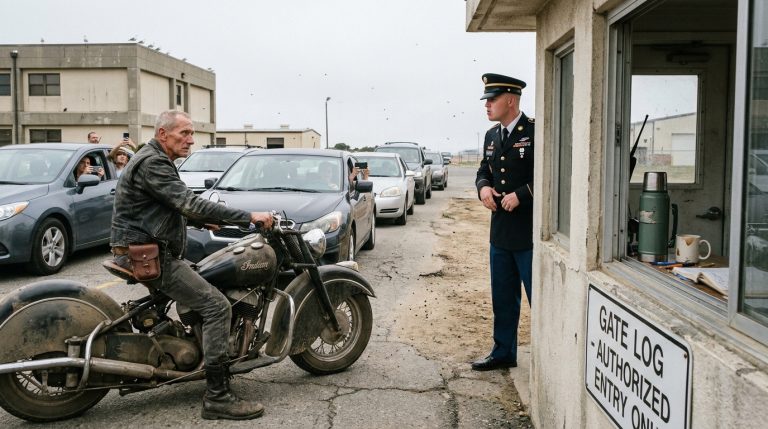
The eastern gate smelled of stale diesel and cold asphalt. Aaron didn’t look up when the canvas-covered jeep idled to a halt near the guard shack.
His palms wrapped tight around the splintered pine handle of the push-broom. The wood had been sanded smooth by forty years of calloused friction.
“Sir. Step back behind the painted curb.”
The MP was young enough to still believe a neatly pressed uniform made him bulletproof. His hand hovered inches from his holster.
Aaron moved his left boot back two inches, exactly to the edge of the yellow line. He didn’t speak. Voice was a wasted resource when dealing with a man who hadn’t learned how to listen.
“I said behind the line,” the soldier repeated, stepping forward to close the distance. “New command directive. No loitering within fifty yards of active perimeter fencing.”
Aaron’s grip tightened until his knuckles turned ash-white against the grain. The morning wind rattled the chain-link fence behind him.
Colonel Ror’s black sedan was parked twenty yards back, engine rumbling with quiet efficiency. The new commander sat inside, watching through tinted glass.
Aaron lowered the broom head against the concrete, the bristles making a dry scraping sound that cut through the idling engine noise.
“The wind carries the trash against this fence every night,” Aaron said, his voice flat, gravelly, and entirely devoid of fear. “Somebody has to clear it before the morning shift rolls out.”
“We have a maintenance crew for that,” the MP snapped, reaching out to grab the wooden handle.
Aaron didn’t pull away. He simply let the man take the weight, locking his elbows and holding his ground with the stubborn mass of a granite milestone.
CHAPTER 2: THE SPLINTERED HANDLE
The MP’s fingers tightened around the composite sling of his rifle, his youthful jaw clenching in frustration.
Aaron did not blink.
“You heard the order, old man,” the soldier muttered, his voice dropping an octave to mask a sudden spike of uncertainty. “Step back or we clear the fence line ourselves.”
“The fence line clears itself when the wind drops,” Aaron replied, his voice remaining as level as a carpenter’s plumb line.
He didn’t release his grip on the splintered pine handle.
Across the asphalt, the idling engine of Colonel Ror’s black sedan cut out with a sharp metallic tick as the block cooled in the morning air.
The rear door clicked open, and polished low-quarters hit the gravel with deliberate, heavy cadence.
Colonel Ror didn’t rush. He walked with the measured stride of an administrator who viewed every human interaction as a budgetary line item requiring immediate reduction.
“Is there an issue at the perimeter, Miller?” Ror asked, not looking at the private, his eyes fixed entirely on Aaron’s faded canvas jacket.
“Just clearing the loiterer, sir,” the MP answered quickly, shifting his stance. “He refused the initial directive.”
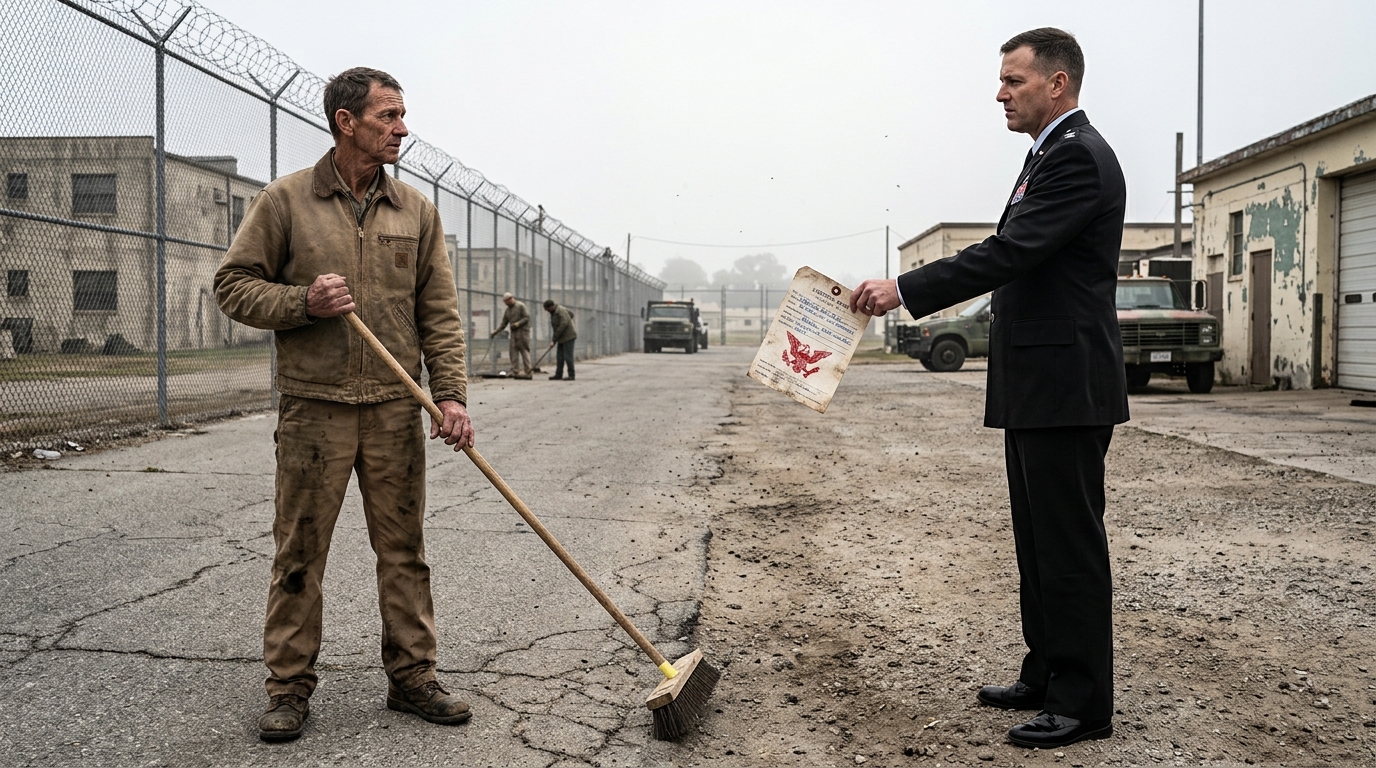
Aaron let the wooden push-broom slide three inches to the left, the bristles scraping over a half-buried logistics tag that had blown in from the motor pool.
The tag was stamped with standard blue ink, but underneath the grease smudge sat a secondary marking—a small, angular corner stamp that had no business being on a trash manifest.
It was the same red-inked family crest Aaron had spotted four decades ago on the supply manifests of Operation Thunderline.
“You’ve been lingering past the warning threshold for three consecutive mornings, civilian,” Ror said, stopping two paces short of the yellow line.
“This asphalt gets tracked with mud every time a transport rolls out,” Aaron said, his thumb running over a rough knot in the broom handle. “Somebody has to sweep it.”
“The installation employs a dedicated sanitation detachment,” Ror replied, his eyes narrowing as he scanned the weathered lines of Aaron’s face. “You aren’t on the payroll. You aren’t on the roster. You are a variable.”
“Variables cause problems,” Aaron said quietly, lifting the broom head just an inch. “Ignored variables cause wrecks.”
Ror stepped directly up to the yellow line, his chest inches from Aaron’s face, smelling faintly of dry-cleaning chemicals and stale bunker coffee.
“You have twenty seconds to pick up your bucket and clear the perimeter before I have the guard detail confiscate your equipment as unauthorized base debris.”
Aaron’s gaze didn’t waver from the colonel’s polished lapel pins, his mind calculating the exact distance to the base library archive where the old training manifests were boxed.
CHAPTER 3: THE SEALED ARCHIVE
Dust motes hung suspended in the pale fluorescent hum of the subterranean records room.
Private Jason Miller dropped a cardboard storage box onto the scarred oak table, the impact sending up a dry cloud that caught in the back of his throat.
“You shouldn’t be digging down here, Miller,” a voice muttered from the shadows near the microfiche reels.
It was Corporal Davis, arms crossed over his utility blouse, watching with a mixture of boredom and caution.
“Ror’s office put a temporary hold on the 1977 operational files this morning,” Davis added, tapping a finger against his belt buckle. “Orders came straight down from command. Said it’s a security audit.”
“An audit that happens to target a missing unit from forty years ago?” Jason snapped back, pulling the rusted metal latch of the storage box. “Look at this manifest.”
Jason slid a brittle, yellowed paper across the scarred wood.
At the bottom corner, right below the scratched-out supply allocations for Operation Thunderline, sat a sharp, crimson imprint of an eagle crest.
It was the exact same red-inked family crest stamped onto the logistics tag Aaron had recovered near the eastern gate.
Davis leaned forward, his eyes tracking the ink smudge before his expression hardened into uneasy silence.
“That crest belongs to the Ror family estate,” Davis whispered, glancing nervously toward the stairwell exit. “My uncle served in logistics back then. He said the supply lines weren’t cut by enemy fire—they were diverted to clear a private inventory before the extraction chopper ever touched down.”
“And the command structure buried the whole platoon to keep the audit quiet,” Jason said, his hands curling over the edge of the table.
Upstairs, heavy boots echoed across the concrete floor, stopping directly outside the archive door.
The brass handle jiggled twice before a sharp knock rattled the frosted glass.
CHAPTER 4: THE COUNTERORDER
The brass knob turned with a dry, metallic click.
Colonel Ror pushed the door open, his eyes fixed not on Corporal Davis, but directly on the open storage box spread across the scarred oak.
“You’re tracking dirt into a sterile records bay, Private,” Ror said, his voice dropping into a flat, measured register that left no room for debate.
“We found the 1977 supply diversion orders, Colonel,” Jason said, standing up straight and keeping his hands flat against the table edge.
Ror didn’t glance at the paper. He didn’t have to.
“Those documents are classified under active administrative review,” Ror replied, stepping fully into the narrow aisle and blocking the exit path. “Hand over the metal box from the eastern gate and step away from the terminal.”
“That box contains personal property belonging to a civilian contractor,” Davis interjected, his voice tight with sudden hesitation as he shifted his weight.
“That box contains unverified base debris that violates perimeter safety codes,” Ror snapped, his chin lifting in an arrogant display of unearned authority. “And you are currently assisting an unauthorized individual in breaching restricted administrative holdings.”
Aaron remained silent near the back shelves, his fingers curling over the wooden handle of his push-broom.
He didn’t need to raise his voice. He had seen this exact expression forty years ago in a jungle command tent before the supply lines vanished.
“You can confiscate the paper,” Aaron said, his low voice cutting cleanly through the tension. “You can seal the files until the ink rots off the page.”
Ror turned his sharp gaze toward the old man, his lips thinning into a cold, contemptuous smirk.
“You finally understand your place, old man.”
“The paper doesn’t change what’s buried out by the eastern fence,” Aaron continued, stepping out from the shadows with slow, deliberate pacing. “A ledger can be rewritten. A missing platoon leaves a gap that every new guard notices when the wind blows.”
CHAPTER 5: THE WEIGHT OF IRON
The fluorescent lights overhead buzzed with a low, electrical whine that matched the tension in the narrow corridor.
“Step aside, Colonel,” Aaron said, his voice dropping into the flat, heavy cadence of a man who had stared down worse than a desk-bound commander.
“You are trespassing in a restricted military holding,” Ror replied, his face darkening with absolute, unearned outrage as he planted his polished shoes squarely in the center of the walkway. “And these men are aiding an administrative breach.”
Private Jason Miller didn’t flinch, holding his ground beside the scarred oak table with his fists clenched at his sides.
“The records are right here, Colonel,” Jason said, his voice ringing clear against the concrete walls. “You can’t seal forty years of logistics fraud just because your family crest is stamped on the margin.”
Ror’s jaw twitched, a sudden muscle spasm betraying the panic beneath his rigid exterior.
“That manifest is a forgery,” Ror barked, raising his voice to drown out the accusation. “Confiscate that box immediately, Corporal!”
Corporal Davis stood frozen between the two officers, looking down at the red-inked family crest before slowly shaking his head.
“I’m not touching it, sir,” Davis muttered, taking a deliberate step backward.
Aaron didn’t wait for the argument to settle.
He lifted his push-broom, sliding the worn wooden handle forward until it rested horizontally against the colonel’s chest.
It wasn’t a violent strike, but an immovable barrier of raw, unyielding physics.
“The gate opens at 0600 sharp tomorrow,” Aaron said, his gaze locking onto the frantic pulse in Ror’s neck. “And I’ll be there with my broom, making sure the path is clean enough for the truth to walk through.”
CHAPTER 6: THE UNBROKEN ROUTINE
Colonel Ror tried to bat the wood aside, his face flushing a deep, mottled crimson under the fluorescent glare.
“You’re done here, Mitchell,” the colonel hissed, his fingers curling into tight, trembling fists at his sides. “I’ll have the MPs escort you off the perimeter and impound every scrap of gear you own before noon.”
“Try it,” Aaron said, not shifting an inch of his weight.
Behind the colonel, Private Miller stepped forward with a clipboard pressed firmly against his chest, sliding a carbon copy of the logistics manifest straight into the space between them.
“The regional inspector general’s office received the unsealed inventory copies thirty minutes ago, sir,” Jason announced, his voice steady and completely devoid of fear. “The supply diversion audit is already outside your jurisdiction.”
Ror snatched the paper, his eyes darting frantically across the red-inked family crest before he crumpled the edge between his thumb and forefinger.
“This is an administrative error,” Ror shouted, his voice cracking against the concrete walls as the surrounding corridor filled with curious junior officers peering around the corners. “You can’t pin a logistical shortfall from forty years ago on active command!”
“The paperwork isn’t what’s standing in your way, Colonel,” Aaron replied quietly, pulling the broom back just enough to step past him.
The colonel spun around, opening his mouth to issue another desperate, retaliatory counter-order, but the words choked in his throat as he looked down the corridor.
A dozen soldiers and base maintenance workers stood in silence, blocking the exit, their arms crossed and their eyes locked squarely on Ror’s uniform insignia.
No one saluted. No one stepped aside to make room for his authority.
Ror opened his mouth to threaten disciplinary action, then closed it, the sudden realization of total structural collapse draining the last of the color from his face.
He turned on his heel and marched down the side passage, swallowed by the shadows of his own empty command.
Aaron watched him go, then turned his gaze back toward the eastern gate where the morning wind was beginning to clear the last of the pale Nevada fog.
He lowered the push-broom against the asphalt, his calloused hands settling comfortably onto the familiar, splintered grain of the pine handle.
The sun broke over the rooftops, hitting the edge of the chain-link fence and warming the cold concrete beneath his work boots.
Aaron moved his broom forward in a slow, steady stroke, sweeping the dust from left to right, exactly where it belonged.