The Rusted Truth of the Canyon Road Where a Quiet Pragmatist Turned an Ambush Into a Masterclass of Survival
CHAPTER 1: THE WEIGHT OF DUST
The engine vibration rattled through the floorboards with a dry, rhythmic thrum.
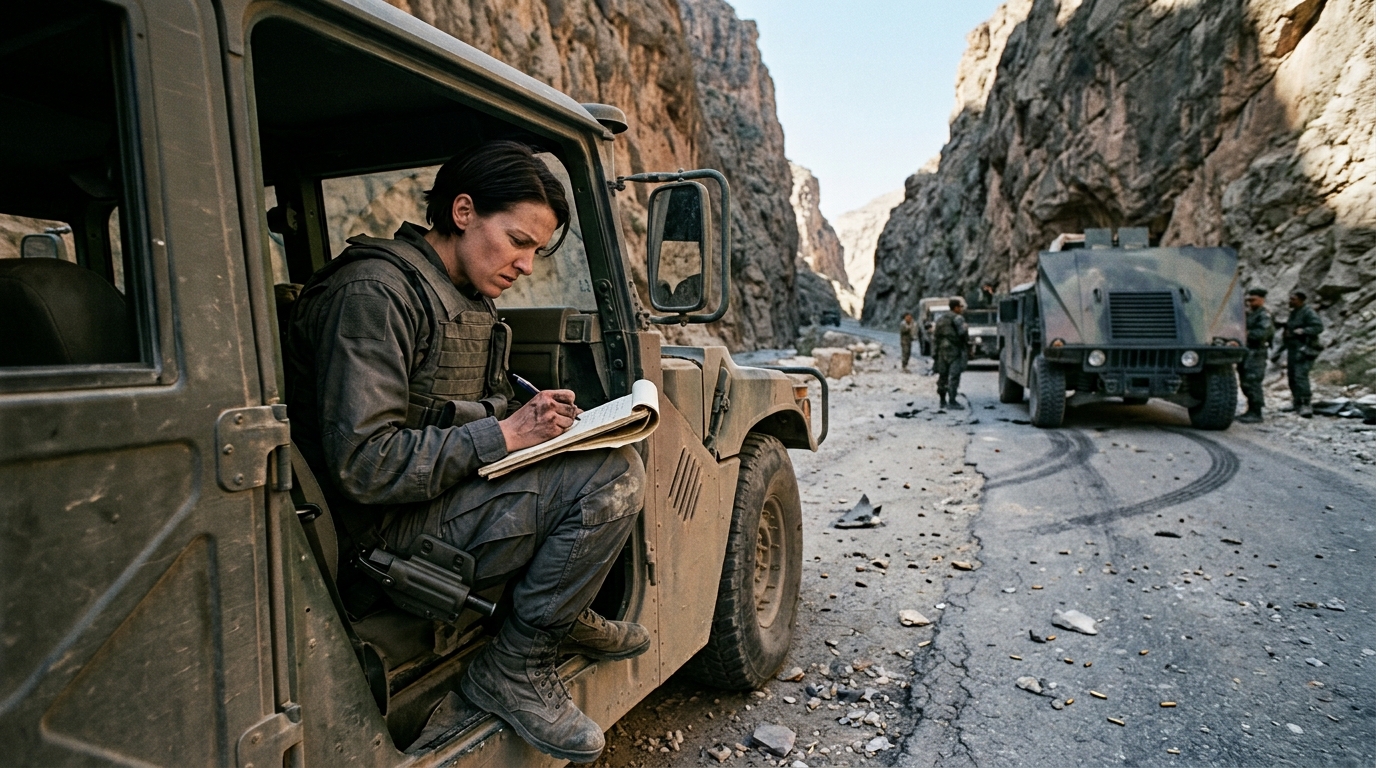
Specialist Okafur kept his eyes locked on the cracked asphalt ahead, his knuckles white against the steering wheel.
In the passenger seat, Sloan Mercer didn’t look at him, her thumb sliding across the edge of a worn paper notebook.
The canyon walls rose on either side like scarred iron teeth, narrowing the sky into a sharp strip of pale blue.
“Slow down,” Mercer said, her voice dropping beneath the roar of the diesel.
“Orders are fifteen percent,” Okafur muttered, jaw tight.
“Do it”.
The radio hissed with standard convoy chatter, voices crisp and oblivious four vehicles ahead.
Mercer pressed her pen against the page, calculating the distance between the limestone ledges and the road shoulder without a wasted motion.
The air was too still for a morning in sector green, carrying that faint, metallic taste of dust before a shift.
She watched the ridge line rise, noting where the natural fractures in the rock offered a clear line of sight down to the convoy’s flank.
The vehicle rolled deeper into the pass, the tires crunching over loose gravel that sounded unnaturally loud against the stone walls.
Okafur glanced sideways, sensing the quiet intensity beside him, but stayed silent.
Mercer turned the page, her pen pausing at kilometer 13.4 as the shadows on the western wall stretched just an inch too far.
CHAPTER 2: THE KILL CORRIDOR
The sound did not travel as a clean report through the narrow stone pass.
It bounced off the vertical faces of the rock, multiplying into a ragged sheet of noise that seemed to swallow the engine roar entirely.
Okafur slammed his boot down on the brake, the rear tires sliding three inches in the loose gravel before grabbing.
Mercer didn’t flinch, her fingers already sliding off the notebook page to grip the edge of the dashboard.
The convoy locked up behind them in a tight, tangled sequence of iron and dust.
Staff Sergeant Cutter’s voice cut through the open radio channel from three vehicles back, loud and flat against the static.
“Contact upper ridge line. Multiple positions.”
Mercer reached across the console, her fingers tapping twice against the secondary frequency dial before pulling her hand back.
The major was already out of the lead vehicle, moving low along the dirt shoulder with her weapon raised.
“Suppressing fire,” Forsythe barked into her handset, her voice tight with the sudden friction of an ambush that shouldn’t have been there.
Two rifles opened up from the rear security elements, sending a flurry of disciplined rounds toward the right limestone shelf.
The stone chipped, sending gray dust billowing into the air, but the firing from above did not break rhythm.
Mercer watched the trajectory of the incoming rounds strike the road six feet ahead of the front bumper.
The angle was too precise for a random patrol, matching the exact spacing of the pre-planned crossfire.
She opened her notebook again, her pen hovering over the fresh paper while the air around the vehicle grew thick with the smell of scorched powder.
Okafur swallowed hard, his eyes darting between the empty road ahead and the high, shadowed ledges.
“They’ve got us bracketed,” Okafur muttered.
“They have the geometry,” Mercer said, her voice entirely level. “Not the time.”
CHAPTER 3: THE SOUND CORRIDOR
The wind had shifted just enough at 0918 to turn the limestone pass into a giant acoustic funnel.
Mercer pressed the edge of her pen against the paper map, drawing a sharp diagonal across the dry stream bed on the western flank.
Major Forsythe dropped low beside the passenger door, her breath coming short against the heat of the engine block.
“The lead vehicle is pinned,” Forsythe said, her jaw tight with forced restraint. “We cannot hold this position for twenty minutes.”
“We don’t have twenty minutes,” Mercer replied without looking up. “The eastern walls are masking the return fire.”
“What are you proposing?”
“A retrograde using the natural sound delay.”
Mercer pointed to the shallow depression running parallel to the road.
“The wind shift alters how footfalls echo off the stone, making movement in the stream bed sound like it’s coming from the opposite wall.”
Forsythe stared at the sketch, her eyes weighing the tactical risk against the reality of a trapped unit.
“You want to pull back forty meters and run a flanking team up a dry ditch,” Forsythe said, her voice hard with skepticism.
“It’s the only geometric window we have before their reload cycle resets,” Mercer answered.
The major looked back toward the wounded personnel near the rear vehicles, then back to the quiet, unyielding private beside her.
“Cutter and Whitfield,” Forsythe muttered, raising her radio. “Get moving.”
CHAPTER 4: THE BOULDER CLUSTER
The limestone shelf loomed eight meters above their heads like a jagged shelf of dry bone.
Cutter pressed his shoulder against the rough stone face, his breath shallow in the thin mountain air.
“I have the silhouette,” Cutter whispered into his collar mic, his muscles locked in rigid tension.
Across the dry wash, Whitfield raised her weapon, her eyes fixed on the secondary ledge cutout.
Down on the convoy floor, Mercer stood beside the open notebook, her pen poised over the final coordinate line.
“Execute,” Mercer said into the secondary channel.
Two simultaneous cracks echoed off the canyon walls, flat and dry against the rolling stone.
The silhouettes on the western ledges collapsed backward out of sight, their suppression abruptly cut short.
Silence rushed into the void, heavy and sudden, before the eastern positions began frantically pivoting their aim.
“Western positions neutral,” Cutter panted, dropping behind the stone cluster.
“Move the vehicles now,” Mercer replied, snapping her notebook shut with a sharp, definitive click.
CHAPTER 5: THE SECONDARY HAMMER
The shockwave rolled across the dry flatland, lifting a cloud of choking dust that burned the back of the throat.
Major Forsythe scanned the southeastern horizon through her binoculars, her jaw working with hard, unyielding tension.
“They’re walking the rounds closer,” Forsythe snapped, turning sharply toward the rear vehicle. “We need suppression now.”
Mercer stepped up to the heavy weapons mount without a word of hesitation, her hands steady against the cold steel.
“Bearing 148,” Mercer said, her voice cutting through the rising wind. “Range 800 meters. Spread fifty meters.”
Whitfield adjusted the traverse handle with a sharp, metallic clatter, locking her sights onto the ridge line.
“Bearing locked,” Whitfield confirmed, her muscles corded with strain.
“Fire for effect,” Mercer instructed.
The heavy weapon stuttered to life in a rapid, rhythmic sequence of concussions, walking 40mm grenades directly into the probable mortar pocket.
Another round landed wide to the west, its trajectory breaking apart under the counter-fire before going completely dead.
Forsythe watched the silence settle over the southeastern ridge, her expression hardening into a cold realization of who had kept them alive.
“You called this layer before we even left the staging area,” Forsythe said, turning to face her.
“Standard doctrine for a two-tier engagement,” Mercer replied, letting her hands fall from the mount.
CHAPTER 6: THE RUSTED LEDGER
The radio on the makeshift command table clicked twice, delivering the steady confirmation of accelerated review orders directly from sector headquarters.
Major Forsythe stood silent a few paces away, her eyes fixed on the horizon where the last trace of daylight bled into deep violet.
“The liaison is inbound with the insignia,” Forsythe said, her voice stripped of its earlier defensive edge.
“I know,” Mercer replied, not looking up from the page.
Whitfield walked over, placing two metal cups of coffee on the wooden crate between them without a word of commentary.
The friction of the canyon pass felt miles away, replaced by the heavy, settling stillness of a problem thoroughly resolved through cold geometry and common sense.
Mercer closed the cover of her notebook, the worn paper sliding shut with a clean, satisfying snap.
She picked up the cup, felt the warmth radiate against her knuckles, and took a slow, steady breath of the night air.