When the Family Dinner Table Turned Into a Federal Audit, the Daughter They Erased Proved She Held the Ultimate Authority
CHAPTER 1: THE SQUEAKY THIRD PLANK
The gravel shifted sharply beneath my heels as I cut the engine, the cool early autumn air biting at my wrists.
The porch light above the front door flickered once, twice, holding in that familiar, sluggish stutter before settling into a dim yellow glow.
Inside the hallway, the scent was an exact archive of my childhood: sharp lemon cleaner layered over heavy wood polish.
I stepped across the threshold, my boots finding the third plank without looking down. It gave out that familiar, high-pitched squeak I used to spend hours trying to bypass when sneaking in past curfew.
The walls were lined with frames spaced at mathematically precise intervals.
Baby portraits of Gregory, framed high school track medals, university graduation group shots, and smiling family vacations in the mountains.
My eyes swept the row from left to right. Not a single frame held my face.
No uniform portraits, no service ribbons, no engineering fair plaques from my teenage years. It was as though a surgical blade had edited me out of the household lineage entirely.
Arthur’s voice drifted from the living room, low and steady against the hum of a speakerphone.
Gregory stood by the mantelpiece, holding a crystal tumbler of amber liquid, gesturing animatedly toward a slide deck glowing faintly from a laptop screen.
Vera hurried out from the kitchen, wiping her hands on a linen towel, her smile fixed and procedural.
“Well, look who finally showed,” she said, her cheek brushing mine with zero pressure, a dry peck meant to satisfy an obligation rather than offer a welcome.
“Good to see you too, Mom,” I said, keeping my voice flat and unreadable.
Her eyes flicked past my shoulder toward Gregory before returning to me. “Go on into the dining room. We’ve got the slideshow queued up for your brother’s big promotion. Senior project lead last quarter. Impressive, right?”
“Of course,” I replied, offering a polite tilt of my chin.
The dining room had been transformed into a shrine of corporate success, complete with place settings, burning tapers, and a small podium fitted at the head of the table.
My name was absent from every place card.
I pulled out the very last chair at the far edge, tucked neatly beside the swinging kitchen door behind a rolling service cart.
It was an ideal vantage point. I could observe every movement in the room while remaining entirely outside their field of direct vision.
Arthur tapped his glass with a silver fork, the sharp ring cutting through the polite murmurs of the room.
“To Gregory,” Arthur announced, lifting his glass high, his chest puffed with unearned pride. “Rising through merit, not shortcuts. Some people take initiative, while others coast along and rely on handouts. Well, that only works until the real world wises up.”
Laughter rippled around the table, light and self-satisfied.
My fingers rested flat against the cold mahogany of the table, my pulse steady beneath my cuffs.
Gregory grinned, taking a slow sip of his drink, soaking in the applause.
I didn’t flinch. I didn’t let my expression drop into a scowl.
Inside, the friction of their arrogance didn’t trigger blind fury; it produced a cold, calculated clarity.
This wasn’t a family dinner. It was an exhibition of willful ignorance, built entirely on the comfort of a lie.
And as I watched my father toast a success built on foundations he didn’t understand, my thumb silently traced the edge of my phone inside my coat pocket, logging the exact time.
CHAPTER 2: TO GREGORY AND SHORTCUTS
Fork tines scraped against fine china around the table, the sound unnaturally sharp in the quiet that followed my father’s declaration.
Arthur lowered his glass, his eyes sweeping the room to catch the approving nods of the invited guests.
“Hard work speaks for itself,” Arthur continued, his voice carrying that familiar, unyielding cadence of a man who believed his own lectures. “You don’t need shortcuts when you have discipline. Some people spend years coasting, waiting for a handout. But true success? That’s about taking initiative.”
Vera leaned forward, her napkin fluttering to her lap as she offered a tight, sympathetic smile down the length of the table toward me.
“Leora, darling, don’t mind your father,” Vera whispered loudly enough for the guests on either side to catch. “We just meant that not everyone is cut out for the fast-paced corporate ladder. Some paths are quieter.”
“Quiet is fine, Mom,” I said, my voice cutting through the ambient clatter without raising a single decibel.
Gregory chuckled, a low, dismissive sound that bounced off the crystal water pitchers.
“Let’s not make it awkward, Lee,” Gregory said, shaking his head with a patronizing grin. “Dad’s just making a point about market drive. Coding bootcamps and remote admin work don’t exactly build executive presence.”
A few guests near the center of the table murmured in agreement, hiding behind their wine glasses.
I kept my hands resting flat on the tablecloth, my fingers inches from the silver dessert fork.
The air smelled of roasted rosemary and expensive wine, but beneath it sat the stale scent of manufactured pedigree.
They weren’t just erasing me; they were actively using my absence to elevate Gregory’s hollow portfolio.
My phone vibrated once against my palm inside my pocket—a silent, automated notification from the regional server architecture syncing my morning clearance credentials.
I didn’t blink. I didn’t reach for the screen.
Instead, I met Gregory’s gaze directly across the candlelight, holding his eye until his smile faltered by a fraction of an inch.
“Initiative is a funny thing, Gregory,” I said softly, letting the silence stretch until the table grew tense. “Sometimes people think they built the engine, when really, they’re just sitting in the driver’s seat someone else bolted down.”
Arthur’s jaw tightened, the skin around his temples pale beneath the dining room chandelier.
“Watch your tone,” Arthur muttered, his hand gripping his water glass hard enough to whiten his knuckles.
“I’m just talking about architecture, Dad,” I replied, lifting my glass for a slow, deliberate sip of water. “Some foundations look solid until you check the source code.”
CHAPTER 3: THE HEARTH PROTOTYPE
I set the water glass down without a sound, the crystal base meeting the polished wood with a faint click.
Arthur didn’t look back up, his attention deliberately anchored to his plate as laughter bubbled up from the opposite end of the table.
I slipped away from my chair while the conversation drifted toward Gregory’s upcoming corporate retreat, moving past the service cart into the hallway.
The air grew cooler away from the dining room candles, smelling faintly of old dust and winter storage.
Voices echoed from the living room, muffled by the stone archway.
“That design piece you gave me last year,” an older man’s voice remarked, deep and resonant near the fireplace. “Still have it on my desk. Everyone asks where I got it. It’s brilliant.”
Arthur’s voice floated back, laced with a casual, practiced modesty. “Glad you liked it. Rare find, that one.”
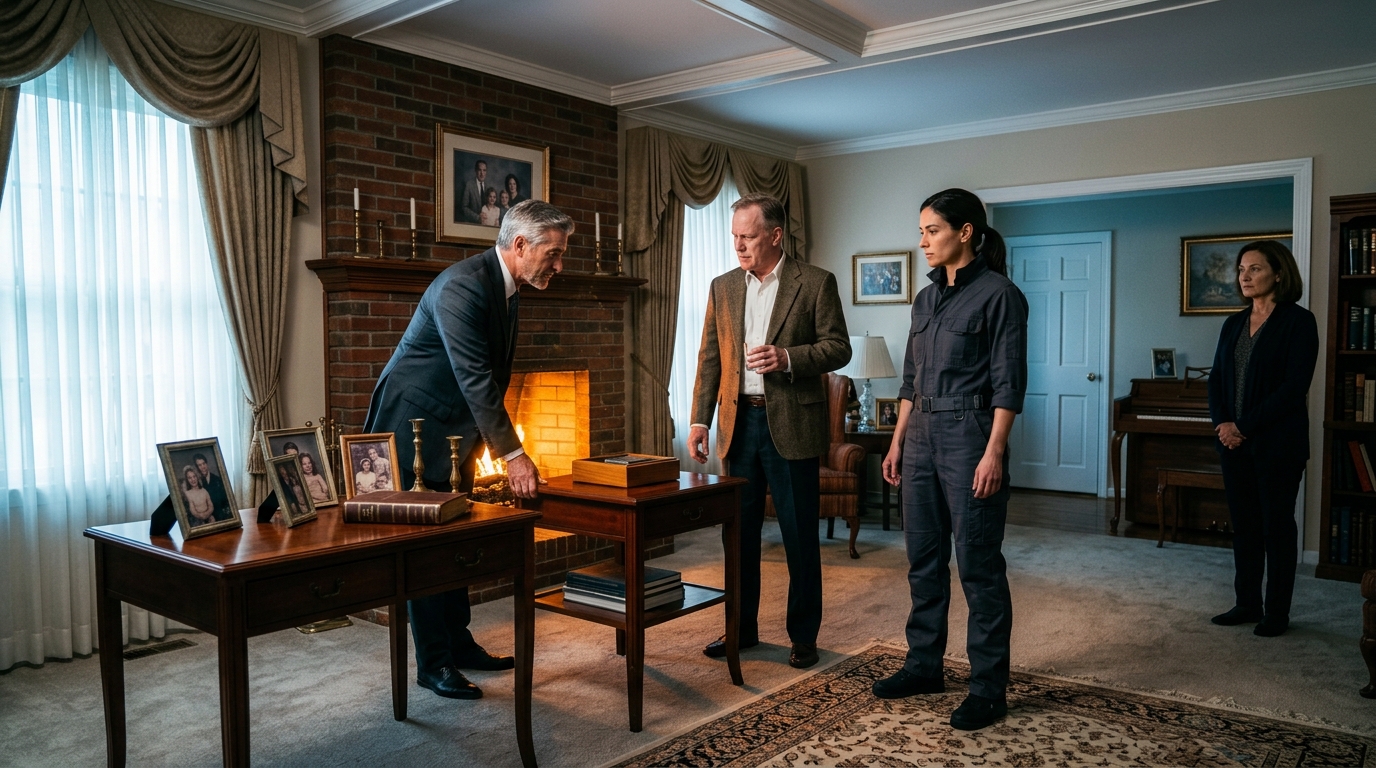
I stepped around the corner and stopped at the edge of the hearth.
Resting on the mahogany side table beside the brick mantelpiece was a polished wooden box with a brushed metal edge and an embedded microcircuitry plate.
It wasn’t a decorative trinket.
It was my compact navigation prototype, engineered eight years ago during my early military R&D rotation and mailed to this very house in a plain manila envelope.
Mr. Ryland, a longtime family friend with graying temples, leaned over it, tapping the metal corner with a fingernail.
“I swear it’s like something straight out of DARPA,” Ryland said, shaking his head in admiration.
I walked closer, my boots making no sound on the thick wool rug.
I looked down at the casing, noting the exact placement of the security bypass toggle I had soldered by hand in a cramped barracks room.
Arthur caught my shadow falling across the wood and stiffened, his eyes darting to mine for a single, sharp heartbeat before he looked away.
He didn’t offer an explanation. He didn’t stutter an excuse.
He simply stood there in the warm glow of the hearth, silently acknowledging that my work had been repackaged and handed out as his own personal token of generosity.
CHAPTER 4: THE UNIFORMED ARRIVAL
Morning light cut horizontally across the glass facade of Pinnacle Defense, turning the polished steel panels into blinding mirrors.
My tires crunched onto the asphalt of the designated military liaison space, coming to a dead stop right beneath the silver placard.
I cut the engine, sat in the stillness for a single breath, and reached for the service cap on the passenger seat.
Stepping out onto the pavement, my boots hit the concrete with a sharp, synchronized rhythm.
The heavy wool of the regulation uniform caught the crisp morning wind, every brass button polished to a dull, uncompromising matte.
A pair of civilian contractors walking toward the glass doors slowed their pace three paces out, their eyes dropping instinctively to the insignia before they drifted wide to give me clearance.
The security guard behind the turnstiles—a young man with too much starch in his collar—snapped upright the second I crossed the threshold.
“Good morning, Colonel Waywright,” he murmured, his hand flying to his earpiece. “She’s at the north entrance.”
“Stand easy,” I said, not breaking stride as I swept through the security gate without waiting for a badge scan.
Inside the central lobby, the usual nervous hum of coffee cups and elevator dings died down in ragged waves as I moved across the terrazzo floor.
Gregory and Arthur stood near the reception desk, both clad in matching navy corporate blazers, leaning over a visitor log.
Arthur was nodding, his posture relaxed with the casual arrogance of a man who believed he owned the room.
Then the rubber soles of my boots hit the uncarpeted marble right beside their heels.
Arthur turned, his mouth half-open to address a subordinate, and froze mid-sentence.
Gregory’s head snapped around, his eyes locking instantly onto the silver stars pinned to my lapel before crawling up to my face.
“What are you—” Gregory started, his voice cracking slightly on the consonant. “How did you get security clearance for this floor?”
I checked my watch, the digital numbers glowing sharp and green in the shadow of the reception arch.
“Your design review starts in ten minutes,” I said, my voice flat and carrying across the empty space of the lobby. “You should check your badge level before you step off the elevator.”
Arthur’s face drained of color, his jaw working silently as he stared at the uniform he had spent a lifetime dismissing as a minor hobby.
CHAPTER 5: THE METADATA AUDIT
The conference room hummed with the quiet, expensive murmur of corporate executives settling into high-backed leather chairs.
I stepped into the horseshoe-shaped layout, my boots finding the exact center of the room before walking straight to the front-row placard bearing my rank and department.
Gregory sat three seats down, his fingers tapping an uneven, nervous tattoo against the plastic casing of his tablet.
Arthur occupied a seat near the back wall, his pencil hovering motionless over a legal pad while his eyes avoided my shoulder entirely.
The CEO, Shannon Murphy, walked in through the side utility door, her sharp gaze sweeping the room before landing squarely on my folder.
“Let’s begin,” Shannon announced, her voice cutting through the chatter without effort. “We have an infrastructure review to clear before the federal oversight committee receives the final packet.”
Gregory stood up on cue, smoothing the lapel of his navy blazer with a practiced, confident flick of his wrist.
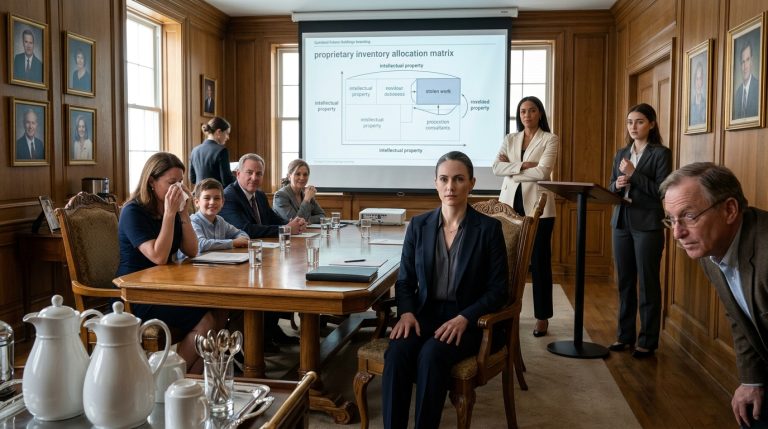
“Thank you, Shannon,” Gregory began, pulling up the first slide of his architecture presentation. “As our team outlined in the preliminary brief, the secure communication overlay utilizes an advanced, proprietary encryption matrix developed entirely in-house.”
The projection screen lit up with a complex network diagram featuring my exact security sub-layers, stripped of any attribution.
I did not interrupt him. I simply unclasped my leather folder, lifted a single sheet of paper, and placed it face up on the polished wood.
“That particular architectural overlay,” I said, my voice cutting cleanly across his rehearsed cadence, “was authored under IDM unit 43 and registered with the Department of Defense eleven months ago.”
Gregory froze mid-gesture, his hand hovering over the slide remote like a broken switch.
“What are you talking about?” Gregory forced a tight, brittle laugh, glancing around the room for support. “This is proprietary corporate property.”
“Check the metadata hash,” I replied, sliding the certified federal timestamp document across the table toward the chief operating officer. “The encryption seed contains a digital watermark matching my personal service credentials.”
The COO leaned over the paper, his brows knitting together as he cross-referenced the numbers with his tablet.
“The digital chain verifies,” the COO said, his voice dropping an octave in the quiet room. “The source code belongs entirely to the colonel.”
Arthur stood up sharply from the back row, his chair scraping violently against the floorboards.
“There is a misunderstanding here,” Arthur barked, his face flushing a mottled crimson. “She’s just a junior observer inserting herself where she doesn’t belong—she has no business overriding corporate contracts.”
I didn’t turn around to look at him.
“Sit down, Arthur,” I said, my tone flat, immovable, and entirely devoid of heat. “The audit is already logging every unauthorized access attempt from your internal network last night.”
CHAPTER 6: THE UNMOVABLE STANDARD
Shannon Murphy stepped forward, her hand resting flat against the edge of the polished walnut table.
“The contract terms stand under Colonel Waywright’s primary jurisdiction,” Shannon announced, her voice ringing clear against the silent walls. “Any internal audit flags will be resolved directly through federal compliance channels.”
Arthur dropped back into his chair behind the last row, his fingers trembling as they fumbled with the clasp of his leather portfolio.
Gregory remained frozen beside his projection screen, his mouth opening and closing once like a stranded fish before he stared down at his empty hands.
There was no shouting, no dramatic table-banging, and no frantic apologies.
Just the heavy, irreversible weight of reality crashing down on a house of cards built entirely on unearned entitlement.
Six months later, the afternoon sun slanted low across the white oak floors of my apartment living room, casting long, clean lines across the rug.
A pot of tomato bisque simmered on the stove, filling the quiet space with the rich, familiar scent of garlic and fresh thyme.
The knock at the front door came right on schedule—three measured taps, neither rushed nor hesitant.
I wiped my hands on a cotton kitchen towel, walked across the floor, and turned the deadbolt.
Arthur stood on the landing holding a bottle of wine by the neck with stiff fingers, while Vera hovered behind him carrying a heavy glass dish wrapped tightly in foil.
Gregory stood a half-step back, his shoulders squared in a quiet, subdued posture that lacked its old corporate bounce.
“Smells good,” Arthur offered, his voice raspy but stripped of its old lectures. “We brought… well, we weren’t sure what you’d want.”
I stepped back and swung the door wide.
“Come on in,” I said.
The dinner was quiet, punctuated only by the soft clink of silverware against ceramic plates and the hum of the refrigerator.
No one brought up the corporate boardrooms, the missing photographs, or the federal audits.
They sat at my table, in my space, under a standard they no longer controlled.
After they finally left, locking the door behind them with a solid, reassuring click, I walked back into the kitchen and turned off the burner.
I leaned my palms against the cool granite counter, took a long, even breath, and looked out the window at the quiet street below.
The noise was gone, replaced entirely by the steady, unshakeable rhythm of my own life.