The Frozen Audit of Blackwood Ridge: A Cold Record of Systemic Ruin and Concrete Reckoning
CHAPTER 1: THE DRIVEWAY FREEZE
The post was clean.
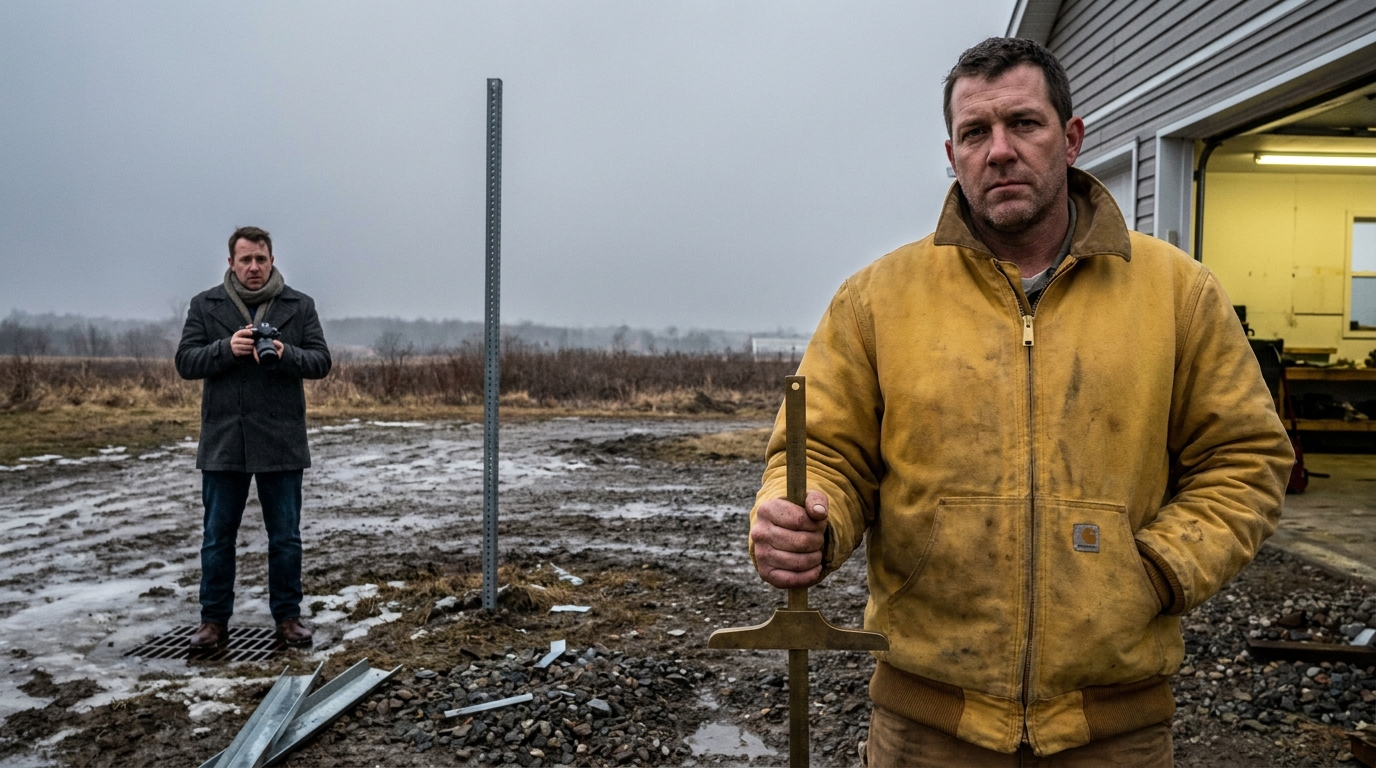
Raw galvanized steel, four inches wide, sticking out of the frozen turf right where the private driveway met the city curb. The yellow reflection sign—Caution: Black Ice Vulnerability—was gone. No torch marks. No sheared bolts. Someone had backed out the heavy hex screws with a socket wrench and carried the metal away.
I rolled the brass depth gauge between my thumb and forefinger. Cold metal against calloused skin.
“Turn that camera off right now.”
The shout hit the driveway before the storm door even slammed. Melissa Grant came down the slope in three-hundred-dollar leather boots, her tread completely wrong for forty-degree glaze. Her heels made a sharp, brittle clack-clack on the concrete. Clip-board tucked against her ribs like a sidearm.
Behind me, in the garage bay with the heating lamps hummed low, my wife Maya didn’t stop her posture. She held the pose on the black rubber mat, phone mounted on a three-foot tripod, live-streaming her morning instructional class to seven hundred subscribers.
“I said turn it off!” Melissa reached the edge of the mat. She didn’t look at Maya’s face. She looked at the camera lens. “Public broadcasting on common residential ground. Unapproved commercial activity. Indecent presentation.”
“It’s a garage,” Maya said. Her voice didn’t rise. She shifted her weight, foot locked on the mat. “The door is open for light. The camera faces my driveway.”
“Your driveway is visible from the access street.” Melissa flipped the top page on her board with a hard, snapping sound. “Community Standards, Section Four. Visual pollution and commercial solicitation. Effective immediately.”
I stepped out from the shadow of the side door. I didn’t raise my hands. I kept my left thumb hooked in my work-coat pocket, my right hand holding the heavy brass gauge.
“Which rule?” I asked.
Melissa didn’t look at me. She kept her eyes on the phone screen mounted on the tripod. On the display, text comments were scrolling past at lightning speed.
“You don’t need to know the rule,” Melissa said. Her jaw locked tight. “You need to clear the frame.”
“She’s on our deed line,” I said. “Three feet inside Parcel-88.”
Melissa’s head snapped toward me then. Her eyes were tiny, dark beads behind titanium-framed glasses. A thin, red line of cold rasped along her neck above her wool collar.
“Everything visible from the curb belongs to the image of this neighborhood,” she said. She leaned closer to the phone, her shadow cutting across Maya’s mat. “Turn it off, or the board takes action before the snow hits tomorrow.”
She turned on her heel. She didn’t walk back up the driveway; she marched, her boots slipping two inches on a patch of gray ice near the gutter. She caught herself on the bare signpost, her knuckles white against the raw steel, before straightening her coat and walking on.
Maya didn’t move from the mat. Her breathing was steady, but her left hand was clenching the edge of her leggings, her knuckles pressing red against the fabric.
“Did you turn it off?” she asked quietly.
“No,” I said. “The stream is still live.”
I walked to the edge of the curb. I knelt down on one knee, ignoring the damp freeze soaking through my canvas pants, and pressed the brass gauge into the gutter seam. The ice depth was three-eighths of an inch. Untreated. No rock salt. No magnesium chloride.
An email notification chimed from the kitchen table inside.
I didn’t run. I walked inside, wiped my boots on the mat, and opened the laptop screen.
The PDF was stamped with the Blackwood Ridge HOA header.
Citation #409-A. Violation of Community Image Standards & Unapproved Media Broadcast. Fine: $25,000. Payment due within 72 hours.
At the bottom, above the electronic seal, was a single line of bold text: Non-compliance will result in immediate acceleration of property leverage.
I didn’t close the laptop. I picked up my brass gauge, set it next to the keyboard, and pulled up the municipal road registry for North District B.
The storm was twelve hours out.
CHAPTER 2: PAPER STORM THE ESCALATION
The kitchen table smelled of mineral spirits and damp oak.
Outside, the wind caught the unlatched aluminum downspout on the north corner of the garage, sloshing it against the brickwork with a rhythm like a dull metronome. Thump. Pause. Thump.
I didn’t open the PDF again. The numbers didn’t change when you stared at them: twenty-five thousand dollars, signed with the rasterized blue-ink signature of Melissa Grant, HOA President. Below her name, in font so small the raster edges bled gray, sat the billing code: ACC-88-Maint.
“Is it a lien warning?” Maya asked from the doorway.
She had a gray fleece thrown over her workout top, her fingers buried in the oversized pockets. She wasn’t shaking, but her jaw muscles were locked so hard the skin over her cheekbones looked stretched.
“Not yet,” I said. “It’s an assessment. A special levy.”
“For twenty-five thousand?”
“They’re calling it an emergency structural remediation fine for visual disruption.” I picked up the brass tread gauge, thumbing the knurled adjustment nut. “It’s designed to make you panic. If you panic, you write a letter. If you write a letter, you acknowledge their jurisdiction over Parcel-88.”
“Is Parcel-88 ours?”
“The deed says we own to the curb,” I said. “The city easement starts six inches into the asphalt. But look at the billing code.”
I spun the laptop so the screen faced her. I pointed at the gray line under the signature.
ACC-88-Maint.
Maya squinted, her brow furrowing. “Maintenance?”
“The HOA doesn’t have an assessment category for ‘visual disruption’ in the public filings,” I said. “I checked the North District clerk database three months ago when they tried to bill us for the oak limb overhanging the sidewalk. Everything they assess has to clear the municipal ledger under three heads: Landscaping, Security, or Surface Mitigation.”
I stood up, the chair legs scraping flat across the linoleum. My canvas pants were stiff at the knees from where the gutter ice had soaked the fabric.
I walked to the hallway closet, pulled out the rusted steel filing box I kept behind the snow boots, and dropped it onto the table. The latch gave a dry, metallic clank.
Inside were six years of Blackwood Ridge annual disclosures. I pulled out the 2025 financial audit—a twenty-page staple-bound packet printed on cheap paper that smelled of stale toner.
I flipped to Schedule C: Contracted Vendor Disclosures.
“Here,” I said, tapping a finger on the line. “Apex-Subrogation Services. They’re listed as our third-party claims auditor.”
Maya leaned over the table, her hand resting on the back of my chair. Her knuckles were pale. “What does a subrogation auditor do for an HOA?”
“They don’t,” I said. “A subrogation firm works for insurance companies. They figure out who to sue when a pipe bursts or a roof collapses so the main carrier doesn’t have to pay out of pocket. Why is an HOA paying a ten-thousand-dollar annual retainer to a subrogation firm when our master liability policy is supposed to be held by Aegis-Umbrella?”
I flipped three pages back to the insurance certificate page.
The box for Aegis-Umbrella Policy #99-B was checked. But the policy number was handwritten in black ballpoint, not typed like the rest of the form. And right below it, in the space reserved for the local agent’s stamp, was a blank square.
“They didn’t file the endorsement,” I muttered.
A heavy thud rattled the front porch.
Not the downspout. A boot.
I moved away from the table before the doorbell finished its second chime. I didn’t rush. I walked with long, heavy strides, my soles gripping the floorboards, and pulled the front door open three inches.
The wind hit first, carrying the wet, metallic scent of incoming sleet. Standing on the top step, wrapped in a black quilted coat with a fleece collar turned up against her ears, was Melissa Grant. She wasn’t alone.
Beside her stood a man in a high-visibility yellow parka with Krueger Contracting embroidered across the chest in faded red thread. He held a clipboard under his arm and a six-foot wooden measuring rod in his gloved hand.
“Mr. Vance,” Melissa said. She didn’t offer a smile. Her breath came out in short, white plumes that vanished into the porch overhang. “This is Mr. Krueger. We’re conducting a pre-storm easement assessment.”
“You’re on private property, Melissa,” I said. I kept my hand on the brass door edge, my body blocking the view of the kitchen table.
“The driveway approach is a designated common access route under Section Two,” she snapped, her voice carrying that tight, practiced edge. “We’re measuring the clearance for the salt trucks. Your wife’s tripod was positioned within eighteen inches of the municipal right-of-way.”
The contractor, Krueger, didn’t look at me. He looked down at his boots, shifting his weight from one foot to the other. His leather gloves were worn gray at the fingertips, stained with old road salt.
“The salt truck doesn’t run down Parcel-88,” I said, looking straight at Krueger. “The city contract specifies the plow turns at the cul-de-sac. The HOA uses a private quad with a tailgate spreader.”
Krueger cleared his throat, his eyes darting toward Melissa for a micro-second before returning to the wet porch boards. “We got the work order for the corner, chief. Just taking the elevation.”
“The sign is gone,” I said.
Melissa’s chin twitched upward. “What sign?”
“The yellow caution marker,” I said. “The one bolted to the steel post at the curve. The one that marks the ground-water bleed from the ridge.”
“Old signage is being updated to meet new aesthetic guidelines,” Melissa said without skipping a beat. She pulled a folded piece of paper from her coat pocket and held it out. She didn’t reach across the threshold; she held it in the open air between us, letting the wind flutter its edges. “This is your second notice. The fine for non-compliance increases by fifty percent every forty-eight hours until the commercial streaming equipment is removed from the property boundaries.”
I looked at the paper. Fine Total: $38,000.
“You’re missing the stamp,” I said softly.
Melissa froze. Her fingers tightened on the folded paper, her fingernails—painted a pale, manicured nude—pressing deep into the stock.
“What did you say?”
“The Aegis-Umbrella certificate,” I said, keeping my voice flat, almost dull. “The 2025 disclosure you mailed out in November. It’s missing the local agent’s validation stamp. Which means the policy was never bound for the current fiscal year.”
Krueger shifted his feet again, his measuring rod clattering against the aluminum porch railing. He looked at Melissa, his mouth slightly open.
Melissa didn’t look back at him. Her eyes narrowed behind her glasses, the tiny red line on her neck deepening in color as the wind whipped a loose strand of hair across her cheek.
“Board records are fully audited by accredited professionals, Mr. Vance,” she said, her words coming out like small, hard pebbles. “Your speculation about insurance documentation does not stay the execution of community enforcement. You have forty-eight hours.”
She turned and stepped down onto the walkway. “Krueger. Take the measurement at the curb and let’s go.”
“I wouldn’t step on that curb,” I called out.
Krueger stopped, one foot hovering over the concrete apron where the groundwater bled from the grass line.
“Why not?” Krueger asked, his voice low and raspy.
“Because it hasn’t been salted since Tuesday,” I said. “And if you drop that rod and break an ankle, you’ll find out real fast whose policy is actually paying your worker’s comp.”
Krueger looked down at the dark, glassy sheen covering the concrete, then back at Melissa. Without a word, he tucked the measuring rod tighter under his arm, stepped around the patch, and walked straight toward his truck parked at the curb.
Melissa stood at the bottom of the steps for three long seconds, staring at me through the cold drizzle that had just begun to fall.
“Forty-eight hours,” she repeated, her voice almost swallowed by the rising wind.
She turned and followed Krueger, her boots making a wet, slipping sound on the pavement as the storm finally rolled over the ridge.
I shut the door, set the deadbolt, and walked back to the table.
The second notice sat on the screen, but my mind was on Krueger’s boots. They were clean. No white salt crust on the leather. For a contractor who claimed to have spread three tons of rock salt along the upper ridge yesterday, his gear was dry as bone.
I picked up the pencil, opened my notebook, and wrote two words next to the $38,000 figure:
Check salt invoices.
CHAPTER 3: THE BROKEN POST THE MISSING SIGN
The graphite tip snapped against the pad.
I didn’t sharpen the pencil. I pressed the broken edge into the margin, drawing a dark, rough circle around Check salt invoices.
Outside, the sleet hit the storm door like handfuls of coarse sand. The temperature inside the hallway dropped two degrees every time the furnace blower cycled off.
“You’re going out there,” Maya said. She was standing at the edge of the rug, her arms folded over her ribs, watching my hands. She didn’t ask it like a question.
“I need the physical record,” I said. I pulled my heavy yellow canvas coat off the wooden peg by the door. The collar smelled of old diesel smoke and damp wool. “If Krueger didn’t salt the upper ridge, there won’t be any sodium residue in the drainage runoff at the easement culvert. Rain washes salt down; it doesn’t erase the crust on the curb face.”
“Melissa has three camera posts along the curve,” she said. Her voice was flat, but her left index finger was tapping a rhythmic, nervous pulse against her elbow. “She’ll claim you’re tampering with common infrastructure.”
“She can claim whatever she wants on paper,” I said, zipping the canvas coat up to my chin. “The city snow ordinance requires a four-inch clearance zone around municipal access drains. I’m checking the drain.”
I grabbed the heavy flash lantern from the bench and stepped out onto the porch.
The air was sharp enough to burn the back of my throat. Sleet was already building up in thin, gray slush lines along the edges of the steps. My boots made a dense, wet crunch as I hit the concrete apron of Parcel-88.
I didn’t walk along the middle of the pavement. I stayed on the turf line, where the unkempt rye grass gave my soles something to bite into.
Fifty yards up the incline, the road bent hard to the north around a blind granite outcrop. This was the spot—the apex of the curve where groundwater leaked continuously from the rock face, running across the road surface before dropping into the storm grate.
The post where the yellow caution sign used to sit was swallowed by the dark.
I clicked the lantern on. The beam cut through the gray slant of sleet, reflecting off the raw, galvanized steel post.
I knelt in the slush at the base of the post. The ground around the steel square-tubing was churned up, mud mixed with crushed rock. I reached down with my gloved hand and wiped a layer of freezing slush off the concrete footing.
Two freshly backed-out bolt heads sat in the mud right next to the base.
They weren’t rusted. The zinc plating was still shiny under the lantern beam. Someone had removed the sign within the last twenty-four hours, and they’d done it in a hurry—one of the lock washers was bent sideways, stripped off the thread instead of turned out clean.
“Looking for something, Mr. Vance?”
The voice came from thirty feet up the hill, right beside the wooden fence line of Parcel-92.
I didn’t jump. I stood up slowly, keeping the lantern pointed down at the mud so the glare wouldn’t blind either of us, and turned my head.
A man in a heavy charcoal car coat was standing under the pine branches, a thick wool scarf wrapped around his chin. It was David Miller, the treasurer for the HOA board. He was holding a small digital camera with a telephoto lens, the strap looped twice around his wrist.
“Checking the drainage,” I said. My voice sounded flat against the deadened hush of the falling sleet.
“The drain is city property,” Miller said. He stepped down toward the curb, his leather dress boots sliding an inch on the slush before he caught his balance against a fence post. “The board maintains the safety perimeter. The sign was removed for mandatory structural re-certification.”
“Re-certification doesn’t take a socket wrench and a stripped washer left in the mud, David,” I said.
Miller stopped ten feet away. In the dim spill of the lantern light, his face was pale, the skin around his eyes tight and dark. He didn’t raise his camera. He just held it against his chest like an extra layer of insulation.
“You’re making this very difficult for yourself,” Miller said softly. “The board has legal authority to issue emergency assessments for non-conforming property use. The twenty-five thousand isn’t a penalty. It’s a security bond.”
“A bond for what?”
“For potential liability,” Miller said. He looked past me down the dark slope toward my house, where the garage light cast a long, yellow rectangle onto the white driveway. “If your wife streams her classes and someone in this neighborhood suffers a loss because of distraction or unvetted commercial activity, the community’s umbrella policy takes the hit.”
I took two steps closer to him. My boots sank three inches into the soft turf at the road edge.
“Which umbrella policy, David?” I asked. “The Aegis-Umbrella policy that expired on October thirty-first, or the fake line item you’re using to pay Apex-Subrogation?”
Miller’s mouth closed. His throat moved once, a hard, dry swallow over his wool scarf. He didn’t look at my face; he looked at the brass tread gauge sticking out of my coat pocket.
“You don’t know how the accounting works,” he said, but the speed had gone out of his voice. It came out thin, fragile.
“I know how a ledger works,” I said. “I know that when an HOA pays a ten-thousand-dollar retainer to an insurance recovery firm while letting its master liability policy lapse, it means the board is self-insuring behind the homeowners’ backs. And I know that if a delivery truck skids on this curve tonight because you pulled the caution sign, the lawsuits won’t stop at the board’s bank account. They’ll attach to every deed in Blackwood Ridge.”
Miller didn’t answer. He reached out with his free hand, touched the cold, bare steel of the signpost, and pulled his fingers back immediately, as if the zinc had burned him.
“Melissa has the filing authority,” he whispered. The wind caught his words, tearing them apart, but I heard the shift in his tone. The corporate shield was gone. It was just a frightened man in an expensive coat standing on an icy road. “I just sign the ledger checks she prepares.”
“Then stop signing them,” I said.
I didn’t wait for him to respond. I turned my back on him, walked to the edge of the storm grate, and kicked away the crust of slush clogging the iron bars. The water underneath gave a low, gurgling roar as it dropped into the culvert.
No salt foam. No white scum on the iron. Just raw, freezing rainwater running over black asphalt.
I turned the lantern off, walked back down the dark slope toward Parcel-88, and left Miller standing alone by the bare post in the gathering storm.
CHAPTER 4: THE AUDIT TRAP THE MUNICIPAL LEDGER
The front door latch clicked home, locking out the dark and the rising howl of the wind.
I shook the slush from my canvas coat onto the rubber mat, my chest heavy with the icy air I’d drawn in up on the curve. In the kitchen, the single overhead bulb cast a harsh, yellow glare across the spread-out papers.
Maya didn’t ask what Miller had said. She saw my eyes, saw the mud caked around the brass depth gauge sticking out of my pocket, and simply pushed a steaming mug of black coffee across the table.
“The third notice came through while you were at the drain,” she said. Her voice was too quiet, stripped of its normal resonance. “Fifty-two thousand dollars. They shortened the window. Twenty-four hours before they file the lien with the county recorder.”
I didn’t touch the mug. I pulled out my chair, sat down, and reached for my phone. My fingers were stiff, the skin red and cracked around the knuckles from the freeze.
“We aren’t filing an appeal with the HOA board,” I said.
“They’re threatening to attach the property, Vince,” Maya said, her hand coming down flat on the table, right over the edge of the printed fine. Her thumb was pressing into the paper so hard the skin turned white. “If they record a lien, the bank flags our line of credit by Monday.”
“They can’t record a lien without a valid municipal compliance index number,” I said. “Look at the header.”
I slid the 2025 HOA audit packet across the wood until it sat directly beside the third citation.
“Every fine Melissa issues has to reference a certified road maintenance log. She claims the fifty-two thousand is for ’emergency safety mitigation and code enforcement.’ But Miller just admitted under the trees that they pulled the caution sign on the curve for ‘re-certification.’ They didn’t re-certify it. They removed it because if a city inspector sees a caution sign on a private road, they demand the quarterly friction logs.”
I pulled my laptop closer, my fingers moving across the keys with heavy, deliberate strikes. The fan inside the casing whirred to life, blowing a faint smell of warm plastic and dust across my knuckles.
I logged straight into the North District Municipal Public Works portal—the internal backend I used every day to track city plow routes and contractor salt allocations.
“What are you pulling?” Maya asked, leaning over my shoulder.
“The snow mitigation logs for Blackwood Ridge,” I said. “Melissa submits these electronically every month to keep the neighborhood on the city’s expedited utility grid. If she doesn’t submit them, the city doesn’t send emergency trucks when the transformers blow.”
The screen flickered, refreshing to a dense table of dates, timestamps, and approved vendor codes.
I tracked my finger down the column for January.
Jan 12 – 4.2 Tons Rock Salt Spred – Krueger Contracting – Approved.
Jan 19 – 3.8 Tons Rock Salt Spred – Krueger Contracting – Approved.
Jan 26 – 5.0 Tons Magnesium Chloride – Krueger Contracting – Approved.
“Look at the timestamps,” I muttered.
Maya squinted at the blue-light screen. “Jan 12… 04:15 AM?”
“Krueger’s truck wasn’t here at four in the morning on the twelfth,” I said, my voice dropping an octave into cold, hard certainty. “I was on shift at the municipal depot at four in the morning on the twelfth. We had a six-inch ice pack hit the west grid. Every private contractor in the district was queued at the salt silos in North Yard until seven AM. I signed their weigh-in tickets myself.”
I pulled up the North Yard weigh-in archive on the second tab.
Krueger Contracting’s rig—License Plate #77-K—didn’t hit the silo scales on January twelfth until 8:42 AM.
“She logged the work before the salt was even purchased,” Maya said, the breath catching in her throat. “She copy-pasted the previous month’s ledger entries and filed them with the city to claim the municipal reimbursement subsidy.”
“It’s worse than that,” I said.
I picked up the brass tread gauge from the table and tapped its heavy metal end against the screen, right over the billing code ACC-88-Maint.
“She isn’t just embezzling the salt budget,” I said. “She’s using Apex-Subrogation to audit the fake maintenance claims. Every time she files a fraudulent safety log with the city, she writes a ten-thousand-dollar retainer check to Apex to ‘review’ the file. The money comes straight out of our HOA reserve account. She’s creating a paper trail of fake maintenance to justify fining anyone whose camera might catch an untreated road.”
“She’s covering the steal with the fines,” Maya whispered.
“She thinks she is,” I said.
I didn’t type a angry email. I didn’t draft a cease-and-desist.
I opened the formal Municipal Discrepancy Portal—the blind reporting channel used by city inspectors when a public safety contract shows structural fraud.
I uploaded three files: Krueger’s weigh-in timestamp from the North Yard, the PDF of the $52,000 fine signed by Melissa, and the high-resolution photo I’d taken thirty minutes ago of the bare, un-salted storm drain at the curve of Parcel-88.
Under the field labeled Action Requested, I typed four words:
Immediate Municipal Compliance Audit.
I hit Submit.
The confirmation screen flashed green: Case #ND-8802 Logged. Priority Status: Pending Review.
“Is that it?” Maya asked, looking at the green box. “Does that stop the lien?”
“No,” I said, looking out the window as a fresh surge of sleet rattled against the glass like iron filings. “That brings the city out here tomorrow morning. And when they look for the salt logs, Melissa won’t be arguing with us anymore. She’ll be arguing with the district inspector.”
The phone on the table suddenly buzzed, vibrating violently against the wood.
The caller ID showed a local number with the HOA board extension.
I didn’t answer. I let it ring five times until it cut to voicemail. Three seconds later, the screen lit up with a text message from Melissa Grant:
Emergency Board Session called for 0800 tomorrow. Attendance mandatory. Bring proof of compliance or execution moves to county sheriff.
I looked at the screen, then at the brass gauge resting on the wooden table.
“Get your winter boots ready,” I told Maya. “Tomorrow morning we go to the community center.”
CHAPTER 5: EMERGENCY MEETING THE PHYSICAL COLD
The boots left grey, slush-heavy prints on the polished linoleum of the Blackwood Ridge Community Center.
Inside, the room smelled of damp winter coats, stale urn coffee, and the sharp, chemical reek of floor wax. Thirty homeowners sat in folding metal chairs, their voices a low, nervous drone that cut out the moment the heavy rear doors swung shut behind Maya and me.
At the head of the room, behind a long folding table, sat Melissa Grant.
Her hair was pinned back so tight the skin around her temples looked translucent. A thick, navy blazer covered her shoulders, and directly in front of her lay a stack of thick manila folders, topped by a printed agenda in bold black ink. David Miller sat to her left, his arms crossed tight against his chest, his eyes fixed firmly on his own fingernails.
“0801,” Melissa said. She didn’t look up from her papers. Her voice carried across the gym floor like a dry snap of pine. “The emergency meeting of the Blackwood Ridge Board of Directors is now in order. Pursuant to Section Nine, public comment is suspended during active compliance enforcement.”
“I’m not here for public comment, Melissa,” I said.
My voice didn’t echo. It stayed flat, heavy, anchored by the weight of my canvas coat. I didn’t take a seat in the back rows. I walked down the central aisle, the rubber soles of my work boots making a dull thud-thud on the floorboards, until I stood six feet from her table.
Maya stayed two steps behind my right shoulder, her hands zipped into her fleece coat, her eyes calm and unblinking.
“Mr. Vance,” Melissa said, finally lifting her chin. Her glasses caught the glare of the overhead fluorescent tubes, hiding her eyes behind twin sheets of white light. “You were instructed to bring proof of compliance regarding the unauthorized commercial operations on Parcel-88. If you do not have certified documentation, the board will vote immediately to record the accelerated lien with the county.”
“The county recorder’s office is closed on Saturday,” I said. “And you don’t have a valid lien filing code.”
A ripple of quiet shifting ran through the rows behind me. Someone cleared their throat. A metal chair leg scraped against the floor.
“We have full statutory authority under the master deed,” Melissa said. She reached for the top folder, her fingers neat and precise. “Section Four grants this board full discretion over common element integrity and visual risk mitigation.”
“You don’t have an umbrella policy,” I said.
The room went dead silent. The low, rhythmic hum of the building’s heating unit suddenly sounded unnaturally loud.
Melissa’s hand paused on the folder tab. Her knuckles didn’t twitch, but her jaw set so hard a thin muscle flexed along her cheek line.
“The community holds a multi-million dollar master umbrella policy through Aegis-Umbrella,” she said, her voice dropping into a measured, clinical rhythm. “Annual disclosures are mailed every November. It is a matter of public board record.”
“I called Aegis-Umbrella at seven-fifteen this morning,” I said, pulling a folded sheet of municipal letterhead from my inner coat pocket. I didn’t throw it. I stepped forward and laid it flat on the table, right over her top folder. “Policy Number 99-B was canceled on October thirty-first for non-payment. You took the thirty-two thousand dollar premium voted from the reserve fund, canceled the endorsement before the binder cleared, and routed the refund through Apex-Subrogation.”
David Miller’s head snapped up. His face wasn’t pale anymore; it was grey. He opened his mouth, but no sound came out.
“That is a reckless, defamatory falsehood,” Melissa said. She didn’t look at the paper on her table. She pushed her chair back two inches, standing up to project height over the table. “Board accounting is subject to external review. Apex-Subrogation is an accredited claims auditor retained to protect this community from unvetted liability—including the very commercial risk your wife creates on Parcel-88!”
“Apex-Subrogation is a single-member LLC registered to your brother-in-law’s residential address in West District,” I said.
A sharp gasp hit the front row of chairs. Mrs. Gable, who had lived on the ridge for twenty-two years, leaned forward, her hand clutching her pearl necklace.
“You canceled the master liability policy on the entire neighborhood to pocket the rebate,” I continued, keeping my voice entirely devoid of volume, letting the cold facts do the work. “You knew that if anyone slipped on the un-salted ice at the curve on Parcel-88 and broke a hip, there was no Aegis-Umbrella coverage to absorb the lawsuit. The claim would hit every individual homeowner’s deed. So you pulled the caution sign. You banned cameras. You issued fifty-two thousand dollars in fake fines to force us off the property before anyone recorded the fact that Krueger Contracting hasn’t spread a single pound of rock salt on that curve since December.”
Melissa leaned forward, pressing both hands flat against the wooden table. Her knuckles were bone-white.
“You have no standing here, Mr. Vance,” she hissed, her voice dropping into a sharp, lethal whisper. “You are a single delinquent lot owner facing imminent foreclosure. This board does not answer to your manufactured conspiracy theories.”
She turned to Miller. “David. Call the motion. We vote on the lien acceleration right now.”
Miller didn’t move. He sat frozen, staring at the paper I’d placed on the table.
“David,” she snapped harder. “Call the motion!”
“He can’t,” a new voice called out from the back of the gym.
The heavy double doors swung open, letting in a sudden, freezing gust of wind that swept across the linoleum floor.
A man in a navy wool trench coat stepped into the hall, carrying a leather briefcase in his left hand and a thick brass-bound clipboard in his right. Behind him stood two uniformed officers from the Municipal Code Enforcement Division, their yellow high-visibility vests gleaming under the gym lights.
“Mr. Miller can’t call the motion,” the man in the trench coat said, walking down the aisle with steady, measured strides. “Because as of eight-oh-four this morning, the North District Public Works Director suspended the operating authority of the Blackwood Ridge HOA board.”
Melissa’s breath hitched. “Who are you?”
“Inspector Thomas, Municipal Compliance,” he said, stopping right next to me. He didn’t look at Melissa’s face; he looked at the manila folders on her table. “We received a formal discrepancy report regarding falsified snow mitigation logs filed under city contract ND-8802. We cross-referenced your weigh-in logs with the silo scales at North Yard.”
He opened his briefcase, pulled out a thick red-stamped order, and set it down right next to my letterhead.
“Your priority service status is revoked,” Thomas said flatly. “And this board is under immediate administrative freeze pending a full audit by the District Attorney’s Fraud Division.”
Melissa stood behind the table, her hands still flat on the wood, her mouth open in a soundless O. The room around her erupted into a roar of overlapping shouts, scraped chairs, and panicked questions from thirty homeowners who had suddenly realized their homes were un-insured.
I didn’t shout. I didn’t smile.
I reached out, picked up my brass tread gauge where it sat in my pocket, and turned toward the exit with Maya.
CHAPTER 6: THE SALT CUT THE FINAL SETTLEMENT
The heavy oak doors of the community center shut behind us with a dull, hollow thud, cutting off the sharp cross-examination inside.
Outside, the storm had finally broken. A pale, weak winter sun broke through the grey cloud deck, casting long, sharp shadows across the frozen parking lot. The air tasted of diesel exhaust and wet salt.
At the curb, a municipal six-ton plow truck sat idling, its yellow strobe light sweeping silent arcs across the snow-mounded pavement. Two city workers in high-visibility gear were already shoveling coarse rock salt directly from the bed onto the main access walkway, the white crystals hitting the ice with a steady, rhythmic crunch-crunch-crunch.
Maya didn’t say a word until we reached the edge of our own drive on Parcel-88. She stopped on the turf line, pulling off her wool gloves to tuck her hair behind her ears. Her face looked tired, lines of exhaustion etched around her eyes, but the tight, defensive lift in her shoulders was completely gone.
“Is it over?” she asked softly.
“The board’s frozen,” I said, looking up the hill toward the curve. “The municipal auditor takes over escrow on Monday. The fifty-two thousand dollar lien notice was voided the second Thomas served the freeze order.”
“What about Melissa?”
“She’ll be answering questions from the district prosecutor regarding the Apex-Subrogation transfers,” I said. “And the homeowners are holding an emergency steering committee to reinstate the Aegis-Umbrella binder before the county tax assessor flags the master deed.”
I walked over to the edge of our driveway apron.
A municipal maintenance utility truck was pulled over by the bare steel post. One of the city road crewmen—a guy named Hank I’d known from the North Yard for six years—was kneeling in the slush with an impact driver.
“Morning, Vance,” Hank grunted, not looking up as the tool whirred. Trrrrt. Trrrrt.
“Morning, Hank,” I said.
He was driving two fresh, grade-eight galvanized hex bolts through the mounting plate of a brand-new, high-reflectivity caution sign. The yellow diamond caught the morning sun, blazing bright against the dark granite outcrop above the storm grate.
Caution: Black Ice Vulnerability.
“District office flagged this post at six AM,” Hank said, wiping a streak of dark grease from his forehead with the back of his sleeve. “Said the old marker was removed without a municipal permit. We’re re-establishing the warning perimeter and laying four hundred pounds of coarse rock salt along the gutter line.”
He stood up, gave the sign a hard shake with his gloved hand to test the seat, and nodded once. The steel held rigid, rooted deep into the concrete footing.
Maya walked up next to me, watching the salt spreaders work their way up the hill toward the cul-de-sac. The white granules crunched crisp and firm under our soles. No ice slick. No hidden water trap. Just clean, gritty traction.
“I need to fix the tripod mount,” she said quietly, looking back down toward our garage bay. “The wind blew the rubber foot loose on Thursday when Melissa was shouting.”
“I’ve got spare rubber grommets in the shop bench,” I said.
We walked down the driveway together. The garage smelled of warm concrete, cedar dust, and the faint, clean scent of melting frost. I opened the tool cabinet, pulled out a small box of brass washers and rubber seals, and set it on the workbench next to her phone mount.
I didn’t rush. I picked up my brass tread gauge, used a rag dipped in mineral spirits to wipe the grey road grime off its knurled adjustment nut, and laid it flat in the top drawer of my tool chest.
I turned the drawer latch until it clicked shut.
Outside, the steady, rhythmic roar of the city plow echoes down the ridge, laying down a thick, clean layer of salt over every inch of the street.