The Frozen Wire: A Calculated Game of Leverage, Ice, and Suburban Retribution
CHAPTER 1: THE ICE LINE
The tire track was five inches deep into the frozen crust, precisely where the red marker flag used to stand. Beneath that rut, hidden under three inches of packed ice and road salt, the yellow jacket of the main propane line had split.
I crouched in the dark, my breath blooming in thick clouds against the sub-zero wind. The faint, sweet smell of mercaptan—rotten eggs—hung low near the ground, heavy and wrong.
A sharp metallic snap cut through the gale.
I rolled the heavy brass utility key across my knuckles once, twice, clicking it against the frozen steel of my flashlight casing before slipping it back into my heavy canvas coat. I didn’t yell. I didn’t run. I pulled the thermal camera from my pocket, zoomed in on the red Mercedes GLE parked flush against the snowbank, and captured three clean shots. Timestamped. Geotagged.
The driver’s door slammed open. High heels crunched violently through the icy crust.
“Put the phone away,” Lena Caldwell said. Her fur-lined coat flapped in the blizzard, but her posture was stiff as rebar. “You’re trespassing on common access.”
“The line is leaking, Lena,” I said. My voice was flat, stripped of tone. “The weight of the GLE cracked the casing two nights ago. You’re parked over five hundred gallons of liquid propane.”
“Don’t start with the theatrics,” she snapped, stepping closer until the scent of expensive perfume cut through the sulfur stench. She didn’t look at the ground. She didn’t look at the cracked protective sheath sticking out of the snow. “The HOA has emergency maintenance priority during winter storms. I don’t need a lecture on utility maps from someone who can’t even pay his dues on time.”
“I paid,” I said. “And the utility shut the valve an hour ago because of your tires.”
“Then you’ll wait until the storm clears for them to open it.” She smirked, a quick, sharp twist of her mouth that never reached her eyes. She pulled a folded white paper from her coat pocket and slapped it against my chest. “Obstruction notice. Two hundred dollars. Payable in forty-eight hours.”
I caught the paper before the wind took it. The ink was fresh.
“The fire department put up yellow tape, Lena,” I said softly, pointing to the ripped plastic fluttering near her rear bumper.
“I removed it,” she said. “Unverified claims don’t override community operations. I run this board, not your imaginary emergencies.”
Inside my house, the temperature had already dropped to forty-two degrees. Frost was creeping across the inside of the living room glass. If the interior pipes froze, the repair bill would run twenty thousand.
I looked at her face, pale with cold and rigid with absolute certainty. She thought this was a fight about parking. She thought power was something you wrote on heavy bond paper with a official seal.
I tucked her fine notice into my pocket, right beside the brass key.
“Keep it parked there,” I said, stepping backward out of the tire ruts.
“What?” She frowned, thrown off by the lack of anger.
“Keep the Mercedes right there, Lena,” I repeated, my thumb tracing the cold edge of the brass key through my pocket. “Don’t move a inch.”
I turned my back on her, walked up the frozen steps of my porch, and closed the deadbolt. Inside, the house was dead silent, the vents blowing empty, freezing air. I pulled up my terminal, opened a fresh folder on the secure server, and titled it Caldwell_Incident_Log_01.
The trap was set. All it needed now was for her to turn the key.
CHAPTER 2: THE FIRE PROTOCOL
The ceramic mug burned through my thin gloves, but two inches past my knuckles, the air was forty-two degrees and dropping. On the oak counter, my phone vibrated, its harsh buzzing rattling against the frozen wood like a dying beetle.
I didn’t rush. I took one slow sip of bitter black coffee, keeping my eyes locked on the red Mercedes GLE sitting dead over my gas line outside. The glow of its tail lights bled through the frost blooming on the bay window.
I picked up the phone on the fourth chime.
“Mr. Mercer?” Captain Vance’s voice was clipped, backed by the static whistle of a truck radio. “We just logged the utility company’s secondary pressure report. That line is bleeding residual gas into the snowpack. Why is there a vehicle parked inside the perimeter?”
“Ask the board president,” I said, my thumb tracing the glaze on the handle. “She tore the tape down five minutes ago. Issued me a fine for blocking common access.”
A sharp, exhalative silence filled the line. In the background, a radio squawked a unit code—Vanguard Security dispatched to North Zone. I noted the name. Vanguard was the HOA’s contracted enforcement arm, the ones who usually towed unapproved trailers or clamped boots on guest vehicles.
“She tore down department tape?” Vance asked. The flat, procedural calm in his tone vanished, replaced by the heavy, dangerous quiet of a man realizing someone had just handed him a massive legal liability.
“She has the physical notice on her dashboard,” I replied. “Claimed the emergency was unverified. Said the board holds emergency access authority during winter storms.”
“The board doesn’t hold authority over a structural hazmat threat,” Vance said. “I’m dispatching Unit 4 back to your court. We’re putting down hard barricades and issuing a formal cease-and-desist under municipal fire code Section 804. If she touches those barriers, it’s a misdemeanor.”
“Make it official, Captain,” I said softly. “In writing. On paper.”
“It’ll be on the hood of her car in ten minutes,” he snapped, and the line went dead.
I set the phone down. Outside, Lena Caldwell hadn’t moved her car. She was sitting in the idling driver’s seat, the exhaust blowing thick, white plumes of moisture straight down into the snow drift where the line was cracked. Every pulse of the engine was driving heat into the frozen soil, softening the ice mask that kept the pressurized propane trapped under the pavement.
My laptop chimed on the dining table. A new email from the HOA management portal.
I walked over, my boots creaking on the frigid hardwood. The message was an automated enforcement escalation, flagged with high priority. Attached was a formal PDF invoice stamped with a corporate logo in the header: Blackwood Mutual Management Group.
I opened the document. The two-hundred-dollar fine Lena had handed me wasn’t just a penalty; it was tagged under an account line item labeled Special Assessment: Default Security Lien.
My eyes narrowed. A default lien code wasn’t used for parking violations. It was the specific legal mechanism used to initiate pre-foreclosure procedures on delinquent properties. They were already building a paper trail to put a cloud on my title.
My phone buzzed again. An incoming text from an unknown number: Remove the obstruction from the gas valve lane immediately or Vanguard Security will clear the site at owner’s expense. Final warning.
I didn’t reply. Instead, I saved the text, took a screenshot of the timestamp, and exported the PDF to my local drive. I pulled up my browser, ran the corporate registry for Blackwood Mutual, and saved their filing history. They were using the storm as cover to manufacture urgency, forcing quick fines before homeowners could verify the legality with municipal courts closed for the blizzard.
Outside, red and white lights sliced through the falling snow.
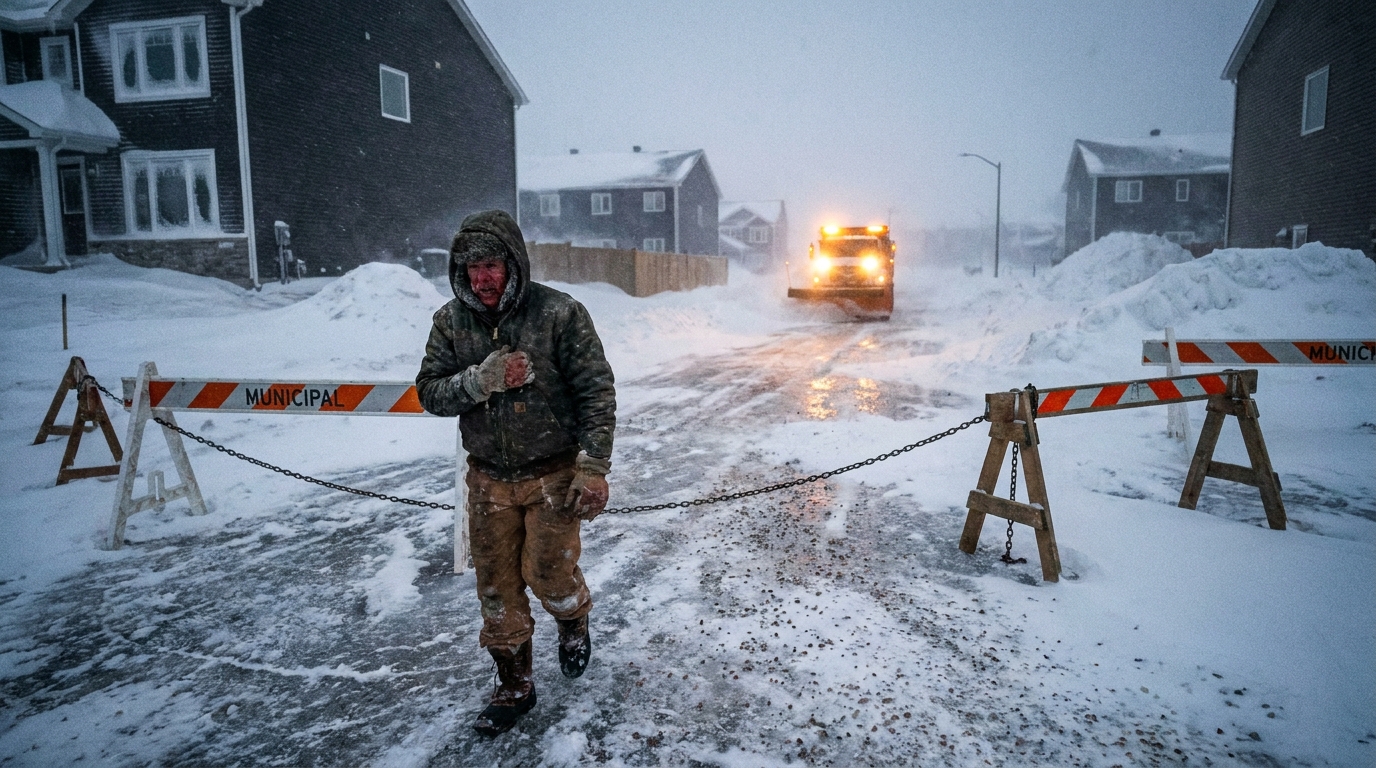
Unit 4 backed down the narrow cul-de-sac, its air brakes hissing loudly in the freeze. Two firefighters in full bunker gear stepped out into the blizzard, carrying heavy wooden sawhorses painted in high-visibility orange, wrapped in reflective tape.
I watched through the glass as Captain Vance himself stepped out of the cab, a heavy clip-board clad in clear plastic tucked under his arm. He didn’t walk to my door. He walked straight to the red Mercedes.
Lena’s door swung open instantly. She stepped out into the wind, her coat flying, her arms already coming up in a sharp, accusatory motion. She started talking before Vance reached the rear bumper, her jaw moving fast, her finger pointed directly at my darkened front door.
Vance didn’t argue. He didn’t raise his voice. He simply held up the plastic-wrapped clipboard, handed her a yellow carbon copy, and pointed straight down at the ground beneath her tires.
Lena didn’t take the paper. She let it fall into the slush.
Vance didn’t pick it up. He motioned to his men. The two firefighters slammed the heavy sawhorses into place directly behind her rear bumper, interlocking them with heavy steel chains. Then they drove two steel stakes into the snowbank, snapping a fresh band of bright yellow hazard tape across the frame.
GAS LEAK. DO NOT OPERATE VEHICLE.
Lena screamed something into the wind—a word that got lost in the howl of the blizzard—and turned toward her driver’s side door. Vance stepped directly into her path, his heavy boots planted wide on the icy asphalt. He pointed at the saw horses, then at the yellow paper fluttering in the snow by her feet.
She stopped. Her shoulders went rigid. For three seconds, nobody moved. The physical reality of the fire department’s authority collided head-first with her manufactured suburban status.
She didn’t get into the car. She reached inside, slammed the door shut, clicked her remote lock, and turned on her heel. As she marched toward her own driveway two doors down, her high heels sank deep into the snowpack, making her stumble once before she caught herself.
She didn’t look back at the truck. She looked straight at my bay window. Even through the frost-rimmed glass and the dark, our eyes met for a fraction of a second.
I didn’t wave. I didn’t smile. I raised my ceramic mug, took another slow sip of cold coffee, and watched her pull her front door shut with a heavy, echoic thud.
Outside, Vance walked up my porch steps. His boots thumped heavily on the wood. I opened the door before he could knock, the bitter wind instantly rushing into the hallway.
“It’s locked down,” Vance said, handing me a second yellow copy of the order. “Official notice served. She moves that car, or enters that zone before the utility crew pressure-tests the main tomorrow morning, she gets picked up by police. End of story.”
“Thanks, Captain,” I said, taking the paper. “What about the HOA? They’re threatening to send Vanguard Security to tow it.”
Vance spat into the snow beside the railing. “Vanguard doesn’t have the authority to break a municipal quarantine. If a tow truck shows up, tell them to call the station. Stay warm, Mr. Mercer.”
“Working on it,” I said.
He turned and walked back to his rig. I pulled the door shut, locking it tight.
I walked back to the kitchen, holding the yellow fire notice beside the Blackwood Mutual invoice. Two documents. One backed by the physical law of a city hazard; the other, a predatory paper trap designed to extract cash and leverage title control.
My house was down to thirty-nine degrees. My breath was visible in the hallway now, floating in thin, grey ribbons toward the ceiling.
I sat down at the laptop, plugged in a secondary external drive, and opened a blank spreadsheet. I titled the file Ledger-99.
If Lena Caldwell wanted to use paper to fight a gas leak, I was going to use her own paper trail to burn her board to the ground.
CHAPTER 3: ZERO POINT
The sharp, metallic stink of scorched insulation drifted up from the floor vent near my boots.
I paused, my gloved fingers hovering over the glowing keyboard. The house was down to thirty-eight degrees now, but the circuit breaker box in the pantry gave off a faint, rhythmic humming—a dirty current fighting against the freezing cold.
Through the bay window, the red Mercedes GLE sat silent behind the barricades, its dark windows reflecting the rhythmic strobe of distant snowplow lights. On my monitor, the newly created Ledger-99 spreadsheet lay open. I had crossed-referenced three different property parcel numbers in our cul-de-sac. Each home had received the exact same $200 assessment notice under Blackwood Mutual’s header within twenty-four hours of a reported utility disruption.
A heavy crunch of boots on snow echoed from the street.
I looked up from the screen. A dark gray pickup truck with no municipal markings pulled to the curb, its high beams cutting through the blowing whiteout. On the driver’s door, a faded vinyl decal caught the glare: a shield logo wrapped around stylized lettering—Vanguard Security.
The driver’s door swung open. A tall man in a heavy tactical parka stepped out, holding a pair of bolt cutters.
He didn’t hesitate. He didn’t check the perimeter or look toward my darkened windows. He walked straight to the interlocked wooden sawhorses Captain Vance had placed behind Lena’s vehicle, hooked the jaws of the cutters over the steel link chain, and leaned his full weight into the handles.
CRACK.
The link sheared with a sound like a pistol shot. The steel chain clattered onto the frozen asphalt.
I stood up from the table, my hand sinking into my coat pocket until my knuckles locked around the cold brass of the utility key. I pulled my phone from my belt, hit record, and stepped toward the front door.
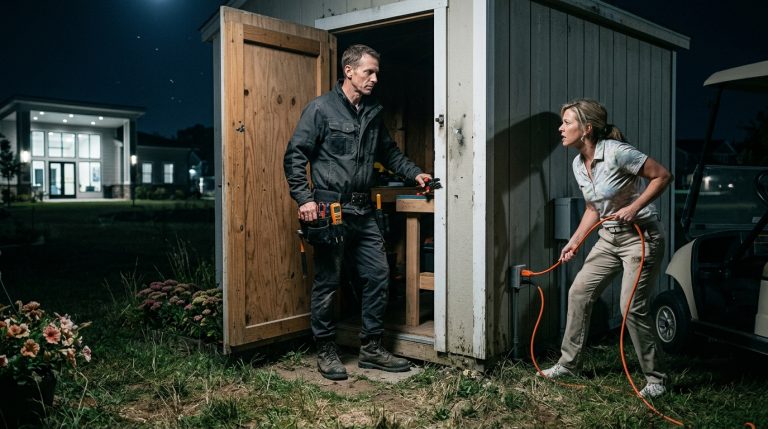
By the time I unlocked the deadbolt and pushed into the howling gale, Lena Caldwell was already stepping out of her front porch shadow. She was holding a spare key fob, her face illuminated by the harsh blue light of her phone screen.
“I told you,” she called out over the wind, her voice carried sharp and brittle across the driveway. “The board controls access. Cut the tape, Marcus.”
The Vanguard driver pulled the yellow hazard ribbon down in one continuous, tearing motion, crumpling the plastic into a ball and kicking a wooden sawhorse flat into the snow drift.
“Lena!” I called out. My voice stayed low, deadened by the heavy canvas collar of my jacket. “That zone is legally quarantined by the municipal fire marshal. The line is pressurized.”
She didn’t even turn her head to face me. “You’re forty-eight hours away from a lien on your deed, Mercer,” she said, her voice dropping into a flat, practiced cadence. “Document whatever you want. The board is moving the vehicle to clear the maintenance lane.”
Marcus tossed the bolt cutters into the bed of his truck, stepped back into his cab, and slammed the door. He didn’t stay to watch. The gray truck shifted into reverse, tires spinning against the ice, and backed down the cul-de-sac into the darkness.
Lena stepped past the flattened sawhorses, her boots crunching through the torn yellow tape. She grabbed the driver’s door handle of the Mercedes and yanked it open.
“Lena, stop,” I said, taking two deliberate steps down my porch stairs. The thermal camera app on my phone was active, showing a bright orange bloom beneath the snow crust directly under her front axle. The ground temperature right there was rising—residual gas pooling in the porous ice pocket created by her tire tracks. “Don’t turn the ignition.”
“Get back inside your freezing house,” she said, her lip curling as she pulled herself into the leather seat. “We’re done talking.”
She slammed the heavy door shut.
The electric locks clicked in unison. Inside the cabin, the dashboard screens flared to life, casting a cold, ambient aura across her face. Through the tinted glass, I saw her hand reach forward, fingers extending toward the push-to-start button.
I didn’t yell. I didn’t lunge for the door. I stopped on the bottom step, raised the phone straight in front of my chest, and held my breath.
Inside the car, her finger pressed the button.
The starter solenoid clicked once—a sharp, high-voltage spark jumping across the starter contacts beneath the engine block.
The world didn’t just explode; it displaced.
A dull, concussive THUMP slammed into my chest like a thrown sandbag, knocking the air straight out of my lungs. A violent sheet of orange fire erupted from beneath the front wheels, tearing through the snowpack in a radial wave. The blast lifted the front three thousand pounds of the Mercedes six inches off the pavement before slamming it back down onto its ruined suspension.
The sound followed a micro-second later—a tearing roar of metal, shattering glass, and vaporized ice.
Heat rolled across the lawn, hot enough to instantly melt the frost on my eyelashes and scorch the front of my canvas coat. The windshield of the SUV blew outward in a shower of granulated safety glass, black smoke instantly billowing up into the whiteout blizzard.
I stumbled back one step, my boots catching the edge of the riser, but my hands held the phone steady.
The driver’s door swung open awkwardly, hanging on a twisted hinge. Lena tumbled out onto the snow, coughing violently, her coat smeared with black soot, her face pale as a sheet in the firelight. She scrambled backward on her hands and knees, staring in absolute terror at the engine bay, where thick yellow flames were licking up through the crumpled aluminum hood.
The red Mercedes GLE was a ruined, smoking shell.
I lowered the phone three inches, watching the flames reflect off the screen. The winter silence returned, broken only by the crackle of burning rubber and the sudden, frantic wail of car alarms going off all down the street.
Lena looked up from the slush, her hands shaking so violently she couldn’t push herself up. Her eyes met mine through the drifting black smoke.
“You…” she choked out, her voice stripped of every shred of authority, reduced to a raspy whisper. “You… you knew…”
I didn’t answer. I stepped down onto the driveway, my boots crunching through the scorched slush, and walked to where the sheared steel chain lay in the snow beside her dropped key fob.
I picked up the severed link, dropped it into my coat pocket next to the brass key, and looked down at her.
“I told you not to turn the key,” I said.
CHAPTER 4: THE PAPER CAGE
Lena didn’t get up. Her gloved hands slipped twice in the black soot and melted slush before she rolled onto her side, her chest heaving, staring up at the towering column of smoke pouring from the Mercedes.
The air smelled of burnt synthetic leather, melted rubber, and raw propane.
Red and blue strobes pierced the blowing whiteout as Engine 4 slid to a stop across the cul-de-sac, followed immediately by a white-and-black municipal police cruiser. Snow thrown from their heavy tires sprayed across the curb.
Captain Vance was out of the cab before the engine fully idle-stopped. He marched straight through the ruined barricade zone, his heavy rubber turnout boots crushing the torn yellow hazard tape into the ice. Two firefighters dragged a heavy foam line behind him, charging the nozzle with a dull hydraulic thump.
“Everyone back!” Vance roared, his voice cutting cleanly through the storm. He grabbed Lena by the collar of her soot-stained coat with one gloved hand and hauled her backward ten feet, depositing her against the snowbank like a discarded sandbag.
An officer stepped out of the cruiser, his flashlight beam slicing through the black smoke to pin Lena where she sat.
“I didn’t… it wasn’t my fault,” Lena rasped, her voice trembling as she pointed a shaking, black-smudged finger at me. “He… he tampered with it. He staged this! He set a trap!”
Officer Miller turned his flashlight toward my face. The beam reflected off the camera lens of the phone still held firmly in my right hand.
“Lower the light, Officer,” I said quietly, my voice unhurried. “I have the entire sequence on video. Audio included.”
Miller paused, shifting the beam down to my chest. “You recorded the ignition?”
“I recorded her cutting the fire department tape,” I said. “I recorded Vanguard Security breaking the chain with bolt cutters ten minutes ago under her orders. And I recorded her turning the key after being warned four separate times.”
Lena scrambled up against the snowbank, her breath ragged. “He’s lying! I have emergency authority! Blackwood Mutual authorized immediate access clearing! Vanguard was executing board policy!”
Captain Vance stepped away from the smoking chassis, where his crew was smothering the engine bay in thick white foam. He walked straight up to Miller, pulling a plastic-sleeved clip-board from his coat.
“Officer,” Vance said, his voice dropping into an icy, procedural tone. “At 0730 hours this morning, I personally served Mrs. Caldwell with a municipal hazard quarantine notice under Section 804. I warned her explicitly that entering this perimeter with a motor vehicle constituted a misdemeanor hazard violation.”
Vance reached into his pocket, pulled out the yellow carbon copy he had retrieved from the slush earlier, and handed it to Miller. “She crumpled it and threw it in the snow.”
Miller looked from the yellow paper to Lena, then back to me. “Let me see the video.”
I stepped forward, keeping my thumb hooked over the side button of the phone. I didn’t hand him the device; I angled the high-brightness screen toward his face and hit play.
The video played with crystalline clarity in the freezing air:
The gray Vanguard truck pulling up. The driver using bolt cutters on the interlocked chain. Lena stepping off her porch, shouting her directive to clear the lane. Her entering the vehicle. My voice clearly stating: ‘The line is pressurized. Don’t turn the ignition.’ Her response: ‘We’re done talking.’ The click of the starter solenoid. The instantaneous sheet of fire.
Miller watched the clip twice without speaking. His jaw set hard.
“Who owns Vanguard Security?” Miller asked, turning his head toward Lena.
“It’s… it’s our contracted vendor,” Lena stammered, her composure splintering further under the officer’s flat gaze. “Blackwood Mutual handles their retainers.”
“They cut municipal emergency chains on your direct order,” Miller said. He unclipped a heavy leather notepad from his belt. “That’s interference with emergency operations, destruction of city property, and reckless endangerment.”
“I am the HOA President!” Lena shouted, her voice cracking into a high-pitched screech that echoed off the frozen houses. “You don’t understand the legal structure here! Blackwood holds a paramount maintenance easement!”
I reached into my coat pocket, pulled out the PDF invoice I had printed earlier from my laptop, and held it out to Miller.
“She used that easement logic to issue $200 pre-foreclosure assessment fines to homeowners who complied with the gas shutoff,” I said. “Look at the account code on the bottom line.”
Miller took the paper. He squinted at the fine print under his flashlight. “Default Security Lien? For a parking dispute?”
“It’s not a parking dispute,” I said, leaning in slightly so only Miller and Vance could hear over the hiss of the foam line. “It’s a manufactured default scheme. She clears the line so Vanguard can document non-compliance, then Blackwood triggers the lien process. That’s why she needed the Mercedes parked right here—to prove the lane was obstructed if I didn’t pay.”
Lena’s face drained of what little color remained. She looked at the folded paper in Miller’s hand, then at my phone, then at the charred frame of her $80,000 SUV being doused in chemical foam.
“Officer,” a voice called out from the utility truck that had just pulled into the cul-de-sac. The gas technician climbed out, holding a brass testing gauge attached to a long metal probe. “You need to see this.”
Miller, Vance, and I walked over to the exposed utility pit where the snow had been blown away by the blast.
The technician pointed his flashlight at the exposed copper fitting where the service pipe met the main valve manifold. The pipe wasn’t just cracked from the weight of a tire; the brass collar had been stripped clean, and a set of heavy tool marks—fresh, un-rusted steel gouges—were bitten deep into the threads.
“This didn’t break from a car sitting on it,” the technician said, his voice flat. “Someone put a twelve-inch pipe wrench on this fitting and torqued it until the seal sheared. The weight of the SUV just finished opening the gap.”
Layer 1 crumbled right there in the snow. This wasn’t a sudden accident caused by Lena’s stubborn driving. The line had been deliberately compromised before the storm even hit.
I looked at the tool marks, then pulled my phone back up. I zoomed in on the photo I’d taken during the first snowstorm three days ago—the one showing the Vanguard truck parked near the utility box before any tape had gone up. In the corner of the frame, lying in the slush near the back bumper of the gray pickup, was a heavy steel pipe wrench.
“Miller,” I said softly, holding the photo out. “Look at the jaw width on that wrench.”
Miller took a long, slow breath. The cold air whistled through his teeth. He turned around, walked straight over to Lena Caldwell, and unclipped the steel handcuffs from his belt.
“Lena Caldwell,” Miller said, his voice devoid of emotion. “Stand up and put your hands behind your back.”
“What?!” she screamed, struggling against the snowbank as Miller pulled her wrist around. “You can’t arrest me! Call Blackwood! Call Vanguard!”
“You have the right to remain silent,” Miller said, snapping the steel cuff onto her right wrist with a cold, metallic CLACK. “Anything you say can and will be used against you in a court of law.”
I stood on the edge of the driveway, watching Miller lead her toward the back of the cruiser. Her high heels dragged through the soot-blackened snow, leaving two jagged lines behind her.
As the police car door slammed shut, Captain Vance walked up beside me, staring at the charred carcass of the Mercedes.
“You got your evidence, Mercer,” Vance said quietly. “But if someone sabotaged that fitting on purpose… this isn’t just an HOA president losing her mind over a parking space.”
“No,” I said, my thumb tracing the sheared steel link inside my pocket. “It means Blackwood isn’t trying to collect fines. They’re trying to force us out.”
CHAPTER 5: LEDGER99
Captain Vance turned his collar up against the driving ice, his eyes fixed on the empty gap where the cruiser’s taillights had dissolved into the whiteout.
“Stay inside, Mercer,” Vance said, his breath freezing in thick crystals on his wool collar. “We’re keeping the foam line charged until the utility crew caps the main line at the street curb. Don’t touch anything near the pit.”
“Understood,” I said.
I turned back toward my house, my boots sinking into the black slush that lined the driveway. My fingers were nearly numb inside my leather gloves, stiffened by thirty minutes in thirty-degree air. The house hit me like a cold vault the second I pushed through the front door—thirty-six degrees now. The air inside smelled faintly of stale frost and damp drywall.
I locked the deadbolt, stripped off my gloves with my teeth, and sat directly in front of the laptop on the dining table. My hands were shaking slightly, not from fear, but from the raw, bitter chill settling deep into my joints.
I clicked open the PDF invoice Lena had handed me—the one stamped with Blackwood Mutual’s corporate crest—and dragged it straight into an offline forensic metadata parser I’d used during my years auditing commercial real estate titles.
The raw text string populated the left side of the split screen:
Author: BMM_Operations_Admin
Creation Date: 11/14/2025
Template ID: FORECLOSURE_TRIGGER_V4
My thumb clicked against the edge of the brass utility key sitting beside my mousepad. Foreclosure Trigger.
I opened a secondary portal, bypassing Blackwood Mutual’s public landing page to query the county land records database directly using my property’s parcel number.
The county ledger pulled up in stark black-and-white rows. I scrolled past my original purchase deed from seven years ago down to the recent filings column.
Two months prior—long before any gas leak, long before the storm—a notice had been quietly recorded against my title: Lis Pendens: Conditional Security Lien.
The filing party wasn’t Blackwood Mutual. It was an entity named Vanguard Security Asset Holdings LLC, registered out of a post office box in Wilmington, Delaware.
I cross-referenced the corporate ID with the state’s business registry. Vanguard Security Asset Holdings held a 100% equity stake in Blackwood Mutual Management Group. The security company that cut the emergency chain wasn’t just a hired vendor; it was the parent company pulling the strings.
I pulled up the spreadsheet I’d named Ledger-99 and began mapping the parcel numbers for every house on our cul-de-sac.
Across eleven properties, six had received identical $200 assessment fines within thirty days of a localized utility disruption—a frozen water main on Lot 4, a cracked electrical conduit on Lot 9, and now the severed propane fitting on my own line.
In every single case, the property owner was an older resident or someone living on a fixed income without a legal defense retainer. Once the $200 fine went unpaid or was contested through the HOA’s internal appeal board—which Lena chaired—Blackwood triggered the Default Security Lien clause. The lien accrued compound interest at 24% per month under a hidden clause in the community bylaws.
Within ninety days, a $200 parking fine ballooned into a $14,000 cloud on title. Vanguard Security then stepped in to purchase the lien at face value, filing quiet-title foreclosures before the homeowner even realized their mortgage was compromised.
They weren’t managing a neighborhood. They were running a systematic land-grab operation designed to force residents into default, buy the deeds for pennies on the dollar, and sell the land to commercial developers expanding from the highway corridor.
A sudden knock rattled the heavy oak frame of my front door.
I didn’t close the laptop. I stood up, slipped the brass utility key into my palm, and walked to the entryway.
I pulled back the brass peephole cover. Standing on my porch in a dark navy trench coat, his hands tucked deep into his pockets, was a man I hadn’t seen in the cul-de-sac before. A silver lapel pin glinted against his dark coat—a stylized shield wrapped around a letter V.
“Mr. Mercer,” the man said through the wood, his voice calm, measured, and entirely unhurried despite the sub-zero gale howling behind him. “My name is Arthur Vance. No relation to the fire captain. I’m legal counsel for Blackwood Mutual.”
I unlocked the deadbolt and pulled the door open three inches, leaving the heavy security chain latched.
“You’re standing on private property,” I said.
Arthur Vance didn’t look angry. He didn’t look flustered. His face was smooth, razor-shaved, and entirely devoid of emotion, the face of a corporate operative who treated human conflict strictly as an accounting entry.
“Mrs. Caldwell made a series of operational errors tonight,” Arthur said, reaching into his coat to pull out a slender leather portfolio. He opened it, revealing a single sheet of watermarked paper with a cashier’s check clipped to the top. “Her actions were unauthorized by the board. Blackwood Mutual is rescinding all fines levied against your account, effective immediately. We are also issuing a full settlement check for $15,000 to cover your heating loss, plumbing inspection, and property distress.”
He held the portfolio up to the gap in the door.
I looked at the check. The memo line read: Full Mutual Release & Confidentiality Agreement – Parcel 411.
“And what happens to Vanguard’s lien on my deed?” I asked softly.
Arthur’s eyes hardened by a fraction of a millimeter—the only tell he gave. His fingers tightened slightly on the leather binder.
“The lien was an administrative filing error,” Arthur said smoothly. “It will be cleared within thirty business days, provided this release is executed tonight.”
“And the pipe wrench marks on the gas fitting?” I asked.
Arthur didn’t blink. He reached into his pocket, pulled out a gold fountain pen, and unclipped the cap.
“Storms cause structural stress, Mr. Mercer,” Arthur said, his voice dropping an octave into a cold, flat murmur. “Sometimes that stress fractures pipes. Sometimes it fractures communities. Take the settlement. The alternative is a protracted title dispute with a multi-million-dollar management group while your house sits without heat in January.”
I looked at his gold pen, then at his calm, arrogant face. He thought the cold would break me. He thought forty-eight hours without heat would make fifteen thousand dollars look like salvation.
I reached out, took the settlement document from his fingers, and tore it cleanly down the middle.
I dropped the two halves into the slush on my porch step, right beside his leather shoes.
“Tell Vanguard to hire a better lawyer,” I said.
I slammed the door shut, turned the deadbolt, and listened to the silence of his footsteps retreating down the frozen stairs.
I walked back to the dining table, sat down in front of the glowing monitor, and opened a new email draft addressed directly to the State Attorney General’s Real Estate Fraud Division and the County Prosecutor’s Special Investigations Unit.
I attached Ledger-99, the forensic PDF metadata, the timestamped photos of the pipe wrench, and the video of Lena directing Vanguard to break the municipal chain.
My thumb pressed the send button.
The screen flashed once: Message Sent.
Outside, the wind howled against the bay window, but inside, the cold didn’t feel like a threat anymore. It felt like a blade being forged.
CHAPTER 6: CHECKMATE IN WHITE
The blue strobes painted sweeping arc patterns across the frozen ceiling, turning the dark living room into a rhythmic pulse of light.
Outside, the snow had stopped falling. The storm had broken, leaving behind a stark, brilliant sky and a bite so cold it made the glass in the bay window hum.
I didn’t move from my chair. I sat with my palm resting flat on the cold wood beside the brass key, watching through the front window as three unmarked state investigator sedans pulled up behind the fire department’s perimeter tape.
Two men in heavy navy winter coats stepped out of the lead vehicle. On their lapels, gold badges caught the strobe lights—State Attorney General’s Special Investigations Unit. Behind them, two county sheriff deputies walked directly toward the curb where Arthur Vance was still standing near his luxury sedan, his gold fountain pen still clutched in his leather-gloved hand.
Arthur didn’t run. He smoothed his coat, stepped toward the lead investigator, and pulled out a leather ID holder, his jaw set in a tight, professional line. He spoke fast, his lips moving in sharp, practiced cadences, waving one hand toward the charred frame of the Mercedes and then toward my porch steps where his torn settlement agreement lay scattered in the slush.
Investigator Miller didn’t look at the paper in the snow. He pulled a thick, manila folder from his jacket, opened it against the hood of the sedan, and pointed directly to a line item stamped across the top document.
Through the window, I recognized the layout instantly. It was the export header from Ledger-99.
Arthur’s mouth stopped moving mid-sentence. His hand, still holding the gold pen, hovered in the freezing air for two full seconds before dropping slowly to his side.
The investigator didn’t ask questions. He didn’t engage in debate. He turned slightly, making space for two county deputies who stepped up on either side of Arthur. One deputy reached out, took the gold fountain pen from Arthur’s hand, and dropped it into a clear plastic evidence bag. The second deputy brought Arthur’s arms behind his back, snapping heavy steel cuffs over his wrists with a dull, metallic double-click.
Arthur looked toward my front window. Through the clear, frost-free patch on the glass, our eyes met.
I didn’t nod. I didn’t smile. I picked up the brass utility key from the table, stood up, and pulled open my front door.
The morning air hit my chest like a cold blade. I walked down the porch steps, my boots crunching cleanly through the fresh, un-drifted powder.
Investigator Miller looked up as I approached the curb. “Mr. Mercer?”
“Yes,” I said.
“State Prosecutor’s office received your filing at 0214 hours,” Miller said, his voice dry and clipped in the freezing morning. “The forensic audit on Vanguard Security Asset Holdings was already flagged under a secondary predicate, but your cross-match with Blackwood Mutual’s default lien register tied the physical sabotage to the corporate title filings.”
He motioned toward the utility pit, where two state forensic technicians were taking high-resolution macro shots of the stripped copper threads.
“The pipe wrench recovered from the Vanguard truck matched the jaw dimensions on the fitting brass down to the millimeter,” Miller continued. “The wrench carried trace copper shavings in the teeth. They were using localized infrastructure damage to manufacture emergency default conditions, triggering automated liens through Blackwood before residents could contest the assessment.”
Arthur Vance stood between the two deputies, his head turned away, staring silently at the snow-covered street. His corporate composure had collapsed into the flat, hollow silence of a man who realized every legal shield he had constructed had been converted into state evidence.
“Arthur Vance and Lena Caldwell are being charged under state RICO statutes for predatory foreclosure fraud, corporate sabotage, and conspiracy to commit arson,” Miller said, closing his folder. “The county court has already issued an emergency stay on all outstanding Blackwood liens across the township. Your deed is clear.”
“Thank you, Investigator,” I said.
Miller nodded once, stepped back into his vehicle, and closed the door. The sheriff’s cruiser pulled away, taking Arthur Vance and the remaining Vanguard personnel out of the cul-de-sac.
By noon, the sun was high in a pale blue winter sky.
The heavy roar of a utility service truck filled the street as the municipal gas crew completed the final pressure test on the replaced main line. A technician in bright orange coveralls walked up my steps, carrying a heavy steel wrench and a digital pressure manifold.
“Pressure’s holding at forty pounds, Mr. Mercer,” he said, turning the primary riser valve on my side wall with a solid, metallic clunk. “Line’s cleared. You can fire the pilot.”
I went back inside.
I walked down the narrow basement stairs to the utility room, set my flashlight on the concrete floor, and knelt beside the furnace casing. The pilot valve was cold to the touch. I reached into my pocket, pulled out the brass utility key, and used its heavy edge to clear a tiny speck of carbon build-up from the igniter gap.
I opened the gas valve, clicked the striker, and held my breath.
A soft, steady WHOOSH filled the small room as a clean blue flame blossomed beneath the heat exchanger. Within thirty seconds, the heavy blower motor hummed to life, pushing warm, dry air up through the ductwork.
I stood up, holding the brass key in my palm.
I walked back up to the main floor. The radiators in the hallway were already beginning to creak and expand as heat moved through the iron pipes. The frost on the bay window was turning to soft drops of water, sliding down the glass in clean, parallel lines.
I stood by the window, looking out over the cul-de-sac.
The burned carcass of the Mercedes was gone, towed away on a flatbed hours ago. In its place, where the torn yellow tape had fluttered in the gale, stood a brand-new, steel-reinforced municipal utility cage, bolted three feet deep into the concrete curb, painted in dark industrial enamel.
The street was silent, clean, and open.
I walked to the dining table, shut down the laptop, and placed the heavy brass utility key flat on top of the closed lid.
The house was warm.