A Quiet War in Whispering Pines: How One Man’s Composting Strategy Dismantled a Tyrant’s Kingdom
CHAPTER 1: The First Movement
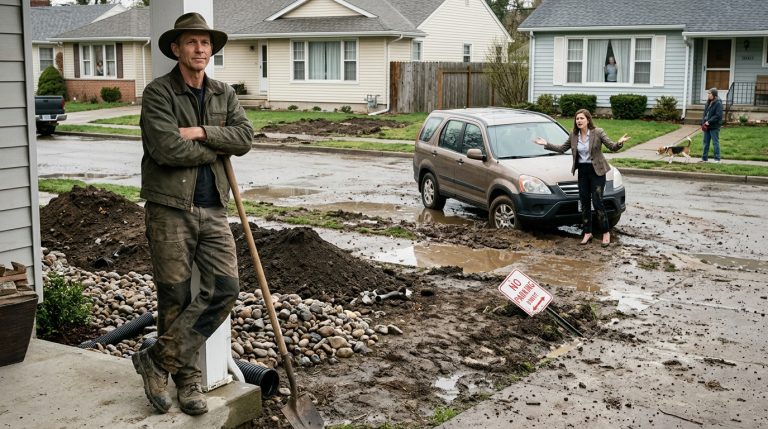
The silence that followed her golf cart’s retreat was not the peaceful stillness of a suburban morning; it was the pressurized calm before an explosive strike. I stood at the edge of my property, the violation notice held loosely between my thumb and forefinger. The paper felt like a tactical error in my grip.
Karen was already fifty yards away, her pink velour jacket a garish, insulting smear against the perfectly trimmed beige backdrop of our cul-de-sac. She was piloting that golf cart like a tank, her posture rigid, her chin tilted at an angle of practiced superiority. She believed she had just won a skirmish. She didn’t realize she had just walked into an active minefield.
I turned my attention back to the compost enclosure. It was a masterpiece of order. Three bins, constructed from cedar I had personally sourced, held a delicate, calculated balance of nitrogen and carbon. It wasn’t trash. It was biology. It was the process of life, turning rot into the foundation for next spring’s garden. To Karen, it was an abomination because it was something she couldn’t label, inventory, or tax.
I walked toward it, not to hide it, but to inspect the joints of the cedar. My hands, calloused from years of working with heavy machinery and structural planning, traced the stainless steel hardware. Everything was secure. Everything was up to code. I had spent two years becoming a ghost in this neighborhood—the man who kept his hedges perfect, his trash tucked away, and his voice low. I had played the role of the model resident to buy myself the peace to build my sanctuary.
But the paper in my hand shifted my internal state. The calm, methodical part of me that had once managed battalion-level logistics didn’t flare with rage; it crystallized. Anger is a waste of energy—a chemical distraction. Instead, I felt the familiar, cold precision of a project beginning.
I walked into my workshop. The scent of sawdust and machine oil greeted me, a stark contrast to the performative, manicured sterility of the street outside. I set the violation notice on my workbench, right beneath the pool of bright, unforgiving light from my task lamp.
The HOA logo glared back at me. They had a bylaw—Section C, paragraph 4—the “unsightly materials” clause. It was a classic administrative weapon: broad, subjective, and designed to intimidate. It relied entirely on the ‘sole discretion’ of the committee.
I pulled out my phone and began to document. I didn’t just take pictures; I took evidence. I snapped high-resolution shots of the compost pile from every angle, capturing the integrity of the cedar, the richness of the soil, the lack of debris, and the absence of any foul odor. Then, I turned my lens to the violation notice itself.
As I saved the files to a folder I’d already named, my peripheral vision caught the window. Outside, a neighbor’s sprinklers clicked on, a rhythmic, predictable ticking that seemed to echo the artificiality of this place. I wasn’t going to fight this with a scream or a protest. I was going to fight this with a mountain of irrefutable, undeniable technical reality.
I sat down at my desk, opened the binder containing the full, two-hundred-page text of the HOA covenants, and pulled out my highlighter. The paper in my hand was just a piece of card stock, but to Karen, it was a weapon. She had no idea that she had just picked a fight with the wrong kind of man. She wanted a conflict? She was about to get a logistical nightmare.
I tapped the screen, naming the folder, then glanced at the clock. It was Tuesday. By Friday, I wouldn’t just be ready. I would be finished.
CHAPTER 2: The Architecture of Logistics
The workshop was a cathedral of order, and for the first time in two years, I needed its silence to be absolute. I left the door cracked just enough to hear the house, the faint vibration of the refrigerator, the distant, muffled sound of Sarah moving in the kitchen. She didn’t need to know yet. Not the details. I needed to build the perimeter of this campaign before I invited her to look at the battlefield.
I sat at the workbench, the violation notice still lying under the harsh circle of the lamp. It was a flimsy, pathetic document when viewed through the lens of a man who had spent two decades ensuring billion-dollar infrastructure projects didn’t collapse under pressure. Karen wasn’t using law; she was using intimidation. The difference was the gap through which I would drive a truck.
I pulled the heavy, three-ring binder containing the Whispering Pines Covenants, Conditions, and Restrictions from the shelf. It had been gathering dust since the day we signed the mortgage. I opened it to Section C, paragraph 4. The language was beautiful in its absurdity. “Sole discretion of the architectural control committee.” It was a phrase designed to be a guillotine, but it was also a pivot point. If the decision was at their discretion, it was, by definition, subject to the standard of “reasonability.” And “reasonability” was a legal term that required objective, not subjective, grounding.
I pulled out a fresh notepad and clicked my pen. The ticking of the sprinkler outside intensified, a rhythmic reminder of the artificial, beige world I had been living in. Suddenly, a memory surfaced—a briefing in an operations center in a desert, the smell of dust and the cold, sharp tang of ozone from the cooling racks of the server banks. We had been trying to route a supply line through a hostile zone, and the map hadn’t matched the ground. The commander had wanted to force the route; I had argued for a change in approach based on the topography. I had won by showing him that the map was a fiction and the terrain was the truth.
Karen was the commander trying to force a route through my life. I was the engineer, and I was about to redraw the terrain.
I started the first spreadsheet: The Karen File.
The first column was the Date and Time. The second was the Description. The third was the By-law Reference. I logged the interaction from that morning with cold, surgical detachment. Every word she had said, every inflection of her voice, was converted into data.
But data wasn’t enough. I needed a counter-logistics chain. I pulled up the county’s municipal codes on waste management and property usage. I began cross-referencing them against the HOA’s own governing documents. There was a hierarchy of law here, and I suspected the HOA’s document was wildly out of alignment with the county’s actual environmental directives.
My fingers flew across the keyboard, the steady clatter of keys replacing the ticking of the sprinkler in my ears. I wasn’t just planning an appeal; I was building a case that would make the HOA board realize that enforcing this violation would be a legal and financial liability for every single homeowner. I would make it too expensive for them to bully me.
My eyes burned, but I didn’t reach for the coffee. I kept my focus on the screen, the blue light reflecting in the polished steel of my calipers resting on the bench. I was looking for the crack in the foundation. I found it in an obscure appendix regarding the “Architectural Control Committee’s” powers—they were legally obligated to provide a written, evidence-based justification for any aesthetic violation that exceeded five hundred dollars in fines. She hadn’t provided a shred of evidence. She had just provided a number.
A grim, satisfied smile tugged at the corner of my mouth. I had the leverage. The strategy was no longer defensive. It was a counter-offensive. I saved the file, the hard drive’s steady, soft hum a promise of coming momentum. This wasn’t about the compost anymore. It was about the structural failure of an ego that had grown too large for its own good. I stood up, the chair scraping sharply against the concrete floor, and walked to the window. The cul-de-sac was dark now, a quiet, orderly row of houses, each one a separate, guarded kingdom.
I looked toward the back of the property, where the compost pile sat in the shadow of the fence. It was quiet. It was steady. It was doing exactly what it was designed to do—slowly, invisibly, transforming the waste of yesterday into the strength of tomorrow.
I turned back to the workbench. I had a lot of work to do. By the time I was finished, Karen would wish she had never learned how to use a clipboard.
CHAPTER 3: The Public Smear
I stood in my kitchen, the morning sunlight filtering through the window and landing directly on the Whispering Pines Whisperer. It was a glossy, professional piece of propaganda, designed to look like a friendly community update while functioning as a surgical strike on my standing in the neighborhood.
There it was, front and center: “Community Standard Spotlight.”
The prose was classic Karen—passive-aggressive, loaded with pseudo-authoritative terminology, and dripping with thinly veiled malice. It didn’t mention me by name, but the photo attached to the article left no room for doubt. It was my compost enclosure, captured from an angle that made the clean, cedar-clad structure look like a collapsing pile of filth. The lighting was overcast, muddying the colors and making the mulch look like wet, rotting refuse.
I picked up the newsletter. The paper felt heavy, slick, and entirely artificial. My hands remained steady, but I felt a tight, burning knot of irritation in my chest—not because I cared what these people thought, but because of the audacity of the intrusion. I walked to the back door and looked out at the actual compost pile. It sat in the morning sun, neat and silent, looking nothing like the chaotic disaster depicted in the newsletter.
She had trespassed. There was no other way she could have gotten that specific angle. She had come onto my property, ducked behind the lattice screen, and framed the shot to deceive.
“Marcus?” Sarah’s voice came from the hallway, soft and tight. She’d been reading it too. She stepped into the kitchen, her face pale. “This is… it’s libel, isn’t it? She’s calling you a health hazard in front of everyone.”
“It’s worse than that,” I said, setting the paper down on the counter with a precision that bordered on the clinical. “It’s a deliberate misrepresentation. She’s trying to poison the well before I even get a chance to speak to the board.”
I felt the familiar, cold shift in my pulse. The irritation vanished, replaced by the mechanical focus of the engineer. She wanted a public spectacle? She wanted to turn the neighborhood against me by appealing to their fear of rats and smells?
I walked back into the workshop, Sarah following me. I sat down at the computer and opened the Karen File. The folder was already growing, populated with the photos I’d taken, the bylaws I’d annotated, and the timeline of her trespasses. I brought up the photo from the newsletter. It was a digital PDF, which meant it had metadata.
I opened the file properties and let out a small, sharp sound of triumph. The device information, the date, and the timestamp were all there. She had taken the photo with her phone three days ago, during the time I was at the office.
“Look at this,” I said, motioning Sarah over. I pointed to the timestamp. “She didn’t just write this; she created the evidence. And in doing so, she just handed me the proof of her own misconduct.”
“What are you going to do?” Sarah asked.
“I’m not going to write a letter to the editor,” I said, my voice quiet, devoid of any performative anger. “I’m going to document the entire history of this ‘standard.’ I’m going to make sure that when this goes to the board, they aren’t looking at a dispute about a compost pile. They’re going to be looking at a record of harassment, trespassing, and intentional misrepresentation.”
I looked out the workshop window again, toward the common green space that backed up to our property. The Whispering Pines HOA was a well-oiled machine, but it was a machine run on social capital. Karen had spent years building hers by appearing to be the protector of order. I was about to prove that her version of order was nothing more than a fragile shell, and underneath it, the machinery was rotting.
I began to draft a new document—not for the HOA, but for myself. I started mapping out the neighborhood, identifying the other residents who had been harassed. I remembered Dave Sterling, the man two streets over who had been bullied over a flag pole. I recalled the quiet frustration of the Hendersons, who were always too afraid to complain.
If she wanted to spotlight “community standards,” then I was going to provide a floodlight.
I started a new spreadsheet: Documented Harassment Cases. I had no intention of being a victim. Every single action she took from this moment forward would be logged, cross-referenced, and eventually, used to dismantle the very authority she was abusing.
The phone on my desk buzzed. It was a notification from the HOA’s management portal. They had officially filed the violation notice I had received into the system. The timer had started. They were expecting me to scramble, to get defensive, to maybe even try to bribe her or apologize.
I clicked the link, saw the sterile, professional interface, and closed the window. I didn’t need to respond yet. I needed more data. I walked out of the workshop and out into the yard. The air was crisp, and the scent of the pine trees from the protected woodland at the edge of the property was strong. It felt like a reprieve, a moment to breathe before the next maneuver.
I stood by the compost bins and watched the neighbors. A couple walked their dog along the path, their eyes flickering briefly toward my yard with a mixture of suspicion and curiosity. The newsletter had done its job. The poison was working. But that was fine. If they were looking, I would give them something to see. I wouldn’t be the man hiding his ‘trash.’ I would be the man who was meticulously, efficiently, and relentlessly preparing his defense.
She thought she was a queen on a throne of polyester and gold-embossed cardstock. She had no idea that I was the one holding the structural schematics for the building she was standing on.
CHAPTER 4: Reconnaissance in the Green
The shift in the neighborhood was palpable. As I walked toward the edge of the property, the air felt thinner, strained by the unspoken judgments of people I had shared polite waves with for years. I saw Mrs. Gable three houses down pull her curtains back just enough to watch me pass. It was a small, petty gesture, but it signaled the effectiveness of Karen’s campaign. I wasn’t just Marcus Jensen anymore; I was a variable—a threat to the beige uniformity of Whispering Pines.
I didn’t acknowledge her. I kept my stride rhythmic, my hands buried deep in the pockets of my canvas work jacket. I wasn’t heading for a confrontation; I was heading for the green space, the expansive, manicured common area that separated our homes from the protected woodland. It was Karen’s crown jewel, but I had a hunch that her obsession with the front-facing “standards” had blinded her to the rot festering in the back.
The path toward the community garden was flanked by meticulously pruned hedges and decorative stone markers, all of which had likely been debated and voted on in closed-door sessions. As I neared the garden entrance, the scent changed. The clean, synthetic air of the manicured lawn vanished, replaced by something heavier—a sour, cloying thickness that signaled anaerobic decay.
I stopped near the edge of a cluster of viburnum shrubs, keeping my profile low. The garden was supposed to be the pride of the association, a place where retired schoolteachers and weekend hobbyists cultivated organic produce. But as I peered through the gaps in the foliage, the illusion shattered.
Karen’s pride was in shambles.
The raised beds were choked with yellowing kale and withered chard, and the gazebo in the center—the site of so many “community socials”—looked tired, its wood graying and split by moisture. But it was the rear corner that drew my focus. The official HOA composting area consisted of four plastic bins, the cheap, mass-produced kind meant for suburban leaf storage, not for the high-volume kitchen waste of an entire neighborhood.
They were overflowing.
I watched for a moment, my breath steady. The lids were warped, failing to lock closed, and the pile inside was a sickening mass of black, viscous rot. There were greasy pizza boxes half-buried in the sludge, discarded pumpkin husks from the festival weeks ago, and a constellation of flies hovering in a low-hanging, frenetic swarm. It wasn’t just poor management; it was a disaster.
And then, I saw the motion.
At the base of the furthest bin, near a tear in the plastic where the contents were spilling directly onto the ground, a shadow moved. It wasn’t the erratic jitter of a squirrel or the cautious crawl of a toad. It was a fluid, deliberate scuttle. A rat, large enough to be a health department nightmare, emerged from the gap, its fur matted with dark, foul-smelling earth. It paused, nose twitching at the air, before vanishing into a burrow it had clearly excavated beneath the bin’s base.
My pulse remained low, cold, and entirely functional. I pulled my phone from my pocket. I didn’t need to step onto the property; my zoom was more than sufficient. I snapped a series of high-definition shots: the overflowing bins, the rotting food, the burrow hole, and the rat itself.
I wasn’t just witnessing negligence; I was witnessing the inevitable result of an ego that cared more about the color of a mailbox than the hygiene of the soil. Karen had spent her entire presidency policing the lives of her neighbors, all while her own backyard—the community garden—was turning into a biological hazard.
“Marcus?”
The voice startled me, not because I hadn’t heard the footsteps, but because of who it belonged to. I turned to find John Henderson standing on the walking path, holding a bag of fertilizer. He looked tired, his brow furrowed as he looked from me to the garden entrance.
“I didn’t think I’d see you out here,” John said, his tone cautious. He looked at the garden, his gaze lingering on the plastic bins. “It’s been a mess for a while, hasn’t it?”
I didn’t lie. I didn’t even hedge. I shifted my body, blocking his view of the burrow hole but acknowledging the state of the bins. “It’s beyond a mess, John. It’s a liability.”
John sighed, his shoulders slumping. “Karen keeps telling everyone it’s ‘in transition.’ She says the new soil hasn’t arrived yet. But the smell… it’s gotten worse.” He hesitated, looking back toward his own house. “She’s been very vocal about your compost pile, Marcus. A lot of people are starting to talk.”
“Let them talk,” I said, the weight of the phone in my pocket feeling like a heavy, solid truth. “The truth isn’t determined by a newsletter, John. It’s determined by the facts on the ground.”
“I just don’t want any trouble,” he said, moving to walk past me.
“I don’t want trouble either,” I replied, watching him go. “I just want things to work correctly.”
I waited until he was out of sight before turning back to the garden. I had the photos. I had the evidence. Karen had been looking for a health hazard in my yard, never realizing that she had been nurturing a much larger one in hers. I didn’t feel a rush of adrenaline; I felt the grim satisfaction of a completed calculation. The next phase of this operation wouldn’t be defensive. It would be a total reconstruction of reality.
I walked back toward my house, the weight of the morning’s work solidifying in my mind. The path felt different now—less like a suburban walkway and more like a corridor of tactical advantage. I had seen the decay, I had documented the negligence, and I had confirmed that the board’s president was not only a hypocrite but a liability.
The battle wasn’t just about my compost anymore. It was about exposing the rot at the center of Whispering Pines. And I was the only one with the tools to do it.
CHAPTER 5: The Tactical Dismantling
The clubhouse was a space designed for banality—beige walls, industrial-grade carpet, and lighting that seemed to bleach the color out of anything it touched. When I walked through the double doors at 7:00 p.m., the room was already filled with the low-frequency hum of a suburban swarm. Residents were squeezed into stacking chairs, their faces a mixture of expectation and low-level agitation. They had come for a show, and thanks to the newsletter, they expected the “hoarder from Chestnut Lane” to crumble under the weight of Karen’s indignation.
I didn’t give them a show. I gave them a briefing.
Karen sat at the head of the table, her platinum-blonde hair arranged in a helmet of defiance, her posture a masterpiece of manufactured poise. Beside her, the puppets—Gary and the woman who seemed perpetually tethered to her phone—clutched their own folders with white-knuckled intensity. My presence was an affront to the narrative they had constructed, and I saw the brief, sharp flicker of irritation in Karen’s eyes as she locked onto me.
“Mr. Jensen,” she announced, her voice projected to reach the back of the room with an artificial, practiced resonance. “You have five minutes to justify your non-compliance.”
I didn’t answer. I simply walked to the front, placed my heavy, tabbed binder on the laminate table, and heard the dull thud it made—a sound of gravity that seemed to pull the oxygen from the air. I had spent hours distilling the complex web of bylaws, county statutes, and photographic evidence into a sequence that moved like a piston.
“I’m not here to justify,” I said, my voice measured and distinct. “I’m here to clarify the record regarding Violation 88-12.”
I opened the binder to the first tab. It was the dictionary definition of ‘unsightly,’ juxtaposed with the high-resolution, time-stamped photograph of my compost system. I didn’t address the room; I addressed the board. I made eye contact with Maria, the board lawyer, and Frank, the accountant. They were the ones who actually understood the weight of a legal liability.
“The violation notice cites the ‘sole discretion’ of the Architectural Control Committee,” I began, my tone entirely devoid of emotion. “However, by state law, ‘discretion’ in a contract between an association and a homeowner is not synonymous with ‘arbitrariness.’ It requires a rational basis.”
I saw Maria shift in her chair. She looked at the photo, then at the text of the bylaw I had highlighted in yellow. The murmur in the room dipped into a focused, uncomfortable silence.
“My compost enclosure is not refuse. It is a controlled biological process, verified by the county guidelines for sustainable waste management.” I held up the printed county brochure, its official logo a stark contrast to the hand-drawn, erratic nature of Karen’s notices. “To label this ‘unsightly’ is not an aesthetic judgment; it is a contradiction of the very statutes that govern our jurisdiction.”
Karen’s face was beginning to flush, the color rising from her neck to her cheeks in a mottled, ugly spread. “That is an irrelevant technicality, Mr. Jensen! We are here because your neighbors—”
“Which neighbors, Karen?” I interrupted, my voice remaining level, cutting through her shrillness like a blade. “Because I have spoken to every neighbor bordering my property, and not one of them has registered a complaint. In fact, most were unaware that a violation had even been alleged.”
The room’s energy shifted. It wasn’t the voyeuristic thrill of a public shaming anymore; it was the sudden, jagged awareness of a lie being dismantled. Gary looked down at his lap. The woman with the phone finally set it down, her focus snapping toward the table.
“You are required, by the board’s own bylaws,” I continued, flipping to the final tab, “to provide a factual, evidence-based justification for any fine exceeding five hundred dollars. You have provided none. Instead, you have utilized a smear campaign via the community newsletter, utilizing photographs taken without my consent on my own property.”
I pushed the binder forward across the table. It sat between us, a barricade of logic. I watched Karen’s hands—they were trembling, just slightly, the fingers tapping a frantic, irregular rhythm against the laminate. She was losing her grip, not on the room, but on the narrative. She had built her kingdom on the assumption that no one would ever have the patience to read the 200 pages of fine print. She was wrong.
“This is not a dispute over a pile of leaves,” I said, leaning in, my voice dropping to a register that carried to every corner of the room. “This is a question of whether this association intends to function according to the law, or according to the personal vendetta of its president.”
The silence in the clubhouse was heavy, pressurized. The fluorescent lights overhead seemed to hum with a discordant, aggressive buzz. I looked at Frank, the accountant. He was staring at the photo of the violation notice, his brow deeply furrowed. He was doing the math—not the math of the fine, but the math of the lawsuit.
Karen opened her mouth to speak, but the words failed her. The structure she had built—the authority, the prestige, the sense of absolute control—wasn’t just being challenged; it was being rendered obsolete by the sheer, cold weight of the documents in front of her. She was a general whose soldiers were starting to realize she had never actually studied the map.
“I move,” I said, addressing the board, “that this board formally strikes Violation 88-12 from the record, citing a lack of evidentiary support and procedural non-compliance.”
Maria, the lawyer, slowly nodded. She didn’t look at Karen. She looked at the binder. The momentum had moved. The game wasn’t over, but the board had just seen the cracks in the foundation, and for the first time, they were looking at the man holding the sledgehammer.
CHAPTER 6: The Inspection
The morning of the inspection did not break with the sun, but with the low-frequency rumble of a county vehicle pulling into the Whispering Pines perimeter. I watched from the darkened interior of my living room, my gaze fixed on the entrance to the community garden. The yellow caution tape, which I had helped the board members string up only hours earlier, fluttered in the damp wind—a vibrant, warning-shot yellow against the drab, gray palette of the overcast sky.
Maria and Frank were already there, standing near the garden gate. They looked smaller, somehow, stripped of the board’s collective authority, their posture rigid with a mixture of professional apprehension and the dawning realization of what they were about to witness. Karen was nowhere to be seen. Her golf cart sat in her driveway like a parked relic, abandoned. She had retreated, but her absence felt like a vacuum in the center of the neighborhood—a silent admission that her defensive line had collapsed.
The county vehicle doors opened. The inspector, a woman in a crisp, county-branded polo, stepped out. She didn’t look like a bureaucrat; she looked like an auditor. She carried a heavy-duty flashlight, a clipboard, and a camera kit. She didn’t waste time on pleasantries. She met Maria and Frank with a curt nod and moved straight toward the garden gate.
I didn’t stay inside. I walked out my front door, the crunch of gravel under my boots sounding unnecessarily loud in the stillness of the street. I stayed on the public path, keeping my distance, but my proximity was intentional. I needed to see this process unfold, to witness the final evaporation of the “standards” Karen had used to bludgeon the neighborhood.
The inspector broke the caution tape with a sharp snap of plastic.
As they moved inside the garden, I followed their progress from the perimeter. The inspector was methodical, moving through the raised beds with the detachment of an expert. She didn’t look at the flowers or the aesthetic layout; she looked at the soil, the drainage, and the structure. She paused at the back corner—the site of the four plastic bins.
She pulled on a pair of nitrile gloves, the snap of the elastic carrying clearly across the green space. She didn’t lift the lids immediately. She stood there for a moment, her nose wrinkling, then she raised the flashlight. The beam cut through the dim, damp air like a laser, illuminating the swarming flies that rose in a panicked, buzzing cloud as she approached.
“This is not composting,” the inspector’s voice was clear, crisp, and completely devoid of judgment. She was stating a clinical fact. “This is a waste storage failure.”
She gestured for Maria and Frank to step closer. She used a long, metal probe to pry open the lid of the primary bin. The sight was even worse than the photos I had taken. It was a slurry of anaerobic sludge, black and viscous, with recognizable bits of kitchen refuse suspended in the putrid mix. The smell, even from twenty yards away, seemed to ripple across the air—sour, feted, and heavy.
“The internal temperature is insufficient,” she noted, pointing the beam at a digital sensor she pulled from her kit. “There is no oxygenation. You have a massive population of pathogens here. And look at the base.”
She knelt, the flashlight beam hitting the plastic where it met the ground. The plastic had been chewed through, and there, surrounding the ragged, irregular hole, were the telltale signs of tunneling—the packed-earth entrances to a burrow network that clearly extended deep beneath the garden’s foundation.
“Rats,” she said simply. “Norway rats. They’ve been using this as a primary food source for months. These burrows are established.”
Frank, the accountant, looked like he was about to be physically ill. Maria stared at the bins, her face a mask of cold, hard realization. She had been protecting the board’s reputation, but she was a lawyer; she understood liability. She was looking at a $60,000 problem, and it was sitting right there in the open.
The inspector stood, her boots muddy, and turned to the board members. “You need a professional extermination program, total excavation of this site to at least eighteen inches, and a full decontamination of the topsoil. And you are looking at significant fines for the health department violation.”
I stayed on the path, my hands deep in my pockets, my expression as neutral as the inspector’s. This was the end of the line for the “standards.” There would be no more talk of mailbox fonts or grass heights. The entire HOA infrastructure had just been exposed as a hollow shell, and the weight of the bill that was about to land on their laps was the final, crushing blow.
Karen’s “kingdom” was essentially a crime scene of incompetence.
The inspector continued her walk-through, photographing the gazebo and the warped, infested raised beds. She was collecting the final pieces of the evidence I had started to assemble in my binder. I felt no surge of triumph, only a deep, abiding sense of alignment. The logic had held. The facts had prevailed.
As the board members began the long walk back toward the clubhouse, their heads down, discussing the emergency budget meeting they would have to call, I turned back toward my own yard. I had a compost system to maintain—a real one, a functioning, healthy, and perfectly balanced one. And now, I had the quiet satisfaction of knowing that the neighborhood was finally, truly, going to have to decide what kind of place it wanted to be.
The war of petty tyrannies was over. Now, we had to figure out how to manage the fallout.
CHAPTER 7: The Reckoning
The clubhouse was suffocating. The air, heavy with the scent of floor wax and the anxious, shallow breathing of over a hundred people, seemed to press against my skin. There was no pretense of a routine meeting tonight. No talk of flowerbed budgets, no drone about fountain repairs. The room was a pressure cooker, and I was the one who had tightened the valve.
Karen sat at the center of the board table, an island of isolated, trembling ego. The others—Gary, the woman with the phone, Maria, and Frank—had physically distanced themselves from her, leaving a wide, empty space on either side of her chair. It was a visual indictment, a staging that told the entire room that she was no longer a leader, but a liability.
Maria called the meeting to order, her voice devoid of its usual rehearsed cheer. She didn’t look at Karen. She looked at the report I had helped force into existence. She walked the room through the financial disaster with a cold, relentless efficiency. She presented the invoice estimates from the excavation and extermination companies, the health department’s violation citation, and the projected drain on the reserve funds. Each number she quoted was like a stone dropped into a deep well—the sound of our community’s hard-earned savings disappearing into the rot of Karen’s neglected garden.
“This is the reality,” Maria said, her voice echoing in the rafters. “We are facing a catastrophic financial impact because of a failure in oversight.”
Every eye in the room turned toward the center table. Karen didn’t look up. Her hands were folded on the laminate surface, her knuckles white, her gaze fixed on a spot somewhere on the floor.
I stood up. I didn’t need notes. I didn’t need the binder. I had the truth of the last two weeks burned into my memory—the trespass, the photos, the newsletter lies, and the rats. I felt a sudden, sharp memory of a bridge project I’d worked on years ago—a project that had failed because the engineers had ignored the subtle, structural weakness in the foundation to keep the aesthetic design intact. The comparison was visceral. Karen had spent her time painting the railings of a structure that was already sinking into the mud.
“My name is Marcus Jensen,” I began, my voice steady, carrying through the dead air of the hall. “When this began, I was fined five thousand dollars for a system that provided life to my soil. I was labeled a ‘health risk’ for the crime of being self-sufficient. I was targeted because I didn’t fit the mold.”
The room was so quiet that the faint hum of the overhead lights sounded like a roar.
“But the real risk to our community wasn’t in my backyard. It was in the center of our green space, managed by the very person who told us we were the problem.” I held up the photos of the bins, the ones the inspector had used to confirm the infestation. I didn’t need to describe them; the room had already heard the rumors, and the sight of the filth on the projector screen behind me was enough to turn stomachs. “This was not an accident. It was a choice. A choice to prioritize an image of ‘standards’ over the actual, physical reality of our environment.”
Karen finally looked up. Her eyes were rimmed with red, her face twisted in a look of panicked, unadulterated fury. She tried to open her mouth, but the room didn’t give her the chance. A low rumble of voices began—disjointed at first, then coalescing into a single, sharp current of outrage.
“She lied to us!” someone shouted from the back.
“We’re paying for her garden, and our own houses are losing value because of it!” another voice added.
Karen stood up then, her chair screeching against the floor, a piercing sound that made the room flinch. “I was protecting this community!” she shrieked, her voice cracking, losing its professional sheen. “I was the only one who cared about how we looked! I was doing this for you!”
It was the final admission. It wasn’t about the rats or the soil or the health of the residents. It was about her need to control the appearance of the world so she wouldn’t have to face the chaos in her own head. The room fell silent, the pity in their expressions far more devastating than the anger. They were looking at a relic, a person who had spent her life guarding an empty fortress.
Maria didn’t hesitate. “The motion is for a vote of no confidence. All in favor of the immediate removal of Karen as president of the board of directors, please signify.”
The “aye” was not a vote. It was a roar. It was the sound of a hundred people reclaiming their agency, of a neighborhood shedding a skin it had outgrown. There were no “nays.” The room was a wall of sound, a collective, thundering mandate.
Karen stood for a moment, her face a mask of disbelief, scanning the room for a single ally. She found none. She didn’t say another word. She grabbed her purse, the motion jerky and desperate, and walked toward the exit. The crowd parted for her, a cold, silent wake of bodies that refused to acknowledge her existence.
As she pushed through the double doors, the clubhouse seemed to exhale. The tension, which had been a physical presence for weeks, evaporated. I sat down, my legs feeling strangely heavy. I had won, but the victory tasted like dust. I looked at the table—the empty chair, the stray papers, the discarded, broken authority. The repair work would be long, the financial cost would be high, and the neighborhood would have to work hard to earn back its sense of unity.
But for the first time in two years, the ground beneath Whispering Pines felt solid.
CHAPTER 8: The Reclaimed Season
The cleanup was a massive, ugly job, but it was the necessary surgery our neighborhood needed to survive. For weeks, the former garden site was nothing but a raw, excavated scar in the middle of our community. The bobcats and dump trucks arrived at dawn, their diesel engines shattering the morning quiet, as they scraped away the contaminated soil, the rotting wood of the gazebo, and the legacy of Karen’s failed empire.
I stood at the edge of the site every morning with a cup of coffee, watching the earth being overturned. It was a cleansing. The inspector’s report had confirmed my deepest suspicions: the site was a biological sinkhole, a testament to the fact that you cannot build a healthy community on a foundation of hidden rot. When the last truck finally rumbled away, leaving behind a field of raw, upturned clay, the silence that followed was heavy and profound.
Under the new board’s leadership, we didn’t just replant; we rethought. Dave Sterling, now our president, had the wisdom to let the land rest, to let the air and the sun finish what the excavators had started. We seeded it with native grasses and wildflowers—durable, local flora that required no “sole discretion” to thrive.
I walked out to the site on a Saturday afternoon, my hands calloused from weeks of rebuilding my own garden beds. The meadow was starting to take hold, a subtle, green fuzz of growth emerging from the once-toxic soil. The air didn’t smell of decay anymore; it smelled of damp earth and coming rain.
I found Sarah sitting on a bench at the edge of the new meadow. She looked relaxed, the tight lines of worry that had marked her face for months finally fading.
“It’s peaceful now,” she said, nodding toward the swaying grasses.
“It’s honest,” I replied, sitting beside her.
We watched a honeybee drift toward a patch of wildflowers. It was a small, simple thing, but it was the first sign of a functional ecosystem returning to the heart of the neighborhood. The “standards” that Karen had fought so hard to protect—the uniform hedges, the rigid mailbox fonts—now seemed like the fever dreams of a different person. They had been replaced by the untidy, vibrant reality of a space that was actually being lived in.
Karen had left a month ago, her house sold in a quiet, rapid transaction to a young family that didn’t know or care about the history of the neighborhood. The sign on her lawn had been the neighborhood’s final, unspoken celebration. I hadn’t gone over to say goodbye. There was nothing left to say. Her defeat hadn’t been in her departure; it had been in the realization that the community she thought she was governing didn’t need her—and, in fact, had thrived the moment she stepped away.
I thought about the binder—the “Karen File”—sitting on my desk at home, thick with its tabs and evidence. I realized then that I didn’t need to look at it anymore. The truth of her failure was written into the landscape itself. She had been a woman who feared the chaos of the world so much that she tried to turn our homes into a showroom, ignoring the fact that the only things that truly matter are the ones that take root when you aren’t looking.
The climax of our struggle hadn’t been the vote in the clubhouse; it had been this quiet, mundane morning.
I stood up and brushed the dust from my jeans. “I need to check the rain collection barrels,” I said, a small, genuine smile forming.
“I’ll be right behind you,” Sarah said.
I walked back toward our house, past the Hendersons, who were busy planting a new row of tomatoes, and past Dave, who waved from his porch. The neighborhood was quiet, but it was the sound of people moving forward. When I reached my backyard, I paused at my own compost system. It was working perfectly, the internal heat stable, the decomposition process a silent, steady engine of growth.
I reached out and touched the cedar, feeling the texture of the wood—weathered, solid, and real. I had repaired a hinge that had loosened during the chaos of the summer, and it held firm under my touch. It was a small, physical piece of closure, a reminder that the things we build with our own hands are the things that actually anchor us.
The conflict had been a crucible. It had stripped away the superficiality of my suburban life and forced me to confront the fragility of the peace I had taken for granted. I was a different man than I had been when the first violation notice was thrust into my hand. I was no longer a ghost; I was an active, invested part of a community that was learning to grow from its own broken pieces.
The sky above us was clearing, the clouds breaking to reveal a deep, expansive blue. I looked down at the earth beneath my feet—rich, dark, and ready. It wasn’t the sterile ground Karen had demanded; it was better. It was alive. And as I turned toward the house, I knew that whatever challenges came next, we would meet them not with a bylaw or a fine, but with the simple, stubborn refusal to let anything destroy the home we had built together. The work was done, the air was clear, and for the first time in a long time, the future was something to be cultivated, not feared.