The Surveyor of Silence: A Colonel’s Measured Dismantling of a Suburban Tyranny
CHAPTER 1: The Perimeter Line
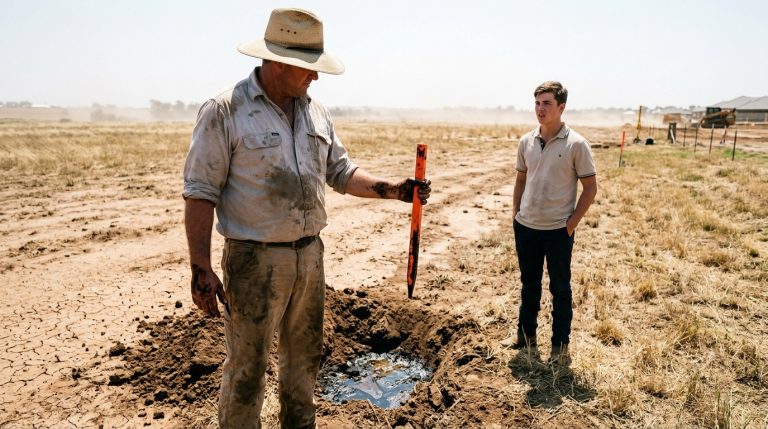
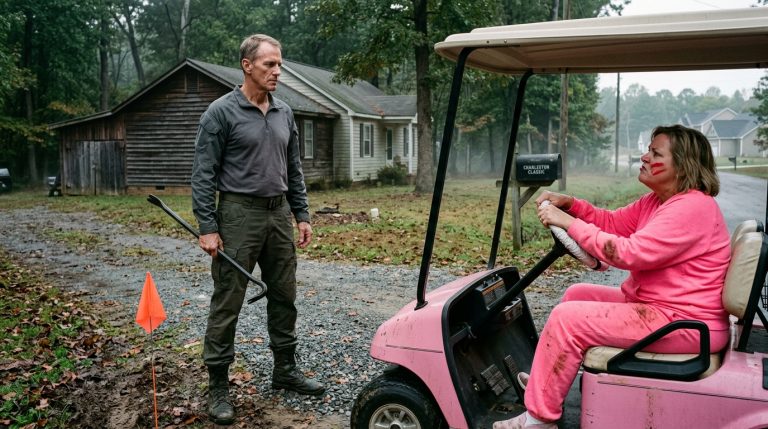
The air in Section D was thick with the scent of dry hay and the metallic tang of the fence line, a sensory landscape that had anchored my family for over a hundred years. I stood motionless, my boots firmly planted in the soil that predated the existence of Whispering Pines by generations. Karen’s voice was a grating, synthesized rhythm—a symphony of entitlement that lacked the weight of actual authority. She stood five feet from the four-strand barbed wire, her face flushed with the exertion of the power-walk she had clearly staged to assert dominance.
“The board has voted to annex,” she said, her clipboard trembling slightly under the force of her own rhetoric. She shoved a document toward me, the edges of the paper catching the harsh midday light. “Your property is in violation of Section D bylaws, Colonel. $52,840.17. Effective immediately.”
I didn’t take the paper. I watched it flutter in the slight breeze, a flimsy, white-and-black intrusion against the deep, earthy greens of my field. My hands stayed in my pockets, gripping the rough fabric of my jeans. Thirty years in the Army Corps of Engineers had taught me one fundamental truth: don’t react to the noise. Analyze the machine.
“You’re in the wrong place, Karen,” I said. My voice wasn’t loud, but it had the flat, percussive quality of a stone dropping into a well.
Her smile faltered, replaced by a jagged flicker of confusion. She had expected a surge of indignation—the red-faced shouting that usually served as the precursor to her victories. She hadn’t expected the absence of a response. I looked past her to the two men standing behind her, their arms crossed in a practiced, hollow imitation of security. They were soft men, men who had never felt the weight of their own actions.
“We have the survey,” she pressed, her voice rising an octave to compensate for my lack of reaction. “The vote was unanimous. The green space management annexation is legal. If you don’t pay, we place a lien. By the end of the week.”
I looked down at the paper she had thrust through the wire. The print was crisp, the logo a gaudy, synthetic pin-tree that lacked the soul of a true marker. I memorized the letterhead, the typeface, and the way her hand moved when she looked at my barn—the way her eyes didn’t see history, but rather “non-compliant structures.” She was an architect of shadows, trying to build a kingdom on a foundation of sand.
“The office is open,” she chirped, turning away with a movement so practiced it felt mechanical. “We accept certified checks.”
I didn’t watch them leave. I turned back toward the house, the silence of the land rushing back to fill the space they had occupied. I felt a cold, sharp clarity settling over me—a familiar sensation, like checking the structural integrity of a bridge before the convoy crosses. I didn’t need to shout to win this. I just needed to start the clock.
As I walked, I realized the fence wire was vibrating. I stopped, looking down at the metal post—a piece of rusted steel that had stood since 1919. Something about the way Karen had presented the “annexation” felt off. The logic was too clean, the paperwork too sudden. I reached into my back pocket and pulled out the notice, smoothing it out. There was no surveyor’s seal on the annex document—only a stamp.
I didn’t just have a neighbor problem. I had an investigation to conduct.
CHAPTER 2: The Courthouse Recon
The drive into town was a study in controlled friction. I gripped the wheel of the F250, the leather steering wheel feeling cold and hard against my palms. My mind didn’t cycle through rage; it cycled through logistics. The courthouse wasn’t just a government building; it was the repository of objective reality. In the military, you didn’t win wars with hearsay or intimidation tactics; you won them with terrain analysis, supply chain security, and absolute, immutable documentation.
I parked in the limestone shadow of the county clerk’s office. The building was old, its foundation settled over a century of property disputes, probate battles, and land grants. It smelled of ozone, floor wax, and the dry, papery scent of records that had outlived their creators. I walked in with the heavy, measured stride of a man who knew exactly what he was looking for.
Brenda sat behind the long, grey Formica counter, a tower of silver hair holding back the chaos of her office. She looked like she had seen every variety of human greed that had passed through this county. I kept my expression neutral, my posture straight.
“I need to pull the master plat for Whispering Pines Estates,” I said. My voice carried the precise, clipped cadence of a command briefing. “2005 filing. I also need the covenants, the articles of incorporation, and every amendment filed in the last twelve months. Specifically, any change to Section D.”
Brenda peered over her bifocals, her gaze sharp, assessing. She didn’t ask why. People rarely came to the clerk’s office with a request this specific unless they were already deep in the trenches of a fight. She moved with a rhythmic efficiency, her fingers tapping against a keyboard that looked older than the current administration.
The screens flickered—a series of digital ghosts manifesting as official records. She pulled a heavy, leather-bound platbook from a shelf behind her, the spine groaning as it opened. It was like unfolding a map of a battlefield.
“Here,” she said, her finger tracing a thick, bold ink line. “This is the original survey. You see the boundary?”
I leaned in. The line was unmistakable. It defined the limit of the subdivision, creating a hard, impermeable edge between their manicured utopia and my own 200 acres. There was no ambiguity. It was a clean, professional piece of engineering.
“Now look at this,” Brenda said, sliding a digital file onto the screen. It was the amendment filed six months ago.
I leaned closer, the sharp edges of the desk digging into my forearms. The boundary line had been altered. It was thinner, digitized with a shakiness that betrayed a lack of proper surveying equipment. It swallowed my property whole, labeling it ‘Section D – Green Belt Management.’
“That line,” I noted, my voice steady, “is a fabrication.”
“It gets worse,” Brenda murmured, pointing to the bottom of the page. “The surveyor’s seal is a stamp, Colonel. Not a wet signature. And the notary—look at the name.”
I scanned the document until my eyes locked on the official stamp. Karen Miller.
The silence that followed was heavy. The discrepancy wasn’t just a clerical error; it was a physical impossibility. A party to a document cannot notarize it. It was a breach of state law so egregious it bypassed incompetence and landed squarely in the realm of criminal intent.
My mind sharpened, the tactical situation crystallizing. They weren’t just misreading the bylaws; they were creating a synthetic reality and attempting to force the county to accept it as truth. The paper in their hands was a weapon, but the paper in mine was the map to their structural collapse.
“Brenda,” I said, my gaze locked on the fraudulent seal. “I need certified copies of all of this. Every page.”
She nodded, a knowing glint in her eyes. “You aren’t the first, but you’re the first to come in here with the records to prove they’re lying. I’ll pull the full history.”
As she moved to the scanner, I stood back, the ambient noise of the office—the hum of printers, the soft shuffling of paper—fading into the background. I was no longer a civilian in a property dispute. I was a strategist identifying the weak point in an enemy’s line. I had the plat, the fraudulent map, and the illegal notary stamp.
The war wasn’t going to be fought at the fence line. It was going to be fought in the quiet, dusty archives of this building, where the truth was bound in leather and recorded in ink. Karen and her board were playing a game of intimidation, but they were playing it against a man who had spent three decades building bridges over hostile rivers. I knew how to handle a structural failure. You don’t patch the crack; you find the root of the collapse. And I had just found the first fracture.
CHAPTER 3: The Evidence Locker
The drive back to the homestead was a decompression exercise, every mile of gravel road a chance to organize the fragments of intelligence I had scavenged from the county archives. I didn’t head straight into the house. Instead, I drove past the main entrance and down the long, winding lane that led to my workshop—a structure of weathered cedar and stubborn integrity.
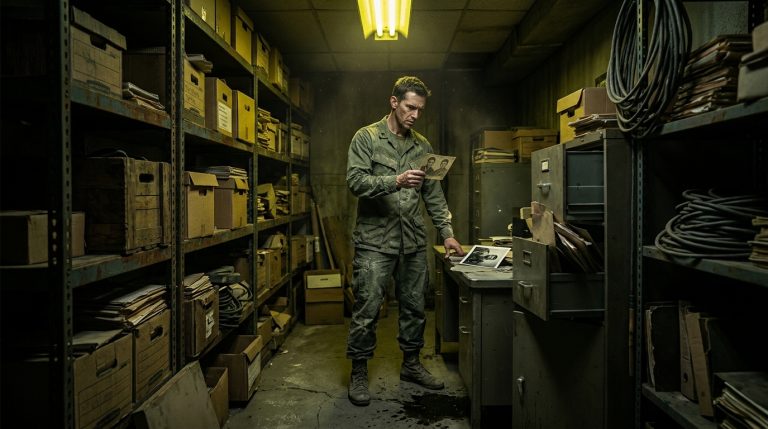
My grandfather had built this workshop to survive. The joints were tight, the foundation poured with an excess of rebar, and the air inside always carried the faint, reassuring scent of cedar shavings and machine oil. I set the manila envelope containing the certified maps on the heavy oak workbench. The papers were pristine, the ink dark and authoritative—the official record, the only record that mattered.
I didn’t reach for a phone or a computer. I reached for a three-ring binder, a relic from my days in the Corps. It was black, scuffed at the corners, and completely devoid of sentiment. I laid it flat, opening the rings with a mechanical click that sounded like the cocking of a rifle.
The first page was the initial violation notice Karen had handed me at the fence line. I looked at it, then at the certified plat map I had just secured. The contrast was sharp. One was a document of manufactured panic; the other was a document of historical, legal fact. I placed them side-by-side, aligning the edges with surgical precision.
As I punched holes in the documents and slotted them into the plastic sleeves, I felt a familiar, intrusive memory—my grandfather’s voice, quiet and deliberate, telling me that a man’s boundary is only as strong as his willingness to hold it. He had never needed a lawyer; he had a shotgun and a clear understanding of the law. I, however, had the burden of a more complex battlefield. I didn’t need a weapon; I needed a ledger of her offenses.
I spent the next hour documenting the initial contact. I took out my camera—a digital tool that was, for all intents and purposes, my modern-day picket line—and photographed the notice from every angle. I documented the paper quality, the lack of a proper surveyor’s seal, and the specific, damning illegality of the notary stamp. I was building a case that was not based on anger, but on the cold, hard physics of evidence.
Once the initial contact was logged, I moved to the “No Contact” protocol. I sat at my computer and began to draft the correspondence that would serve as my first official maneuver. My fingers moved across the keys with the same rhythmic intensity I used to apply when coordinating supply lines in the field.
“To the Board of Directors,” I typed, the words appearing on the screen with a stark, brutal clarity. I stated my position—concise, devoid of emotion, and backed by the specific, verified references from the county plat. I wasn’t asking for a truce; I was stating the terms of the environment. I would not pay, I would not comply, and any further attempt to assert authority over my property would be categorized, filed, and handed over to legal counsel.
The silence in the workshop was absolute. Outside, the wind rattled the metal roof of the barn, a sound that usually comforted me, but now felt like the ticking of a clock. I saved the document and printed it. The laser printer hissed, pushing out the sharp, black text. I held the page for a moment, smelling the ozone of the toner—the smell of the new war.
I didn’t send it yet. First, I needed to ensure that my home was a secured zone. I walked outside, the heat of the afternoon sun hitting my back like a physical force. I traced the perimeter of the homestead, checking the barbed wire. It was tight. It was a physical manifestation of my resolve.
Every fence post I checked felt like a deliberate, tactical placement. I was creating a “No-Fly Zone” in the heart of suburbia. If Karen wanted to send an inspector, she was going to have to do it in a world where every step, every photograph, and every word spoken was documented, categorized, and eventually, used against her.
I returned to the workshop and placed the drafted cease-and-desist into a formal envelope. I didn’t feel satisfied. Satisfaction was a weakness. I felt the cold, hard focus of a commander who has finally finished the initial survey of the terrain and is now ready to begin the long, grinding work of the siege. I was in the bunker now, and the enemy had no idea that the walls they were trying to tear down were made of a substance far harder than their flimsy, printed threats.
CHAPTER 4: The Resistance Alliance
I sat at the heavy oak table, the workshop’s singular lamp casting a cone of light over the three-ring binder that now held the blueprints of my counter-offensive. The silence was absolute, but it felt different now—less like the solitude of a defensive position and more like the stillness of a command post before a coordinated strike. My allies were out there, fragmented, living in the same shadow of compliance that Karen had built, and I knew that if I wanted to dismantle her, I needed to know the terrain of their fear.
I walked to the front porch, the cool evening air clinging to my skin. I kept my back to the dim interior, my eyes fixed on the entrance to Whispering Pines. The main road was a ribbon of gray beneath the moonlight. The streetlights of the subdivision flickered on in a rhythmic, synthetic pulse, a visual manifestation of the order they demanded. I took a sip of black coffee, the bitterness a necessary wakefulness, and watched.
The white sedan—the HOA patrol—crept along the perimeter fence, its headlights sweeping over the landscape like a searchlight. It was a tedious, mechanical display of authority. Then, I saw them. A young couple, perhaps in their thirties, were out in their front yard, moving with an erratic, frantic pace. The husband was on a ladder, fighting with the trim around their front door, while the woman stood below, clutching a pile of paint swatches. They were not moving with the casual ease of a homeowner on a Saturday; they were moving with the desperate, jagged rhythm of people afraid of being caught.
I didn’t wait. I went to the truck, threw a small cooler of bottled water into the bed, and navigated the F250 down to the edge of my property line. I parked just out of sight of the main road, near the gate. I didn’t approach them aggressively; I simply stepped out and began walking the fence line, my presence deliberate, a man checking the integrity of his borders.
When the couple finished, they packed their gear into a sedan and headed toward the exit. I didn’t wave, but I didn’t hide, either. I kept my posture relaxed, my head turned just enough to signal intent. The husband slowed the car, then pulled over, the gravel crunching beneath the tires.
“Afternoon,” I said, my voice pitched for conversation, not interrogation.
The man, David, looked exhausted. His wife, Emily, kept her eyes on the dashboard.
“Tough day for a paint job,” I noted, gesturing to the fresh, wet trim.
David let out a sharp, incredulous breath. “Final notice. Arctic white instead of whisper white. We’ve got until Monday or it’s a grand.”
“Karen,” I stated. It wasn’t a question.
David’s head snapped toward me. “She taped the notice to the door herself. Said the association’s aesthetic integrity was at risk.”
“She’s looking for leverage,” I said. “And she’s using your fear to get it.” I looked at them, observing the way their hands tightened on the wheel, the way they checked the rearview mirror as if expecting the white sedan to reappear. They were good people, trapped in a structure they couldn’t calculate.
I turned back to the truck and pulled the binder from the floorboard. I didn’t show them the heavy legal documents or the fraudulent plat maps yet. I showed them the photos of the inspectors on my property, the documentation of my own “violations.”
“I’m the one she’s trying to annex,” I told them.
The look on Emily’s face—a mix of recognition and raw relief—was the first gear in the clockwork of the resistance. They didn’t know they were part of a larger picture; they thought their struggle was a private failure. I gave them my contact information, a simple slip of paper with a direct line, and watched the tension in their shoulders drop by a fraction.
“You aren’t alone,” I said, my voice steady. “And you aren’t the only ones who have been asked to pay for a mistake that isn’t yours.”
As they drove away, I didn’t go back to the house. I stayed by the gate, watching the subdivision. I wasn’t just watching a neighborhood; I was watching the cracks in the foundation. David and Emily were the first, but I knew the pattern. If she was hitting them this hard, there were others—others with garden gnomes, others with non-conforming basketball hoops, others who were sitting in their houses right now, staring at the ceiling, wondering when the notice would come for them.
I knew Karen’s strategy. She relied on the “Sovereign Protector” myth—the idea that she was maintaining order. But order is a fragile thing when it’s based on lies. I had the foundation. Now, I needed the people. The binder in my truck wasn’t just my property records anymore; it was the start of an intelligence network. Every conversation I had, every story I heard, was a new piece of evidence, a new thread to pull in the fabric of her kingdom. I wasn’t going to fight her from the outside; I was going to help her neighbors realize that they had been on the inside of a fraud all along.
CHAPTER 5: The Legal Gunslinger
The rain began as a tentative drumming against the workshop’s corrugated metal roof, but within minutes, it had escalated into a relentless, rhythmic roar that muffled the outside world. I was still organizing the notes from my meeting with David and Emily when a sleek, black sedan pulled into the gravel drive, its tires churning through the mud. Arthur Davies didn’t wait for a formal invitation. He stepped out, his tailored suit jacket pulled tight over his shoulders, and made a beeline for the workshop door.
I unlocked the heavy bolt, the metal sliding back with a sharp, familiar rasp. Davies stepped inside, bringing the scent of rain and wet asphalt with him. He was a man who looked like he belonged in a courtroom—his hair a shock of white, his eyes sharp and analytical. He didn’t offer a handshake. He stopped in the center of the shop, his gaze scanning the organized chaos of my worktables, the three-ring binder, and the maps pinned to the walls.
“You’ve been busy, Colonel,” he said, his voice echoing slightly in the small space. He walked to the workbench and touched the spine of the black binder with his fingertip, a movement that was almost reverent.
“I’ve been documenting,” I corrected him.
Davies turned to me, a slow, predatory grin spreading across his face. “Documentation is the start of a story. What I’m here for is the end of it.”
He didn’t waste time on pleasantries. He reached into his briefcase and produced a stack of legal pads, setting them down next to my map. He explained the strategy with the cold, clinical efficiency of a surgeon. We weren’t just going to fight the annexation; we were going to force a confrontation that the HOA couldn’t survive. He proposed a cease-and-desist letter—a formal, high-impact document that would not only threaten litigation but would publicly identify the specific legal statutes regarding harassment, trespass, and the flagrant abuse of notary authority.
“She’ll ignore it,” I said, my voice flat.
“Exactly,” Davies replied. His eyes were alight with a dark, calculated energy. “We don’t send this to win. We send this to provoke. She’s arrogant, Colonel. She thinks she’s untouchable because she’s hiding behind her board, her bylaws, and her local influence. When she gets this, she’ll view it as an insult. She’ll double down. She’ll initiate something she thinks is a power move, and that is exactly when we close the trap.”
The rain intensified, the sound becoming a roar that forced us to lean in, to speak with a more deliberate, tactical intensity. Davies’s logic was flawless, mirroring my own—he understood that the enemy, when cornered by someone they perceived as inferior, would inevitably overreach. He wasn’t just a lawyer; he was a mirror of my own strategic discipline.
“I have neighbors,” I said, realizing it was time to bring him into the fold. I gestured toward the email threads and the notes I’d taken from the Whispering Pines resistance. “They’re scared, and they’re tired of being fined for the color of their trim. If we act, I have a dozen people ready to step forward with their own stories.”
Davies nodded, but his expression remained grim. “We keep them in the background for now. If we pull them in too early, she’ll try to intimidate them, maybe even sue them individually to drain their resources. We keep the focus on your property, on the fraud you’ve personally documented. Once we break her shield, once we get the court to look at her notary practices, the rest of them will follow like dominoes.”
He spent the next two hours outlining the “No-Contact” protocol. He instructed me to file every interaction, every notice, every phone call. We were to stop arguing, stop engaging, and stop acknowledging her authority entirely. Every single action she took was to be treated as evidence in a future criminal case.
As he spoke, I felt a weight lifting from my shoulders. The isolation of the last few weeks, the weight of standing alone against a system I didn’t recognize, was fading. In its place was the cold, sharp satisfaction of a well-executed plan. I looked out the workshop door. The rain was still falling, washing away the dust of the driveway, turning the earth into a dark, rich loam.
Davies left as abruptly as he had arrived, leaving behind a stack of legal papers and a set of instructions that felt like a set of coordinates for a final strike. I stood in the doorway for a long time after the tail-lights of his sedan disappeared into the darkness, watching the water track down the metal siding.
The trap was baited. The strategy was set. Karen thought she was still the one holding the clipboard, the one directing the movement of everyone around her. She had no idea that the man she had tried to bully into submission had just handed the rope to the only person in the state who knew exactly how to use it to hang her. The paper war had just escalated into a formal engagement, and for the first time, I felt the unmistakable, chilling thrill of the hunt.
CHAPTER 6: The Financial Forensic
The box was a sprawling mess of disorganization, a clear attempt by the HOA’s management to bury their tracks in a landslide of mundane receipts and blurry, photocopied invoices. I pulled the first handful of papers out, the smell of damp paper and stale coffee rising from the box—a scent I had come to associate with the rot of their organization. My dining table, typically reserved for quiet meals and the occasional family check-in, had been transformed into a forensic war room.
I worked with a methodical, military precision. I started with a blank spreadsheet, listing every vendor contract and every line item associated with Whispering Pines’ “Section D” maintenance. The process was grueling, a relentless exercise in checking thousands of micro-transactions, but I moved through it with the patience of a sniper waiting for a target to emerge. My focus was on the outliers—the bills that didn’t make sense, the numbers that inflated without reason.
Hours bled into days. The house was quiet, save for the hum of my computer and the scratch of my pen as I circled discrepancies. Then, I found it. Hidden within a folder marked “Routine Landscape Maintenance,” there was a series of invoices from a firm called Pristine Properties Management, LLC.
The amounts were astronomical. They weren’t just charging for mulch or lawn service; they were charging for “Administrative Oversight” and “Strategic Development” at a rate that would have made a high-level government contractor blush. I cross-referenced the service dates with the actual maintenance logs—the ones Tom, my tenant farmer, had inadvertently helped me verify. The invoices claimed hundreds of hours of work on my property line, work that never happened. I had the security footage, the time-stamped logs from my own cameras, and the testimony of the very men who supposedly performed the work—they had never even set foot on my land.
My pulse quickened, but I kept my hand steady. I pulled the business registration for Pristine Properties. I looked at the registered agent’s name: Gary Miller. The surname clicked, a sharp, cold realization. I cross-referenced it with the HOA board’s meeting minutes I had requested earlier. Every single contract, every outrageous administrative fee, had been approved by a quorum led by the board president—Karen Miller.
The scope of the operation wasn’t just a bullying campaign; it was a closed-loop system of theft. They were using the HOA’s bylaws as a legal bludgeon to manufacture debt, then using the debt as a justification to drain the community’s funds into a company owned by their own family.
I set the documents side-by-side, the invoice for the phantom lawn maintenance sitting right next to the business filing for Pristine Properties. The connection was raw, tangible, and completely indefensible. The “Nonprofit Social Welfare Organization” was a hollow shell, a fraudulent vehicle designed to fleece its own members for the personal gain of the Miller family.
My fingers hovered over the keyboard as I typed out the final summary for the binder, the “Financials” section. This wasn’t just an observation; it was the structural skeleton of their enterprise. Every check Karen had signed, every contract she had authorized, was a signature on her own indictment.
I felt a surge of cold, analytical adrenaline. The “No-Contact” protocol Davies had insisted upon now made perfect sense. If I had confronted her, she would have panicked, shredded the records, or pivoted to a new, harder-to-track scheme. By staying silent, by letting her think she was winning, I had allowed her to continue the very pattern that was leading her directly to this moment of exposure.
I stood up, my knees stiff from hours of hunching over the table, and walked to the window. The lights of Whispering Pines were visible in the distance, a grid of artificial security and order. She thought she was the guardian of that order. She had no idea that I had just mapped the entire criminal infrastructure that fueled her kingdom, and that every stone in her path was now laid and ready to be turned over.
I returned to the desk and tucked the documents into the binder, the physical snap of the rings sounding like a hammer blow. I wasn’t done. There were still loose ends—the notary fraud, the forged survey maps—but the financial evidence was the anchor. I had the “why” and the “how.” The only thing left was the “when.” I closed the binder and looked at the clock. It was nearly four in the morning, but my mind was as sharp as a blade. I had enough here to ruin them, and the thought didn’t bring me joy—it brought me the calm, focused clarity of a mission that was nearing its final, necessary conclusion.
CHAPTER 7: The Public Execution
The limestone walls of the county commission chambers were cool to the touch, a stark, unchanging monument to law and procedure. I stood in the back of the room, adjusting the collar of my service jacket, the eagles on my shoulders feeling heavier than they had in years. The room was packed—a sea of anxious faces, neighbors from Whispering Pines, local press, and at the front, the three commissioners sitting in a raised semi-circle. Karen was already there, positioned near the front row with her board members. They looked polished, confident, and utterly oblivious to the fact that the ground beneath them had already been hollowed out.
When the bailiff called my name, the sound cut through the murmuring like a clean, sharp blade. I walked to the podium. My steps were measured, rhythmic, and silent against the worn carpet. I didn’t look at Karen. I looked directly at Judge Harris, the lead commissioner, a man whose face was a map of decades spent navigating municipal disputes.
“Good evening, Judge Harris, members of the commission,” I began, my voice steady, carrying the cadence of a field briefing. “My name is Jack Miller, Colonel, United States Army, retired. I am here to address a systemic failure in the governance of Whispering Pines Estates, and specifically, the fraudulent annexation and administrative racketeering orchestrated by its current board.”
The room went silent. Karen stood up, her face a mask of practiced outrage. “This is defamatory! This is an unauthorized—”
“Mrs. Miller,” Judge Harris interrupted, his voice cutting her off with the finality of a gavel strike. “Sit down. You will have your time to address the commission. Colonel, proceed.”
I clicked the remote in my hand, and the projector hummed to life. The first slide hit the screen behind me: the 1919 deed, followed by the original 2005 plat map. The visual evidence was so stark, so undeniably grounded in property law, that even the room’s air seemed to thin. I moved through the slides with the cold, mechanical precision of a clockmaker. I showed the forged survey map—the “Section D” expansion—and then, with a slow, calculated move, I pulled up the scan of the notary stamp.
I didn’t speak the word fraud. I didn’t have to. I let the visual discrepancy between the official county records and their doctored amendment do the work. The murmurs in the room turned into low, resonant questions. People began to turn to their neighbors, the shock shifting into a cold, hard anger.
“But this, Judge,” I continued, pivoting to the final, most damning set of slides, “is not merely a clerical error.”
I projected the Pristine Properties business filing. I projected the invoices for the phantom lawn maintenance. And finally, I projected the checks—the very checks Karen had signed, transferring the community’s dues directly into her brother-in-law’s coffers.
The room erupted. It wasn’t the disorganized noise of a crowd; it was the focused, singular roar of a community that had just realized it was being hollowed out. Karen’s face, once pink with indignation, was now white—a sheet of absolute, terrifying clarity. She looked around the room, searching for an ally, a loophole, a way to spin the narrative, but there was nothing left to grab onto. The evidence was right there, projected ten feet tall against the wall, untouchable and undeniable.
I watched her from the podium, my own pulse steady, my breathing deep. I wasn’t feeling victory; I was feeling the satisfaction of a structure perfectly dismantled. She had played the game of shadows, but she had failed to account for the permanence of the truth. When I finished, I didn’t look back. I stepped down from the podium and walked out of the chambers, the sound of the commission’s gavel calling for order trailing behind me like an echo of a war already won. The job was done. The system would now do exactly what it was designed to do: crush what remained of her empire.
CHAPTER 8: The Quiet Aftermath
The departure from the chambers was not a retreat; it was an extraction. I walked into the hallway, the cool air of the courthouse lobby hitting my face like a reprieve. Behind me, the muffled sounds of the courtroom spillover—the indignant shouts of board members, the sharp, rapid-fire questions of the press—felt distant, a storm receding into the horizon. I walked to the heavy limestone steps, the weight of the colonel’s eagles on my shoulders feeling less like a uniform and more like a closing chapter.
Arthur Davies caught up to me at the bottom of the stairs, his face flushed with the kind of grim satisfaction only a true litigator knows. He didn’t speak immediately. He just stood there, watching the rain stop and the evening sky break open into a bruised, deepening purple.
“The Attorney General’s office is moving,” he said, his voice dropping to a low, tactical murmur. “They’ve got the invoices, they’ve got the bank records, and they’ve got the testimony from the clerk. Karen is looking at five years. Minimum.”
I looked at him, feeling the sharp, cold clarity of the mission’s completion. “And the association?”
“Dissolved,” Davies replied, a thin smile touching his lips. “The state is appointing a receiver. The new board is being seated next week—David and Emily are leading the charge. It’s over, Colonel. You won.”
He walked away toward his car, leaving me alone on the steps. I didn’t feel a rush of triumph. I felt the slow, steady settling of the earth. I drove home in the silence of the F250, the tires crunching over the gravel of my lane until the familiar silhouette of the homestead emerged in the darkness. The house was exactly as I had left it—a stubborn, unchanging monument to a century of history.
The next few weeks were a lesson in the architecture of peace. The transition of the Whispering Pines subdivision from a kingdom of petty rules to a community of neighbors was almost jarring in its simplicity. I watched from my porch as the white compliance sedan was towed away—a final, rusting relic of a failed regime. The residents, once fearful and isolated, began to reclaim their front yards. I saw David and Emily working on their own home, their movements no longer frantic, but deliberate and calm.
I spent the final days of the cleanup working on the 1952 Ford 8N. It sat in the barn, a machine that had survived the passage of time far better than the fragile ego of the woman who had tried to take it from me. I cleaned the spark plugs, replaced the rusted fuel line, and polished the dull, oxidized metal until it glowed with a deep, honest luster. The work was restorative. It was a tangible, mechanical connection to the past, a way of repairing the friction that had scarred the land.
One afternoon, a package arrived at my door. It was a formal letter from the new board of the Whispering Pines Homeowners Association—a genuine, unforced apology, along with a simple, high-quality gift certificate to a local steakhouse. I didn’t need the gesture, but I appreciated it. It was the closing of a loop, the final structural adjustment in a system that had been out of balance for far too long.
I stood on the porch, the evening sun casting long, golden shadows across the fields. Sarah was visiting, and we sat in the quiet air, the scent of fresh-cut hay rising from the pasture. “You know,” she said, her voice soft, “you could have let them take the land, Dad. You could have just moved on.”
“I could have,” I agreed, my gaze tracing the boundary of the property—a line that was now, finally, undisputed. “But some lines aren’t just property. They’re the foundation of who you are. Karen didn’t understand that. She thought she was fighting for fees and fines. I was fighting for the weight of the history that put me here.”
I reached out and touched the railing of the porch, the wood solid, aged, and enduring. The war was over. There were no more notices, no more trespassing inspectors, and no more fraudulent maps. The machinery of my life had returned to its steady, rhythmic hum. I looked out over the fields, the vast expanse of the Texas landscape stretching out toward the horizon, and for the first time in a year, I didn’t feel the need to calculate the next move. I just felt the peace of a job done right. The foundation was secure, the structure was sound, and the land was, as it had always been, my own.