The Silent Frequency: How One Man Dismantled a Suburban Empire Using Cold Math and Hidden Leverage
CHAPTER 1: THE FIRST FREQUENCY
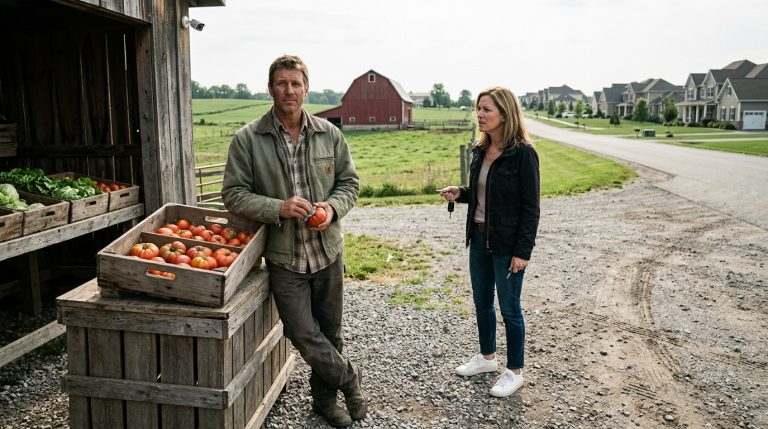
The gravel crunched under Karen’s heels, a dry, rhythmic sound that grated against the low-frequency hum emanating from the tower behind me. I didn’t reach for the hammer in my hand. I didn’t reach for anything. I simply stood, my boots firmly planted on the earth I’d held for two decades, watching the way her floral mumu billowed in the sudden, hot draft of a late-afternoon gust.
“That ugly thing has to come down, Mr. Callahan, immediately.”
Her voice was an abrasive friction, like gravel being ground in a mortar. She didn’t wait for a response; she wasn’t here for a dialogue. She was here to broadcast an ultimatum. Her face was a congested map of blood vessels and indignation, the kind of look a field commander wears when they realize they’ve overestimated their opponent’s fear.
I shifted my weight. The hammer felt heavy, a cold, comforting weight against my palm. I watched her finger, a sausage-casing of skin and aggression, as it stabbed toward the silo. To her, it was a blight. A rust-bucket of agricultural obsolescence. She didn’t see the sleek, fiber-optic arteries running beneath the foundation or the way the signal saturated the valley like a silent, invisible tide.
“This is a planned community,” she spat, the phrase tasting like ash. “We have aesthetic standards. You have thirty days, or the fines will be substantial.”
She lunged forward, thrusting a thick, cream-colored envelope into my chest. The paper was heavy, stiff with the arrogance of bureaucratic certainty. I caught it reflexively, the snap of the envelope against my palm sounding like a gunshot in the quiet afternoon.
I held her gaze, keeping my eyes flat, devoid of the annoyance she was fishing for. This was the opening move of a chess game she didn’t realize she was losing. I didn’t see a neighbor; I saw a variable that had just been introduced to an equation I had solved fifteen years ago.
“Thirty days,” I repeated softly. My voice was calm, the professional output of a man who had spent his youth managing navigational systems under extreme pressure. “I hear you, Karen.”
She looked startled by the lack of vitriol. She wanted a brawl; she wanted the satisfaction of my anger. Instead, I stood as silent as the tower at my back, an immovable object against her petty, screeching momentum.
She turned on her heel, her golf cart whirring to life with a pathetic, high-pitched whine. As she pulled away, I looked down at the envelope. I didn’t open it. I knew the contents—the manufactured outrage, the cited bylaws, the threats of foreclosure. I walked toward the workshop, the cool, dark scent of cedar and oil waiting inside. I sat down at my workbench and placed the envelope beside a disassembled radio transmitter. I didn’t feel the sting of her words. I only felt the cold, sharp clarity of a target being identified.
The envelope was a declaration of war, but she had completely failed to account for who she was attacking. I didn’t need to shout; I just needed to wait for her to overstep, and based on the way she handled that golf cart—hitting the throttle too hard, leaving a scar of churned dirt in my driveway—she was already going to give me exactly what I needed.
I leaned back, the silence of the room amplifying the faint, rhythmic pulse of the server rack in the corner. She wanted a fight over a structure she couldn’t understand. She had no idea that beneath the surface, I had been recording every second of this conversation.
CHAPTER 2: THE CALIBRATION OF SILENCE
The workshop air was thick with the scent of oxidized copper and stale coffee. I didn’t touch the envelope. Instead, I reached for a small, precision-calibrated screwdriver and pushed the disassembled radio transmitter aside. The room was dark, save for the blue glow of the monitor reflecting off the steel filing cabinet. I wasn’t just working; I was processing. Every interaction with Karen was a data point, and I was busy building a profile.
I pulled the filing cabinet handle—the heavy steel drawer slid open with a soft, expensive glide. I withdrew the original 99-year lease agreement with Omniink Telecom. I didn’t need to read it; I had the relevant sections etched into my memory. Section 4B: perpetual access. Section 77: protection against interference. But it was the Federal Telecommunications Act clause—Section 11A—that was the linchpin. It wasn’t just a legal provision; it was a wall of concrete, and Karen had just run her golf cart straight into it.
My phone vibrated against the wooden workbench. A text from an unknown number. My heart rate didn’t elevate; it settled into that steady, rhythmic state I’d maintained since my years in the Air Force. I picked up the device. It was a weather report for the North Ridge sector. A storm front was moving in from the west, the kind of high-pressure system that played hell with satellite alignments and early-generation wireless relays.
I glanced toward the window. The sky was bruising, turning a sickly, washed-out violet. The timing was perfect.
I stood and walked to the window, watching the distant silhouette of the tower against the gathering clouds. It looked like an old, sturdy pine, a relic of a simpler time, but its internals were a complex lattice of high-speed data transmission. I imagined the signals streaming through the air right now—the frantic emails, the automated utility billing, the digital chatter of a neighborhood that thought it was independent but was actually tethered to my ten acres by a single, fragile strand of fiber optic.
Karen didn’t understand that she was playing in my arena. She viewed this as a struggle over property aesthetics, a conflict of lawn-care standards and fence-line disputes. She thought she was the one holding the leash.
I walked back to the workbench and finally pulled the utility knife from my pocket. I didn’t slice the envelope open in a hurry; I used the blade to carefully score the paper along the fold, keeping the edges clean. I removed the letter. The fine: $10,000. The penalty: $500 per day. The language was sharp, accusatory, and predictably inflammatory.
I sat down and took a photograph of the letter, the camera shutter making a soft, clinical click. I uploaded the image to the cloud, creating a timestamped entry in the file I had started the day I bought the land.
Memory hit: I remembered a briefing in the desert, years ago, where a superior officer told me that in communications warfare, the most dangerous enemy isn’t the one who shouts the loudest; it’s the one who forces you to disclose your intent before you’ve even realized the fight has begun. Karen was shouting. I was just setting the dial.
I opened a separate browser window and initiated a query on the North Ridge Homeowners Association’s public filings. My fingers moved with the practiced ease of someone who had spent decades navigating complex navigational systems. There, nestled in the sub-pages of a state portal, was the board registration. President: Karen. Treasurer: Todd. Secretary: Brenda.
I tapped the screen. The registration data was thin, but the trail was there. I wasn’t just looking for rules; I was looking for the friction points—the places where their bureaucratic arrogance would eventually cause the system to overheat. I needed to see their patterns. I needed to know what they were protecting.
I looked back at the silo. The low-frequency hum seemed to deepen, a sub-audible thrumming that resonated in my chest. I knew David Chen would be expecting a call, but not yet. I needed to let the tension build. I needed to ensure that when they finally pushed, they didn’t just stumble—they had to fall into the deepest part of the trap I was currently refining.
I pulled a blank sheet of paper toward me and began to map out the connections. Not with words, but with a structural diagram of the neighborhood’s influence. I drew a circle for the board, a line to the treasury, and a jagged, uncertain line toward the vendors. I sat back, the dim light of the workshop carving sharp, angular shadows across the workbench.
My phone buzzed again. A notification of a missed call from an unrecognized number. Probably Todd, checking to see if I’d read the fine print. I let the phone sit there, glowing on the wood. I wouldn’t call back. Not tonight. Tonight was for maintenance. I needed to make sure that when the storm hit, I was the only one in the valley with the power to see through the static.
I leaned forward, the metallic tang of the transmitter wire clinging to my fingertips. The silence of the house was absolute, save for the hum of the tower. I reached out and shut off the main light, the room dropping into a soft, cool gray. I had thirty days, Karen had said. That was plenty of time.
CHAPTER 3: THE SEEDING OF DISSENT
The storm arrived not with a roar, but with a pressure drop that made the ears pop and the metal siding of the workshop groan like a ship’s hull. Outside, the trees were already beginning to thrash against the gray sky, a chaotic, uncoordinated dance that contrasted sharply with the disciplined, linear order of my files. I didn’t reach for the light switch. I didn’t need to. I had memorized the layout of my own life, and the physical space of the workshop was an extension of my own internal logic.
I stood up, the chair’s wood protesting with a sharp, dry crack that echoed in the quiet space. It was time to stop being a ghost in my own valley. I pulled on my jacket, feeling the weight of the phone in my pocket—my only interface with a world that was becoming increasingly hostile, and yet, paradoxically, increasingly predictable.
I stepped out into the night. The air was heavy with the ozone-sharp scent of approaching rain, and the wind was already biting, carrying the grit of the high desert. I didn’t head for the main gate. I took the perimeter path, a narrow, overgrown trail that hugged the property line, shadowed by the dense stand of pines that shielded the tower from the road. This was the hidden geometry of my land—a buffer zone that kept me separate, a physical manifestation of the distance between me and the encroaching development.
As I walked, the ground beneath my boots felt uneven, shifting in the damp air. I reached the edge of my fence line, where the property met the paved sidewalk of the North Ridge Meadows expansion. This was the frontier. On one side: my silence, my sovereignty, my tower. On the other: the perfectly manicured, homogeneous rows of houses that Karen believed she ruled.
A gust of wind hammered the trees, sending a shower of needles against my jacket. I stopped, hunkering down behind the thick, gnarled trunk of an ancient oak. I wasn’t just observing; I was measuring. A set of headlights swept across the street—a vehicle moving slowly, deliberately. A golf cart. Beige, plastic, and glowing with the artificial, smug light of the HOA’s night patrol.
It was Todd. He was making his rounds, a redundant, petty exercise in territorial marking. He slowed down as he approached the entrance to my property, his head swiveling, eyes scanning the darkness for a violation. He was searching for a reason, a sign of weakness, a crack in the armor. I watched him, my breathing steady, my posture relaxed. He couldn’t see me, not in the shadows of the pines, but he could feel the presence of the land.
He lingered for a second too long, the hum of the electric motor sounding absurdly loud against the rising wind. Then, he accelerated, his brake lights flashing red—a dying ember in the dark—before disappearing into the maze of identical driveways.
I pushed away from the oak, the rough bark scraping my palm, and stepped onto the sidewalk. This was the shift. I wasn’t going to remain on the defensive. I had the Hendersons, I had the GarcAs, and I had the raw data. But now, I needed the human catalyst.
I walked toward the Henderson house, my footsteps muted by the rising wind. Their yard was a study in repressed individuality: the rose bushes were trimmed to the millimeter, the walkway was swept clean of debris, and the house itself glowed with a warm, anxious light. I didn’t approach the front door; that was too formal, too likely to draw attention from anyone watching from an upstairs window. I circled toward the side garden, where I knew Eleanor spent her evenings.
I tapped lightly on the glass of the sliding door. A beat of silence, then the curtain pulled back just an inch. Eleanor’s face appeared, her eyes wide, flickering with a mixture of hope and fear. She recognized me immediately. She unlatched the door, a faint click of metal on metal, and I slipped inside, the sudden warmth of the kitchen hitting me like a physical blow.
“Jack,” she whispered, her hands clutching at the silk of her cardigan. “What are you doing here? They’re patrolling.”
“I know,” I said, my voice low, controlled. “That’s why I’m here. Todd is doing his rounds, and Karen is likely at home, drafting tomorrow’s newsletter. They’re predictable, Eleanor. That’s their weakness.”
She gestured toward the kitchen table, where a notebook lay open—full of dates, times, and observations. “I’ve been tracking them,” she confessed, her voice gaining a sliver of iron. “Every time they come by, every time they leave a notice. It’s not just the bird bath, Jack. They’re watching the kids. They’re checking the trash.”
I leaned over the table, my shadow stretching long and thin across the linoleum. “Then you have exactly what we need,” I said. “This isn’t just about your bird bath anymore. It’s about building a ledger. If you can give me these notes, and if you can talk to the neighbors you know are just as tired as you are, we can change the entire structure of the next board meeting.”
She looked at me, a long, searching gaze. The fear in her eyes hadn’t disappeared, but it had been displaced by something else: the realization that the silence she’d been forced to keep was a weapon she could choose to discard.
“They’ll come after us,” she said, though it sounded less like a warning and more like an admission of what she was already prepared to face.
“They can’t come after everyone at once,” I replied. “That’s the beauty of the system they built. It relies on us being isolated. If we stand together—if we synchronize our records—they lose their leverage.”
She reached out and closed the notebook, sliding it across the table toward me. It was a small, unassuming thing, but it contained the seeds of an insurrection. As I took it, the house groaned under a particularly violent gust of wind, a reminder of the storm outside. But here, in the kitchen, the air was still, pregnant with the weight of a decision made.
I stepped back toward the sliding door. “Stay quiet, Eleanor. Stay observant. When the time comes, you’ll know.”
I stepped back out into the teeth of the wind. The walk home felt different now. The darkness wasn’t just a covering; it was a tactical advantage. I had the ledger, I had the timeline, and I had the first crack in the foundation. As I reached my property line, I stopped for a moment, listening to the hum of the tower. It was steady, unyielding, and for the first time, I felt like the neighborhood was finally starting to hum right along with it.
CHAPTER 4: THE TYPOGRAPHY OF SHAME
The walk back across the dark, manicured streets of North Ridge Meadows was a exercise in shadow-work. I didn’t stick to the pavement. I moved through the spaces between the houses—the narrow alleys, the back-fence corridors where the trash cans sat in uniform rows like soldiers awaiting inspection. I kept my head down, my gaze fixed on the ground, watching the way the streetlights cast long, distorted silhouettes against the asphalt.
I reached the entrance to the subdivision. It was here, illuminated by a harsh, flickering security light, that the HOA’s most potent weapon stood: the community bulletin board. It was a glass-fronted case, locked, rigid, and plastered with the aggressive, red-lettered announcements that Karen used to maintain order. I stopped. The wind had died down, replaced by a tense, heavy silence that felt like the moment before a circuit breaks.
I approached the glass. Inside, pinned with surgical precision, was a new flyer. COMMUNITY ALERT: PROPERTY VIOLATION AT 141 OAKRIDGE TRAIL. The font was thick, bold, and designed to induce shame. It was a digital shaming, a public flaying of my reputation. I studied the board, not just the flyer, but the way it was mounted. The lock was a standard, flimsy piece of hardware. Karen hadn’t bothered with security; she assumed the threat of the HOA’s authority was lock enough.
I didn’t try to break the glass. I looked closer at the bottom corner of the frame. There, caught in the latch, was a small, plastic tag—a piece of debris from a previous repair. It was a discrepancy, a tiny, physical flaw in the system’s armor. I pulled a thin, stiff piece of metal from my pocket, a tool I’d carried since my days of field maintenance, and slid it into the gap.
The click was soft, almost disappointing in its simplicity. The case swung open.
I didn’t take the flyer down. That would be an admission of conflict. Instead, I reached into my pocket and pulled out a small, pre-printed sticker—a neutral, bureaucratic-looking label I had designed on my home printer. It matched the font and the paper quality of the HOA’s own warnings. I pressed it firmly over the address section of the flyer. It didn’t remove the accusation; it merely obscured the target, turning the “Property Violation” into a generic, abstract threat.
Then, I took a second, smaller sticker—this one a plain white strip—and applied it over the “Violation” heading. Now, the flyer read: COMMUNITY ALERT: PENDING REVIEW.
It was a subtle, almost imperceptible modification, but it was enough to introduce doubt. In the rigid, binary world of Karen’s bureaucracy, a “Violation” was a fact, but a “Pending Review” was a question. And questions were the one thing Karen couldn’t handle.
I snapped the case shut. The lock clicked, the metal biting into the frame with finality. I turned and walked away, my boots hitting the pavement with a steady, calculated cadence. I hadn’t destroyed her weapon; I had sabotaged its calibration.
As I made my way back toward the darkness of my own land, the sound of an engine broke the silence. A pair of headlights cut through the gloom—Todd, again. He was patrolling the entrance, likely checking his handiwork. I stepped into the shadows of a large, decorative bush, my body going completely still. I watched him pull up to the bulletin board. He stopped, got out of the cart, and spent a moment checking the glass. He leaned in, his face inches from the flyer.
He didn’t touch it. He just stared. He was looking for the authority he expected to see, but the ambiguity I’d introduced had clearly unsettled him. He paced for a moment, his brow furrowed in the dim, pulsing light of the streetlamp. He was a creature of the system, and when the system didn’t deliver the expected signal, he stalled.
I waited, my heart rate holding at a steady, resting pace. He eventually climbed back into the cart, his movements slower, less arrogant. He drove off, but he didn’t head straight back to the subdivision. He took a slow, circling route, looking back at the board one more time before disappearing.
I waited another thirty seconds, then stepped back onto the path. The air felt colder now, but the clarity of the task ahead was absolute. The ledger in my jacket was a roadmap, the bulletin board was a proof-of-concept, and the next step was a direct engagement with the financial core.
I reached the boundary of my property, the transition from the manicured lawn of North Ridge to the wild, honest earth of my land feeling like a change in atmospheric pressure. I walked into the dark, my silhouette merging with the pines, and didn’t look back. Karen thought she was holding a trial; she didn’t realize that the evidence was already being cataloged, and the judge was already sitting in the room, waiting for the defense to fold.
I headed for the workshop. It was time to draft the formal request for the records. Not as a plea, but as an ultimatum. Sarah Jenkins would refine the language, but the intent was already written in the quiet, sharp precision of what I had done tonight. The system wasn’t just going to be challenged; it was going to be audited into the ground.
CHAPTER 5: THE AUDIT OF SHADOWS
I stood perfectly still in the center of the workshop, my senses dialing into the sound of the wind rattling the heavy door frame. It wasn’t the wind. It was the distinct, rhythmic tap of a heavy object against wood. I didn’t reach for a weapon; I reached for the light switch, killing the remaining glow of the monitors. I retreated into the corner of the room, behind the heavy steel lathe, my movements efficient and silent.
The door handle turned—slowly, almost tentatively. A shaft of moonlight cut across the floorboards as the door drifted open. A silhouette stood there, backlit by the pale, washed-out glow of the streetlamp at the end of my driveway. It was a man, hunched and cautious. I recognized the silhouette—the narrow, pinched shoulders, the slight, nervous tremor in the hands. It was Todd.
He stepped inside, his breath hitching in the quiet air. He held a small, metallic object—a flashlight, its beam a thin, probing needle of light that swept across the workbench, cutting through the dust motes and lingering shadows. He was searching for something. Not the radio parts, not the tools. He was hunting for the files.
I stayed behind the lathe, my pulse barely registering. Todd moved with the clumsy, amateur confidence of someone who had never had to look over his shoulder before. He flipped through the papers on my desk, his movements rapid and frantic. He knocked a screwdriver to the floor—the clink of metal on concrete sounded like a thunderclap. He froze, his head snapping toward the dark corner where I was hiding.
He didn’t see me. His eyes, adjusted to the narrow, intense beam of the flashlight, were effectively blind to the deeper shadows. He cursed under his breath, a sharp, panicked sound, and began shoving papers into a folder he’d brought with him. He was desperate. Karen had sent him to retrieve the ledger, or perhaps to find proof of my communications with Omniink. Either way, he was a thief in a house that didn’t belong to him, and he was failing.
I could have ended it then. I could have stepped out, forced him to the floor, and dictated the terms of his surrender. But that wasn’t the strategy. If I took him down here, I’d just have a body and a mess. I needed him to report back. I needed him to go to Karen and tell her he’d found nothing, or worse—to lie and say he had, only to have the lie collapse when the hammer finally fell.
He snatched up the folder and turned, his flashlight beam swinging wildly across the room. It grazed the edge of the lathe where I was crouched, the light reflecting off my wedding ring. I tucked my hand beneath my jacket, holding my breath until my lungs burned. He stood there for a heartbeat, staring into the dark, then shook his head, muttered something about “not here,” and hurried toward the door.
I waited until I heard the muffled hum of his golf cart fading into the distance before I moved. I didn’t rush. I walked to the door and checked the ground. A single, muddy footprint marked the threshold—a perfect, clean impression in the dust. I took a photo, the flash briefly blinding me in the dark. Documentation was the currency of this war.
I walked to the workbench and gathered my things. The ledger was safe, but the intrusion changed the operational parameters. They were feeling the pressure. The “Pending Review” sticker on the bulletin board had clearly stung, and now they were resorting to physical intimidation. It was an admission of failure.
I didn’t stay in the workshop. I needed a secure location to finish the audit request and prepare the final strike. I headed for the storage shed at the back of the property, a reinforced, windowless structure that housed the emergency power backups for the tower. It was the most secure room on the property, a Faraday-shielded box where I could work without the risk of interception.
Inside, I sat down at a small, ruggedized terminal connected to a satellite uplink. The glow of the screen was cold, sterile, and entirely focused. I began typing, my fingers dancing across the keys. I wasn’t writing a letter; I was drafting a formal, multi-point inquiry into the HOA’s financial mismanagement. I pulled the bank statements Todd had left in the mess he’d made, cross-referencing them against the business registry I’d pulled for Lush Greenscapes.
The numbers didn’t just disagree; they fought. I found phantom payments, double-billed landscaping invoices, and a series of “consultation fees” that had been paid to a shell company in the city. It wasn’t just embezzlement; it was a shell game, and I had the map.
I hit ‘send’ on the draft, routing it to Sarah Jenkins’ encrypted server. Then, I leaned back, the hum of the cooling fans in the shed a comforting contrast to the silence of the house. Todd had come looking for secrets, but he’d only succeeded in proving how terrified they were.
The wind outside began to pick up again, a low, ominous howl that rattled the corrugated roof of the shed. I watched the progress bar on the screen as the document uploaded. 0%, 25%, 50%… The numbers crawled forward, a slow, inevitable march toward the inevitable collapse of Karen’s little empire. I wasn’t a farmer, and I wasn’t a neighbor anymore. I was a structural engineer, and the foundation they had built was already starting to shift.
CHAPTER 6: THE ARCHITECTURE OF COLLAPSE
The final byte uploaded with a soft chime from the satellite link, a sound that felt entirely too clean for the chaos I was about to unleash. I sat in the darkness of the reinforced shed, the screen’s light washing out my face, and stared at the confirmation message. The request for financial transparency was now sitting in the inbox of the HOA’s registered legal agent, a copy already archived on Sarah Jenkins’ secure server.
I didn’t linger. I reached for the terminal and executed a hard-wipe of the local cache, the cursor blinking with rhythmic, clinical precision until the screen went black. I stood up, the cramped space of the shed suddenly feeling stifling. I had to get back to the workshop; I needed to be in my own territory when the ripples hit.
I stepped out into the night. The storm had reached its peak. The wind was no longer a breeze; it was a physical force, shoving against me as I moved, a chaotic, wet darkness that smelled of turned earth and pine needles. The tower above me, invisible in the gloom, continued its work, the internal electronics oblivious to the human drama unfolding beneath its base. It was a stoic, indifferent monument to the infrastructure I had built—the very thing Karen was now poised to lose everything over.
As I approached the workshop, I saw it: a flicker of movement near the driveway.
I stopped. My boots sank into the damp mud of the path. A vehicle was idling at the edge of my property—a sedan, not the golf cart. The headlights were extinguished, but the interior light was on, briefly illuminating a silhouette. Someone was watching the house.
My instincts, sharpened by years of navigation and situational awareness, locked into position. I didn’t retreat; I moved toward the workshop through the dense line of trees, using the terrain to maintain cover. I watched the car. It wasn’t Todd. The silhouette was too sharp, too deliberate. It was Karen.
She was sitting in the driver’s seat, her hands gripped so tightly on the wheel that I could see her knuckles white against the dark leather. She was waiting for me. She hadn’t gone to her home; she was here, at the epicenter of her obsession, clearly rattled by the rumors of the audit request that must have already begun to circulate.
She was losing her grip. I could see the way she leaned toward the windshield, her eyes searching the darkness, her posture shifting from that of a queen to that of a desperate, cornered animal. She was the one who had initiated this—the notices, the fines, the public shaming—and now, she was terrified of the silence that had followed.
She turned the ignition, and for a moment, I thought she was leaving. But then she shifted the car into drive and crept forward, moving slowly, cautiously, toward the very base of the tower. She was trespassing. She was violating the very boundary she had spent months lecturing me about.
I didn’t step out. I watched. She stopped the car beneath the shadow of the silo, got out, and walked toward the base, her heels sinking into the mud. She looked up at the structure, her mouth moving as if she were whispering a curse, her hands outstretched toward the steel monolith. She was trying to touch the thing that defined her entire, failing mission.
This was the failure of her Layer 1—the realization that the “ugly blight” was a titan she couldn’t tear down with a mere binder of rules. She stood there for a long moment, defeated by the sheer, physical scale of the engineering. She turned back toward her car, her movements listless, the arrogance she had worn like armor completely gone.
I turned away before she could catch a glimpse of me. I didn’t need to confront her; I needed her to see for herself that she was out of her depth. The audit would be the physical blow, but this—the realization of her own insignificance against the scale of what I’d built—was the psychological collapse that would ensure she couldn’t recover.
I reached the workshop, slipped inside, and locked the door behind me. I sat at my workbench, the ledger still tucked in my jacket. The audit request was launched, the board was panicking, and Karen was wandering in the dark, hunting for a victory that didn’t exist.
I didn’t feel triumph. I felt a cold, mechanical satisfaction. The plan was tracking perfectly. I looked at the terminal in the corner, the one connected to the local network. I began to run a diagnostic on the tower’s transmission logs, searching for the final piece of evidence Sarah would need—the logs of the unauthorized access attempts Todd had made earlier that week.
They had tried to steal, they had tried to intimidate, and they had tried to surveil. They were going to leave this valley, not because I asked them to, but because they had run out of ground to stand on.
I leaned back, the hum of the cooling fans in the workshop now feeling like a steady, rhythmic heartbeat. The storm outside was beginning to break, the wind dying down to a low, mournful whistle. I had two chapters left in this operation. The first was the exposure; the second was the end. And the end, I realized, was already written in the numbers I was now pulling from the system.
CHAPTER 7: THE SILENCE OF THE FREQUENCY
The air in the workshop was cold enough to see my breath, a thin, white vapor that ghosted toward the ceiling. I didn’t turn on the lights. I didn’t need to. I had the diagnostic screen open on the laptop, the green text scrolling in a hypnotic, rhythmic stream. It was time. Sarah Jenkins had confirmed the receipt of the files, and the legal machinery was already grinding into motion. But legal maneuvers were slow, and I needed an immediate, visceral demonstration of the stakes.
I reached out and keyed in the authorization code, my movements precise, devoid of hesitation. The screen flickered, the green text replaced by a stark, flashing red warning: REMOTE DIAGNOSTIC OVERRIDE INITIATED.
I leaned back, the metal chair frame biting into my spine. Outside, the valley was quiet—the kind of artificial, manufactured quiet of a neighborhood that assumed its peace was permanent. Within sixty seconds, that would change.
I pulled out my phone and dialed the number for the Network Operations Center. I needed to be the one to confirm the shutdown, to ensure that the blackout was total and undeniable. My phone pulsed with a dull, insistent vibration against my palm, a physical rhythm that matched the tension rising in my gut.
“NOC, this is Anya,” the voice answered, crisp and detached. “Verification code requested for sector 734.”
“Callahan, Authorization Delta-7-Alpha,” I said, my voice steady, the tone of a man delivering a calibrated command. “Execute total signal termination for the North Ridge sector. Five minutes. No exceptions.”
“Confirmed, Mr. Callahan. Termination sequence commencing in three, two, one…”
The hum of the tower, that low-frequency thrum that had been the heartbeat of this valley for fifteen years, died instantly. The silence was so sudden it felt like a pressure change. I sat in the darkness, the only sound the faint, dying whir of the workshop’s local ventilation.
I walked to the door and stepped out onto the porch. The neighborhood was lit by the same, sterile streetlamps, but the digital atmosphere had vanished. I could see the effect in real-time. Across the street, the GarcAs’ house—usually aglow with the blue light of screens—was suddenly plunged into a different, darker gloom. A few moments later, I saw a silhouette appear at their front window, then another. They were looking at their phones, faces illuminated by the bright, blank screens of devices that were no longer receiving data.
A house two doors down turned on its porch light. Then another. The panic was quiet at first, but it was spreading like a fault line. People were coming out to their porches, holding their devices up to the sky, their voices rising in a confused, anxious chorus that drifted through the cold night air.
I checked my watch. One minute gone. Four to go.
I knew Karen was at her house—I’d seen her car, and I knew her schedule. She was probably drafting a response to the legal inquiries, her fingers flying across her keyboard, oblivious to the fact that her medium of control had just evaporated.
I didn’t move. I stood on the porch, a silent observer of the chaos I’d orchestrated. The neighborhood was experiencing a fundamental break in their daily reality, a forced reminder that their suburban perfection was a house of cards built on top of a digital infrastructure they’d spent months trying to destroy.
The sound of a golf cart drifted up the street—Todd. He was moving fast, his engine whirring with an erratic, desperate intensity. He was heading toward the entrance, toward the bulletin board, toward the tower. He was going to try to do something, anything, to restore the link.
I stepped down into the mud, my boots making no sound. I followed the path, keeping to the shadows, my eyes fixed on the distant, dark silhouette of the silo. The neighborhood was effectively paralyzed, caught in the friction between their manufactured rules and the physical reality of the technology they relied upon.
When I reached the base of the tower, Todd was already there, pacing, his flashlight beam slicing through the dark. He was tapping at his phone, his voice a frantic, high-pitched plea. “Karen, it’s down. The whole grid. Call me, dammit, call me!”
He didn’t see me. I stood ten feet away, a shadow among the pines, watching him crumble under the weight of the silence. He was a small man in a small kingdom, and he was finally realizing that the world didn’t stop when he wanted it to.
I checked my watch. Three minutes gone.
I stepped out of the shadows. The sound of my boots on the gravel made him jump, his flashlight beam swinging wildly toward me, pinning me in a harsh, white glare.
“Callahan,” he rasped, his voice trembling. “What did you do? Why is the signal dead?”
“It’s not dead, Todd,” I said, my voice cold, devoid of sympathy. “It’s being recalibrated. The HOA wanted to dictate the terms of this valley’s infrastructure, and now you’re experiencing the result of that logic. How does it feel to be disconnected from the world you think you control?”
He stared at me, his eyes wide, the desperation in his expression finally turning to a hollow, frantic fear. He was reaching for his radio, but the words died in his throat. He had no authority here. He had no rules to cite. He only had the cold, silent truth of the tower, and for the first time in his life, he didn’t know what to do next.
CHAPTER 8: THE WEIGHT OF THE SIGNAL
The flash of Todd’s light died as he dropped it, the beam spinning on the gravel until it hit a rock and clicked off, plunging us into the absolute, honest dark. He was still standing there, his chest heaving, his hands clawing at the air as if trying to find the signal that had tethered him to his own importance. He didn’t look at me. He looked at the tower—the dark, silent spire that had suddenly become the most terrifying thing in his world.
“It’s not broken, Todd,” I said, my voice cutting through the damp night air. “It’s just resting. Like you should have been.”
He didn’t answer. He turned and stumbled back toward his cart, his movements erratic, the grace of his suburban authority replaced by the clumsy, panicked gait of a man who’d just realized he’d spent his entire life building on sand. He scrambled into the driver’s seat and drove away, not toward the entrance, but toward the houses, his taillights fading into the gloom.
I turned toward the main road. The neighborhood was in a state of soft, creeping realization. Doors were opening; people were stepping out into the dark. It wasn’t the kind of chaos Karen had feared—the riots or the anarchy—it was the quiet, simmering, localized fury of a community that had finally caught the smell of rot.
I walked toward the community center, the center of the HOA’s false gravity. The building was glowing with the emergency lights, but it was otherwise dormant. I didn’t need to be there to know what was happening. The legal documents I’d sent were already being circulated by Sarah Jenkins to the appropriate regulatory bodies. The forensic audit was underway, and the evidence I’d provided—the Lush Greenscapes contracts, the redacted bank statements—had been the missing pieces of a puzzle that had been visible for years, ignored only by those who benefited from the mess.
I found my truck parked near the edge of the woods and pulled into the driveway just as the first police cruiser rolled slowly into the subdivision. It wasn’t a raid, not yet. It was a summons. They were serving the papers.
I watched from the safety of my porch. I didn’t go down there. I didn’t need to see the look on Karen’s face when she realized the binder of rules she carried in her heart had no jurisdiction over the law. I watched as the cruiser pulled into her driveway. I watched as she emerged, wrapped in a trench coat, her face a pale, strained mask that even in the dim light of the streetlamp betrayed her complete and total erasure.
She wasn’t a queen anymore. She was just a woman with a mountain of legal debt and a reputation that had been systematically dismantled by the very man she had tried to evict.
The next few hours were a study in the slow, inevitable grinding of justice. The police talked to her, then to Todd. There was no shouting, no dramatic arrest, just the methodical taking of statements and the serving of legal notices. It was bureaucratic, precise, and entirely devoid of the drama she had tried to inject into our lives.
By dawn, the neighborhood was still, but it was a different kind of quiet. It was the silence of a structure that had finally been leveled so that something new could be built in its place.
I went inside, the house feeling more like a home than it had in fifteen years. I went to the workbench in the workshop and picked up the small, damaged radio transmitter I’d been tinkering with when Karen first arrived. I sat down and began to work, my hands steady, my mind clear. I carefully soldered the connection that had been frayed, the heat of the iron a tiny, controlled point of intensity.
The tower outside began to hum again—a deep, resonant vibration that I could feel in the soles of my feet. The signal was back. The valley was waking up.
There was a light knock at the door. I looked up and saw Eleanor Henderson standing on the porch. She looked tired, but her shoulders were squared, and there was a brightness in her eyes I hadn’t seen before. I stood, walked over, and opened the door.
“It’s over,” she said, her voice steady.
“It’s a start,” I corrected, offering a quiet, genuine smile.
“The board is dissolved,” she continued, clutching her notebook—the one I’d given her, the one that had documented the truth. “We’re meeting tomorrow at the community center. Everyone. To choose the new interim committee.”
“I’ll be there,” I said.
She nodded, looked past me toward the tower, and then back at me. “Thank you, Jack. For giving us back our voices.”
“I didn’t give you anything, Eleanor,” I said. “I just turned on the lights.”
She smiled, turned, and walked down the steps, her silhouette disappearing into the morning mist. I went back to the workbench and put the finished transmitter on the rack. The silo stood tall against the rising sun, the steel reflecting the soft, warm glow of a new morning. It was just a tower—a piece of infrastructure, a piece of physics, a piece of truth. It wasn’t an eyesore; it was the anchor that had held the reality of the valley together while everything else was being torn apart.
I sat down and looked out the window at the hills. The grass was green, the trees were quiet, and for the first time in years, the air didn’t taste like conflict. I reached out and touched the side of the transmitter, the metal cool and solid beneath my fingers. The strategy had been simple, the execution had been precise, and the result was exactly what I had intended: a peace that was no longer dependent on the whims of an autocrat, but on the enduring, unshakeable reality of the world as it actually was.