The Iron Anchor: A Texas Rancher’s Quiet War Against the Erosion of Property and Principle
CHAPTER 1: THE WEIGHT OF THE FENCE
The heat didn’t just sit on the ranch; it pressed down like a physical weight, baking the scent of sagebrush and dry, iron-rich earth into the air. I kept the mask down. Beneath the darkened lens, the world was reduced to the essentials: the jagged, glowing seam of the weld and the rhythmic thrum of my own heartbeat.
My boot rested against the steel grid of the cattle guard. It felt solid. It felt like a decision.
“That hideous metal contraption is a lawsuit waiting to happen.”
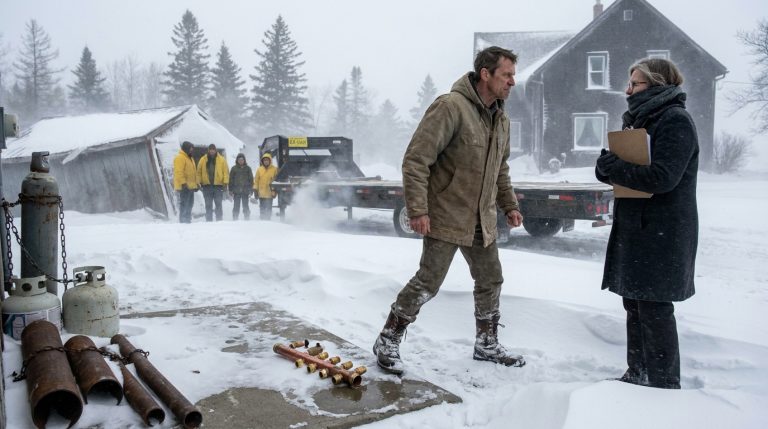
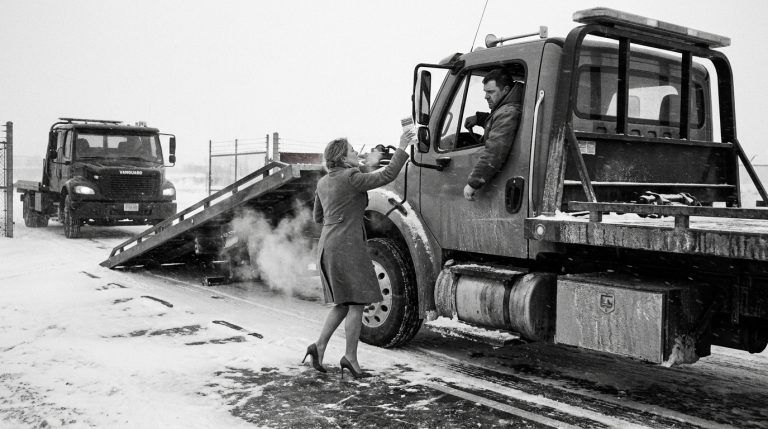
The voice cut through the hiss of the torch like a blade. I didn’t reach for the mask immediately. I let the silence stretch, forcing her to stand there in the swirling dust, letting the reality of my inaction frustrate her. Karen Thompson didn’t like waiting, and she certainly didn’t like being ignored. Her floral dress, a jarring, aggressive smear of pastel in the desert-muted landscape, caught the dying sun.
I killed the torch, the sudden absence of noise ringing in my ears, and flipped the mask up.
“Ma’am,” I said, my voice as level as the concrete I’d poured three days ago.
She was flanked by a man clutching a clipboard like it was a weapon. Gary. I remembered his name from the last board meeting flyer that had ended up in my trash. He looked ready to bolt, his eyes darting toward the treeline where my herd was grazing in the thick, unkempt grass of the front pasture.
“You’ll remove it by Friday,” Karen said, her chin tilted at that practiced, self-righteous angle. “Or we will.”
I looked past her, toward the subdivision—a sprawling, beige smear of stucco and manicured lawn that bled into the horizon. They called it progress. I called it a slow, agonizing suffocation of the landscape.
“This isn’t a modification, Karen,” I said, wiping a smear of grease from my cheek with the back of a calloused glove. “It’s infrastructure. It’s what keeps my livestock from turning your cul-de-sacs into a pasture.”
“The covenants are clear, Mr. McGregor,” Gary stammered, finally finding his voice, though he didn’t dare look me in the eye. “Section 7, subsection B. No improvements without architectural approval.”
I shifted, the metal of the guard groaning slightly under my weight. My eyes traced the edge of the property line, where a small, plastic orange stake stood—new, out of place, and hammered deep into the dry earth. It wasn’t there yesterday. I’d walked the perimeter twice.
It was a surveyor’s mark.
A cold, sharp realization tightened in my chest. This wasn’t about an “ugly” piece of metal. Karen wasn’t here because of the aesthetics. She was here because they were measuring.
“You can read the covenants to the cows if you like,” I said, stepping off the guard. “But you’re standing on a recorded easement that predates your entire development by seventy-seven years. You’re trespassing.”
Karen’s face mottled, a dark, pulsing red. She wasn’t used to the word. She was used to compliance. She took a step forward, then hesitated as I moved to hang the welding torch on the side of the truck.
“We’ll see about that, Major,” she hissed, using my old rank like an insult. “By Monday, you won’t have a ranch left to defend.”
She turned and marched back toward her luxury SUV, the gravel crunching under her heels. I watched her go, my focus drifting back to that small, orange stake near the fence line. The sun dipped lower, casting long, skeletal shadows across the dust.
They weren’t just here to complain. They were here because they wanted the land, and they were trying to move it out from under me before I realized why.
CHAPTER 2: THE FIRST SALVO
The dust Karen’s SUV kicked up hung in the stagnant air long after she had vanished into the beige sprawl of the subdivision. It coated the leaves of the nearby live oaks and settled onto the back of my neck, grit against sweat. I didn’t move. I kept my gaze fixed on the plastic orange surveyor’s stake. It looked like a scab on the landscape—a bright, artificial warning of an approaching infection.
I stood there for a long minute, the silence of the ranch returning in waves. Usually, this silence was my sanctuary. Today, it felt pressurized, like the air right before a thunderstorm breaks.
My back ached—the kind of deep, dull throb that brings back memories of long, sleepless shifts in the motor pool, where the only thing keeping the rhythm was the grind of gears and the endless, mindless paperwork required to keep a unit moving. Back then, it was just procedure. Here, the procedure felt like a noose. I reached down, my fingers calloused and stiff, and gripped the surveyor’s stake. It was set deep, driven into the hard-packed earth with a professional’s efficiency.
I pulled. It didn’t budge. I braced my boots against the gravel, put my weight into it, and gave a sharp, jarring yank. The plastic groaned, the earth giving way with a dry, ripping sound. It came out, revealing a sliver of freshly disturbed dirt beneath—a darker, richer color than the surrounding caliche. Someone had been here recently. Probably last night, under the cover of the shadows I usually trusted.
A phantom smell hit me—not the earthy scent of the ranch, but the faint, synthetic tang of expensive office coffee and high-end carpet cleaner. It was the smell of the subdivision, bleeding over the property line.
I turned back to the cattle guard. The support welds I’d finished before Karen’s arrival were clean, the steel still radiating a faint heat. It was a sturdy thing, built to handle the weight of heavy livestock and the pounding of a lifetime of work. It felt like an anchor. But as I looked at it, I realized it was just a piece of metal, and they weren’t fighting the metal. They were fighting the access. If they could get me to remove it, or get it declared “unsafe,” they would effectively turn my private entrance into a liability, forcing me to either abandon the easement or sell out to whatever developer was paying Karen to play watchdog.
The “why” was still obscured, but the pattern was emerging. The HOA wasn’t just being petty. They were being precise.
I walked back to the office, the crunch of gravel under my boots sounding unnecessarily loud in the encroaching twilight. The office—once a dusty tool shed, now my command center—was cluttered with maps and folders. My wife, Sarah, was waiting by the door. She didn’t say anything, just handed me a glass of iced tea, her eyes tracking my hands, which were still stained with grease and road dust.
“She’s not going to stop, is she?” Sarah asked quietly.
“No,” I said, setting the orange stake on the edge of my antique desk. “She’s not. She’s an instrument, Sarah. Someone’s turning the crank.”
I sat down, the chair creaking, and pulled the 1928 deed from the folder. The paper was fragile, the edges yellowed and brittle, but the ink—that bold, old-fashioned script—was as clear as the day it was pressed into the parchment. I ran my thumb over the granting clause. It was a promise made by a man named Jedediah Miller, a man who understood the value of a road, a fence, and the absolute necessity of holding your ground.
I didn’t open the laptop yet. Instead, I stared at the map pinned to the wall. The subdivision, Willow Creek, was a perfect, geometric grid. My land, by contrast, was jagged, defined by the creek and the natural contours of the hills. It was a messy, stubborn shape.
My phone buzzed on the desk. An unknown number. I let it vibrate, watching the screen light up against the dark oak of the desk. One buzz. Two. Three. Silence.
I picked it up and hit the call-back button. No one answered. Just a dial tone, flat and unhelpful.
I felt a cold flicker of recognition. This was how the game was played in the Corps. You don’t strike with your own hand if you can force your opponent to make a mistake first. Karen wanted a war. I was going to give her a legal siege. I reached for the desk lamp, the light casting a harsh, concentrated beam on the deed. It was time to find out exactly what kind of historical weight I had under my feet.
CHAPTER 3: THE PAPER ARCHITECTURE
The digital catalog on the records office terminal blinked with a sterile, insistent rhythm that felt entirely out of place against the backdrop of brittle, yellowed paper surrounding me. I sat in a high-backed wooden chair that had likely been here since the building’s construction, my knees nearly touching the bottom of the cramped microfilm reader. The air here was climate-controlled to the point of being dead, stripped of all moisture, and carried the pervasive, sweet-rot scent of century-old glue and decaying fibers.
David had given me a checklist, his voice crackling over the phone earlier that morning with the clipped, precise tone he used when he was in full Jag-Corps mode. “Mac, don’t look for the modern survey. They’ve scrubbed the digital records of anything that contradicts the subdivision’s master plan. Look for the grantor-grantee index from 1925 to 1930. If the easement was recorded, it has to be in the hard-copy books. They can’t scrub history that’s bound in leather.”
I reached for the heavy ledger—Volume 12—my fingers tracing the spine. The leather was cracked, dry as the Texas range I’d left behind, and flaked away under my touch. I opened it. The pages were a testament to a slower, more deliberate era, filled with the elegant, flowing script of a clerk who clearly took pride in every stroke.
I began to scan the names. Jedediah Miller.
There it was. April 17th, 1928.
I cross-referenced the page number against the index, and a frown tugged at my mouth. The ledger said page 45, but the digital catalog—the one I’d been viewing just moments before—had listed the entry for that specific date on page 48. A three-page discrepancy. In the world of property law, three pages was an eternity. It was a gap, a space where an original record could be pulled, replaced, or simply erased by someone with enough motive and access.
My heart didn’t race—I’d learned in Afghanistan that adrenaline was just a form of noise that clouded the objective—but it did tighten. I turned to page 45.
The page was there, but it looked different. The ink was slightly faded, the edges of the paper singed as if by an old, slow heat. My eyes tracked the legal description: …granting unto the cattle company and its successors and assigns in perpetuity, a 30-foot easement for the purpose of ingress and egress…
It seemed standard enough, but then I looked at the bottom of the page, where the marginal notes were usually tucked. There was a faint, embossed seal, barely visible under the overhead fluorescents. I pulled out my penlight, the sharp beam cutting through the gloom, and angled it so the light raked across the paper.
The seal wasn’t a standard county clerk’s mark. It was an older, heraldic stamp, the kind used by land grant commissions back when the territory was still being carved out of the wilderness.
I sat back, the chair groaning under the shift in my weight. Karen Thompson and her HOA board were operating on the assumption that this was a simple covenant dispute, a battle of “rules vs. defiance.” But if this document held the weight I suspected it did, it wasn’t a covenant issue at all. It was a sovereign land grant issue, protected by laws that hadn’t been written in any modern binder.
I pulled out my phone and snapped a series of high-resolution photos, ensuring the lighting was consistent and the embossed seal was centered. My hands were rock steady, even as the scale of what they were trying to hide began to sink in. They weren’t just trying to devalue my land for a commercial expansion; they were trying to bury a legal precedent that would render their entire subdivision’s zoning authority void if it were ever brought to light.
Karen wasn’t the architect of this. She was the cleanup crew.
I heard the heavy thud of the record room’s double doors opening behind me. The sound echoed in the cavernous space. I didn’t turn around immediately, instead closing the heavy ledger and sliding it slightly out of alignment so that anyone browsing the shelf wouldn’t immediately see what I’d been studying.
“Help you with something?” A voice drifted over from the far end of the aisle. It was the clerk, a woman in her fifties with glasses on a chain, clutching a stack of files.
“Just doing some family research,” I said, keeping my voice neutral, detached. I stood up, my joints popping in the quiet room. “Looking for the original homestead maps.”
“They’re in the restricted section,” she replied, her gaze lingering on the ledger I’d been using. “Need a permit for that.”
“I’ll keep that in mind,” I said, giving her a nod that suggested I was just another harmless amateur historian.
As I walked toward the exit, I felt the weight of the phone in my pocket. The digital proof was in there, but it was useless if I didn’t know how to deploy it. I pushed through the heavy doors and stepped out into the blinding, white heat of the Texas afternoon. The parking lot was a sea of shimmering mirage. My truck sat at the far end, looking like a rusted sentinel in a desert of white sedan commuters.
I didn’t head for the truck immediately. I stood on the sidewalk, letting the heat hit me, letting it sharpen my focus. I had the “silver bullet,” but I was now officially a person of interest in a game much larger than a suburban HOA. I scanned the lot. A black SUV, the windows tinted to near opacity, was parked two rows over. The engine wasn’t running, but the exhaust was clear, suggesting it had been there for a while.
I got into my truck and started the engine. The cab was an oven, the leather of the seat burning against my arms. I pulled out, checking my mirrors. The black SUV didn’t move.
I took the long way back to the ranch, winding through the back roads, the ones that weren’t on the GPS, the ones where the pavement gave way to washboard gravel and dust. Every mile was a test—a test of my surroundings, of my patience, and of my conviction. By the time the familiar silhouette of my fence line came into view, the sun was beginning to dip, painting the clouds in bruised, violent shades of purple.
I pulled to a stop at the cattle guard. I didn’t get out. I just sat there, listening to the ticking of the cooling engine, watching the shadows stretch across the land. This was home, but it was also a fortress now. And for the first time, I realized that I wasn’t just defending a piece of property. I was holding a line that someone very powerful wanted erased.
I looked at the house. A single light was on in the kitchen. Sarah.
I reached down, touched the gear shift, and rolled forward, the tires crossing the metal grid with a hollow, rhythmic thud. It was a sound of ownership. I wouldn’t be backing down. I couldn’t.
CHAPTER 4: THE FRAUDULENT LEAN
The kitchen light cast a yellow, sickly glow over the kitchen table, highlighting the coffee rings and the scattering of survey maps that had become my new geography. Sarah was asleep, or trying to be; I could hear the faint, uneven rhythm of her breathing from the bedroom down the hall. I, however, was anchored to the table, the certified copy of the 1928 deed spread out before me like a map to a hidden minefield.
It wasn’t until midnight that the notification arrived. Not a shout, not a knock, but a thin, electronic ping on my laptop. A digital record filing from the Travis County Clerk’s office.
My pulse didn’t spike. I reached for the cup of black coffee I’d brewed three hours ago—now cold and bitter—and took a slow, deliberate sip. I opened the file. It was a formal notice of a mechanic’s lien, filed by Willow Creek Estates HOA against the McGregor property. The reason cited was “unpaid fines and remediation costs” for the “unauthorized and hazardous installation” of the cattle guard.
The amount was absurd—seventeen hundred dollars—but the intent was clear. They were moving from passive-aggressive letters to active, bureaucratic warfare. By filing the lien, they were officially clouding my title, placing a legal encumbrance on my land that would make it impossible to refinance, sell, or even pull a standard permit for repairs without clearing their claim first.
It was a bullying tactic, pure and simple. It was meant to make me blink.
I leaned back, the wooden chair groaning in the quiet house, and looked at the clock. Twelve-fifteen. I pulled out my phone and dialed the one number that mattered. David Chen didn’t have an office line, just a personal cell that he answered at any hour of the day or night.
“Mac,” he answered on the first ring, his voice sharp with that instant, combat-readiness he’d carried since our days in the sand. “I saw the filing. They’re getting desperate.”
“It’s a fraudulent claim, Dave,” I said, my voice steady. “They know the easement is recorded. They know I have the 1928 deed. They’re filing it anyway to trigger a cloud on my title.”
“They are,” David confirmed. I could hear the rustle of papers on his end, the sound of a man who was already two steps ahead of the adversary. “But they’ve also made a massive tactical error. In Texas, filing a fraudulent lien against a homestead is a felony. Not a civil matter. A criminal one. They just handed us the keys to the kingdom.”
“I have the proof, Dave. I went to the records office today. I found a discrepancy in their index. They’ve been pulling records, trying to bury the original land grant seal.”
There was a long silence on the other end, the kind of silence that held a lot of weight. “If you found that seal, Mac, then this isn’t just about the cattle guard anymore. If that land grant holds, that entire subdivision is sitting on ground they don’t actually have the authority to regulate. Keep that document off the cloud. Scan it, put it on an encrypted drive, and keep the hard copy in a physical safe. Do not, under any circumstances, let them know you have that specific page.”
“I’m ahead of you,” I said, looking over at the heavy fireproof safe tucked into the corner of the pantry.
“Good. Don’t respond to the lien yet. Let them tighten the noose. If they go to court to enforce a fraudulent lien, they’ll be walking into a trap we’ve built for them. They’ll have to testify under oath that they believe this is a valid debt. When we show the judge that it was filed with full knowledge of the senior easement, the HOA board is going to find themselves personally liable, not just collectively.”
“They’re going to try to move the cattle guard themselves, Dave. I can feel it. Karen’s pride won’t let her survive a loss in court without a physical demonstration of her ‘authority’.”
“If they step one foot on your land, you document it,” David said, his voice dropping an octave. “You don’t engage. You record. You make sure they know they’re being watched, but you don’t give them a reason to claim you were the instigator. Let them be the aggressors. Let them be the ones who bring the chainsaws and the heavy machinery. The more noise they make, the easier it’ll be for the sheriff to see who the real problem is.”
I hung up, the silence of the house pressing back in on me. I stood up and walked to the window, looking out over the front pasture. The moonlight bathed the land in a silver, ghost-like light, turning the live oaks into twisted, silent witnesses. Somewhere out there, hidden in the darkness of the subdivision, Karen Thompson was likely drafting her next move, convinced that she was on the side of order and progress.
She didn’t know that every move she made was being anticipated.
I wasn’t a farmer anymore, not really. I was a structural engineer, and I was looking at their HOA as a failing bridge. They had load-bearing walls that were rotting, and I was just waiting for the right moment to pull the support beam. I walked back to the table, picked up the lien notice, and tucked it into the folder with the 1928 deed.
The battle wasn’t just coming—it was already here. And for the first time in a long time, I knew exactly how it was going to end. I turned off the kitchen light, leaving the room in a cool, deep gray, and sat there for a long time, watching the darkness, waiting for the dawn. I had work to do, and the first order of business was making sure that when they arrived to tear down that cattle guard, they wouldn’t just be entering private property. They’d be stepping into a kill zone of their own making.
CHAPTER 5: THE SURVEILLANCE TRAP
The morning didn’t break so much as it bruised, the sky turning a sickly, washed-out indigo before the heat began to claw its way back up the horizon. I was already outside by then. The GoPro was clamped to the thick, gnarled branch of an oak overlooking the easement, the lens adjusted for maximum focal depth. It was a precise, technical job—the kind I used to oversee in the Corps—and every movement was measured.
The wind had shifted overnight, bringing with it the dry, metallic tang of an approaching front. It whipped the loose dust into miniature cyclones that spiraled across the gravel, the grit stinging my skin.
I pulled the camouflage netting tight over the second camera, a trail cam I’d secured to a cedar trunk twenty yards from the cattle guard. From this angle, I had a perfect, unimpeded view of the access point. Anyone pulling onto my land would be framed perfectly, their actions recorded, their faces identifiable.
The rumble started as a low vibration in the soles of my boots before it became audible—the deep, guttural growl of a diesel engine. A one-demolition flatbed was crawling down the county road, its yellow strobe light cutting through the hazy light like a baleful eye. They weren’t moving fast, which meant they were confident. They were here to work, and they clearly had no idea that the terrain had changed.
I retreated to the shadow of a thicket of brush, my movements fluid and practiced. I had my phone in my hand, the screen dark but the camera app running in the background. I wasn’t going to engage them the second they arrived. I needed to let them establish intent. I needed the visual evidence of them trespassing, of them offloading the gear, and of the moment they placed a hand on the structure that I legally owned.
The truck pulled onto the easement, the heavy tires crunching into the gravel with a sound like grinding teeth. It came to a stop ten feet shy of the cattle guard. Two men stepped out. They wore the neon-yellow vests of contractors, but their expressions were more sullen than professional. They moved with a practiced, heavy-footed indifference, unloading the cutting torch, the chains, and a portable generator.
I watched through the brush, my breathing steady. Every detail I’d planned—the angles, the documentation, the alert to the sheriff’s office—was now moving in real-time.
A sudden, sharp gust of wind tore through the oaks, sending a shower of dead leaves skittering across the road. The temperature dropped five degrees in as many seconds, the air turning sharp and biting. It was a weather shift I hadn’t accounted for, but it served me well. The wind would mask the sound of my movement if I needed to reposition, and it would keep the dust swirling, making it harder for them to see anything beyond the immediate radius of their truck.
One of the men—the burly one, his beard gray-flecked and unkempt—hooked a chain to the cattle guard’s support brace. He signaled his partner, who started the generator. The harsh, rhythmic thwack-thwack-thwack of the machine tore through the quiet of the morning.
My skin crawled with the sensation of being caught in the open, but I held my position. The man with the chain began to tighten the hook, his face screwed up in the effort, the metal grating against metal. He wasn’t just moving it; he was preparing to tear it from the concrete foundation.
I stepped out of the brush, my boots finding the gravel with a soft, deliberate crunch.
The sound didn’t carry well over the generator, but the motion did. The burly man straightened, his hands still gripping the chain, and his eyes locked onto mine. He looked startled—not by a man, but by the lack of fear in my stance.
I didn’t yell. I didn’t reach for a weapon. I simply pulled my phone up, framing him in the shot, the red recording light blinking steadily.
“Step away from the structure,” I said, my voice cutting through the mechanical noise. It wasn’t a question. It was a command.
The man hesitated, the chain slipping slightly in his grip. His partner, busy at the generator, didn’t hear me at first, then looked up, his jaw dropping as he saw me standing there, alone, in the middle of the access road. They had been told they were clearing out a “hazard,” something that shouldn’t be here. But seeing me—the owner, the man who had built this, the man who was currently holding a device that would serve as the centerpiece of their criminal liability—the narrative started to fracture.
They looked at each other, then toward the county road, as if expecting the cavalry to arrive. But there was only the wind, the dust, and the cold, unyielding reality of the property line. The escalation had begun, and for the first time, I felt the heavy, exhilarating weight of the trap finally closing.
CHAPTER 6: THE CONFRONTATION
The air felt thinner now, charged with the ozone of the approaching front and the frantic, shallow breaths of the two men standing by their generator. The burly contractor, Bill, had gone pale, his hands still hovering near the chain. He was looking at my phone, at the blinking red light, and then at the legal papers I had laid out on the flatbed of their truck. He wasn’t a criminal, not in his own mind. He was a guy trying to get paid for a job that had suddenly acquired the sharp, lethal scent of a felony.
“I told you,” I said, my voice barely raised above the idling roar of the flatbed. “You move that guard, and you’re doing it on a criminal trespass. I have the sheriff’s office on notice. They’re already in the dispatch loop for this address.”
Bill’s partner looked at him, his face a mask of sweating uncertainty. “Boss, he’s got the paperwork. And he’s filming. If the cops come…”
Before Bill could answer, the gravel of the access road erupted.
A white luxury SUV crested the rise, its tires screaming as they fought for traction on the loose rocks. It skidded, fishtailed, and slammed to a halt just inches from the rear bumper of the demolition truck. The door flew open, and Karen Thompson stepped out. She looked less like a president of an HOA and more like a woman unspooling from a tight, invisible wire. Her floral dress was rumpled, her hair windblown, and her eyes were fixed on the cattle guard with a terrifying, singular intensity.
She didn’t look at me. She didn’t look at the phone in my hand. She marched straight to Bill, her heels digging into the soft earth.
“Why isn’t that thing gone?” she demanded, her voice shrill, cutting through the wind. “I am paying you to remove an eyesore, not to have a conversation with a squatter.”
Bill shifted, his posture defensive. “Ma’am, he’s got a deed. He says it’s a recorded easement. He’s already called the sheriff. We aren’t touching it until you show us something that says we won’t get arrested.”
Karen whirled around then, her gaze locking onto mine. It was a cold, hateful look—a distillation of every petty authority she’d wielded for years. She walked toward me, each step deliberate. I didn’t back up. I didn’t need to. I was on my own ground, and every inch of it was backed by the weight of the document currently locked in my safe.
“You think this is clever?” she hissed, her voice low enough that the contractors couldn’t hear. “You think a dusty piece of paper gives you the right to hold a community hostage? This is a prestigious development. We have standards. We have a vision. And people like you, with your rust and your cattle and your outdated, pathetic little rights—you are the reason we have rules.”
“The law isn’t a rulebook, Karen,” I said, my voice steady, the calm infuriating her more than any shout could have. “The law is a boundary. And you crossed it.”
“I am the president of this association!” she screamed, the sound tearing through the wind. She spun back toward the men, her face mottled and dark. “Hook the chain! Now! I will pay you double. I will indemnify you. If he wants to press charges, let him! I have the resources of an entire neighborhood behind me. He has nothing but a shack and a fence!”
The contractors stood frozen. The wind had picked up, blowing the grit into our faces, making the scene feel chaotic and desperate. Bill took a step back, shaking his head. “No. I’m done. This isn’t what we signed up for.”
Karen lunged for the chain herself. It was a pathetic, frantic gesture, a woman trying to physically dismantle a reality she couldn’t control. She grabbed the metal, her hands slipping, her fingernails scraping against the cold, iron-hard steel. She let out a jagged, frustrated cry and jerked the chain, her heel catching on a rock. She stumbled, falling hard against the edge of the cattle guard, her skirt catching on the metal.
She stayed there for a heartbeat, panting, her face pressed against the steel, the picture of absolute, unvarnished defeat. The contractors had already retreated to their truck, their faces averted, their hands in their pockets.
Then, the sound I had been waiting for finally cut through the wind. The low, mournful wail of a siren, growing louder as it turned off the county road.
Karen pushed herself up, her face a mask of shock as she saw the patrol car pulling in behind her SUV. The blue and red lights began to dance across the dust, casting long, strobing shadows against the trees.
I lowered my phone, the recording complete. I didn’t need to say another word. The arrival of the uniform was the only punctuation the moment required. I watched as the deputy exited the car, his movements slow, practiced, and calm. Karen turned to face him, her mouth opening to speak, but the words died in her throat as she realized that for the first time in her life, her title meant absolutely nothing.
The standoff had ended, and the unraveling had begun.
CHAPTER 7: THE ARCHITECTURE OF BETRAYAL
The deputy’s presence didn’t dissipate the tension; it merely localized it. Deputy Miller stood between Karen and me, a physical barrier of neutral authority that felt as rigid as the concrete under my feet. Karen was still shivering, the adrenaline that had fueled her aggression now curdling into a pale, frantic state of shock. She kept trying to speak, her voice thin and reedy, but the deputy’s raised hand silenced her with practiced efficiency.
I didn’t watch her. I didn’t need to. I was watching the demolition truck’s dashboard through the window. Bill was already on his phone, his head bowed, his shoulders tense. He wasn’t talking to Karen; he was talking to someone else.
I took a step toward the flatbed, my movements deliberate. Bill caught my eye through the glass, his expression shifting from defensive to something approaching pure, unadulterated dread. He saw the recording on my phone, the calm in my posture, and he realized he was the one holding the bag for a disaster he hadn’t fully comprehended until this very second.
“Deputy,” I said, my voice cutting through the wind. “Check the truck’s work order. It didn’t come from the HOA board. It came from an LLC. I’d be interested to know who the registered agent is.”
Karen’s head snapped toward me, her eyes widening. The mask didn’t just slip; it shattered.
The deputy looked at me, then at Karen, his expression unreadable. He walked to the driver’s side of the truck and tapped on the glass. Bill rolled it down, the sound of a heated, indistinct conversation drifting out. A moment later, the deputy returned, holding a slim, laminated sheet—the work order. He scanned it, then looked at Karen.
“Miss Thompson, this isn’t an HOA-sanctioned demolition order. This is a private contract under the name ‘Willow Creek Development Group.’ That’s not the association.”
Karen stood frozen, the wind whipping her hair across her face, masking the sudden, sharp intake of breath. She wasn’t fighting for her community anymore; she was fighting to keep her own narrative from collapsing.
I didn’t wait for the deputy to finish his questioning. I had enough. I walked back to my office—the shed—my mind already running the calculations. The HOA was a decoy. The real objective was the “Development Group,” a shell company designed to strip away the historical protections of the Miller property so that the land could be annexed, cleared, and paved. Karen had been their local enforcer, a puppet convinced she was leading a crusade when she was actually clearing the ground for an industrial project that would have destroyed the area’s entire aquifer.
I locked the door to the office and sat down at the terminal. I didn’t need to hack into their system; I just needed to look at the digital footprint they’d left on the county’s public access portal. I pulled up the registration for the “Willow Creek Development Group.” The registered agent was a firm out of Houston—the same firm that represented the developers building the new luxury high-rises on the edge of the city.
I scrolled down, my eyes widening. Attached to the registration was a secondary document: a “Land Use Variance Request,” dated three months before the HOA board had even drafted their first notice against me. It was a clear, unambiguous plan to convert the old Miller ranch into a commercial staging area for heavy equipment.
The cattle guard hadn’t been an eyesore. It had been the first thing they had to remove because it was a piece of permanent infrastructure that proved the land was still being used for its original, granted purpose.
I stared at the screen, the blue light reflecting in the dark lenses of my glasses. The betrayal wasn’t just Karen’s. It was systemic. I grabbed my phone and dialed David.
“Mac?” he answered. “I’m looking at the sheriff’s preliminary report. They’re holding the crew for questioning. Karen’s lawyer is already at the station, but he’s frantic. He knows they’ve overreached.”
“It’s not just the HOA, Dave. I found the LLC. It’s a commercial developer, not a community association. Karen was an employee of the firm, or at least a contractor. They used the HOA as a shield to bypass the environmental impact studies.”
There was a pause, a long, heavy silence. “That changes everything, Mac. That makes this a racketeering case. We aren’t just filing for an injunction anymore. We’re filing for a federal investigation into land fraud.”
“Do it,” I said, my voice tight. “And Dave? Find out who in the county office approved the variance request. Someone had to sign off on their claim that this land was abandoned.”
I hung up, the room feeling smaller, the walls closing in as the reality of the conspiracy took shape. I wasn’t just a rancher anymore. I was a whistleblower. I turned to the desk, the deeds, the maps, and the photos of the hidden seal arranged in a tight, logical grid. I had the architecture of their betrayal, and I was going to use it to dismantle them, piece by agonizing piece. The storm outside was finally breaking, the rain beginning to hammer against the tin roof, a rhythmic, driving sound that mirrored the pace of my own thoughts. I was ready.
CHAPTER 8: THE FINAL RECKONING
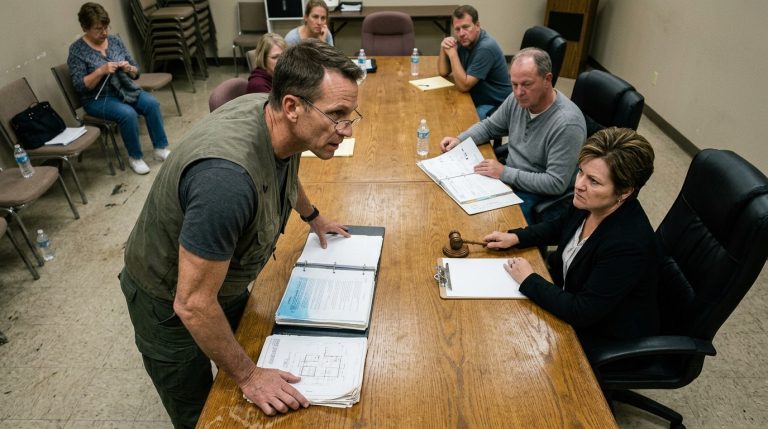
The clubhouse was still humming with the residue of the public tribunal, but I didn’t stay for the applause. I stepped out into the night air. The rain had slowed to a steady, rhythmic tapping against the pavement—a sound of restoration. The air was cool and washed clean, smelling of wet concrete and the approaching winter.
Susan, the new interim president, caught up to me at the edge of the parking lot. She looked tired, the kind of exhaustion that comes from carrying the weight of a community that has lost its way, but there was a new, focused clarity in her eyes.
“Mac,” she said, her voice soft but steady. “We’ve got the motion drafted. We’re going to formally rescind the lien, pull the records, and issue the public apology tomorrow morning. I’ve already contacted the title insurance company to let them know the error was on our end. You don’t need to worry about the property title anymore. It’s clear.”
“That’s the right move, Susan,” I replied, standing still as the rain began to soak into the shoulders of my jacket. “But the developer… the Willow Creek Development Group? They aren’t going to go away just because the HOA changed leadership.”
Susan nodded, a grim smile touching her lips. “We know. Mr. Henderson and the legal committee have been looking into their filings. We found the internal communications from the board—Karen’s communications. We’re turning it all over to the federal authorities on Monday. Fraud, racketeering, conspiracy to defraud the property owners… they aren’t going to have a leg to stand on.”
I watched her walk back toward the clubhouse, a woman reclaiming her home, and I felt the knot of tension that had been coiled in my stomach for months finally begin to unspool. The architecture of their betrayal had been dismantled, not by a single strike, but by the sheer, grinding friction of the truth.
I drove home slowly, the ranch truck’s headlights cutting through the mist. When I pulled up to the cattle guard, I stopped. I didn’t just drive over it this time. I got out.
The rain-slicked steel gleamed under the truck’s lights, a dark, heavy shape against the wet earth. I knelt, my boots sinking into the mud, and ran a hand over the weld I had finished the day Karen first arrived. It was cold now, smooth and immovable. I felt the vibration of the land beneath it—a stable, ancient presence that no developer’s map could erase.
I reached into my pocket and pulled out the small, orange plastic surveyor’s stake I’d pulled from the ground days ago. I turned it over in my hand. It looked fragile, almost pathetic in the dark. I didn’t keep it as a trophy. I walked to the edge of the creek, where the brush was thick and the ground was soft, and I buried it deep in the silt, beneath a layer of stone and root. It would stay there, a buried secret for someone else to uncover in another century, but for now, it was gone.
Back on the porch, Sarah was waiting. She didn’t ask about the meeting. She didn’t ask about the developer. She simply held the door open, the warm, golden light of the living room spilling out into the darkness.
Inside, the house was silent, but it was a different kind of silence—a peaceful, settled quiet. I walked over to the fireplace, where a low, steady flame was licking at the logs. I took the folder containing the 1928 deed and the photos of the hidden land grant seal, and I placed them inside the fireproof safe. I turned the dial, the heavy bolt sliding home with a final, metallic thunk.
The secret was locked away, not because I was afraid of it, but because it didn’t need to be wielded anymore. The land was safe. The history was honored. And I was back to being a man who just wanted to raise his herd and watch the sunset behind the hills.
I sat in the worn leather armchair by the fire, the fatigue of the long battle finally pulling at my eyes. I thought about Jedediah Miller, the old rancher who had held this ground before me, and I realized that stewardship was never about conquest. It was about persistence. It was about knowing when to draw the line and, more importantly, knowing that the line itself was the victory.
I picked up a book, the pages crisp and familiar, but I didn’t read. I listened to the rain, the steady, rhythmic pulse of a world returning to its natural state. Tomorrow, the sun would rise over the hills, the cattle would graze, and the cattle guard would sit, a silent, iron sentinel, doing exactly what it was meant to do.
I closed my eyes, the warmth of the fire spreading through the room, and let the long, hard journey fade into the soft, velvet dark. For the first time in months, I didn’t have a plan. I didn’t have a defense. I just had the land, and the land was finally at rest.