They Paved Over My Driveway. That Was Their First Mistake
CHAPTER 1: The Concrete Breach
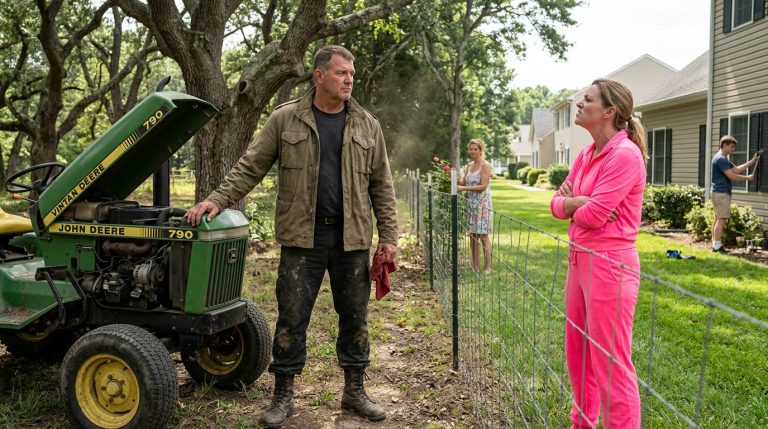
The engine of my truck went quiet, but my hands didn’t. They stayed locked onto the steering wheel, knuckles pale against the worn leather. I looked out the windshield, my eyes refusing to register the reality of the scene. The wide, rough-hewn slab of concrete my grandfather had poured during the heat of ’71 was gone. In its place lay a strip of smooth, black asphalt that seemed to drink the Texas sun, bisected by sharp, clinical yellow paint.
There was a sign now, too. A metal pole driven into the earth—my earth—announcing the site as permitted community parking.
“You’re home early,” a voice clipped through the open window.
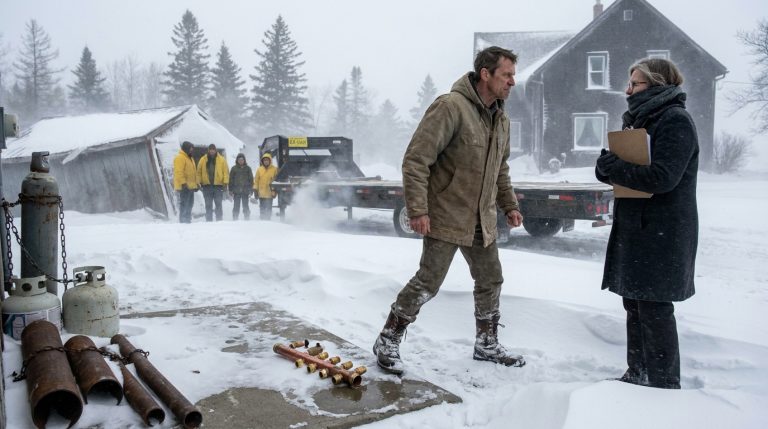
I turned my head slowly. She was standing on the edge of the new asphalt, perfectly poised in a linen blazer that looked like it had never touched a speck of red dirt in its life. Beverly Cratch. She held a clipboard with the kind of proprietary grace one might reserve for a ledger of souls.
“You’re trespassing,” I said. My voice sounded flat, a dead weight in the humid air.
She gave me a smile that didn’t reach her eyes. It was a practiced, efficient thing, designed to make the person she was speaking to feel like they were the one committing the error. “This is community space now, dear. You’ll need a valid permit to remain here, or I’m afraid I’ll have to ask you to move your vehicle to the street.”
I looked past her, at the small, cheap car sitting where my grandfather’s old Ford had rested for decades. My pulse hammered in my throat, a rhythmic, angry thud. I wasn’t just tired; I was being erased. I gripped the door handle, the metal cold and biting against my palm. I could feel the ghost of my grandfather’s hand on my shoulder, the way he used to grip the edge of the concrete mixer, stubborn against the heat.
“I own the deed to this land,” I said, my tone as hard and jagged as broken rock.
Beverly laughed—a soft, tinkling sound that suggested I was a child failing to grasp a simple arithmetic problem. “Ownership is a dynamic concept in an organized community, Mr. Whitfield. The bylaws have been updated to reflect current usage needs.”
She stepped forward, tapping her pen against the clipboard. I could see the ink of the signature block, the official-looking seal she’d printed herself. She leaned in, her perfume cloying and sweet, invading the space that should have been nothing but the smell of engine oil and memories.
“You really should have kept an eye on your affairs,” she whispered, her smile widening into something predatory. “Default is such an inconvenient thing to recover from.”
My breath hitched. Default. She wasn’t just talking about parking. She was looking at my house, the foundation, the roof, the very dirt under her heels. She thought I was just a tired, broke man returning from West Texas, ripe for the taking. She didn’t know yet that I had spent the last six years learning exactly how to dismantle things, one bolt at a time.
I didn’t argue. I didn’t reach for the paperwork in the passenger seat. I just stared at the yellow paint on the asphalt and realized the sign wasn’t for the neighbors. It was a tether, and she had just handed me the end of the rope.
CHAPTER 2: The Forensic Silence
I didn’t turn the engine off right away. I sat there in the cab of my truck, the air conditioning humming a dying rhythm, watching Beverly Cratch walk back toward her own vehicle with the smooth, rhythmic stride of a woman who felt she had already won. She didn’t look back. She didn’t need to. In her mind, the paperwork was already done, the concrete was already broken, and I was just an outlier being smoothed out of her neighborhood’s ledger.
When she finally vanished behind a hedge of manicured boxwoods, I put the truck in reverse. I didn’t head for the front door of the house. That would have been a mistake—an impulsive, emotional reaction. Instead, I drove to the industrial park on the edge of town, where my work trailer sat tucked behind a wall of corrugated metal and overgrown weeds. It was a metal box, sun-bleached and rattling, but inside, it was the only place in the world where I felt like I could actually breathe.
I stepped out into the night air. It was sharp, the kind of Texas cold that settles into your marrow after a long summer day. I could still smell the tar from the driveway, a cloying, chemical scent that clung to my jacket like a bad omen.
Inside the trailer, the only light came from the glowing screen of my laptop, reflected in the dust motes dancing in the air. I sat down, my knees knocking against the desk. For a moment, my mind didn’t go to the legal filings or the bylaws. It went back to the heat of ’71. I could almost hear the low, hungry groan of the cement mixer, the sound of my grandfather laughing as his friend nearly tipped the rig into the ditch. It was a memory of sweat and grit, of things being built to last. The asphalt they’d poured today was the polar opposite—it was slick, sterile, and built for a fee.
I pushed the memory away. Sentiment was a luxury I couldn’t afford if I wanted to keep the roof over my head.
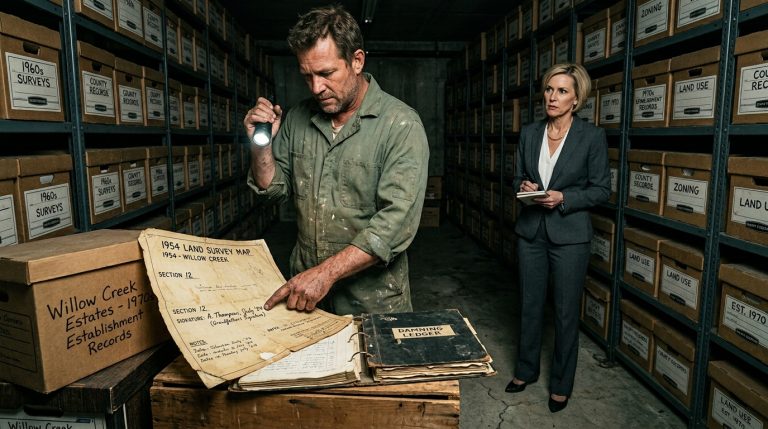
I opened the folder of scanned documents I’d been building for the last eighteen months. I had HOA covenants, county tax records, and a growing stack of correspondence from Beverly. I started with the amendment. It was typed on high-quality bond paper, the font sterile and imposing. But as I pulled up the digitized county records on my second monitor, the first crack in the façade appeared.
The HOA’s authority for the reclassification rested entirely on a bylaw change that supposedly passed in the fall of 2021. According to the document, the motion was carried by a majority vote of the homeowners. I clicked through to the attendance sheet. Thirty-four names. I pulled up the property registry. There were ninety-one lots in the Creston Ridge subdivision.
Thirty-four out of ninety-one. That wasn’t a majority; it was a rounding error.
I leaned back, the metal chair creaking under my weight. My throat felt dry, a tight, burning sensation that had nothing to do with the coffee I’d been nursing. I checked the timestamp on the filing. It had been notarized by a firm in Fort Worth—a firm I’d never heard of. I did a quick search, the keys clacking beneath my fingers like gunfire in the silence of the trailer. The firm was legitimate, but its primary clients were commercial developers and mid-sized property management groups.
The pieces began to align, not into a messy neighborhood disagreement, but into a rigid, geometric shape of corporate intent. Beverly hadn’t just been “improving” the neighborhood; she had been preparing a ledger. If she could prove the driveway was “community property,” she could create a lienable event. If I failed to pay the retroactive fees or the “parking administration” costs, they could force a foreclosure. They didn’t just want the asphalt; they wanted the deed.
I scrolled through the financial reports Gus had managed to photograph during his undercover stints at the board meetings. There were numbers—parking fees, maintenance assessments, administrative costs. They looked clean, properly formatted, and utterly lifeless. But beneath the lines, the math was just slightly off. The revenue from the parking lot didn’t correlate with the permit sales I’d observed.
There was a surplus. Every month, a few hundred dollars—a drop in the bucket, really—disappeared into a category labeled ‘General Infrastructure Reserve.’
I opened a blank spreadsheet, my focus narrowing until the rest of the world ceased to exist. I began to input the data, cross-referencing every reported fee against the bank statements I had obtained through the property manager’s portal. The math began to scream at me. It wasn’t just incompetence. It was a siphon.
My stomach churned, a cold, hard knot. This was the decoy. They were so busy hiding their skim that they had left the foundation of their entire power structure exposed. If I focused on the parking, I was playing their game. If I followed the money, I was building a trap.
I stopped, my fingers hovering over the keys. The trailer felt suddenly small, the walls closing in as if they were made of the same cold asphalt Beverly had laid on my land. I reached out and touched the edge of the desk, grounding myself. I needed someone to verify this. Someone who knew the difference between a neighborhood dispute and a criminal enterprise.
Priscilla Daws.
The name felt like a weight. I looked at the clock: 3:00 AM. I couldn’t call her yet. I saved the spreadsheet, naming it simply Concrete Ledger, and pushed the laptop away. The shadows in the trailer seemed to lengthen, mocking me with their silence. I had the start of it—the crack in the foundation—but I knew that once I started pulling this thread, the whole house of cards would come down.
And they would know I was the one holding the scissors.
CHAPTER 3: The Silent Council
The sunrise was a thin, gray line cutting across the horizon when I pulled my truck up to Gus Hullbrook’s workshop. The air was heavy with the smell of damp earth and old oil. Gus’s place was an architectural afterthought—a converted detached garage that looked like it was held together by sheer willpower and a lifetime of accumulation.
I didn’t knock. I stepped into the dim light of the shop, the air instantly cooling as I moved away from the rising sun. Gus was already there, hunched over a workbench with a jeweler’s loupe pressed to his eye, tinkering with something that looked like a carburetor from the thirties. He didn’t look up as I approached, but he reached out with his left hand, his fingers stained with grease, and gestured to a stool that was buried under a pile of discarded schematics.
“You’re back early,” he said, his voice a raspy friction. “And you look like you haven’t slept since the drive from West Texas.”
“I haven’t,” I replied, pulling a chair out from beneath the workbench. I set my laptop down, the screen still dark. “I looked at the books, Gus. The parking revenue. The general reserve fund. It doesn’t hold water.”
Gus finally pulled the loupe from his eye and turned. He looked older in the pale, filtered light—the salt-and-pepper of his beard seemed more prominent, and his eyes were squinted as if he were constantly peering through a sightline. He looked at the laptop, then back at me, his expression hardening.
“I told you, they’re digging deep,” he muttered. “I’ve been sitting in those back-row seats for three years, watching Beverly run that board like it’s her own private fiefdom. She doesn’t just want the driveway, kid. She wants to own the movement of every person on Creston Ridge.”
He reached over to a metal filing cabinet that looked like it had been salvaged from a shipwreck and pulled out a thick, spiral-bound notebook. It was tattered, the pages swollen with humidity and marked with a dense, frantic shorthand. He slid it across the workbench toward me.
“That’s the last three years of attendance and motions,” Gus said. “I tracked every vote, every ‘anonymous’ proxy, and every time the minutes were ‘amended’ after the fact.”
I opened the book, my heart hammering against my ribs. I flipped to the section on the 2021 bylaw amendment. My eyes scanned the list of attendees. My finger hovered over a name—Francis Aldridge. I remembered her. She was a holdout. But as I read the notes in Gus’s cramped handwriting, I saw a discrepancy. The official minutes claimed Francis had voted in favor of the community parking initiative. Gus’s notes, taken in real-time, told a different story entirely: Francis opposed. Loudly. Beverly silenced her with a procedural point of order.
“She didn’t just lie,” I murmured, the weight of the realization settling in my chest. “She edited the history.”
“That’s the game,” Gus said, wiping his hands on a rag that had seen better days. “She writes the record, she makes the law. And since nobody checks the records, she’s never wrong.”
I looked at the screen of my laptop, then at the notebook. I had the financial numbers—the skeleton of the fraud—but Gus had the pulse. He had the physical evidence of the manipulation. If I could link the illegal vote to the financial discrepancies, I wouldn’t just have a civil dispute. I would have an actionable case for fraud, a breach of fiduciary duty that could strip them of their standing entirely.
“I need to talk to Francis,” I said, looking up.
Gus gave a low, rumbling laugh. “She’s been keeping her head down. Ever since Beverly took over, folks are afraid to speak up. They’re scared of the fines, the legal threats, the way Beverly makes a person feel like they’re living on land that doesn’t really belong to them.”
“I’m not asking them to be heroes,” I said, a cold resolve sharpening my words. “I’m just asking them to be witnesses. If I can get enough of them to verify that the records were falsified, the entire legal basis for the driveway seizure collapses.”
I stood up, the notebook clutched in my hand. It felt heavy, a physical manifestation of a neighborhood’s stolen agency. I looked at Gus, who was watching me with a mixture of caution and respect.
“You going to be alright, kid?” he asked. “Beverly’s husband is the treasurer. They’re a closed loop.”
“The loop has a leak,” I said, looking toward the door. “I found it. Now I just need to make sure everyone sees the water rising.”
I walked back out into the bright, harsh Texas morning. The air felt different now. Less like a cage, and more like a battlefield. I had the map, I had the evidence, and for the first time in six years, I wasn’t just a man waiting for his land to be stolen. I was the one who was going to take it back.
CHAPTER 4: The Legal Chessboard
The Fort Worth skyline was blurred by a sudden, violent deluge of rain that had turned the afternoon into a bruised purple twilight. I stepped out of the elevator and into the quiet, pressurized atmosphere of Priscilla Daws’s law firm. Everything here was designed to make you feel small: the high ceilings, the deep-pile carpets that muffled your footsteps, and the relentless, hummed silence of air conditioning fighting the humidity outside.
I didn’t have to wait. Priscilla’s assistant, a woman with eyes that seemed to record every heartbeat in the room, gestured toward the double mahogany doors.
Priscilla was standing by the window, watching the rain lash against the glass. She didn’t turn when I entered. She was wearing a structured navy suit that looked like armor, and her reflection in the glass was sharp, composed, and utterly unyielding.
“You’re late, Mr. Whitfield,” she said, her voice smooth but carrying the authority of a gavel strike.
“I had to stop by a workshop,” I said, setting Gus’s tattered notebook on the heavy oak conference table. “I have the records. The attendance, the minutes, the voting discrepancies. It’s all here.”
She turned then, her gaze dropping to the notebook. She didn’t look impressed, but she did look interested. She walked over to the table and flipped the book open, her fingers moving with the precise, practiced efficiency of a surgeon. She spent several minutes reading through Gus’s shorthand, her expression never wavering.
“This is not a formal record,” she said finally, looking up. “In a courtroom, this is hearsay. A disgruntled neighbor’s opinion of a board meeting.”
“It’s not just an opinion,” I pushed back, stepping closer. “It’s a pattern. Look at the dates of the amendments. Compare them to the financial transfers in the bank statements I sent you. Every time they forced through a questionable bylaw, there was a corresponding ‘administrative expense’ or ‘infrastructure fee’ paid to her cousin’s firm.”
Priscilla sat down, placing her hands flat on the table. She looked at me, her eyes probing, searching for the crack in my resolve. “If we move on this, it becomes a public fight. Beverly Cratch is not going to fold because you found a notebook in a garage. She’ll fight back, and she’ll use every resource that HOA has—your neighbors’ dues, their collective voice—to paint you as the antagonist. She’ll claim you’re the one embezzling, or that you’re harassing board members. Are you prepared for that?”
I thought of the driveway. I thought of the smell of hot tar and the sight of my grandfather’s concrete being pulverized into dust. “I’m prepared for whatever she has,” I said.
Priscilla leaned back. “Then we don’t start with a lawsuit. We start with a Quiet Title action. We force the HOA to prove their ownership of the easement in court. We challenge the validity of every bylaw they’ve passed since 2019. We make them produce the original ballots, the verified proxy forms, and the original meeting minutes for every vote they’ve used to manipulate that neighborhood.”
She paused, her gaze steady. “And while we have them tied up in discovery, we submit a formal inquiry to the county regarding the infrastructure funds. If they’ve been misappropriating those, it’s not just a civil matter anymore. It’s a criminal one. It will force them to reveal the books. And that is where the truth will finally break cover.”
I felt a surge of cold adrenaline. This was the trap. It wasn’t about the driveway anymore. It was about exposing the entire architecture of their greed.
“How long?” I asked.
“Long enough for them to make a mistake,” she replied. “Pressure does things to people, Mr. Whitfield. When they realize their control is slipping, they stop being careful. They start moving money, they start making threats, and they start leaving tracks. Your job is to keep your head down and let them dig their own hole. Do not engage with them. Do not attend their meetings. Let them think you’re beaten.”
She stood up and closed the notebook. “Go home. Mow your lawn. Paint your fence. Be the quiet, invisible man they want you to be. Meanwhile, I will begin the process of locking down your property title and filing the discovery requests. They’ll receive the notice in seventy-two hours.”
I nodded, the plan forming in my mind with clinical clarity. I had spent six years away, watching from the distance, but the game was local now. It was happening on the very ground my grandfather had broken his back to pour.
As I walked out of the office and back into the rain, the storm felt less like a nuisance and more like a cleansing. The city lights reflected in the puddles on the street, flickering like dying embers. Beverly thought she had the upper hand, but she was operating on the assumption that I was playing for the driveway. She had no idea that I was playing for the entire board.
I started my truck, the engine roaring to life in the damp, heavy air. I drove back toward Creston Ridge, my eyes tracking every detail of the road. The fight was shifting, and I was exactly where I needed to be: in the shadows, waiting for the first sign of their panic.
CHAPTER 5: The Controlled Demolition
The sky was a sheet of flat, gunmetal gray as I eased my truck onto the gravel shoulder opposite my house. Wyatt’s crew was already there, a cluster of men in high-visibility vests moving with a precise, military economy. The excavator, a hulking mass of yellow steel, sat like a dormant beast in the center of the asphalt lot. It was quiet, but the air felt charged, humming with the kind of tension that precedes a lightning strike.
I stepped out of the truck, the cold biting through my light jacket. I walked toward the edge of the property, my boots crunching on the transition between the county dirt and the cursed asphalt. I didn’t look at the house. I looked at the lot—the fake lines, the yellow stops, the sign that had stood here like a tombstone for my grandfather’s pride.
“You ready, boss?” Wyatt asked, walking over. He was a man of few words, his face etched with lines of sun and dust. He didn’t ask if I was sure. He didn’t ask about the legal ramifications or the neighbors peering from behind their curtains. He just waited for the nod.
“Tear it out,” I said.
The sound that followed was violent—a harsh, mechanical roar as the excavator’s arm rose into the air and dropped, the steel teeth biting into the asphalt with a scream of tearing stone. It was a rhythmic, punishing sound. Bite, rip, lift, drop. The ground beneath my feet trembled. I watched as the black, sterile surface of the parking lot was peeled back like a scab, revealing the raw, dark earth of Denton County beneath.
It felt like surgery.
I glanced toward the houses lining the ridge. I could see the subtle shift of blinds, the silhouette of a neighbor watching from a kitchen window. They weren’t just watching a demolition; they were witnessing the dismantling of the authority Beverly had spent years cultivating. I felt a flash of something sharp and cold—a suspicion that I was being watched, that someone would step out, that the police would arrive to stop us. My hands clenched at my sides. Every movement in the neighborhood felt like a potential threat, every parked car a silent informant.
Wyatt’s crew moved with relentless speed, clearing the debris into a waiting dump truck. The smell of crushed rock and old, subterranean soil filled the air. It was the scent of the past coming back to the surface. I saw a piece of white concrete debris—a fragment of the original driveway my grandfather had poured—and I walked over, picking it up. It was heavy, textured with the grit of fifty years.
“Mr. Whitfield!”
The voice was thin, frantic, and cut through the roar of the machinery. I turned. Beverly Cratch was running across the lawn, her blazer fluttering behind her like a desperate cape. Her face was flushed, stripped of its usual curated calm, and her eyes were darting between the excavator and the empty space where the parking lot had been. She looked less like a president of an association and more like someone watching their own house burn down.
“Stop this!” she shouted, waving her phone, her thumb hovering over the screen as if she were trying to summon the law with a single tap. “This is unauthorized destruction of community infrastructure! I’ve called the sheriff! They’ll have you in cuffs for this!”
I didn’t answer. I just stood there, holding the piece of old concrete, watching her scramble. She reached the edge of the work zone, her heels sinking into the dirt, and she stopped, finally realizing the scale of what was happening. She looked at the excavator, then at the piles of rubble, and finally at me.
“You think you’re smart, don’t you?” she hissed, her voice vibrating with a genuine, unadulterated fear. “You think you can just come back here and undo everything? You have no idea what’s already in motion.”
“I know exactly what’s in motion, Beverly,” I said, my voice quiet, cutting through the grinding of the gears. “I have the ledger. I have the votes. And I have the truth about where those fees have been going.”
Her expression flickered—a brief, naked moment of realization that I had seen behind the curtain. She took a step back, her mouth opening, but then the cruiser turned the corner. Deputy Foresight. He rolled slowly down the street, the lights on his roof dark, and pulled up to the curb.
He didn’t get out immediately. He sat there, observing the scene: the excavator, the rubble, the weeping blazer, and me. He watched for a long, heavy moment before he finally stepped out, his posture relaxed, his hands nowhere near his weapon.
“Morning, Deputy,” I said, not moving.
He looked at the scene, then at the folder I had prepared—the one Priscilla had helped me assemble. I stepped forward and held it out. He took it, his eyes scanning the documents, his thumb flipping through the court orders and the county engineering certifications. The neighborhood was silent now, save for the idling of the dump truck. Even the neighbors watching from the windows seemed to hold their breath.
“Everything in order?” I asked.
The deputy looked at the folder, then at Beverly, who was still trembling, her phone held out like a shield. He closed the folder and handed it back to me.
“I don’t see anything here that breaks the law,” he said. He looked at Beverly. “Ma’am, unless you have an injunction signed by a judge, I suggest you step back and let the man finish his work. This is private property.”
Beverly went still. The color drained from her face, leaving her looking hollow. The reality of her defeat wasn’t a sudden explosion; it was the quiet, absolute silence of the law walking away from her.
“Finish it, Wyatt,” I said.
The machine roared back to life, the steel teeth biting into the earth again. I didn’t look at Beverly as she turned and walked away, her steps uneven, her posture collapsing into the shape of someone who had suddenly realized that the rules were no longer her own.
CHAPTER 6: The Final Audit
The room was suffocating. Every seat was occupied, and the walls seemed to press inward with the collective weight of ninety-one households. Gus sat in the front row, his notebook resting on his knee like a weapon. Roslin was beside him, her posture rigid, and Francis Aldridge sat near the front, staring directly at the empty board seats with a look of quiet, unyielding anticipation. I stood at the back, feeling the cold air from the doorway on my neck.
Beverly and Gerald Cratch were at the front. They looked diminished, their armor of professional detachment having been stripped away by the court’s discovery orders. Beverly still wore the blazer, but it looked frayed, the sharp lines of her authority blunted by the palpable heat of the room. Gerald kept his head down, focused on a stack of papers that looked less like a budget and more like a sinking ship.
“This meeting is officially called to order,” Beverly said. Her voice didn’t carry; it cracked, a thin, brittle sound that was instantly swallowed by the room’s hostility.
I walked forward. I didn’t wait for her to acknowledge me. The floorboards creaked under my boots, a deliberate, slow rhythm that drew every eye. I stopped at the table, reached into my bag, and pulled out the folder Priscilla had finalized. I didn’t shout. I didn’t dramatize. I simply opened the folder and placed the documents—the forensic audit, the verified county records, and the evidence of the laundering scheme—on the table in front of them.
“This isn’t a meeting,” I said, my voice steady, carrying clearly across the room. “This is an audit.”
Gerald looked up, his face pale. He opened his mouth, but no sound came out. He looked at the papers, and for a moment, the room was so silent I could hear the hum of the overhead lights.
“The parking revenue,” I continued, pointing to the audit summary. “It wasn’t going into the reserve fund. It was being routed through a series of shell accounts managed by your cousin’s firm, Gerald. We tracked the transfers. We have the bank records. It wasn’t just a mistake in the ledger; it was a systematic extraction of neighborhood funds to cover illicit debts elsewhere.”
Beverly stood up, her hand shaking as she pointed at me. “You have no right! This is private information! You’re harassing the board!”
“I’m presenting facts,” I said. “Facts that have already been submitted to the County District Attorney’s office. The court-ordered discovery is complete. The game is over.”
Francis Aldridge stood up. “I vote for the immediate removal of the current board members, effective immediately,” she said, her voice clear and resonant.
“Seconded,” Roslin said from the front row.
A ripple of motion went through the room. People began to stand. It wasn’t a riot; it was a consensus. It was the sound of a community waking up from a long, manipulated sleep. Beverly looked around, her eyes wide, searching for a face, a whisper of support, but she found only the cold, hard stares of the people she had bullied for years. Gerald just slumped back into his chair, the weight of the evidence finally pinning him down.
The removal was quick—a clinical, legal procedure that took less than an hour. The Cratch family didn’t fight back; they couldn’t. They left the room in silence, walking past a sea of people who didn’t even bother to turn their heads.
The denouement was slow. The room began to clear, but not before the remaining residents stayed behind to talk, to vent, to look at the documents that had held them hostage for so long. I didn’t stay for the celebration. I walked out into the cool, November night.
That November, we poured the new concrete. It was a cold morning, the air crisp and biting, but the smell of the wet slurry rising into the air was the most honest thing I had ever experienced. Terrence was there, his hands still steady despite the years, helping me level the slab. Gus brought the coffee, the same strong, black brew that had kept him awake during his years of note-taking.
We didn’t talk much. We worked. It felt like a witness stand, a way of proving that we were still here, that the land had survived the theft. When we finished, I took a trowel and stamped the date into the corner, just as my grandfather had.
Along the south side, where the asphalt had once been, I planted the raised beds. I put in native Texas flowers—bluebonnets, Indian paintbrush, things that would take root in the harsh, red soil and bloom regardless of the weather. My mother stopped by a few days later, her knees still stiff but her eyes bright as she looked at the new slab.
“He would have liked this,” she said softly, touching the concrete.
I looked at the garden, the straight fence, the clean gutters. The driveway was level, and it was mine, but it was more than that. It was the physical proof that order, when built on truth, is the only thing that lasts. Beverly had tried to rewrite the reality of this place with paperwork and cheap asphalt, but she hadn’t understood the fundamental law of the land: that anything built on a lie will eventually be torn out, leaving only the truth behind.
I backed my truck onto the new concrete, the tires gripping firmly on the solid, cured surface. The house was quiet, the neighborhood was settling into a strange, peaceful rhythm, and for the first time in six years, the land felt like it was finally breathing.