The Weight of Procedure: A Neighborhood Under Siege and the Restoration of Rusted Truth
CHAPTER 1: The First Thread
The house felt too quiet, the silence heavy with the vibration of the tow truck’s departure. Inside, the air was still, filtered through the scent of old paper and the metallic tang of the street. I walked to the kitchen, my movements measured, stripped of the adrenaline that had been surging only minutes ago. My hands were steady. That was the first rule: keep the pulse low, the mind clear, and the actions calculated.
I didn’t head for the phone. I headed for the filing cabinet in the study.
The HOA bylaws were a thick, dust-heavy stack of pages, bound in a plastic sleeve that had yellowed with time. I pulled them out, the rustle of paper sounding like dead leaves in the quiet room. Beverly had invoked an “emergency safety clause” to authorize the seizure, but as I flipped to the section on property modifications and enforcement, I felt the familiar grit of a lie.
There was no emergency clause.
I traced the text with a finger, the paper dry and brittle. The rules were clear—a board vote was required for any unilateral action, and a public notice was mandatory for any property removal. She hadn’t followed any of them. She had acted as if the weight of her title could simply bend the law to fit her trajectory.
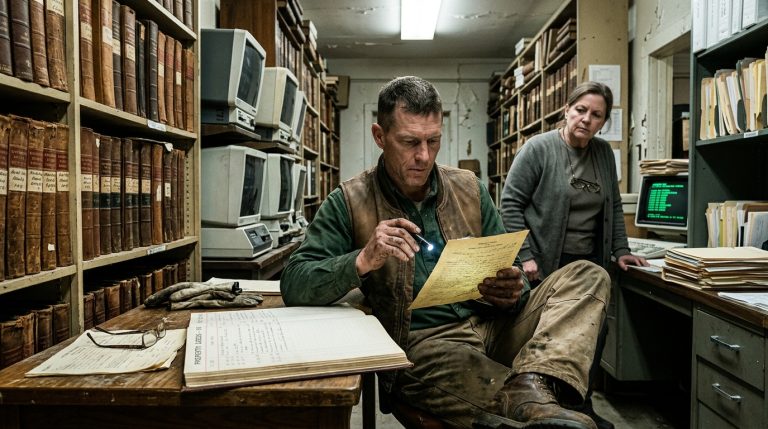
My phone sat on the desk, screen dark. I picked it up, feeling the cold glass against my palm. I needed a specific type of leverage—something that didn’t involve shouting or public displays. I opened my browser, navigating to the county’s property record portal. It was a labyrinth of outdated interfaces and dead links, but I knew the architecture of public records. You didn’t search for what they wanted you to see; you searched for the filings that were accidentally uploaded in the wrong batch.
I found it buried in a sub-folder under “Proposed Infrastructure Modifications.”
A site plan for a visibility easement, dated two weeks ago. It cut through my corner lot like a scalpel, designed to clear the view for a “Traffic Modification Project.” I stared at the digital map, the lines too precise, too calculated. This wasn’t about the sightline of my truck. The truck was simply a nuisance to be removed before the heavy machinery arrived to dig.
The name on the filing agent line was familiar. Not Beverly, but a cousin, someone I’d seen at the neighborhood cookouts standing just out of reach of the main conversation.
A shadow moved across the study window. I didn’t turn. I simply watched the reflection in the glass of my monitor. A neighbor was standing on the sidewalk, looking toward my house, their posture tense. They were waiting for a reaction—an explosion, a protest.
They weren’t going to get one. I reached out and closed the folder on the site plan. The real struggle wasn’t happening on the street; it was happening in the ink. I began to draft an email to the county clerk, my fingers moving rhythmically against the keys. Every word was a move on a board they didn’t even know they were playing on.
The screen flickered. A notification pinged: “HOA Enforcement Bulletin: Final notice of non-compliance for military equipment.”
I didn’t clear the notification. I simply saved my draft and leaned back, the silence of the house pressing in. Beverly thought she had cleared the field. She had no idea how much weight I was about to drop on the board.
CHAPTER 2: The Audits Shadow
The blinking cursor was a metronome, counting down the seconds of an inevitable collision. I didn’t look away. I watched the text of my email to the county clerk, reading the formal, clinical language I had constructed. It was a request for clarification, innocuous enough to bypass a casual clerk’s alarm bells, but specific enough to force a deeper look into the “Proposed Infrastructure Modifications” sub-folder.
It was a probe. A way to see if the system was already compromised.
I pushed away from the desk, the chair’s rollers clicking against the hardwood—a sharp, dissonant sound in the stillness. My study smelled of dust and the faint, acidic tang of printer toner. I looked at the wall, at the framed photograph of the unit, and for a fleeting, unwanted second, my mind drifted. I saw the faces, the mud-caked boots, the absolute, cold clarity of a command environment where every action had a purpose and every resource was accounted for. Here, in this quiet, suburban home, the stakes were just as absolute, but the battlefield was obscured by manicured lawns and polite, plastic smiles.
The psychological phantom of the base didn’t weaken me; it sharpened my focus. I moved to the kitchen, the floorboards groaning slightly under my weight. The house was a vessel of history, but right now, it was a tactical outpost. I didn’t reach for a drink. I checked the lock on the front door, feeling the heavy deadbolt slide into place with a definitive, mechanical thud.
The doorbell rang. It wasn’t the tentative, apologetic chime of a neighbor. It was a firm, sustained pressure.
I didn’t answer. I stood in the foyer, my pulse steady, the rhythm of my breath unchanged. I watched through the narrow, frosted glass of the sidelight. A man in a high-visibility vest stood on the porch, a tablet gripped in his hand. He wasn’t looking at the door; he was looking at the driveway, scanning the empty, scarred concrete where the truck had been.
He wasn’t from the city. He was from a property management firm—the kind of firm that exists to act as a buffer for HOAs, absorbing the legal shrapnel so the board members stay clean.
“Mr. Thorne?” his voice muffled, projected through the heavy wood. “I’m with Ridgecrest Management. We’re here to document the compliance status of your lot.”
I stayed perfectly still. The “Equal Intellect” rule was already in effect. If I opened the door, I provided him a platform. If I didn’t, I forced him to document his own intrusion on the porch.
“The violation remains active,” he continued, louder now, checking his watch. “Under the emergency authority of the HOA President, this lot is subject to inspection until the sightline obstruction is deemed fully mitigated. We have a work order to assess the property boundary for the upcoming infrastructure project.”
The infrastructure project. He had slipped. He wasn’t just here to look at a tow-zone; he was here to survey the easement.
I stepped back, moving into the shadow of the hallway where he couldn’t see me through the glass. I pulled out my phone and tapped the recording icon. Then, I didn’t walk to the door. I walked to the window overlooking the street, keeping low, my silhouette shielded by the heavy drapes.
Across the street, a car had pulled to the curb. It was a gray sedan, nondescript, its engine idling. Two people sat inside, facing my house. They weren’t neighbors. They weren’t watching to see if I came out to argue. They were waiting for me to be driven out.
The strategy was becoming clear. Beverly wasn’t just relying on the HOA bylaws; she was using professional contractors to create a physical record of non-compliance that she would later use to justify a lien on the house. If she could tie up the property in legal proceedings, she could bypass the need for a board vote on the easement. She would present the board with a fait accompli—the property was already compromised, the project already underway.
The man on the porch tapped on the glass, then retreated to the sedan. He spoke to the occupants, gesturing toward my house, his posture agitated. He was getting impatient. That was the first crack.
I went back to the study. I didn’t turn on the lights. I sat in the darkness, the glow of the monitor reflecting off the glass of the window, and opened the HOA’s financial disclosure document again.
If I wanted to beat them, I couldn’t just complain about the tow. I had to expose the why.
I started cross-referencing the invoices. $120,000 for “Consulting Services.” I typed the company name into a business registry database, not the public one, but the restricted one—the one that revealed the true ownership of shell companies.
The entry came back: Caldwell-Ridge Enterprises. Registered agent: Beverly Caldwell’s husband.
The air in the room seemed to thin. It wasn’t just an easement; it was a pipeline for public funds. The $8.8 million project wasn’t meant to improve the neighborhood; it was a massive, synthetic drain.
I didn’t feel anger. I felt the cold, hard logic of a mission objective. I had the decoy—the sightline violation. I had the truth—the embezzlement. The challenge now was to bridge the two without tipping my hand until the wrecker arrived.
My phone vibrated. A new email from the HOA management firm. Notice of Formal Intent to Commence Site Survey.
I picked up the phone. I didn’t call the police. I didn’t call a lawyer. I called the recovery unit dispatch.
“This is Thorne,” I said, my voice low and efficient. “The situation has escalated. We’re moving the timeline forward. Prepare the heavy unit.”
“Copy that, Thorne,” the dispatcher replied, the static on the line sounding like shifting gravel. “We have the permits. The county has cleared the route. How soon?”
I looked out the window. The gray sedan was still there, but the man had returned to the porch, his hand hovering over the doorbell.
“Yesterday,” I said. “Send it now.”
I hung up and stood in the center of the room. The house was quiet, but the air outside was about to vibrate. I had given them their decoy, and they had taken the bait with both hands. Now, they were going to have to deal with the weight of what they had truly invited into the cul-de-sac.
CHAPTER 3: The CounterPermit
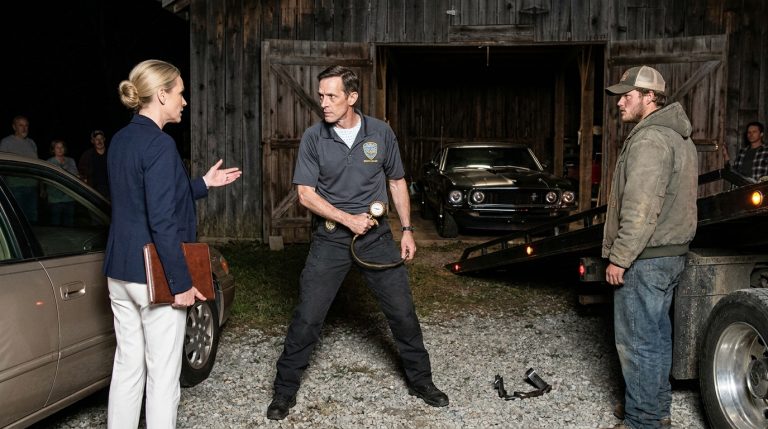
The sound wasn’t the rhythmic tapping of a doorbell anymore. It was the heavy, industrial groan of a hydraulic outrigger being extended. I didn’t move from my chair, though my muscles coiled with the involuntary tension of a veteran anticipating incoming fire. Through the study window, I watched as a utility truck, marked with the generic, faceless logo of the HOA’s preferred maintenance contractor, maneuvered into the cul-de-sac.
They weren’t here to talk. They were here to mark the ground.
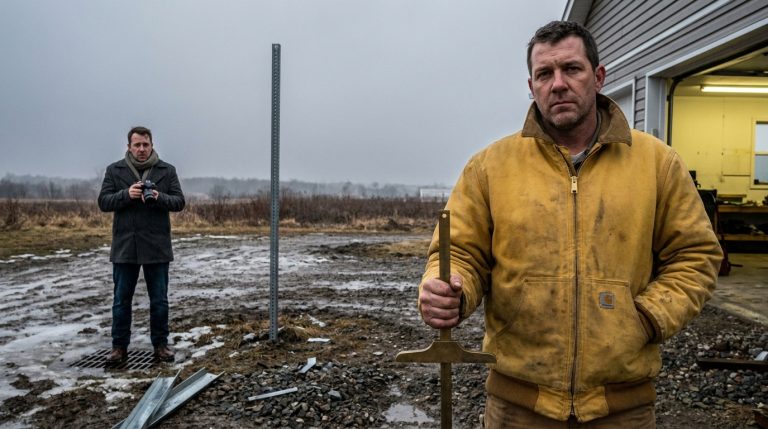
I watched the worker step out, his movements efficient, practiced. He didn’t look at my house. He immediately went to the edge of my driveway, pulling a canister of fluorescent orange spray paint from his belt. The hiss of the nozzle was audible even through the double-paned glass—a jagged, bright line being drawn across the concrete, exactly where the proposed easement had been mapped in the site plan.
He was laying the physical groundwork for the “visibility project” before the formal hearing. It was a classic move: manufacture the reality on the ground, then force the bureaucracy to catch up to the fait accompli.
I stood up, my joints popping in the quiet room. I didn’t rush. I walked to the hallway closet, pulled out a heavy, canvas-bound folder, and checked the contents. The permits I had filed through the municipal recovery portal were there, notarized and time-stamped. I had spent the last two hours on the phone with county authorities, leveraging the specific, obscure statutes of “Emergency Recovery Operations” to secure a priority clearance for a heavy-unit arrival.
The strategy was simple: if Beverly wanted to play by the rules of “emergency authority,” I would ensure the rules were enforced by the only people who could trump her—the county inspectors who held the actual keys to infrastructure development.
I walked to the front door and opened it. The cool, damp air of the evening rushed in, smelling of rain and asphalt. The worker froze, his thumb hovering over the nozzle. He looked up, his expression one of bored irritation.
“Private property,” I said, my voice projecting with a measured, low-register authority that didn’t invite debate. “And that paint job is a violation of the current county-filed survey of this lot. You’re over the easement boundary by at least four feet.”
The worker straightened, wiping his hand on his trousers. “I’ve got orders, buddy. HOA board directive. We’re marking for the new traffic sightline.”
“I don’t care who signed your order,” I replied, stepping onto the porch. I didn’t raise my voice. I didn’t need to. “I care about the legal filing. You paint one more line, and you’re documenting your own trespass. I have a county investigator on record regarding this specific lot. Feel free to call your supervisor and ask them if they want to be named in a civil liability suit for unauthorized ground-breaking.”
He hesitated. The word “liability” had the effect of a circuit breaker. He looked at the orange line, then at his truck, then back at me. “My boss told me this was cleared.”
“Your boss told you what they needed you to believe,” I said. “Check your manifest again. The county hasn’t approved the easement permit. They’ve suspended it.”
He didn’t wait for a second invitation. He threw the canister into the bed of the truck, climbed into the driver’s seat, and fired the engine. He didn’t look back as he backed out, the orange line still bleeding into the concrete—a physical piece of evidence that I now had on record.
I watched him go, then pulled my phone out to photograph the marks. The “butterfly detour” of his early arrival had backfired on them. They had tipped their hand, and in the process, had provided me with a clear, time-stamped instance of unauthorized property modification.
I turned back toward the house, but stopped when I saw the gray sedan still parked across the street. A figure was stepping out—not the worker, but a woman in a sharp, grey blazer. She looked like a consultant, her movements too calculated for a neighborhood visit. She was watching me, her gaze lingering on the orange spray paint on my driveway.
She didn’t approach. She simply pulled out her phone, snapped a photo of the marks, and tapped a message.
The game had moved from a nuisance complaint to a cold, tactical stand-off. They knew I was digging, and they were beginning to realize that the “emergency” they had manufactured was starting to collapse under its own weight.
I went back inside and locked the door, the click of the latch sounding like the safety of a weapon being engaged. I sat back at the desk and opened the recovery tracking portal. The heavy unit was already on the move, its path cleared by the permits I had secured.
I checked the status again.
Estimated Time of Arrival: 45 minutes.
I didn’t feel relief. I felt a grim, focused exhaustion. The house felt smaller, the walls pressing in as the reality of the impending standoff set in. I stood up and paced the study, the floorboards silent now, my mind running through every possible counter-move Beverly could pull. She wouldn’t go quietly. She would try one more grand, performative act to reclaim control.
I looked at the memorial plate, sitting on the corner of the desk, its metal dull and scuffed. I picked it up, rubbing the edge of the bent corner with my thumb. It was a tangible reminder of why I was doing this. It wasn’t about the street, or the driveway, or the property values. It was about the fact that they thought they could erase things that mattered to people, thinking no one would notice or care enough to push back.
The radiator ticked, a rhythmic, metallic sound in the stagnant air. I felt the weight of the next hour. Every minute was a tactical unit of time, and I had to spend them wisely. I returned to the desk and began drafting the final notification to the county board, ensuring that when the heavy unit arrived, the paper trail was already waiting to greet it.
CHAPTER 4: The Arrival
The ground beneath my boots began to hum long before the wrecker came into view. It was a low-frequency vibration, the kind that bypassed the ears and settled directly into the marrow of your bones. I stood at the edge of the driveway, my hands shoved deep into my pockets, fingers brushing the folded, incriminating pages of the site plan.
The gray sedan was still across the street, but the people inside were no longer sitting back. They were out of the car, standing near the curb, their eyes locked on the corner of the cul-de-sac.
Then it crested the bend.
It was a 50-ton recovery wrecker, its amber beacons strobing against the overcast sky like a warning flare. It moved with the sluggish, irresistible momentum of a tectonic plate. The engine note was deep, a controlled, guttural roar that made the parked vehicles along the street chirp their alarms in a frantic, disjointed chorus. As it rolled into the cul-de-sac, it seemed to swallow the light, casting a massive, elongated shadow that stretched toward my garage.
I stayed still, a calm center in a rapidly tightening vortex. The wrecker didn’t rush. It crept forward, the driver maneuvering the massive steel booms with the precision of a surgeon. It stopped exactly where the orange paint lines still marred the concrete.
The air shifted. A patrol car pulled into the block, blue and red lights dancing against the siding of the nearby houses. The officer behind the wheel didn’t look like he wanted to be there. He stepped out, his hand instinctively gravitating toward his belt, his eyes darting between the towering wrecker and the small, defiant figure of Beverly Caldwell, who had appeared on her porch like a ghost summoned by the noise.
“Thorne,” the officer called out, his voice thin against the ambient rumble of the idling wrecker. “What is this?”
I didn’t answer him immediately. I waited for the driver to climb down, his helmet tucked under his arm. He walked toward us, his boots crunching loudly on the gravel, and handed the officer a clipboard.
“Oversized transport and active recovery permit,” the driver said, his voice flat, professional. “State-authorized, municipal-cleared. We’re here to secure the lot.”
The officer took the clipboard, his gaze scanning the pages. He was looking for a reason to stop it—a missing signature, an expired date. He paused, his eyes lingering on the municipal stamp. He looked at me, then at the orange paint on the driveway, then at the looming presence of the wrecker. His posture, previously rigid, began to sag just a fraction. He knew the paperwork was ironclad.
Beverly didn’t wait. She marched down her driveway, her heels clicking aggressively on the pavement. “Officer, stop this! This is a residential zone! That—that monstrosity is a violation of every noise and safety ordinance in the bylaws!”
She wasn’t looking at me. She was looking at the wrecker, her face a mask of brittle fury. She didn’t see the driver. She didn’t see the officer. She saw the erasure of her control.
“Ma’am,” the officer said, his voice tense. “The permits are valid. They’ve cleared the county.”
“They’re forged!” she snapped, jabbing a finger toward me. “He’s using intimidation! That vehicle is a weapon!”
I took a slow step forward, the movement intentional. I looked at the officer, then at the board members who had started to trickle out of their homes, their faces pale in the strobe of the patrol lights.
“Officer,” I said, my voice steady, cutting through the noise. “I filed a complaint regarding this lot four hours ago. I have proof of unauthorized property modification and a formal investigation into financial irregularities involving the association. If you’re going to act, you’d better be sure you’re acting on behalf of the law, not the board.”
The officer’s expression went blank. He was a small gear in a very large machine, and he could feel the system beginning to grind against itself. He looked at the wrecker, then at the clipboard, then back at me. He was searching for an out, a way to maintain order without crossing the line into state-level oversight.
“We have an active recovery,” the driver said, stepping up to the edge of the driveway. “We’re initiating.”
He didn’t wait for the officer’s permission. He turned toward the wrecker, his hand signaling to his partner. The hydraulics hissed—a sharp, piercing sound—and the massive steel chains began to lower.
Beverly let out a strangled cry. “No! You can’t!” She stepped between the wrecker and my driveway, her clipboard held up like a shield. “I am the President of this HOA! I am ordering you to stop!”
The driver didn’t even blink. He continued the procedure, the metal chains clinking as they hit the asphalt.
The atmosphere in the cul-de-sac reached a breaking point. The silence that followed wasn’t peaceful; it was the heavy, suffocating silence of an audience witnessing a landslide. Phones were up, recording everything—the wrecker, the police, the frantic woman clutching her clipboard. The decoy secret—the sightline violation—wasn’t just crumbling; it was being physically pushed aside by the sheer scale of the truth that was about to be revealed.
I looked at Beverly. For the first time, I didn’t see a threat. I saw someone who had spent so long building a house of cards that she had forgotten the wind could blow at any time.
“It’s not an HOA matter anymore, Beverly,” I said, the words clear and cold in the humid air.
She turned to face me, her eyes wild, searching for a script that didn’t exist. The wrecker’s chains tightened, the metal groaning under the strain. The game wasn’t ending; it was finally, brutally, beginning.
CHAPTER 5: The Collapse
The air in the cul-de-sac had grown thin, vibrating with the static of a thousand unspoken questions. Beverly stood motionless near the curb, her clipboard dangling from a hand that had begun to tremble. The wrecker’s engine continued to pulse—a deep, low thrum that acted as a heartbeat for the unfolding disaster.
The county investigator did not rush. She moved with the methodical, unhurried precision of someone who had already reached the end of the file. She stepped away from the patrol cruisers and toward the small group of HOA board members, holding the folder open. She didn’t shout; she didn’t need to. Her voice was cool, carrying clearly over the idling machinery.
“Miss Caldwell,” she began, her tone conversational, almost polite, which made the impact of her next words significantly sharper. “We’ve reviewed the emergency easement filing you submitted. We also cross-referenced the infrastructure project’s ledger with your cousin’s shell company.”
Beverly’s head snapped up. The mask of controlled indignation was slipping. “Those are drafts. Administrative errors. You’re overstepping.”
“An administrative error, perhaps,” the investigator replied, pulling a single sheet of paper from the folder and holding it up. The light caught the sheen of the official seal. “But the $120,000 consulting fee listed under ‘Site Improvement’ with no corresponding contract? That’s a misappropriation of association funds. That’s a felony.”
A murmur rippled through the crowd. Phones were no longer just recording; they were tracking every twitch in Beverly’s face. A neighbor—someone I’d seen her dismiss at a dozen past meetings—took a step forward, his voice a low, hard edge. “You told us that money was for the streetlights.”
Beverly didn’t look at him. Her eyes were fixed on the investigator’s folder as if it were a predator. “I was protecting our values. Every decision was made to ensure this community stays relevant.”
“You weren’t protecting values,” I said, my voice steady, cutting through the noise. I was standing just a few feet away, close enough to see the sweat beads forming on her hairline. “You were protecting a revenue stream. You didn’t tow my truck because it was a safety hazard. You towed it because my lot was the only thing standing in the way of your infrastructure project’s survey.”
The investigator nodded, turning to the officers who were now hovering, uncertainty replaced by the cold clarity of a documented crime. “Officer, I’m initiating a formal detention pending further review of the association’s assets.”
The officer stepped forward, the handcuffs glinting under the streetlights. Beverly backed away, her heels catching on the uneven concrete. She stumbled, and for a moment, her eyes locked with mine. There was no realization of guilt there—only a profound, desperate confusion, as if she truly believed the world had broken its own rules by not letting her win.
“You don’t understand,” she whispered, her voice barely audible over the wrecker’s idle. “I run this.”
“Not anymore,” the investigator said.
As the officer reached for her arm, Beverly’s legs gave out, not out of fatigue, but out of a sudden, total psychological collapse. She didn’t fight; she didn’t scream. She simply surrendered to the gravity of the situation, her body slumping against the curb as the reality of her exposure set in. The board members, meanwhile, were huddled together, frantically discussing the suspension of the bylaws. The neighborhood, once a tightly wound mechanism of her design, was spinning off its axis.
I looked away from her and back at the wrecker. The driver was watching the scene with the detached, weary eyes of a man who had seen this brand of theater a hundred times before. He looked at me and gave a single, almost imperceptible nod. The work was done. The mechanism of the HOA had been disassembled in public view, and the recovery was no longer a personal conflict—it was an administrative reality.
The investigator signaled to the patrol car. They guided Beverly to the back seat, her movements leaden. The board members stood by the curb, looking like people waking up from a long, feverish dream, realizing that the house they had helped build had been sitting on a sinkhole all along.
The cul-de-sac was still crowded, but the tension had shifted. It was no longer the electric, paranoid charge of a neighborhood under siege. It was the quiet, hollowed-out feeling of a space where the air has finally been cleared.
I looked at the orange paint on my driveway, now marred by the heavy tread of the recovery vehicle’s tires. It didn’t matter. It was just paint. The easement was dead. The shell company was under audit. The neighborhood was, for the first time in years, just a collection of houses again, stripped of the synthetic authority that had governed them.
The investigator turned to me, closing the folder. “We’ll be in touch regarding your statement, Mr. Thorne. I suggest you stay close to the property records. There’s a lot of cleanup to be done.”
“I’m not going anywhere,” I said.
The patrol car pulled away, the blue lights fading into the darkness of the street. The board members didn’t look at me as they retreated toward their homes, their heads down, already starting the quiet, uncomfortable work of acknowledging their own negligence.
The wrecker remained, the massive steel booms silhouetted against the night sky. The driver climbed back into the cab, the engine note rising as he prepared to pack up. The neighborhood was silent, save for the rhythmic clicking of the cooling metal. I stood in the dark, my hand resting on the cool, solid concrete of my driveway, and for the first time in weeks, the silence didn’t feel like a threat. It felt like the ground beneath my feet.
CHAPTER 6: The Restoration
The streetlights flickered to life, casting long, stark shadows across the concrete. I didn’t move immediately. I remained where I was, my boots still resting on the scarred patch of driveway where the wrecker had done its work. The silence that followed the removal of the cruisers and the investigator’s team was not the same silence from this morning; it was a cleaner, more resonant quiet. It was the sound of a system that had been forced to stop its erratic spinning and settle back into its natural rhythm.
The board members had long since retreated behind their front doors, the neighborhood now observing from behind closed curtains, the spectacle finally concluded. I turned toward my garage. The door was still open, the light from the interior spilling out onto the driveway and illuminating the faint, jagged outlines of the orange paint markings—the ghosts of the easement that never was.
I stepped into the garage. It was cool, smelling of oil, metal, and the organized order of a workspace that had seen me through the worst of the standoff. I walked to the workbench, where I had left the memorial plate hours ago. The bent corner caught the light. I picked it up, feeling the cold, rigid texture of the steel. It was a simple object, yet it had carried the weight of the entire day.
I reached for the tools I kept in a locked drawer—a small hammer, a block of hardwood, and a fine-grit file. I didn’t rush. I set the plate onto the hardwood block, lining up the bent corner. With a precise, measured swing of the hammer, I began to flatten the steel. Tap. Tap. Tap. The sound was rhythmic, intentional, the only noise in the empty garage.
It wasn’t about making it look new. It was about making it true again. As the metal straightened, the scuffs and the scratches remained—the history of the day etched into the surface. That was the point. We didn’t erase the struggle; we restored the integrity of the object that had borne the brunt of it.
Once the corner was flush, I took the file and smoothed the rough edge where the metal had been torn. The steel was cool, unyielding, but it responded to the pressure, returning to a form that felt right, that felt permanent. When I was finished, I held the plate up. It wasn’t perfect, but it was whole.
I moved to the side of the garage, where the mounting bracket sat, still bolted to the wall near the entrance. I aligned the plate and tightened the screws, the metal seating firmly against the frame. It looked as it had always looked, a quiet, solid testament to things that couldn’t be towed away by a clipboard-wielding president.
A soft knock sounded at the garage door frame. I didn’t look up, but I knew who it was. One of the younger neighbors—the father who had asked about the names on the plate earlier that day. He stood in the doorway, his hands in his pockets, his posture hesitant.
“The police said the audit is going to take months,” he said quietly. He wasn’t here to demand answers. He was just looking for a way to process the change.
“It will,” I replied, setting the hammer down and wiping my hands on a cloth. “But the easement is cancelled. The fines are void. You can tell the others to stop worrying about the notices.”
He nodded, looking at the memorial plate on the wall. “She really thought she could just…” He trailed off, shaking his head. “I didn’t think anyone would actually stand up to her.”
“I didn’t stand up to her,” I said. “I just followed the process until it caught up with her.”
He stayed for a moment longer, then nodded once, a gesture of quiet, mutual understanding, and walked back out into the night. I went to the light switch and flicked it off, plunging the garage into shadow, save for the sliver of moonlight crossing the floor.
I walked out to the driveway. The air was crisp, the wind having died down, leaving the neighborhood in a state of profound, settled peace. I looked down the street, toward the spot where the gray sedan had been parked. It was gone. Everything that had been built on the foundation of the decoy—the intimidation, the false emergency, the arrogance—had been hauled away with the wrecker.
The investigation would continue. The audit would churn through the numbers, and the truth of the embezzlement would be codified in a final, public report. There would be no more fake sightlines, no more shell-company contracts, no more “emergency” seizures.
I took a deep breath, the cold air filling my lungs. I hadn’t won by being the loudest or the most aggressive. I had won because I had understood that the rules were not something to be broken or bypassed, but something to be utilized. I had been the one to insist on the procedure, and in doing so, I had forced the system to act as its own corrective force.
I started toward the house, my footsteps steady on the concrete. I paused for one last look at the street. It was just a street again. A quiet, ordinary place where people lived and worked and, occasionally, fought to keep the things they cared about.
I entered the house and locked the door behind me, the sound final and secure. I didn’t go back to the study. I didn’t check the emails or the county portal. The objective had been met, the truth had been restored, and for the first time in what felt like a lifetime, there was no more noise. Just the quiet, steady hum of a house—my house—at peace.