The Glass Heart: A Billionaire’s Quiet Awakening to the Only Truth That Actually Matters
CHAPTER 1: THE ARCHITECTURE OF MERCY
Ethan did not look at the document; he looked at the woman sitting before him, watching the way her fingers trembled against the edge of the mahogany desk—a gesture more honest than anything he had encountered in a decade of boardroom negotiations. The study was silent, save for the rhythmic, distant tapping of pebbles against the flagstone outside. Lily was still there, lining up her treasures with the gravity of a queen arranging her court.
“You don’t have to,” Clara whispered again, her voice cracking like dry parchment. She looked at the letter, then at him, her eyes searching for the hidden condition. In his world, a letterhead like this always required a signature in blood, a percentage of future returns, or a lifetime of silence.
Ethan leaned back, the leather of his chair creaking. He felt the weight of the last few weeks pressing into his shoulders—not the weight of his stocks or the pending collapse of the Holt acquisition, but the crushing, suffocating weight of his own blindness. He looked at the folder. It was a simple administrative task, but it felt like the first real choice he had made since he was twenty-two.
“The procedure isn’t charity, Clara,” Ethan said, his voice quiet, stripped of the transactional edge he usually carried. He watched her flinch, expecting the correction, but he didn’t give it. “It is a restoration. I spent my life building walls, and I seem to have forgotten that the only things worth protecting are the ones that can hear you.”
Clara’s hand hovered over the letter. She looked toward the door, toward the small, blurred shadow of her daughter on the floor. The faded texture of her apron, washed a hundred times to keep up appearances, suddenly seemed like a badge of endurance he hadn’t possessed the courage to earn.
“Why?” she asked, the question no longer a defense, but an appeal. “You don’t know us. I’m just staff. I’m the woman who irons the sheets and stays invisible.”
Ethan looked at the crystal glass sitting on the side table—empty, catching the afternoon light. It was just an object, yet it held the memory of a poison he never drank. He thought of Lily, her small, steady hands reaching out, her unblinking eyes that had refused to let him swallow a lie.
“I spent years paying people to tell me what I wanted to hear,” Ethan murmured, half to himself. “It turns out the only truth I ever received was a gift I didn’t pay for.”
He stood up, the movement fluid and deliberate, and walked around the desk. He didn’t offer a hand—that felt too much like a power play—but he stopped a respectful distance away, his posture softening.
“Clara, the surgery is scheduled for Tuesday. I have already secured the best surgeons in the country. There are no stipulations. There is no debt.” He paused, a flicker of something ancient and unquiet moving behind his eyes. “But if you would allow me… I would like to be there. Not as your employer. Just as someone who wants to hear the world change for her.”
Clara stared at him, the silence in the room thickening until it felt tangible, like the air before a storm. Outside, a pebble clattered. Lily let out a soft, joyful sound. The distance between the billionaire and the maid vanished, replaced by the crushing reality of their shared fragility.
Clara reached out, her fingers finally closing around the letter. She didn’t thank him. She didn’t have the capacity for it. She simply stood, a woman who had lived in the periphery of a kingdom, and looked at the man who had finally decided to step out of his tower.
“Tuesday,” she whispered, her eyes fixed on the paper.
Ethan nodded, but as she turned to leave, he felt a sharp, sudden coldness—the realization that he had no idea who he was without the glass, the empire, or the lie. He watched them go, the woman and the child, and for the first time, he realized the house wasn’t quiet. It was waiting.
CHAPTER 2: THE STERILE THRESHOLD
The hospital lobby was a landscape of pale blues and aggressive, artificial brightness. It was a texture entirely foreign to the Caldwell estate, where light was filtered through heavy velvet drapes and adjusted for aesthetic perfection. Here, the light was unfiltered, cold, and insistent. Ethan walked a half-step behind Clara, his suit—tailored for boardrooms and executive suites—suddenly feeling like a costume in a play he hadn’t rehearsed for.
Clara moved with a hurried, practiced grace. She held Lily’s hand, her fingers curled tight around the toddler’s small palm. The girl looked up at the ceiling, at the flickering fluorescent tube that hummed with a low, grating frequency. She didn’t seem bothered by the sterility, but Ethan felt a phantom ache in his own ear, a sympathetic resonance with the girl’s silent, half-blocked world.
“They expect us at ten,” Clara said, her voice barely rising above the general murmur of the waiting area. She didn’t look back at him. She was focused entirely on the check-in desk, her posture set in that rigid, defensive line of a woman who expected to be told she was in the wrong place.
“We’re early,” Ethan replied. He kept his eyes moving, scanning the room. Not for threats—the instinct was automatic—but for something else. He found himself cataloging the patients: the elderly woman clutching a worn prayer book, the young man leaning heavily against a cane. He was used to analyzing people by their net worth or their strategic leverage. Here, their value was stripped down.
CHAPTER 2: THE HOSPITAL CORRIDOR
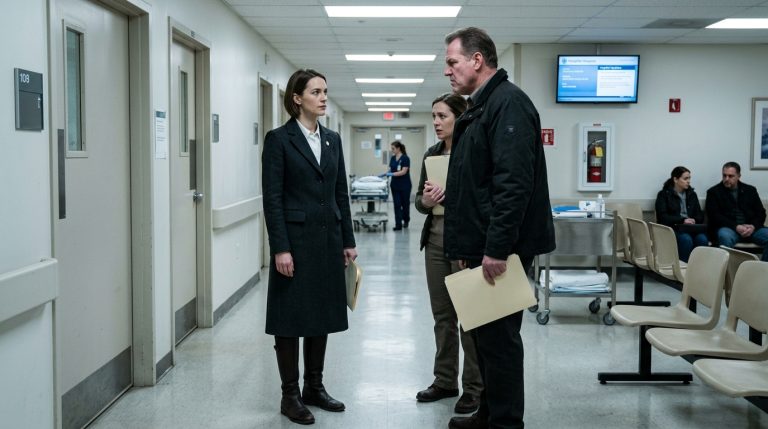
The hospital was a study in sterile geometry—white tile, brushed steel, and the oppressive, humming silence that only exists in places where people come to confront the fragility of their own existence. Ethan walked several paces behind Clara and Lily. He was wearing a charcoal coat that he usually reserved for board meetings, but today, it felt heavy, dragging against his frame as if it were weighed down by the sheer novelty of being here.
He hadn’t been to a public hospital in fifteen years. The last time, he had used a private entrance, a private suite, and a hand-picked staff who never looked him in the eye for longer than necessary. Here, he was just another man in a hallway, and the anonymity was both jarring and strangely clarifying.
Lily held Clara’s hand with a grip that was surprisingly firm. She wasn’t looking at the ceiling or the flickering fluorescent lights; she was focused on the path ahead, her small, yellow-clad figure moving with a purpose that made Ethan’s chest ache. He thought about the pebbles she had been playing with in his hallway. She didn’t possess the concept of social hierarchy. To her, a hospital was just a place she had to go, and Ethan was just the man walking behind her.
Clara stopped at the reception desk. Her shoulders were pulled inward, the familiar posture of someone bracing for a cold reception or a bureaucratic hurdle. She reached into her bag, pulling out a folder that was worn at the corners—the one Marcus had described.
Ethan watched as the receptionist, a woman with tired eyes and a name tag that hung slightly askew, flipped through the documents. He stepped up, intending to intervene, to flash his credentials, to use the sheer force of his presence to grease the wheels. But he stopped.
Clara was speaking. Her voice was low, but steady. She was explaining the history, the previous consultations, the financial hurdles she had navigated with the quiet, grueling persistence of a marathon runner. The receptionist listened. She didn’t look at Clara as an employee of a billionaire; she looked at her as a mother. For the first time, Ethan realized how much of the world’s humanity he had traded away for the sake of efficiency.
“We have the authorization,” the receptionist said, her tone softening as she looked at Lily. She tapped a few keys. “Everything is in order. We can begin the preliminary testing within the hour.”
Clara exhaled—a sound of such profound, quiet relief that it seemed to vibrate in the sterile air. She turned back to Ethan, her face flushing, a mix of gratitude and the lingering, instinctive fear of being noticed.
“Thank you,” she said, just that, but the two words carried the weight of four years of stifled hope.
Ethan nodded. He felt a sudden, sharp need to understand the architecture of this sacrifice. “Clara,” he said, moving closer as they walked toward the waiting area. “Before we go further, I’ve been reviewing the records of my own staff. The files Marcus pulled—there’s a discrepancy in the payroll department dating back eighteen months. Not linked to Diana, but to someone else. Someone who had access to my private study while you were cleaning.”
Clara slowed her pace. She looked up at him, her eyes widening. “You think someone else was watching?”
“I think I was surrounded by people who were waiting for the glass to break,” Ethan admitted, the admission tasting like ash. “I need you to tell me—in all those years you spent in that house, cleaning, organizing, hovering in the background—did you ever notice anyone else? Anyone who didn’t fit the pattern?”
Clara looked toward Lily, then back at Ethan, her gaze dropping to the scuffed floor. She hesitated. The hallway lights hummed, a low-frequency buzz that seemed to sharpen the tension in the air.
“There was a maintenance man,” she whispered, her voice barely audible above the distant squeak of a gurney’s wheels. “He didn’t work for the estate management. He came on Tuesdays. He always spent hours in the server room, but he never actually fixed anything. I saw him once, standing in the doorway of your study, just watching you sleep after you’d passed out from one of your long nights.”
Ethan froze. The coldness that gripped his chest wasn’t fear—it was a crystalline, terrifying clarity. Diana had been the decoy, the flash of emerald and gold meant to distract him while the rot worked its way into the very foundation of his life.
“Tuesday,” Ethan repeated, his voice dangerously soft. “He was there today?”
“I don’t know,” Clara said, her voice shaking. “But he hasn’t missed a Tuesday in three years.”
Ethan looked at his watch. It was barely ten in the morning. He had a procedure to fund, a child to protect, and a silent threat still moving through the halls of the house he called home. He looked at Lily, who was busy trying to balance on the edge of the carpet runner, oblivious to the fact that the man beside her was currently recalculating the price of his own survival.
He realized then that he couldn’t just walk away from his old life. He had to go back. But this time, he wouldn’t be playing the billionaire. He would be playing the ghost.
CHAPTER 3: THE GHOST IN THE ARCHITECTURE
The cold wind cut through Ethan’s charcoal coat, biting into his skin with a sharpness that felt like an accusation. Beside him, Clara secured Lily into the back of the car, her movements methodical and weary. Ethan stood for a moment, watching his breath plume in the air, his mind churning with the image of the maintenance man Clara had described. The man who had watched him sleep. The man who had occupied his private sanctum on Tuesdays while Ethan was distracted by the performance of a woman who didn’t exist.
He slid into the driver’s seat of his own vehicle—not the luxury sedan with the chauffeur, but a utilitarian SUV he kept for trips into the city. He needed to be behind the wheel. He needed to control the friction of the road beneath him, to feel the mechanics of the world instead of merely ordering them to operate.
“Is something wrong, Mr. Caldwell?” Clara asked as she buckled herself in. She was watching him in the rearview mirror, her eyes wary. She had seen the shift in his posture—the way his hands gripped the leather of the steering wheel until his knuckles turned ivory.
“Everything is wrong, Clara,” Ethan said, his voice flat, devoid of his usual boardroom cadence. “I’ve spent the better part of a decade surrounding myself with systems, with people who were supposed to be invisible. I thought that made me secure. I realize now it only made me blind.”
He pulled out of the parking lot, the SUV’s tires crunching over the gravel. As he navigated the route back to the estate, he kept his eyes on the road, but his mind was an archive, replaying every Tuesday for the last three years. He searched for patterns: the way the servers had always seemed to lag on Wednesday mornings; the unexplained glitches in his security logs; the faint scent of ozone that used to linger in the study, which he had attributed to the vintage audio equipment.
He wasn’t just driving home. He was driving toward a confrontation with a version of his life that had been systematically hollowed out.
The estate came into view, its massive stone facade looming against the gray sky like a fortress that had been breached from the inside. When they pulled up to the service entrance, Ethan didn’t wait for a security team to greet them. He turned off the engine and sat in the silence for a long moment, listening to the house breathe. It sounded different now. Not like a home, not even like a headquarters, but like a complex, malfunctioning machine.
“Clara,” he said, turning to look at her. “When we go inside, I want you to go directly to your quarters. Keep Lily with you. Do not let her leave your sight. If anyone asks for you, say you’re attending to the infirmary follow-ups.”
Clara’s face went pale. “What are you going to do?”
“I’m going to find the Tuesday man,” Ethan said. He reached into the glove box and pulled out a small, metallic object—a digital scanner he had used years ago for high-stakes site inspections. It was a relic of his early, hands-on days, and it was significantly less sophisticated than the modern surveillance he usually relied on. That was the point. It was analog, offline, and silent.
He stepped out of the car and walked toward the house, but he didn’t head for the front doors. He bypassed the grand staircase and slipped into the labyrinthine service corridors. This was the territory of the invisible, the space where the maids and the maintenance staff moved like shadows. He knew the layout of the mansion’s bones—the pipes, the electrical conduits, the narrow crawlspaces hidden behind the paneled walls—but he had never walked them.
The texture of the air here was different. It smelled of old dust, floor wax, and the metallic tang of damp masonry. As he walked, he noticed things he had never seen before: a scuff mark on the wall at an odd height, a loose floorboard in the pantry, a faint, rhythmic humming vibrating through the floor beneath his feet.
He reached the door to the server room, the heart of his empire. He didn’t use his keycard; he knew if he did, it would be logged in the system he no longer trusted. Instead, he knelt by the door and used the scanner. He moved the device slowly along the seam of the doorframe. The small red light on the scanner flickered, then held steady.
There was a signal. A low, persistent data transmission, pulsing like a heartbeat through the walls.
Ethan leaned his forehead against the cold wood of the door. The decoy was gone—Diana was in custody, her emerald dress replaced by the coarse fabric of a holding cell—but the infection remained. He wasn’t just fighting a rival named Raymond Holt; he was fighting the very infrastructure he had trusted to keep him safe.
He stood up, his hand hovering over the door handle. He realized that if he opened this door, he was effectively declaring war on his own ghost. He took a breath, the air in the corridor tasting of stale secrets, and turned the handle.
The door creaked open, revealing the cavernous, darkened room filled with the blinking lights of a thousand servers. And there, bathed in the soft, flickering blue glow of the monitors, sat a figure in a heavy, grease-stained jacket. The Tuesday man. He wasn’t working. He was waiting.
He turned around slowly, his face illuminated by the screen’s harsh light. It wasn’t someone Ethan recognized, yet the expression—that cold, detached, observant look—was intimately familiar. It was the face of a man who had been looking at Ethan through a glass screen for three years, dissecting his every movement, his every weakness, his every mistake.
“You’re early, Mr. Caldwell,” the man said, his voice as thin and sharp as a paper cut. “I wasn’t expecting you to be home until after the hospital rounds.”
Ethan stepped into the room, the heavy door clicking shut behind him. He didn’t reach for his phone. He didn’t call for security. He simply looked at the man, the silence between them stretching into a taut, vibrating wire.
“I’m done with the schedule,” Ethan said. “Let’s talk about what else you’ve been doing on my time.”
CHAPTER 4: THE FRACTURED FOUNDATION
The man’s smile didn’t reach his eyes. He remained seated, his fingers hovering over a console that wasn’t connected to the estate’s main network, but to something else—a localized, independent bridge that bypassed every security protocol Ethan had ever commissioned.
“You’re a long way from the boardroom, Ethan,” the man said, his voice grating against the steady, rhythmic whir of the server fans. “You always were fond of the illusion of control. It made you predictable.”
Ethan didn’t respond immediately. He stepped further into the room, his boots crunching on a scattering of plastic casings on the floor. He focused on the man’s hands—the stillness, the calluses, the way he seemed completely unbothered by the fact that he was currently cornered. It was the composure of someone who had already accounted for the variable of Ethan’s arrival.
“Who do you work for?” Ethan asked, his voice steady, though his pulse hammered against his throat.
“I work for the architecture,” the man replied, turning back to the screen. “You built this house to be impenetrable. You created a system so complex that no one person could oversee it. You essentially created a vacuum of accountability. I’m just the vacuum cleaner.”
Suddenly, the lights overhead flickered, a violent staccato of white, and the servers began to scream. A high-pitched, metallic whine climbed the scale until it threatened to shatter the glass in the control room’s observation window. The power surge hit like a physical weight, throwing the room into a chaotic, strobe-light dance of data transmission.
Ethan lunged for the man, but the surge surged through the floor, a ground-fault that sent a sharp, stinging shock through his boots. He stumbled, catching himself against a server rack. The physical sensation was searing—a reminder that he was no longer operating in a world of digital abstractions, but in a space governed by physics.
“You’re not stopping me,” the man shouted over the rising cacophony. “You’re only accelerating the off-load.”
Ethan scrambled to his feet, ignoring the lingering tremor in his legs. He saw the man’s hand move toward a physical hard-drive port on the console—a manual override. If he pulled that drive, the data—the proof of Holt’s involvement, the records of the sabotage, the entire map of his betrayal—would be wiped or, worse, transmitted to an untraceable external node.
Ethan didn’t think about his wealth or his reputation. He acted with a primal, desperate necessity. He grabbed a heavy, industrial-grade cooling fan from a nearby workbench and threw it—not at the man, but at the console. The heavy metal casing smashed into the monitor, showering the room in sparks and jagged plastic.
The man lunged to protect the hardware, his facade of calm shattering instantly. He became, for the first time, a human being trying to save a life’s work. They collided in the center of the aisle, a tangle of limbs and desperate, clumsy force. The man was smaller, but he fought with the frantic agility of someone who had never expected to face physical resistance.
Ethan pinned him against the racks, his hands locked around the man’s grease-stained jacket. He felt the man’s heart racing—a erratic, terrified rhythm that matched his own.
“The drive,” Ethan commanded, his voice tight with the strain of the struggle. “Give it to me.”
The man laughed, a sound that was choked and breathless. He grabbed a small, rectangular object from his pocket—a flash drive—and held it up, but he didn’t hand it over. Instead, he twisted his wrist, dropping the drive into the narrow, dark gap between the floorboards of the raised server platform.
It was gone. A physical impossibility to retrieve without dismantling the entire floor, a process that would take hours, if not days.
“You think you’re protecting your kingdom,” the man gasped, his eyes bright with a dangerous, fanatical light. “But you’ve been living in a tomb, Ethan. That drive was the map. You just lost your way out.”
The man yanked himself free, his jacket tearing at the seams, and shoved Ethan back. He didn’t run for the door. He turned and pressed a sequence on a secondary control pad on the wall. A pressurized fire-suppression system—a halon gas discharge—engaged. A hiss of white, freezing vapor filled the room, instantly dropping the temperature and obscuring everything in a blinding, opaque cloud.
Ethan retreated toward the door, his eyes stinging, his lungs burning with the sudden lack of oxygen. He reached the heavy door, fumbled for the handle, and threw himself out into the service corridor just as the system fully vented.
He slumped against the opposite wall, the cold air of the hallway rushing into his lungs. He was alone. The room was sealed behind him, the man was trapped or gone—he couldn’t tell—and the evidence that had been the key to his survival had vanished into the foundation of his own house.
He looked down at his hands. They were covered in soot and grease. He felt a sudden, profound sense of detachment. The empire, the security, the prestige—it was all just furniture in a house that was now actively trying to burn itself down. He looked toward the ceiling, hearing the distant, muffled sound of his own security team rushing toward the alarm.
He realized with a hollow, gut-wrenching clarity that the man had been right. He was no longer the owner of the Caldwell estate. He was just a witness to its collapse. And he had no map, no leverage, and no one left to trust but the woman who had watched him from the shadows for four years.
CHAPTER 5: THE SURGICAL TRUTH
Ethan didn’t wait for the security team to cycle the room’s atmosphere. He knew that if the maintenance man had planned this, the room was already a ghost of its former self. Data deleted, hardware fried, the physical drive buried in the sub-floor—it was a masterstroke of defensive demolition. He turned his back on the server room and walked toward the only place where he might still find a thread of reality: the staff wing, toward the quiet, modest room where Clara and Lily were hidden.
He moved through the hallways with a jarring, newfound speed. His boots didn’t echo with the arrogance of a billionaire’s stride; they tapped with the sharp, uneven cadence of a man hunting for pieces of his own life. As he reached the service wing, the house felt different—every shadow in the hallway, every creak of the floorboards under the heavy tapestries seemed to watch him with a new, mocking awareness. He realized now that he had never been the master of this estate; he had merely been its most expensive resident.
He reached Clara’s door and knocked once, sharply. There was no hesitation. Clara opened it, her eyes wide with the terror of a woman who had heard the alarms and seen the security teams scrambling. She was clutching Lily to her chest, the child’s small, pale hand resting against her mother’s collarbone.
“Is it done?” Clara whispered, pulling him into the room.
“It’s gone,” Ethan said, his voice ragged. He bypassed the small table and sat on the edge of the cot, his head in his hands. The scent of the server room’s cooling gas—acrid and metallic—lingered on his skin, a stark contrast to the smell of Lily’s lavender shampoo. “He buried the data. The entire infrastructure is compromised, and the only proof of Holt’s endgame is beneath six inches of reinforced concrete.”
Clara sat opposite him, her expression hardening. She didn’t offer comfort; she offered the brutal pragmatism of a woman who had survived much harder winters. “Then stop looking at the servers. You’re trying to win a war on a battlefield he designed. If you want to break his hold, you have to look at what he actually wants.”
Ethan looked up, startled. “He wants the company. He wants the leverage.”
“No,” Clara said, shaking her head. She moved to a small, cluttered dresser and pulled out a stack of documents she had been carefully organizing—not just her own, but records she had salvaged from the trash bins over the last six months. She laid them out on the cot. “He wanted you to be the kind of man who would look for data in a server room instead of noticing the discrepancy in the supply chain, the shifting logistics, the way your own board members were being replaced by people who didn’t exist in the company archives.”
Ethan stared at the papers. They weren’t high-level corporate audits; they were receipts, inventory logs, shift rotations. They were the mundane, dirty textures of his empire. As he traced the names and the dates, he saw it—the pattern of a slow-motion takeover that had been happening right beneath his nose, disguised by the very digital complexity he had bragged about.
“He didn’t just want the server data,” Ethan realized, his voice a low, horrified hum. “He was bankrupting the actual assets while I was busy protecting the digital ones. The company is already gone, Clara. He’s already liquidated the shell.”
The reality hit him with the weight of an anchor. He had lost. Not the battle, but the entire history of his effort. But as he looked at the papers, and then at Lily, who had crawled off the bed and was playing with a set of wooden blocks on the rug, he felt a strange, cold calm settle over him.
“If he has the assets,” Ethan said, his voice quiet, “then he has to report them. He has to move them through the legitimate financial channels to keep them under his name.” He stood up, the exhaustion in his limbs replaced by a sharp, focused intent. “He thinks he’s won because I have nothing left to defend. But he forgot that a man with nothing left to lose is the only one who can afford to play the game properly.”
“What are you going to do?” Clara asked, standing up with him.
“I’m going to go to the only people who don’t care about my money,” Ethan said. He pulled his phone from his pocket, opened the encrypted log, and for the first time, he didn’t call his security firm or his lawyers. He called the regulatory board’s anonymous whistleblower line—the one he had dismissed as a nuisance for a decade. “I’m going to show them exactly how the foundation of this house was built.”
He looked at Clara, and for the first time, the distance between them—the billionaire and the maid—vanished. They were just two people standing in a room, looking at the wreckage of a lie, and realizing that the truth, however ugly, was the only thing solid enough to build on.
“Stay here,” Ethan said. “When the authorities arrive, you tell them everything. You tell them about the Tuesday man. You tell them about the discrepancies you found. They won’t look at you as staff, Clara. They’ll look at you as the only witness left in the room.”
He walked toward the door, his steps steady, his resolve forged in the cold realization that he hadn’t been fighting to save his empire—he had been fighting to finally earn his own identity.
CHAPTER 6: THE QUIET AFTER THE STORM
The morning sun filtered through the tall, arched windows of the grand entrance, casting long, dusty parallelograms across the marble floor. It was a light that didn’t just illuminate the room; it exposed the emptiness of it. The grand ballroom, which only weeks ago had been a theater of champagne and performative smiles, was now a hollow, echoing shell. Ethan walked across the space, his footsteps sounding sharp and solitary.
He didn’t head for the study or the server room. He stopped in the center of the room, looking at the spot where the cocktail table had stood. He remembered the exact moment the little girl had pulled on his sleeve—the small, steady tug of a hand that had changed the trajectory of his existence. He realized then that he had never actually seen this house. He had lived in a digital projection of it, a life curated for security and status.
He heard the heavy front doors groan as they opened. Marcus stepped in, followed by two men in standard suits—law enforcement. They looked at Ethan with a mixture of professional detachment and genuine bewilderment. They had spent the last twenty-four hours unearthing a web of corruption so deep it threatened to take down half the local infrastructure.
“We have the warrants,” Marcus said, his voice unusually strained. “Holt’s associates are being brought in. The liquidations are frozen. You’re clear, Ethan, but the legal process… it’s going to take months to untangle what they did to your reputation.”
“I don’t care about the reputation,” Ethan said, his voice firm. He walked toward the main staircase, his movements slow and deliberate. “I care about the foundation. Is it still standing?”
Marcus looked at him, confused for a second, then nodded. “The structure is solid. The rot was superficial.”
Ethan nodded. He walked past Marcus, toward the service wing. He found Clara in the kitchen. She was sitting at the small wooden table that had been her quiet sanctuary for four years, a cup of tea in her hands. Lily was by her side, drawing on a piece of paper with a box of crayons. The sight—the simple, domestic reality of it—made Ethan’s chest feel like it was finally expanding after holding its breath for years.
Clara stood up, her face a mask of uncertainty. She had seen the police vehicles, the investigators, the collapse of a world she had spent years navigating with careful, invisible steps.
“The hearing procedure,” Ethan said, coming to a stop in front of her. He pulled a folded document from his pocket and placed it on the table. It wasn’t the corporate contract she was used to; it was a personal authorization, signed, notarized, and fully funded through an escrow account that would remain untouched by the volatility of his business. “It’s done. The doctors are expecting you both in Boston on Monday. Everything is covered, including the travel and the housing for the duration of the recovery.”
Clara looked at the document, then up at Ethan. There were no tears, just a look of profound, steady recognition. She had been the only one who had truly seen him—the man behind the glass—and he had finally seen her.
“What about you, Mr. Caldwell?” she asked.
“I’m going to sell the estate,” Ethan said. He looked around the room—the high ceilings, the polished surfaces, the sterile, expensive architecture he had once thought was the peak of achievement. Now, it just looked like a museum of a life he no longer wanted. “I’m going to find a place that doesn’t require a security team to keep the ghosts out.”
He turned to Lily. The little girl looked up from her drawing, her wide, unblinking eyes meeting his. She didn’t see a billionaire or a target or an employer. She saw a man who had finally learned how to stand still. He reached out and touched the wooden block she had set on the table, straightening it until it was perfectly aligned with the others.
“You heard the truth,” he said softly, a ghost of a smile touching his lips. “I think that’s the most important thing anyone can ever do.”
He walked out of the kitchen, back through the grand hallway, and out the front doors. He didn’t look back at the Caldwell estate. He didn’t check his phone for the latest market fluctuations or the status of the investigation. He walked toward his car, the sunlight warm on his face, feeling the grit of the city road beneath his feet.
The weight of the empire was gone. The mystery of the glass, the decoy, the hidden servers—it had all collapsed into the only thing that mattered: a quiet morning, a clear sky, and the realization that he was, for the first time in his life, finally free to choose his own direction. He sat in the driver’s seat, turned the key, and drove away, not as the man he had been, but as the man he had fought so desperately to become.