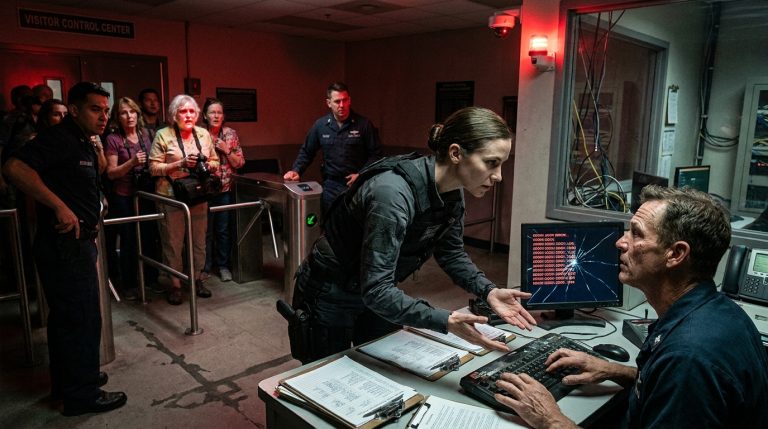
The Weight of the Protocol: A Tactical Reckoning in the Corridors of Naval Special Warfare
CHAPTER 1: The Echo of the Mat
The gravel clearing behind the southeastern wall was quiet, save for the rhythmic metallic ticking of the cooling Humvee. It was a sound that usually signaled the end of a long day of drills, but today, it felt like the lingering vibration of a string just plucked.
Elena stood by the open tail-gate, her gloved fingers resting on the edge of the dented steel. The air held the metallic tang of the nearby coastline—salt, iron, and the dry, pulverized stone of the training ground. Everything here was worn, oxidized by the Atlantic air, the surfaces showing the friction of a thousand boots and a decade of constant use.
She reached for the medical supplies, her motions practiced and slow, a stark contrast to the kinetic violence that had erupted on the mat two weeks prior. Since that day, the unit had treated her with a kind of clinical distance. It wasn’t hatred; it was a cautious, wary respect. They viewed her now as a variable they hadn’t accounted for—a piece of hardware that had malfunctioned and, in the process, revealed a hidden capacity for lethality.
She pulled a crate from the bay, its weight familiar, the rubberized grip worn smooth by her own hands. As she slotted it into the storage rack, her eyes flickered to the side pocket of the cargo unit. She had left her logbook there. She reached in, fingers brushing against the rough canvas, but the book didn’t catch on her fingertips.
She frowned, pulling her hand out empty. She slid the crate out an inch, checking the dark recess behind the metal frame. The book was gone.
A sharp, familiar metallic click sounded from the perimeter fence—a gate latch hitting its stop. Elena didn’t flinch. She simply tilted her head, her gaze tracking the subtle movement of a shadow stretching long across the gravel. It wasn’t the erratic shuffle of a recruit; it was the measured, silent pace of someone who knew exactly how to move through a kill zone without triggering a response.
She checked the time on her watch. 16:42. The evening rotation shift change. If someone was picking through her gear, they weren’t looking for medical supplies. They were looking for the documentation of why she had been reassigned from the field—the records that didn’t exist on any open-source tracker.
She stepped away from the Humvee, her boots silent on the packed earth. She walked toward the shadow, not with the intent of a confrontation, but with the focused, pragmatic gait of a guardian checking a perimeter fence. The air felt heavier, the humidity rising as the sun dipped behind the administrative block.
She turned the corner of the supply hut, expecting to see a curious technician or a lingering observer. Instead, the alley was empty, save for a single, discarded brass casing glinting in the dirt—a 9mm shell, far too clean to be a remnant of the day’s training. She picked it up, feeling the cold, smooth weight of it. It was still warm.
The realization sat in her chest like lead. She wasn’t just being watched. She was being tracked. And the person who had taken her logbook had been close enough to reach out and touch her while she was busy with the gear. The perimeter wasn’t as secure as the command claimed.
She looked back toward the training mat, now a vacant square of gray vinyl, and felt the first tremor of a deeper, more dangerous game beginning to unfold. The peace of the last two weeks had been a fabrication—a thin veneer rusting away under the pressure of something she hadn’t yet identified.
She pocketed the casing, her pulse steady, her mind already calculating the tactical reach of the nearest security cameras. Then, a low, distinct sound cut through the silence—a radio chirp, encrypted and unauthorized, coming from the direction of the armory.
Someone was communicating about her. And they were using a frequency that didn’t belong to this unit.
CHAPTER 2: The Audit
The frequency wasn’t just unauthorized; it was an encrypted handshake—a digital ghost from a life she had scrubbed clean.
Elena stood in the alley, the cold brass casing still tight in her palm, its warmth leaching into her skin. The radio chatter from the armory block wasn’t human speech. It was a rhythmic, high-frequency pulse that modulated every four seconds. She knew it. It was a dead-drop protocol, a way to signal without transmitting data. It meant someone on the base was not just looking for her records—they were trying to verify if she was still capable of identifying them.
She didn’t rush. The impulse to sprint was a novice’s trap; she suppressed it, forcing her breathing back into the steady, shallow cadence of a surgical standby. She stepped back into the shadows of the supply hut, her boots making no sound on the grit. If she left the logbook behind, she was a liability. If she went after it, she was a target.
She opted for the path of least resistance: she moved toward the armory with the casual, bored stride of a medic completing a late-day inventory check.
As she rounded the corner of the concrete corridor, the air grew colder, the scent of damp, unventilated concrete replacing the salt of the coast. She passed two SEAL trainees leaning against a locker. They went silent as she approached, their eyes flicking to her shoulders. They didn’t mock her anymore, but they didn’t meet her gaze, either. They were afraid—not of her strength, but of the proximity to the violence she had unleashed on the mat.
“Petty Officer,” one of them muttered, nodding stiffly.
“Keep your gear secure,” Elena replied, her voice neutral, the tone of a professional offering a hollow reminder.
She reached the armory entrance. A heavy steel door stood slightly ajar, the lock mechanism scarred with fresh gouges. Someone had forced it—but it wasn’t the clumsy, violent break of a thief. It was the precise, methodical work of an operator. Elena paused, her hand hovering near the door handle.
She remembered the feeling of the blacked-out extraction team—the smell of damp earth and the specific, metallic taste of fear that only comes when you are hunted by your own side. The phantom memory pulled at her peripheral vision, a flicker of a dark room, a flickering flare, the sound of a team disintegrating under fire. She blinked, grounding herself in the present.
The armory was dim, illuminated only by the flicker of a faulty overhead fluorescent tube. The hum of the light was the only sound, masking the radio pulse she had heard outside. She stepped inside.
The crates of small arms and optics were untouched, but the administrative desk at the back of the room had been cleared. A single, thin folder sat in the center of the dust-dusted surface. It wasn’t the logbook. It was a transfer requisition.
She moved to the desk, her boots crunching on a fine layer of pulverized cement. She picked up the folder. It was an audit request, dated for tomorrow morning, demanding a full review of her previous deployments—every mission, every team, every operational override. At the bottom, a stamp: Classified Archive, Naval Special Warfare Command Unit 7.
Her name was the only thing typed on the page. The rest was redacted in a thick, heavy ink that looked fresh.
“Looking for something, Petty Officer?”
The voice came from the darkness near the far wall. Elena didn’t spin. She turned slowly, her posture relaxed, her weight centered on her back foot.
Chief Instructor Harmon stood there, his face half-shrouded by the shadow of the overhead rack. He held a tablet in one hand, his thumb hovering near the power button. He looked tired—not the exhaustion of a long drill, but the heavy, stagnant fatigue of a man forced to clean up a political spill he hadn’t created.
“I’m looking for a logbook,” Elena said, her voice steady. “And I’m looking for the reason why my file is currently being scrubbed by someone who doesn’t have the clearance for the redaction.”
Harmon walked into the light. He didn’t have his usual swagger. He held the folder out, but didn’t let go of it. “The command is nervous, Concaid. That demonstration? It didn’t just break two operators. It broke the illusion that you’re a logistics asset. Now, they want to know exactly what kind of weapon they’re harboring.”
“I’m a medic,” Elena said.
“You’re a liability,” Harmon countered, his voice dropping to a gravelly whisper. “Someone pulled your file from the central archive this morning. They aren’t just looking at your performance. They’re looking for the team that wasn’t supposed to exist. You know what happens to people who become variables in a closed-system environment.”
He pulled the folder back, tucking it under his arm. “Go back to your station. Stay off the radar. If you see the shadow again, don’t follow it. The person who took your logbook isn’t a SEAL. They’re a ghost, and they’re waiting for you to make a mistake.”
Elena stared at him. He wasn’t warning her for her safety; he was warning her because he was terrified that the truth would burn the whole facility down.
“Who has the key to the archive?” she asked.
Harmon looked at the door, then back at her. “Nobody has the key anymore. The archive room was sealed after your transfer six months ago. Yet, here you are, being audited by a dead department.”
He stepped past her, leaving the scent of stale tobacco and ozone in the air. Elena stood alone in the dim armory, the sound of the faulty light buzzing overhead like a trapped insect. She turned back to the desk. Underneath where the folder had been, she saw something she had missed: a small, circular dent in the metal surface, shaped like a signature seal she hadn’t seen since the last time her recon team had been deployed in the blackout.
Someone had been here, and they had left a calling card. They didn’t want her gone; they wanted her to know that the hunt had already begun.
CHAPTER 3: Friction Points
Elena didn’t reach out to touch the mark again. Instead, she stood perfectly still, letting the ambient noise of the armory settle around her. The buzzing of the fluorescent tube had shifted from a monotonous drone to a staccato rhythm—a flickering stutter that felt like a code, or perhaps just a failing capacitor. She leaned over the desk, her eyes narrowed as she studied the dust patterns. Someone had moved a heavy crate of optic mounts recently. The dust was pushed up in a clean, sharp ridge, a testament to a deliberate, hurried slide.
She moved around the perimeter of the desk, her boots finding the exact points of silence on the concrete floor. She had learned long ago that in a room full of gear, the most dangerous object was the one that was slightly out of place. She pulled a small penlight from her tactical vest and clicked it on. The beam was narrow, focused, casting harsh, high-contrast shadows across the room’s disarray.
She swept the light along the wall behind the desk. There, tucked into the gap between the concrete foundation and a steel equipment rack, was a sliver of white. She used the tip of her tactical knife to pry it loose. It was a receipt—a standard-issue logistics form, but the ink was smeared, as if it had been handled by someone with damp, oily hands. It was an inventory log for an R&D unit that had been decommissioned three years ago, the same timeline as the retired commander whose name had appeared on the requisition form earlier.
She wasn’t just being audited. She was being traced through the back-end of the base’s supply chain.
She tucked the paper into her inner pocket and turned toward the exit. As she pushed the heavy steel door open, the hinge groaned—a high-pitched, metallic shriek that echoed through the empty hallway. She froze, one hand on the cold door frame, waiting. Silence returned, heavy and thick, but it was the silence of a held breath. Someone was close.
She walked out into the corridor, her pace measured. She didn’t look back. She navigated the maze of the logistics wing, her mind mapping the layout: the armory, the supply bays, the administration offices. They were all connected by these narrow, utilitarian halls. She felt a sudden, sharp pang of vertigo—a momentary disorientation where the flickering hallway lights seemed to stretch and compress. For a split second, the concrete floor felt like the unstable deck of a transport ship in a storm. She reached out, steadying herself against a locker, her knuckles white.
She pushed the memory down, locking it into the same mental compartment where she kept the location of her weapons and the mission parameters of her past. Focus.
She reached the intersection leading to her office. Her door was at the end of the hall, a nondescript portal that usually housed nothing more than inventory lists and supply schedules. As she approached, she saw it: the door was cracked open by a fraction of an inch.
She stopped. Her hand went instinctively to her belt, fingers brushing the empty holster where her shears usually rested. She was a medic; she carried instruments, not sidearms. That had always been the rule. Today, the absence of a weapon felt like a failure of logic.
She eased the door open with the toe of her boot. The room was dark, but the faint glow of a terminal screen illuminated the desk. Someone was logged into her workstation.
Elena didn’t breathe. She watched as a cursor blinked rhythmically on the screen. A file directory was open—Personnel_CONCAID_E_REDACTED. The file was being mirrored to an external drive. She could see the progress bar creeping across the bottom of the screen: 64%, 65%.
She didn’t storm the room. That was what they expected. Instead, she took a calculated step to the right, toward the maintenance locker she knew was situated behind the door. If she moved now, she could trigger the fire suppression system—a manual override that would flood the room with inert gas, forcing anyone inside to reveal themselves or suffocate.
She calculated the distance, the time it would take for the gas to discharge, and her own exit route. Her heart rate remained flat, a steady, rhythmic thud against her ribs. She reached out, her fingers finding the red emergency lever on the wall. She felt the heavy, oxidized texture of the safety wire.
She paused. If she pulled it, she would alert every guard on the base. She would become the center of a security incident. But if she didn’t, the person at her computer would finish their download, taking the final thread of her history with them.
She watched the bar move. 88%. 90%.
She realized then that this wasn’t an audit. This was a purge. They weren’t checking her past; they were ensuring it couldn’t be used against them. The realization hit her with the cold, jarring force of a physical blow. The ‘audit’ was just the cover story. The real objective was the total erasure of her service record.
She pulled the lever.
The sound was instantaneous—a deep, booming hiss as the gas canisters pressurized. The alarm bells didn’t start yet, but the hiss was a roar in the small office. Elena lunged into the doorway, her eyes scanning the room.
The computer chair was spinning, the back of it still warm from a body that had been there only seconds before. The shadow of a figure was already halfway through the rear service vent, a small, square opening that led into the ventilation shafts of the entire block.
She reached the window, her hands gripping the steel frame. She caught a glimpse of a tactical boot—not the standard Navy issue, but a specialized, high-grip sole she hadn’t seen in years. It was the same gear her old recon team had used.
She stood in the center of her office, the inert gas beginning to swirl in the air like a localized fog. The computer monitor went black, the download interrupted. She looked at the screen, then at the open vent. She was alone in a room that was rapidly becoming unbreathable, and she had just committed an act of sabotage against her own command.
She didn’t regret it. She reached out and pulled a small, silver flash drive from the back of the terminal—the person had left it behind in their haste. She shoved it into her pocket and dove into the hallway just as the alarm bells finally began their rhythmic, piercing wail.
She had the evidence. Now, she just had to survive long enough to read it.
CHAPTER 4: The Shadow Observer
The alarm was a rhythmic, abrasive shriek that stripped away the base’s veneer of professional calm. Elena stood in the corridor, the inert gas from her office billowing out like a phantom, its white, hazy fingers curling along the floor tiles. The flash drive in her pocket felt like a live wire. She didn’t head for the main exit. That would be the predictable choice, the one the security protocols would immediately seal.
She turned into the service maintenance corridor, the narrow, unlit throat of the building’s infrastructure. The air here was stale, heavy with the scent of stagnant water and oxidizing metal. Her boots struck the grated floor with a hollow, ringing sound that felt agonizingly loud against the alarm’s cadence. She kept her back to the wall, her eyes scanning the shadows.
She had triggered the system to create a diversion, but she hadn’t accounted for how quickly the base’s automated response would isolate the sector. She reached the first bulkhead door—a heavy, fire-rated steel barrier. She punched in the override, expecting the familiar green light of a system bypass. Instead, the keypad blinked a steady, ominous crimson.
Access Denied.
She tried again, her fingers nimble, her mind cycling through the potential bypass codes. Nothing. The system wasn’t just on lockdown; her authorization had been stripped from the network entirely. She was effectively a ghost in the system she had spent six months helping to manage.
The sound of heavy, rhythmic footfalls echoed from the main hallway. Not the disorganized running of confused trainees, but the heavy, synchronized stomping of a security intervention team. She looked up. The ventilation grate above her was loose, the screw heads worn down by decades of use. It was a tight fit, but she had squeezed through smaller gaps in far worse conditions.
She reached up, her fingers gripping the cold, rusted edges of the grate. She felt a slight tremor in her hands—not from fear, but from the residual adrenaline of the office sabotage. As she pulled the grate aside, a faint, rhythmic scratching sound drifted down from the darkness above. It was precise, measured, and matched the four-second cadence of the encrypted radio pulse she had heard earlier.
Someone was in the shafts.
She didn’t hesitate. She hoisted herself into the crawlspace, the metal scraping against her fatigues, leaving streaks of rust across her sleeves. The space was cramped, suffocating, and smelled of decades of accumulated dust. She moved forward, her body angled to minimize friction, her movements slow and deliberate. She wasn’t an observer anymore; she was part of the machinery of the building, a component moving through the veins of the installation.
She paused at a junction, peering through the slats of a nearby vent. Below, in the medical supply room, two security officers were moving with tactical precision. They weren’t looking for a thief; they were sweeping the room for a signature—something they knew she had left behind. One of them stopped at the desk where she had been logged in. He reached out, his gloved hand tracing the empty space where the computer tower stood. He didn’t speak, but he pulled a small, handheld device from his vest—a scanner that hummed with a low-frequency light.
Elena watched, her breathing shallow. The device wasn’t a standard security tool. It was an advanced signal interceptor, the kind used to track encrypted hardware. They weren’t just looking for her; they were hunting the flash drive in her pocket.
She moved deeper into the shaft, the scratching sound growing louder. She rounded a corner and saw it—a small, glowing LED light attached to a control box, blinking in that same, infuriating four-second pulse. Beside it sat a small, blackened transceiver. It wasn’t base equipment. It was a bridge—a relay designed to bypass the base’s firewall and tunnel data directly to an outside source.
The realization hit her like a secondary impact. The tampering wasn’t just about erasing her files. The entire base was being used as a staging ground, and her transfer to logistics had been the perfect cover to keep her stationed at the junction of the facility’s data network.
She reached out, her fingers hovering over the transceiver. If she disabled it, she would alert whoever was on the other end. If she left it, she remained a pawn in their game.
She heard a voice below—the security officer, his radio crackling with a cold, clipped command. “Sector 4 compromised. Subject is likely moving toward the secondary shaft. Seal all vents. Use lethal force if necessary.”
Lethal force. Not for a security breach, but for a data recovery.
She gripped the transceiver and pulled. The wires snapped with a sharp, crisp pop, the signal light dying instantly. The scratching sound stopped. A heavy, absolute silence settled into the shaft.
She was now in the dark, with a stolen drive in her pocket and the entire base’s security apparatus closing in on her location. She looked down at the transceiver in her hand. It was marked with a familiar insignia—a small, stylized icon of a compass, its needle pointing toward a coordinate that didn’t exist on any map. It was the same mark that had been on the equipment from her old recon unit.
The people hunting her weren’t base security. They were her own former team, and they had been waiting for her to make this move all along.
She turned, her movements fluid and devoid of panic, and began to crawl toward the secondary ventilation exit. She had to get to the server room, the only place where she could access the deep-archive logs and find out who, exactly, had authorized her unit’s destruction three years ago.
The shaft groaned under her weight, a low, metallic complaint, and for a heartbeat, she wondered if the base itself was trying to push her out, to reject her like an infection. She pushed the thought away. She was the one who knew the architecture of this place better than anyone. She was the one who would finish what they had started.
CHAPTER 5: Broken Hardware
The darkness was not empty; it was pressurized. As the base’s power grid collapsed, the hum of the ventilation fans—the only constant sound in the shaft—spooled down into a low, mournful moan before cutting out entirely. Elena remained perfectly still, her back pressed against a cooling duct that pulsed with the residual heat of the facility’s dying circuits. The silence that followed was heavy, a tactile presence that seemed to press against her eardrums.
She didn’t move. She waited for her eyes to adjust, for the faint, filtered light of the moon outside to bleed through the microscopic gaps in the vent slats. Her hands moved over the surface of the shaft, feeling for the rivets and the seams. The metal was cold, oxidized by decades of neglect, the edges biting into her palms with the sharp, unforgiving grit of iron.
Below her, in the medical supply bay, the security team had stopped their movement. She heard the soft clink of a weapon being set down on a desk—the heavy, purposeful sound of a professional preparing for a long wait. They knew she was in the shafts. They were waiting for her to make a sound, to commit the one error that would give them a target.
She reached into her pocket and retrieved the flash drive. It felt warm, a contrast to the biting cold of the ventilation tunnel. If she could reach the secondary server room at the end of this run, she might be able to interface the drive with a standalone terminal. It was a long shot, a gamble that relied on the base’s legacy systems still being compatible with the encryption standards her unit had used three years ago.
She began to move again, her motion stripped of all unnecessary energy. She slid along the bottom of the shaft, her weight carefully distributed to prevent the metal from groaning. She remembered the maintenance blueprints from her first month here—an old set of schematics she’d found in the archive before it was sealed. She knew every junction, every blind spot, and every structural vulnerability.
She reached a junction and found the path blocked by a heavy, manual bypass gate. It was corroded shut, the wheel mechanism frozen by years of moisture. She gripped the metal, the rough surface tearing at her skin, and applied steady, calculated pressure.
Creak.
The sound was small, but in the absolute silence, it felt like a gunshot. She froze.
“Movement in the duct,” a voice whispered below. It wasn’t the security team. It was closer—just on the other side of the vent grating. “Target is sector 3. Move.”
They weren’t just guessing; they were tracking her movement through the vibration of the shafts. Elena let go of the wheel and reached for her tactical knife. She had to shift the target. She pulled a heavy bolt from her belt—a spare she had liberated from the armory—and threw it down the secondary shaft to the left.
Clang. Clatter. Silence.
The security team didn’t hesitate. A burst of muffled, suppressed fire raked the secondary shaft, the bullets tearing through the thin metal with a sound like shredded paper. Elena used the distraction to throw her full weight against the frozen wheel. With a harsh, metallic snap that felt like a bone breaking, the mechanism gave way.
She slipped through the opening and dropped into the dark, narrow space beyond. She was now in the restricted zone—the area that contained the physical infrastructure for the base’s older, non-digital monitoring stations. The air here tasted of damp paper and ancient, stagnant oil.
She clicked on her small penlight, but kept the beam covered with her fingers, allowing only a thin, crimson thread of light to illuminate her path. The walls here were lined with thousands of rows of legacy copper wiring—the physical, analog backbone of the facility. She reached out and touched a bundle of wires, the insulation cracked and brittle.
She had been here before. Or, rather, she had studied this specific layout. This was where the base’s original communications relay was housed—a relic of a bygone era, yet still functioning as the silent observer for the entire unit.
She felt a sudden, sharp vibration beneath her boots. The power wasn’t gone; it was being rerouted. She realized then that the blackout wasn’t a failure—it was a trap. The system was forcing all traffic into this exact corridor, isolating her in a space where they could monitor her every move.
She reached the server terminal, a heavy, dust-caked unit that looked like it hadn’t been touched in a decade. She pulled the flash drive from her pocket and felt a moment of hesitation. If she plugged it in, she would trigger a diagnostic ping that would reveal her exact location to the entire command.
She looked at the transceiver she had taken from the relay. It was resting in her hand, a small, black box that felt strangely heavy. She realized the transceiver wasn’t just a bridge—it was a diagnostic tool. If she could hard-wire the flash drive through the transceiver, she could spoof the ping. She would be invisible.
She began to strip the wires, her fingers working with the precision of a surgeon, her focus absolute. The grit of the iron walls, the smell of ozone, the rhythmic pulse of the base’s dying power—all of it faded, leaving only the tactical necessity of the task.
She wasn’t just a medic anymore. She was a ghost, stitching herself back into the machinery of a facility that was actively trying to delete her. She spliced the final connection, and the terminal’s screen flickered to life, the phosphor green glow illuminating her face in the dark.
The screen didn’t show files. It showed a map—a real-time, global tracking grid. And at the center of the grid was not the base, but a series of coordinates that spanned the last three years of her life. She realized then that the ‘recon unit’ hadn’t been destroyed by accident. It had been systematically liquidated, and she was the only loose end still breathing.
The terminal emitted a soft, high-pitched tone. A file began to download, its title simple, devastating: PROJECT RUSTED TRUTH: AFTER-ACTION REPORT.
She was looking at the blueprint of her own life’s wreckage. And she was the one who had finally opened the file.
CHAPTER 6: The Midpoint Decoy
The download bar crawled across the screen with agonizing deliberation: 12%, 14%, 18%. Elena’s ears were tuned to the sound of the room, filtering the electrical hum of the terminal from the external chaos of the corridor. The door behind her didn’t just rattle; it thrummed with a rhythmic, percussive force as someone used a hydraulic ram to test the steel integrity.
She turned, her eyes scanning the room. She had entered through the secondary ventilation duct, but the server room itself was a dead end. She was effectively pinned in a concrete vault. She reached into her pocket, her fingers brushing the flash drive, and realized the terminal had finished the initial handshake. She pulled the drive, but the screen didn’t go blank. It shifted.
A new window opened, overriding the After-Action Report. It was a live video feed from a camera located inside her own office.
She watched, frozen, as the security team entered the room she had just fled. They weren’t looking for data anymore. They were dismantling the room, pulling the floor tiles and tearing open the drywall. One of them held a device—a tracking transmitter—and he was pointing it directly at the ventilation shaft she had used.
“Target is local,” the officer said. His voice was cold, professional, and entirely devoid of emotion. “The file was a trap. The moment she accessed the server, she tripped the secondary containment protocol.”
Elena felt the blood turn to ice in her veins. The file she had fought so hard to reach—the Rusted Truth report—wasn’t the truth at all. It was a decoy, a data-poisoning exercise designed to track the movements of anyone with the clearance to access the restricted archives. She had fallen for a standard intelligence maneuver, a ghost-hunt designed to expose the last remaining asset of her unit.
The door behind her shrieked as a bolt sheared off. The light in the room turned from the soft phosphor green of the monitor to a harsh, blinding white as the emergency floodlights activated.
She didn’t panic. Panic was a waste of caloric energy. She shifted her focus to the room’s hardware. The server unit was a massive, antiquated cabinet of steel and wires, but it was anchored to the wall with bolts that had rusted into the foundation. She didn’t need to fight the people behind the door; she needed to change the environment.
She reached for the emergency power shunt she had bypassed earlier. If she shorted the entire rack, the resulting magnetic pulse would not only fry the security team’s communications, it would shatter the glass and the electronic locking mechanisms of the primary server rack.
She grabbed a heavy diagnostic cable, stripped the ends with her teeth, and jammed the copper wires into the terminal’s power supply.
The spark was violent—a jagged, blue-white lash of electricity that scorched the air and blew the terminal’s monitor apart in a shower of glass and plastic. The room plunged into absolute, suffocating darkness. The sound of the door finally giving way was drowned out by the scream of the servers as they suffered a catastrophic magnetic overload.
Elena dropped to the floor, her hands pressed against the cold concrete. She felt the heavy, vibrating thud of boots entering the room. She couldn’t see them, but she could hear the snap of a safety being disengaged.
“Contact! Visual on the terminal!”
She moved before the command was even finished. She wasn’t moving like a medic; she was moving like a shadow in a room she had already mapped. She knew the layout, the blind spots, and the rhythm of the security team’s sweep. She caught the edge of a heavy cabinet, swung her weight, and struck the leading figure with the full force of her momentum.
The impact was solid—a crunch of bone and a stifled grunt. She didn’t wait to see if he fell. She snatched the radio from his vest, kicked the second officer’s shin with a precision strike to the peroneal nerve, and vaulted over the main server console.
She was in the hall before they could regroup. Her lungs burned, the air in the corridor thin and metallic, but she didn’t stop. She ran toward the central elevator, the only place left to go. She knew the security team was already rerouting, closing off the exits, but she also knew they were reacting to her motion, not her destination.
She hit the elevator button and felt the floor tremble. The base was in a full lockdown now. Every door was sealed, every camera active, and every guard on duty was converging on her sector. She hadn’t found the truth, but she had forced them to reveal their hand. They were desperate, and in that desperation, they were making mistakes.
She stood in the elevator, the metal doors sliding shut with a final, echoing thud. As the car began its ascent, she looked at the flash drive in her palm. The data on it might be poisoned, but the drive itself was a piece of hardware that carried a unique signature—a hardware ID that she could trace back to the manufacturer.
They thought they had trapped her, but they had inadvertently handed her the final, physical thread she needed to pull to unravel their entire operation. The hunt had escalated, but for the first time in three years, the predator and the prey were starting to look an awful lot alike.
CHAPTER 7: The Silent Conduit
The elevator shuddered, a heavy, tectonic grinding that vibrated through the soles of Elena’s boots. It didn’t just stop; it seized. The sudden deceleration threw her against the back wall, the air being driven from her lungs in a sharp, involuntary gasp. Above her, the cable groaned—a strained, high-tensile protest—before falling into a dead, unnatural silence.
She wasn’t just stuck; she was suspended in the gut of the facility. She reached for the emergency panel, but the metal was hot to the touch, the control board short-circuited by the same pulse she had triggered in the server room. She was trapped in a five-by-five steel box, surrounded by the vertical concrete throat of the elevator shaft.
She didn’t waste time on the buttons. She moved to the ceiling hatch, her fingers searching for the release latch. It was locked from the outside—a standard security measure, but one she knew how to bypass. She took the tactical knife from her vest, wedging the blade into the narrow gap between the hatch and the frame. With a sharp, controlled twist, the locking mechanism groaned and clicked open.
She pushed the hatch aside and hauled herself up, emerging into the cold, damp air of the shaft. Below her, the emergency lights of the elevator car cast long, distorted shadows against the concrete walls. Above, the dark, tapering abyss of the shaft stretched upward toward the command levels.
She heard a voice—a low, distorted sound echoing through the shaft. It wasn’t the security team. It was a radio broadcast, coming through the elevator’s emergency speaker.
“Petty Officer Concaid. This is Command. You are currently in an unauthorized sector. Cease all movement immediately.”
It was a voice she hadn’t heard in three years. Her former commanding officer, the man who had been reported dead during the blackout in the field. Her pulse spiked—a sudden, irrational rhythm that she fought to control. For a heartbeat, the reality of the situation blurred. Was it him? Had he survived?
No. Logic. The command was using a voice-synthesis program to manipulate her. They knew her psychological profile, they knew the emotional weight of her past, and they were using it to bait her into a reaction.
“I’m listening,” she said, her voice steady, echoing into the shaft.
“You are carrying data that does not belong to you,” the voice replied, its cadence eerily perfect, yet lacking the subtle, human micro-fluctuations of the man she had known. “The project was a failure. The unit was liquidated to protect the integrity of the mission. You are the final variable, Elena. Drop the drive into the shaft, and you will be escorted to medical for a full debriefing.”
Medical. Debriefing. She knew what those words meant in the context of Rusted Truth. It was a euphemism for a terminal extraction.
She didn’t respond. She reached into her pocket and pulled out the flash drive. She looked at it, the small, plastic object that had cost her everything. If she dropped it, the hunt ended, but the truth remained buried under the concrete and the lies.
She turned and began to climb. She moved with a desperate, frantic fluidity, her hands finding the structural steel reinforcements of the shaft. She wasn’t climbing toward an exit; she was climbing toward the source. If they were communicating with her, they were using a relay. And if there was a relay, there was an operator.
She reached the next floor—the executive levels, a place she hadn’t stepped foot in since her transfer. She pried the door open and slipped into the hallway. It was pristine, the floors polished to a mirror finish, the walls lined with framed photos of naval history—a stark, sterile contrast to the rusted decay of the maintenance sectors.
She moved along the wall, the flash drive held tight in her hand. She found the terminal room—the override hub for the entire floor. She entered, her presence triggering the silent, motion-activated lights.
A single chair was turned toward the window, looking out over the Atlantic. As she stepped forward, the chair swiveled slowly.
It was Chief Harmon. He wasn’t armed. He was sitting with his hands folded in his lap, a small, black radio transmitter resting on the table beside him. He looked at her, his expression a mixture of profound exhaustion and deep, ingrained regret.
“You shouldn’t have come up here, Concaid,” he said softly. “The drive you’re carrying isn’t data. It’s a beacon. The moment you reached this floor, you tripped a secondary failsafe. They aren’t going to arrest you. They are going to erase the entire level.”
Elena looked out the window. In the distance, over the dark, churning water of the Atlantic, she saw the faint, navigation lights of an approaching craft—a sleek, unmarked interceptor that was moving far too fast to be a standard patrol.
“You were part of the unit,” she said, her voice cold, the realization hitting her with a final, crushing clarity. “You weren’t the one who buried us. You were the one who made sure we stayed down.”
Harmon didn’t deny it. He closed his eyes. “I’m the one who ensured you were transferred to logistics, Elena. I saved your life. But you’ve turned it into a casualty.”
He reached for the transmitter, but Elena was already in motion. She didn’t strike him; she moved past him, toward the console, her fingers flying across the keys. She had one chance—to broadcast the contents of the drive onto the open, unencrypted naval frequency. If she couldn’t have the truth, she would make sure that everyone—the entire fleet—would have it.
The security team breached the door, their weapons raised, but Elena was already hitting the final key.
“Transmission initiated,” the system stated, the voice clinical and final.
Harmon stared at her, a strange, grim smile touching his lips. “It’s too late, Elena. You didn’t broadcast the truth. You just broadcast a virus that will wipe the entire command network, including yourself.”
She looked at the screen. The transmission progress bar was accelerating, but it wasn’t sending data out; it was pulling a massive, recursive loop of corrupt code into the base’s mainframe.
She hadn’t saved the truth. She had finished the purge.
CHAPTER 8: The Horizon Check
The room roared with the sound of a dying machine. Sparks cascaded from the server racks like golden rain, searing the air with the smell of scorched insulation and burning silicon. Elena didn’t look back at Harmon; she scrambled toward the primary data cabinet, her hands clawing at the secondary latch—the one that wasn’t digital, but mechanical. She needed the physical hard drive, the final, cold-storage backup that the virus couldn’t touch.
The security team had retreated to the hallway, their voices distant, muffled by the wall of fire and sparks now separating them from the core. Harmon remained in the chair, a silhouette against the white-hot glare of the failing racks. He didn’t try to stop her. He watched with a grim, detached curiosity, as if he were observing a chemical reaction reach its final, predictable state.
“You’re chasing ghosts, Elena,” he said, his voice barely audible over the thrum of the electrical fire. “There is no truth left. There is only the protocol.”
Elena ignored him. She hammered the mechanical release with the butt of her tactical knife. Clang. Clang. Snap. The latch gave way, and she pulled the heavy, metallic drive module from the rack. It was hot, vibrating with the residual energy of the failed server. She shoved it into her inner pocket and turned to face the room.
The heat was becoming unbearable, a dry, blistering pressure that stripped the moisture from her throat. She looked at the terminal. The screen was a chaotic blizzard of static, the data stream having effectively shredded itself. She had succeeded in destroying the evidence, but in doing so, she had also destroyed the leverage she needed to survive the night.
She turned back to Harmon. “The mission wasn’t a failure, Chief. It was a trade.”
Harmon looked up, his eyes softening for the first time. “What are you talking about?”
“We didn’t lose the asset in the field,” Elena said, her voice hard, clinical, and precise. “We surrendered it to the civilian contractors who funded the project. The blackout wasn’t a combat incident. It was an extraction. My unit wasn’t liquidated; we were sold.”
The room went still, save for the crackle of the fire. The security team had stopped their assault, their silence betraying a sudden, collective hesitation. They weren’t just protecting a command; they were protecting a corporate bottom line.
Elena didn’t wait for them to process it. She smashed the window with the heavy drive module, the glass shattering outward into the freezing Atlantic gale. The sudden intake of cold, oxygen-rich air caused the fire to bloom, a wall of flame erupting toward the hallway.
She climbed onto the ledge, the wind tearing at her fatigues, the freezing spray of the ocean stinging her face. She looked back one final time. Harmon was still sitting in the chair, staring at the empty space where she had been.
She jumped.
The fall was a blur of freezing darkness and the rush of wind. She hit the surface of the water with a bone-jarring impact, the cold shock stealing the breath from her lungs. She sank, the weight of the drive pulling at her, but she kicked, her muscles burning, her mind locked on the horizon. She broke the surface, gasping, and began to swim toward the distant, flickering lights of a civilian freighter.
Hours later, the adrenaline faded, replaced by a hollow, aching exhaustion. She sat on the deck of the freighter, wrapped in a coarse, wool blanket, the cold Atlantic air biting into her skin. She pulled the hard drive from her pocket. It was scarred, the casing warped by the heat, but it was intact.
She knew what she had. It wasn’t just a list of names or a budget report. It was the digital blueprint of the trade—the signatures, the offshore account transfers, the entire, dirty architecture of her unit’s betrayal. She hadn’t just proven her innocence; she had dismantled the bridge that linked the Navy to the shadows.
The sun began to bleed over the horizon, painting the water in muted, rusted shades of gold and gray. She looked at her hands—they were raw, covered in small cuts and streaks of oil, the physical scars of the past twenty-four hours. She held the drive out, feeling the cold, smooth weight of it.
She was alone, adrift in a vast, indifferent ocean, with no rank, no unit, and no status. But for the first time in three years, the weight in her chest—the heavy, suffocating pressure of a secret kept at the cost of her own existence—was gone.
She stood up and walked to the rail, the ship’s engine a low, rhythmic pulse beneath her feet. She looked down at the water, then back at the drive. She had the proof. Now, she had to choose what to do with it. She wasn’t a medic, and she wasn’t a soldier. She was the only person left who knew the cost of the truth, and she was going to make sure the world learned it, one shard at a time.
She turned back toward the cabin, the door creaking on its rusted hinges. She didn’t look back at the coastline. The base, the command, the ghosts of the recon unit—they were all sinking into the gray, swallowed by the distance. She walked inside, the warmth of the cabin greeting her, and for the first time in a long, brutal journey, she simply let her eyes close and breathed.