A Legacy of Silent Echoes: Finding the Soft Light in the Aftermath of the Storm
CHAPTER 1: THE ECHO OF THE BELL
The quiet of the house was not an absence of sound, but a thick, pressurized layer of it. Roger leaned against the hallway wall, his chest heaving with slow, rhythmic breaths that he counted to keep the tremors in his hands from becoming a visible spectacle. He touched the fraying cuff of his sleeve, the coarse wool grinding against his thumb.
Lily stood in the center of the living room, the late afternoon light filtering through the dust motes and catching the gold embroidery on the Seal team patch she held. She didn’t look at him. She looked at the patch, then at the empty plastic chair she had pulled from the kitchen, which now sat by the window like an unwanted guest.
“Pop,” she said, her voice small, stripped of the bravado she had tried to carry in the classroom. “That man… the Master Chief. He said you were a legend.”
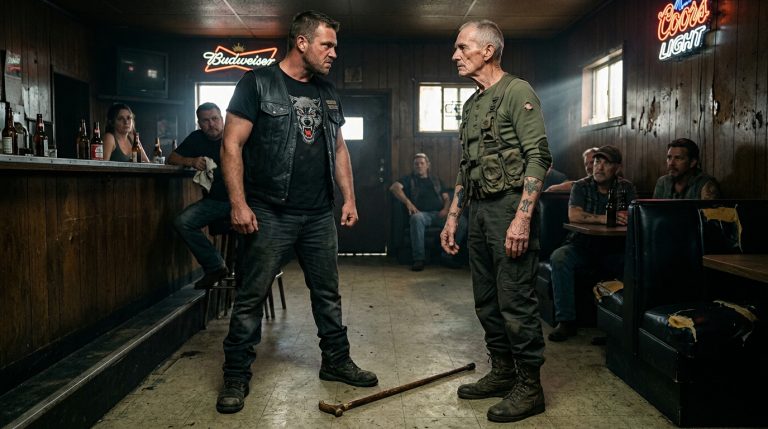
Roger walked toward the sofa, his cane tapping a steady, syncopated rhythm against the hardwood. He sat down, the leather of the cushions sighing under his weight. He didn’t answer immediately. He reached out and tapped the wooden armrest, a gesture of grounding.
“People like to build stories, Lily,” he rasped, his voice still carrying the grit of the day’s exertion. “They see a glimmer of something they recognize, and they paint a mural over it. It’s not always the truth. It’s just what they need to see.”
“But he saluted you,” she insisted, turning to face him. Her eyes were wide, the trauma of the morning giving way to a frantic, burgeoning curiosity. “He called you Master Chief. And he talked about… after-action reports and jungles.”
Roger looked away, out the window where the overgrown garden was beginning to blur into the encroaching twilight. He felt the familiar, dull ache in his hip—a reminder of the years he spent carrying things that were never meant to be carried. He had spent a lifetime keeping the past in a pressurized container, buried deep enough that it wouldn’t leak into the present. Today, the seal had broken.
He reached into his pocket and pulled out his phone. It was an old model, the screen cracked, but it buzzed with a sudden, sharp vibration. He looked down at the notification: an email from the Regional Benefits Office. The header was cold, clinical, and bureaucratic. It requested his immediate presence to verify his service records—records that had been redacted for thirty years.
A cold shiver raced through his spine, sharp and distinct, the kind that had nothing to do with the temperature of the room. It was the sensation of being tracked.
“Lily,” Roger said, his voice dropping to a low, guarded note. “The world is a loud place. Sometimes, it demands things from you that you aren’t ready to give. That patch—it’s a symbol. But it’s not who I am when I sit here and help you with your math homework. Do you understand?”
She stepped closer, her face shadowed by the gathering dark. She stopped a foot away, holding the patch out toward him. “Why were you hiding, Pop? If you were a hero, why did you let them laugh at us?”
Roger looked at her, searching for the right words, but found only the weight of the years. He realized then that the silence he had maintained wasn’t just to protect himself. It was a barrier, one he had built so carefully that he had forgotten how to dismantle it without crushing the very person he loved most.
He reached out and took the patch from her hand. It felt cold, metallic, and heavy. Before he could respond, he noticed a thick, official-looking envelope lying on the kitchen counter, half-buried under a pile of mail he hadn’t checked in days. The return address was not the school. It was the Department of the Navy.
He felt the air leave his lungs. He hadn’t touched that drawer in the garage in years, but the government had clearly started looking. The quiet domestic life he had cultivated was fracturing, and the light that had spilled in today wasn’t a sunrise—it was the first warning of an approaching fire.
“Lily,” he started again, his voice trembling ever so slightly. “Go to your room. I need to make a call.”
She hesitated, her eyes flickering to the envelope on the counter, then back to his face. She saw something there—a flicker of fear, or perhaps the final, desperate calculation of a man who knew he was being cornered. She nodded slowly, but as she turned to leave, she stopped and looked back.
“You’re not a clerk, are you, Pop?”
Roger didn’t answer. He watched her walk away, her small footsteps echoing in the hall, and for the first time in years, he felt entirely, terrifyingly exposed.
CHAPTER 2: THE WEIGHT OF TWEED
The kitchen was bathed in the thin, unforgiving light of a dying afternoon. Roger stood by the counter, his hand hovering over the official envelope. The paper was heavy, cream-colored, and smelled faintly of chemical bleach—the distinct scent of government archives. His fingers, spotted with age and stiff with the damp chill of his own biology, brushed the embossed seal of the Department of the Navy.
He did not open it. He didn’t have to. The mere presence of the document on his counter, in his home, meant that the “ghosting” he had performed for decades had finally been compromised.
A sharp, jagged bolt of pain—a phantom echo of a shrapnel wound from a life he rarely spoke of—shot through his right hip. He gasped, his knees buckling for a fraction of a second, and he had to jam his cane into the floorboards to stabilize himself. The cane hissed against the wood. He gritted his teeth, the muscles in his jaw bunching tight. This was the bargain he had made: for every day he remained upright for Lily, his body extracted a compounding interest in pain. He touched the fraying tweed of his cuff, the rough, familiar texture providing the only solace in the sudden storm of his internal reality.
He shuffled to the small wooden table in the corner and sat. The chair, a relic of a life before the medals and the madness, groaned. He watched the shadows grow long, stretching like thin, dark fingers across the linoleum. He needed to be invisible, but the machine had found his trail.
Why now? He had been a ghost for thirty years. He was a man who lived in the margins, a man who fed pigeons and helped a ten-year-old girl with her history homework. He wasn’t a threat to the state, and he certainly wasn’t a candidate for their scrutiny.
Unless the inquiry wasn’t about his service at all. Unless it was about the cost of that service—the medical records he had suppressed, the markers of his slow decay that he had hidden behind private doctors and pay-as-you-go clinics. If they were looking at his pension, they were looking at his health. And if they looked at his health, they would find the truth of why he walked with a cane, and why he wouldn’t live long enough to see Lily graduate high school.
The silence was interrupted by the faint sound of Lily’s footsteps from the hallway. She wasn’t playing; she was pacing. He could hear the soft thud-drag, thud-drag of her sneakers. She was processing the day, the change in the atmosphere of their home. She was ten, but she possessed the uncanny ability to perceive the tremors in the tectonic plates of his life.
Roger leaned his head back against the wall, closing his eyes. He thought of the young Master Chief, Hayes, and the reverence in that crisp, razor-sharp salute. It felt like a lifetime ago, though it had been barely six hours. He had been “seen” today, and that sight had brought the hounds to his door.
He reached out and pulled the envelope toward him, but he didn’t break the seal. Instead, he reached into his jacket pocket and pulled out a small, worn leather notebook. He thumbed through the pages, past the grocery lists and the scribbled reminders for Lily’s dentist appointments, until he reached the back. There, written in a cipher only he could understand, were the names of three men—men who were now scattered across the country, men who had been “plank owners” just like him.
If the system was coming, he couldn’t face it as a pensioner. He would have to face it as the man they used to fear. But to do that, he would have to sacrifice the grandfather he had become.
He stood up, the pain in his hip searing and hot, a constant, nagging reminder of the expiration date he had set for himself. He navigated to the small desk under the window and sat, his breathing measured and deep. He pulled a pen from the jar, the plastic cool against his sweating palm. He began to write, not a response to the Navy, but a letter to Lily. A map of the places he had been, a catalog of the things he had done, and an explanation for why the red tweed jacket was the only armor he had ever truly needed.
The room grew darker as the sun dipped below the horizon, the golden light turning to a bruised, deep purple. He wrote for an hour, the pen scratching against the paper like the frantic scuttling of a beetle. He wasn’t just explaining history; he was preparing a legacy for a girl who deserved the truth, even if the truth was a heavy, rusted, and agonizing thing.
He was interrupted by a soft knock on the kitchen door. He slid the notebook under a stack of old newspapers, his movements fluid and practiced, his posture instantly shifting from that of a broken old man to a man on high alert.
“Pop?” Lily’s voice was barely a whisper. “I’m hungry.”
Roger exhaled, the tension in his shoulders slumping. He looked at the envelope on the table, then at the shadow of his granddaughter in the doorway. “Come in, Lily,” he said, his voice soft and steady. “Let’s make something.”
He stood up, the pain flaring once more, but he masked it behind a smile that reached his eyes. He had a few more days, perhaps a few more weeks, before the world outside broke the door down. Until then, he would cook, he would listen, and he would keep the shadows at bay.
CHAPTER 3: THE UNSPOKEN FILE
The kitchen was warm, the air thick with the smell of boiling pasta and the metallic tang of the tap water. Roger moved with a deliberate, agonizing slowness, keeping his back to the counter where the cream-colored envelope lay. He felt the phantom eyes of the bureaucracy watching him, gauging his gait, timing his tremors.
Lily was at the table, her sketchbook open, but her pencil wasn’t moving. She watched him with a level of perception that felt like an interrogation.
“You didn’t eat lunch, Pop,” she said quietly. It wasn’t a question.
“Busy day, Lily. You know how it goes.” Roger strained the pasta, the steam rising to fog his glasses. He wiped them on his tweed sleeve, his hand steadying itself against the edge of the sink. He couldn’t afford to be clumsy. Not tonight.
After dinner, as Lily settled into the living room to finish her homework, Roger retreated to the garage. The air in the space was stagnant, tasting of grease and dry concrete. He moved to the corner, where a heavy, rusted locker stood—a relic from a base that had been decommissioned long before Lily was born. He pushed aside a tarp, the friction of the fabric against the metal sounding like a scream in the quiet space.
He unlocked the locker. The tumblers fell with a heavy, satisfying thud. Inside, the space was filled with the detritus of a life spent in shadows: old gear, a stack of maps with hand-drawn coordinates, and a small, reinforced metal box.
He didn’t go for the box. Instead, he pulled out a thick manila folder buried beneath a pile of old flight logs. He spread the contents out on the workbench, under the weak flicker of an overhead fluorescent bulb.
The documents were sparse, but they told a story that made his blood run cold. There were copies of his pension file, but someone had been adding to them. There were annotations in the margins, red-inked questions about his deployments, specific dates that didn’t match the public record. This wasn’t a clerical error by a bored government clerk. This was an audit. Someone was picking at the loose threads of his identity, and they were getting dangerously close to the knot.
His heart hammered against his ribs, a frantic, irregular rhythm that he fought to suppress. He leaned his weight onto his hands, feeling the concrete floor vibrate through the soles of his shoes. The pain in his hip was a dull, constant throb, a reminder that the “cost” of his silence was rising.
He reached for a small, folded citation tucked into the very back of the folder. It was dated 1974. He remembered that day. He remembered the mud, the smoke, and the sound of the jungle at night. But as he looked at the citation, he froze. The name on the document wasn’t his. It was a name he hadn’t thought of in decades—a man who had died in the same operation, a man whose service record had been conveniently “misplaced” during the subsequent investigation.
His breath hitched. The administrative attack wasn’t just about his pension; it was an attempt to pin a historical anomaly on him, to use his “ghost” status as a dumping ground for a thirty-year-old failure of the chain of command. They wanted him to talk, to defend his record, to open the doors he had spent his life keeping bolted shut.
A floorboard creaked in the garage doorway.
Roger didn’t spin. He didn’t reach for a weapon. He simply closed the folder with a calm, practiced movement, his shoulders remaining square. He turned to see Lily standing in the threshold, her silhouette framed by the light from the house.
“Pop?” she whispered. “I heard a noise.”
“Just an old lock, Lily,” Roger said, his voice as smooth as river stone. “Just clearing out some things.”
She walked into the garage, her eyes darting to the workbench. She saw the metal box, the heavy locker, the sheer volume of things he had kept hidden in the dark. She stopped, her gaze resting on the manila folder. The air between them felt brittle, as if a single word could shatter it.
“Is that why you’re worried?” she asked. “Because of the envelope?”
Roger sighed, the sound echoing in the empty space. He stepped toward her, moving with that practiced, careful rhythm, and placed a hand on her shoulder. Her frame felt so fragile beneath his touch—a stark contrast to the tactical gear that had once defined his reality.
“The world is complicated, kiddo,” he said. “Sometimes, people get lost in the paperwork. I’m just trying to make sure we don’t get lost with them.”
He led her back toward the house, but as he pulled the locker door shut, he looked back at the workbench. He knew now that he had been wrong. He wasn’t just defending his past. He was being hunted by it. The “decoy” was clear—they wanted the money, the pension, the administrative surrender. But the reality was far more dangerous. They wanted him to acknowledge the dead, and if he did that, he would have to admit to the things that had kept him alive.
The light from the house was warm and inviting, but as Roger crossed the threshold, he felt the cool, damp air of the garage clinging to his tweed jacket, a persistent shadow he couldn’t quite shake.
CHAPTER 4: SHADOWS IN THE GARDEN
Roger stood by the kitchen window, his hand gripping the edge of the sill so tightly his knuckles turned a bloodless white. Outside, in the fading light of the driveway, Jim Miller was stepping out of a dark sedan. Jim, the man who had witnessed the schoolhouse confrontation, the man who had recognized the trident pin. He wasn’t just a neighbor anymore; he was a potential link to the audit that was slowly tightening around Roger’s life.
Roger’s hip gave a sharp, agonizing warning—a reminder that his body was a failing machine—but he pushed the pain into a corner of his mind, locking it away behind years of compartmentalization. He adjusted the collar of his tweed jacket, making sure the fabric sat perfectly over the slight, unnatural bump of the medical brace he wore beneath it. He turned away from the window, his movements fluid despite the internal fire, and opened the back door.
The evening air was crisp, carrying the scent of damp earth and the neighbor’s jasmine. Jim was walking up the gravel path, his gait easy, familiar, the walk of a man who still carried the cadence of the Corps in his stride. He looked up, spotting Roger in the doorway, and offered a small, knowing nod.
“Roger,” Jim said, stopping at the edge of the porch. He didn’t look like an investigator. He wore a heavy flannel shirt, the sleeves rolled up to reveal forearms mapped with old scars. “Hope I’m not catching you at a bad time.”
“It’s never a bad time for a neighbor, Jim,” Roger replied, his voice a low, raspy rumble. He stepped onto the porch, the wood groaning beneath his weight. He kept his posture stiff, projecting the image of a man who was fragile but unbreakable. “What brings you by?”
Jim paused, his eyes flickering toward the dark garage. “I heard some talk at the base. Coronado. They’re running a clean-up on some old files. Someone mentioned a name, and I thought, maybe you should know.”
Roger felt a cold, metallic taste in his mouth. “Talk is cheap, Jim. Especially in the Navy.”
“This wasn’t cheap talk,” Jim said, his voice lowering, shedding the neighborly veneer. “They’re flagging the pension of an old operator. A ‘ghost’ from the Delta days. They’re saying there’s a discrepancy—a missing citation for a man who officially doesn’t exist anymore.”
Roger didn’t react. He leaned slightly on his cane, the handle digging into his palm. “Plenty of men didn’t exist back then. That was the point of the job.”
“They have your name on the internal audit, Roger,” Jim said, his gaze sharpening. “They think you’re holding the records of that man—the man who went down in the jungle. They think you’re hoarding the files to cover a systemic failure from the early seventies. They aren’t looking for a hero. They’re looking for a scapegoat to close the books on a liability.”
The garden around them seemed to shrink, the shadows of the hedges lengthening into bars across the lawn. Roger felt the weight of the notebook in the house, the map of his life that he had spent the afternoon detailing for Lily. If they found that, they wouldn’t just find records; they would find the truth of his condition, the truth of his decline.
“I have nothing to hide, Jim,” Roger said, the lie tasting like ash. “But I have no interest in dredging up things that have been buried for half a century. If the Navy wants to play accountant with dead men, that’s their business.”
“It’s not just business,” Jim pressed, stepping closer. “They’re sending a team from DC. Personnel records division. They’ll be here by the end of the week to ‘verify’ your residency and service standing. Roger, if they step inside this house, they won’t stop until they’ve stripped everything you own.”
Roger looked at Jim, seeing the genuine concern in the man’s eyes. Jim Miller was a good man, a man who had served his time and earned his rest, but he didn’t understand the nature of the beast that was coming. They weren’t looking for a scapegoat; they were looking for a way to rewrite a history that still held too much power.
“I appreciate the warning, Jim,” Roger said, his voice hardening. “But I think you should go. You’ve got a family, a job. You don’t want to be anywhere near this when the paperwork starts flying.”
Jim hesitated, his eyes lingering on the red tweed of Roger’s jacket. He understood the dismissal, the tactical withdrawal. “Keep your guard up, Master Chief,” he muttered, turning back toward his car.
Roger watched him leave, his chest aching with a hollow, rhythmic thrum. As the taillights of the sedan disappeared down the street, he felt the first true tremors of the coming storm. The pension issue was a decoy—a way to force him into the open—but the real goal was the erasure of his legacy, a final act of bureaucratic violence to ensure the ‘ghosts’ stayed buried, even if it meant destroying the man who had become the last witness.
He walked back into the kitchen, the warmth of the house feeling suddenly alien, like a theater set. He had to move, he had to hide the records, he had to secure Lily. The “ghost” was being forced into a corner, and for the first time in thirty years, the predator in him woke up, hungry and cold. He looked at the cream-colored envelope on the counter, still sealed, and felt the weight of the impending failure. He couldn’t stop them, not with logic, not with law. He would have to use the only thing he had left: his invisibility.
CHAPTER 5: THE GLASS THRESHOLD
The floor came up to meet Roger with an impersonal, brutal speed. It wasn’t a graceful fall; it was the collapse of a structure that had been held together by sheer, stubborn force of will. One moment, he was standing in the kitchen, the weight of the coming audit crushing him; the next, the world was tilted at an impossible angle, his cane clattering across the linoleum like a dropped sword.
He hit the floor hard. The impact vibrated through his shoulder, a dry, snapping sensation that signaled a bone protesting the sudden stress. Darkness crowded the edges of his vision, not the comfortable dark of sleep, but the jagged, invasive dark of a system-wide failure.
He lay there, his cheek pressed against the cold, smooth surface of the linoleum. He could smell the floor wax—lemony and synthetic—and the faint, metallic scent of his own sweat. He tried to move, to push himself up with his left arm, but his muscles felt like frayed wires, unable to bridge the gap between his intent and his anatomy.
“Pop?”
The voice was muffled, distant, as if she were speaking to him from the bottom of a well. Lily.
Panic, sharp and unrefined, clawed at him. He couldn’t let her see this. He couldn’t let her see the wreckage of the man she called a hero. He tried to speak, but his tongue felt thick, a useless muscle in the back of his throat.
Get up, he told himself. Calculate the distance to the wall. Use the leverage of the chair. Move.
But the command failed to reach his legs. Instead, he drifted. The kitchen light—a harsh, flickering fluorescent bulb—seemed to warp, transforming into the strobe of a transport helicopter at night, the sound of the blades beating against the air turning into the rhythmic, frantic thud of his own heart. He was back in the Delta. He was on the ground, waiting for extraction that was never coming. The cold of the kitchen floor became the chilling damp of the jungle floor, pressing into his skin.
He saw his squad leader’s face, etched in dirt and exhaustion, staring down at him. “Stay with us, Clayton,” the phantom voice whispered. “Don’t you dare close your eyes.”
He blinked, and the jungle vanished. He was back in the kitchen. Lily was kneeling beside him, her face a mask of terror, her hands trembling as they hovered over his shoulders.
“Pop! Pop, please, talk to me!” She was crying now, the sound sharp and ragged, cutting through the haze of his confusion.
He found his voice, a raw, grinding sound that tore at his throat. “I’m… I’m here, Lily.”
He forced his arm to move, grabbing onto the bottom of the kitchen table. His grip was weak, his fingers sliding against the wood, but he managed to anchor himself. He needed to hide the brace. He needed to hide the way his body was betraying him. He pulled himself up, an inch at a time, his breathing coming in jagged, wheezing bursts.
“Don’t,” he gasped, as she tried to grab his arm to pull him up. “Don’t touch the… the hip.”
The brace had shifted. He felt the cold, hard plastic digging into the soft tissue of his thigh, a cruel reminder of the degenerative condition he had spent years trying to outrun. It wasn’t a war injury anymore; it was the slow, steady erosion of his very structure.
He managed to reach the chair, his movements jerky, broken. He slumped into the seat, his forehead resting on the table. He felt like a cracked vessel, the light leaking out of him, the Kintsugi of his life failing to hold the pieces together.
Lily stood over him, her face pale, her hands gripped tightly in front of her chest. She looked at him—really looked at him—for the first time. She saw the tremor in his hands, the unnatural stiffness of his posture, the way his breath was a struggle. The “legend” was gone, replaced by a man who was fighting a war against his own biology.
“You’re sick,” she said, the words barely audible. It wasn’t an accusation; it was a realization, a devastating piece of the puzzle locking into place. “The VA… the files… it’s not about the medals, is it?”
Roger closed his eyes, the fatigue so heavy it felt like lead. He had wanted to spare her this, to keep her in the sun, to let her believe in the quiet hero. He had played the part, kept the mask polished, but the mask had finally shattered.
“I wanted to stay,” he whispered, his voice trembling. “I just needed a little more time.”
The room felt small, the walls closing in. He realized then that the audit wasn’t the threat he needed to fear. The threat was the mirror, and the truth reflected within it. He had spent his life protecting others, only to realize that he had failed the one person he had actually needed to save: his granddaughter, from the knowledge of his decline. He heard the distant sound of a siren—perhaps a neighbor, perhaps the beginning of the end—but he didn’t move. He sat there, a man unraveled, waiting for the silence to finish what the exhaustion had started.
CHAPTER 6: THE RESONANCE OF TRUTH
The sirens didn’t stop at their door. They passed, a distant, howling reminder of a world that was still turning, oblivious to the quiet collapse within the kitchen. Roger sat at the table, his head bowed, the weight of the confession pressing into his spine. The room felt vacuum-sealed, the air still and heavy.
Lily didn’t move. She stood by the kitchen door, her eyes fixed on him, not with the terror of a child seeing a parent broken, but with the steady, quiet focus of a witness. She walked forward, the linoleum creaking under her weight, and pulled out the chair opposite him. She sat down, her movements unhurried, her gaze unwavering.
“You’re not going to die today, are you, Pop?” she asked.
The question was so direct, so painfully unadorned, that Roger felt a sudden, sharp ache in his chest. He looked up, his eyes meeting hers. He saw the child he had tried to protect, but he also saw the woman she was becoming—a woman forged in the fires of his own guarded reality.
“Not today,” he said, his voice a raspy whisper. “But I won’t be here forever, Lily. That was the secret. That was the reason for the walls.”
He reached into the pocket of his tweed jacket and pulled out the small, worn leather notebook he had hidden earlier. He slid it across the table. It was the map he had been drafting—the truth about his missions, the truth about the injury that had started the slow decay of his body, and the truth about the pride he took in the life he had built with her.
“I didn’t want you to remember me as a fading light,” he said. “I wanted you to see the man who stood in the storm.”
Lily opened the notebook. She began to read, her thumb tracing the lines of his cipher. She didn’t look up as she read, and for a long time, the only sound in the room was the steady, rhythmic ticking of the wall clock. Roger watched her, his own breath coming in shallow, measured drafts. He felt a profound, terrifying vulnerability, as if he had been flayed open for her to see, but beneath that, he felt a strange, quiet peace. The secret was no longer a burden he carried alone.
When she finished, she closed the book and looked at him. The tears were there, but they were silent, a testament to the resilience he had instilled in her.
“You should have told me,” she said, her voice shaking but clear. “You shouldn’t have carried it by yourself.”
“I thought I was protecting you,” he replied.
“You weren’t protecting me,” she said softly. “You were just making sure I’d be alone when you were gone.”
The weight of her words hit him harder than any mission, any injury, any enemy he had ever faced. He had been a sovereign protector, but he had failed to understand that the greatest strength wasn’t in keeping the truth away—it was in sharing the burden of it.
He reached out his hand across the table, and this time, he didn’t tremble. Lily took it, her small, warm fingers closing around his. It was a grounding connection, a tether to the world he had fought so hard to remain in.
In the days that followed, the audit came and went. The investigators from DC arrived, cold and clinical, but they found no monster, no hoarder of secrets—only an old man in a frayed red tweed jacket who had kept meticulous, if unconventional, records of a life lived in service. The discrepancy was cleared, his pension was adjusted, and the “ghost” was officially, finally, laid to rest.
Roger didn’t go back to the garage. He didn’t lock the metal box. He spent his afternoons in the garden with Lily, teaching her how to tend to the cedar trees, how to fix the broken gate, and how to look at the world without fear.
One afternoon, he found the old wooden cane he had leaned on for years. It was leaning against the back door, weathered and scarred. He picked it up, feeling the grain of the wood, and then, with a quiet, deliberate motion, he walked to the shed. He didn’t throw it away. He used a piece of sandpaper to smooth the jagged edges, repairing the wood, transforming the symbol of his fragility into something that was, in its own way, whole.
He sat on the back porch as the sun began to dip, the golden light painting the garden in warm, fading hues. Lily sat beside him, sketching the trees. He rested his hand on her shoulder, feeling the steady, vibrant beat of her life—a continuation of everything he had fought to preserve. The battle wasn’t won; it was simply finished. He was, for the first time in his life, just a man, sitting in the quiet, watching the light change, knowing that when the final darkness came, he would not be leaving behind a legend, but a legacy.