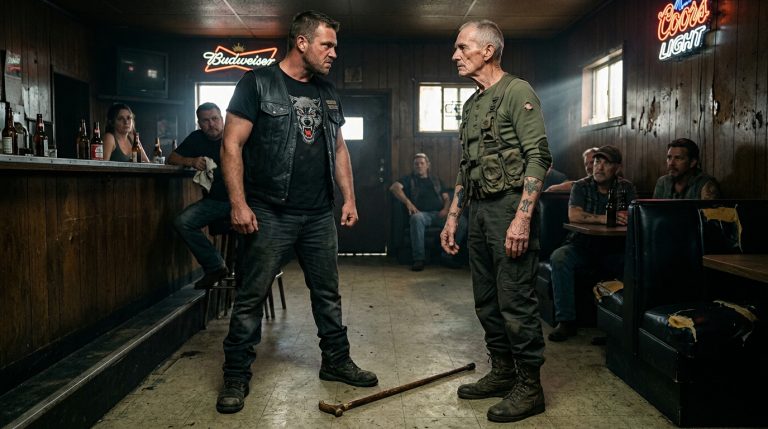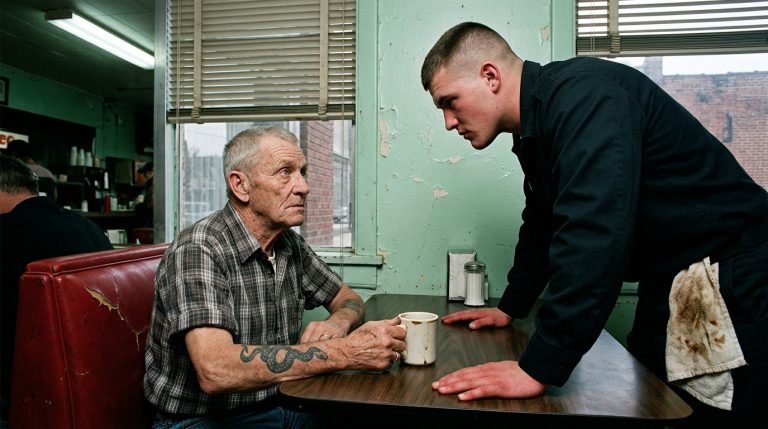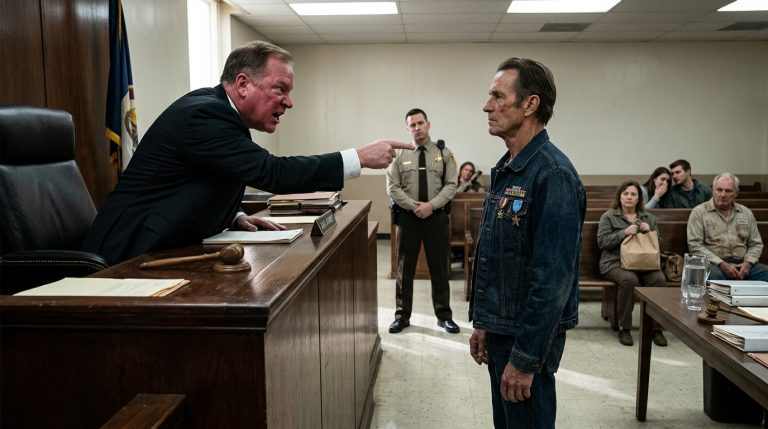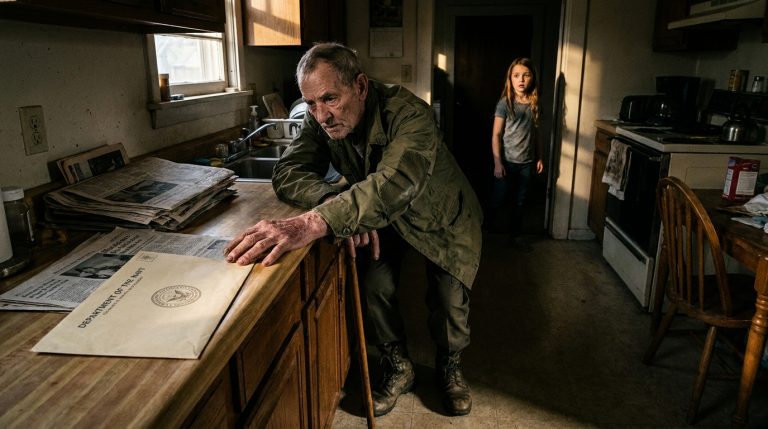
The Weight of Iron: A Veteran’s Quiet Legacy Under the Heavy Sky of the North Carolina Pines
CHAPTER 1: The Rattling Air Conditioner
The air in the day room of Building 427 was thick, a heavy blanket of North Carolina summer that even the rattling window unit couldn’t pierce. It smelled of old floor wax, hot dust, and the lingering, metallic scent of a dry, neglected heater. Private First Class Danny Reeves felt the familiar, itching restlessness of a long afternoon between training exercises.
He looked at the couch. The man there looked like a piece of drift-wood washed up on the wrong shore—seventy-six years of wear and tear, skin mapped with the topography of hard, sun-drenched years. White hair, stillness so absolute it was almost unnatural, and hands folded over his chest like a statue in a cathedral.
“Watch this,” Danny whispered. The words were a low scrape against the silence.
Specialist Mike Torres stood near the vending machine, his posture shifting, his hands jammed into his pockets. He looked at the old man, then back at Danny. “I don’t know, man. He’s just resting. Let him be.”
“He’s a relic, Mike,” Danny murmured, uncapping the permanent marker with a decisive, dry click. The smell of the ink was sharp—a chemical intrusion into the stale air of the room. “He’s been asleep for five minutes and he hasn’t moved an inch. He’s out cold. Grandpa’s going to wake up with a masterpiece on his forehead.”
Danny moved with the confidence of the young, the unscarred, and the ignorant. He saw only a target, a joke, a way to puncture the boredom. He stepped onto the thin carpet, the fibers dry and brittle beneath his boots. The floorboards didn’t groan, but he felt the age of the building through the soles of his feet—everything here felt old, worn, and tired, except for the adrenaline currently spiking in his own blood.
The veteran’s face was a landscape of deep lines, the skin thin and papery over sharp cheekbones. Danny’s hand hovered, the felt tip of the marker drawing closer to the skin of the man’s brow. He imagined the reaction, the confusion, the laughter that would ripple through the room.
The marker touched the skin.
It was a fraction of a second, a gentle pressure, but it was enough to disrupt the static state of the room.
The old man’s eyes didn’t flutter. They didn’t wake up with the groggy, confused blinking of a man dragged from sleep. They snapped open, instantly clear, instantly focused, and instantly cold. It was like looking into a furnace that had been banked and suddenly stoked to a roaring, dangerous white heat.
Before Danny’s brain could even register the movement, his wrist was locked. The pain was immediate, sharp, and terrifyingly precise—it was a lever of iron, a mechanical trap that didn’t just hold him; it dismantled his ability to resist. Danny’s knees buckled.
He didn’t just fall; he was redirected. The world blurred. One moment he was holding a marker, the next he was hitting the carpeted floor hard, his arm twisted at an angle that made his shoulder scream. He blinked, gasping, only to see Torres being yanked off his feet by the collar of his uniform, the veteran moving with a fluid, predatory economy that defied age.
“Room clear?”
The voice was not loud. It was as dry as parchment, as sharp as a blade, and it carried the weight of a thousand nights spent in places where the dark had teeth. The veteran stood above them, his knees bent, his weight balanced, his hand raised in a guard that felt older than the modern manuals they were taught. He was breathing with a slow, rhythmic consistency that didn’t match the violence of his movement.
Danny looked up from the floor, his vision swimming, his wrist pulsing with a dull, throbbing ache. The veteran wasn’t looking at him anymore. His eyes were scanning the corners of the room, tracking shapes that weren’t there, his focus locked on a horizon that only he could see. The air in the room had changed; the heat seemed to have evaporated, replaced by a sudden, biting chill that felt like a draft from a long-sealed grave.
CHAPTER 2: The Reflex
Danny couldn’t breathe. It wasn’t just the physical pressure on his wrist, which felt as if it had been clamped into a rusted iron vice, but the utter, clinical detachment radiating from the old man standing over him. The day room, usually a place of casual noise and low-grade boredom, had become an airless vacuum.
He looked up at Dale Hutchens. The man’s face was a study in stillness—not the stillness of sleep, but the deliberate, calculated pause of a predator waiting for the wind to shift. His eyes were scanning the room, moving with a rhythmic, mechanical precision that made Danny’s skin crawl. He wasn’t looking at Danny; he was looking through him, his gaze fixing on a point somewhere behind the peeling beige paint of the far wall.
“Sir,” Torres managed to wheeze, his voice thin and cracking. He was still pinned to the carpet, the older man’s hand still locked firmly into the fabric of his collar. “We… we’re soldiers. Fort Bragg.”
The words seemed to hang in the stale air, disconnected and meaningless. Dale’s head tilted slightly, a movement so subtle it might have been a twitch of the neck, but his grip didn’t falter by a single millimeter. For a fleeting, terrifying second, Danny saw something flicker in the veteran’s eyes—a dark, crowded shadow, the ghost of a humid jungle night, the smell of wet rot and the sharp, sudden bite of iron.
Laos, a thought whispered in Danny’s mind, unbidden and cold. He didn’t know why he thought it, only that the air felt suddenly saturated with the scent of damp earth and something acrid, like old cordite.
The veteran’s breathing hadn’t accelerated. His chest rose and fell in a slow, hypnotic cadence. Danny tried to pull his wrist away, but the movement was useless. He felt the grinding of bone against bone, a sharp warning that signaled the limit of his reach. He was being held by a machine of muscle and muscle-memory that had been tempered in fires he couldn’t comprehend.
“The marker,” Dale said. His voice was a rasp, low and resonant, lacking any trace of anger or even annoyance. It was the voice of a man reciting a checklist.
Danny’s fingers spasmed, and the marker slipped from his grip, thudding against the carpet with a soft, final sound. It rolled a few inches, coming to rest near the base of a vinyl chair.
Dale’s eyes dropped to the discarded object. The intensity in his gaze didn’t break, but it shifted. He glanced at the other soldiers who were pressed against the wall, their faces pale, their eyes wide and fixed on the floor. He seemed to be counting them, or perhaps assessing the structural integrity of their fear.
Slowly, deliberately, he released his grip on Danny’s wrist and Torres’s collar. The sudden loss of pressure left Danny feeling unmoored, his arm dangling limp and vibrating with residual pain. The veteran stepped back, his posture shifting seamlessly from a coiled spring into a loose, comfortable slouch. It was a transformation so complete it made Danny doubt his own memory of the last ten seconds. Had he really been pinned to the floor by a man his grandfather’s age?
Dale reached out and picked up the marker. He held it between his thumb and forefinger, examining it with the same curiosity one might show a strange, harmless insect.
“You were bored,” Dale stated, not as an accusation, but as an observation of a physical fact. He looked at Danny, his eyes finally clearing of that distant, battlefield fog. “You were looking to fill the time. And you thought a sleeping man was a soft target.”
Danny scrambled backward, his boots sliding against the thin, synthetic carpet until his back hit the cold metal frame of the vending machine. He was shaking. He couldn’t stop the tremor in his hands, nor the way his heart hammered against his ribs like a panicked bird.
“I… I didn’t mean to,” Danny stammered. He felt the eyes of his peers on him—the weight of their collective shock—but he couldn’t look away from the old man.
“Intent is a luxury,” Dale replied, his voice dropping into a quiet, gravelly register. “In the field, it’s the result that matters. You pulled the trigger on a joke, Private. You’re lucky I’ve been out of the field for a long time.”
He turned his back on them, moving toward the window with a gait that was almost casual. He reached for the rattling air conditioner, his hands steady, and nudged the dial with a quick, decisive flick of his wrist. The grinding noise smoothed out, the machine settling into a steady, muted hum.
The silence that returned to the room was heavy, dense with the realization that they were entirely out of their depth. They were soldiers, yes, trained in the arts of modern combat, but they were standing in the presence of a relic that had been forged in a reality far harsher than any training exercise. Danny looked at the marker in the old man’s hand, then at his own trembling arm, and understood that the hierarchy of this room had been permanently, violently inverted.
CHAPTER 3: The Sergeant Majors Entrance
The silence in the day room was not empty; it was pressurized. It weighed on Danny’s chest, a physical force that made the simple act of breathing feel like a chore. He remained hunched near the vending machine, his hand still tingling where the veteran’s grip had left a ghost-pressure on his wrist. Beside him, Torres was staring at the floorboards, his face a mask of pale, stunned disbelief.
Then, the heavy steel-reinforced door of the day room clicked.
It was a sharp, biting sound, like a hammer striking an anvil. Every soldier in the room, including the ones who hadn’t been part of the prank, stiffened. The posture was reflex, the sudden snap of attention that came from years of conditioning, but there was a new quality to it now—a desperate, frantic need to be invisible.
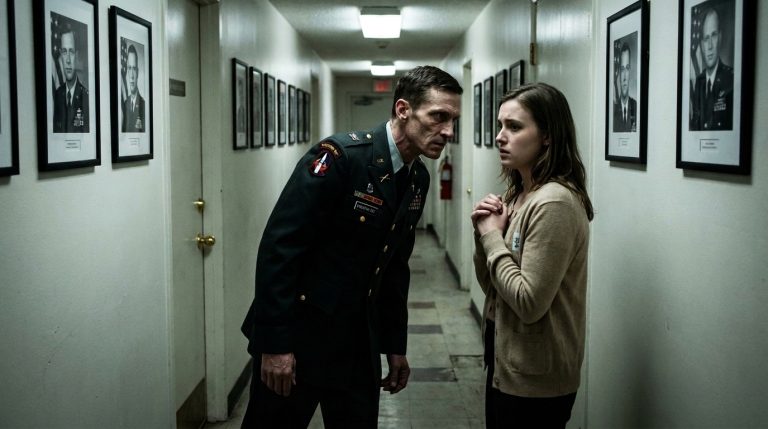
Command Sergeant Major William Foster stepped into the room. He didn’t enter so much as he occupied the space, his presence filling the corners and dampening the hum of the air conditioner. At fifty-three, he carried the authority of a man who didn’t need to shout to be heard; he wore it in the set of his jaw and the measured, heavy strike of his boots against the linoleum.
Foster’s eyes swept the room. It was a tactical scan, quick and comprehensive. He took in the disheveled arrangement of the furniture, the strained silence of the men against the walls, and the raw, lingering tension that draped over Danny and Torres like a shroud. Then, his gaze settled on Dale Hutchens.
The change in Foster was instantaneous and jarring. The sharp, iron-willed posture of the Command Sergeant Major didn’t break, but it pivoted. His shoulders lost their rigid set. The harsh line of his mouth softened, not into weakness, but into a look of profound, almost reverent recognition.
“No way,” Foster murmured, the words barely audible, yet they carried more gravity than a roar. “No goddamn way. Dale Hutchens?”
Danny watched, feeling a cold knot of dread tighten in his gut, as the man who commanded the respect—and fear—of the entire brigade walked forward. Foster didn’t move with the stiff formality of a subordinate meeting a superior; he moved with the unselfconscious haste of a fan approaching a long-lost idol.
Dale turned. He didn’t look surprised. He didn’t even look particularly interested, but the hard, flinty light in his eyes dulled just enough to be polite. He studied Foster for a long, agonizing moment, his head tilted in calculation, as if he were re-evaluating a file he hadn’t opened in decades.
“Billy Foster,” Dale said, his voice a low, raspy gravel. “Last time I saw you, you were a staff sergeant trying not to puke during mountain warfare training. That was twenty-four years ago, sir.”
The mention of the name hung in the air, a bridge between two worlds that shouldn’t have touched. Danny’s stomach turned over. Mountain warfare training. Twenty-four years. He tried to reconcile the man who had just dismantled him with the timeline Foster was implying. The veteran wasn’t just old; he was a relic of a time before Danny was even a thought, a man whose existence was calibrated in a currency of survival that had long since been devalued.
Foster reached out, ignoring the soldiers, ignoring the broken-down prank, and embraced the old man. It wasn’t the polite, military handshake Danny was used to; it was a firm, grounding hold, the kind of grip two men might share when they were the only ones left in a dark room.
When Foster finally stepped back, he turned to face the room. The warmth vanished from his eyes, replaced by a cold, instructional precision. He looked at Danny, then at Torres, and finally at the small group of soldiers who had watched the entire scene with mounting, palpable horror.
“Do you idiots have any idea who you just tried to prank?” Foster’s voice was quiet, but it seemed to vibrate against the walls of the day room.
Danny tried to speak, to offer some semblance of an apology, but his throat felt as dry as parchment. He had expected a reprimand. He had expected the standard disciplinary measures—the extra duty, the counseling statements, the chewing out. He had not expected this. He had not expected to be caught in the middle of a history lesson that felt more like an interrogation.
Foster didn’t wait for an answer. He moved to the center of the room, standing beside Dale, his hand resting on the back of the sofa with a proprietary, protective air. The room felt smaller now, the shadows longer, the air itself heavy with the residue of things that hadn’t been spoken aloud. Danny realized with a sinking, final certainty that the day room of Building 427 would never be the same. The joke was over, and the consequences were only just beginning to manifest, heavy and slow, like the movement of a glacier.
CHAPTER 4: The Hallway Confrontation
The heavy door clicked shut behind the departing soldiers, sealing the day room and leaving Danny and Torres in the sudden, expansive silence of the hallway. The air here was cooler, smelling of floor wax and the faint, antiseptic bite of industrial cleaner, a stark contrast to the thick, oppressive heat of the room they had just vacated. Danny’s hands were still buzzing with the ghost of the veteran’s grip, a lingering sensation of cold, hard iron that seemed to have imprinted itself onto his skin.
Torres didn’t speak. He walked a few paces ahead, his boots clicking rhythmically against the linoleum, a sound that seemed unnaturally loud in the quiet corridor. Danny followed, his eyes fixed on the back of Torres’s neck, watching the way his shoulder blades twitched with every step. They were walking away from the center of the world, away from the man who had just dismantled their understanding of what it meant to be a soldier, yet the weight of that encounter felt as though it were walking right alongside them.
“I need to sit down,” Torres whispered, his voice catching. He stopped abruptly, leaning his back against the wall, the friction of his uniform against the painted surface a harsh, grating sound. He slid down, his knees coming up to his chest, his head dropping back against the plaster. “Did you see his hands, Danny? When he let go?”
Danny stopped, leaning his own shoulder against the opposite wall. He closed his eyes, searching his memory for the image. He hadn’t been looking at the veteran’s hands—he’d been looking at the way his own life seemed to be shrinking into a very small, very uncomfortable box. But now, as he searched, he saw it. The old man’s hands had been perfectly steady, but the knuckles were a map of scar tissue, white and raised against the tanned, parchment-thin skin. More than that, they were stained. Not with ink, though the marker he had held was black and vivid, but with something darker, deeper, an almost imperceptible fading residue that seemed to have lived under his skin for forty years.
“He’s not just old,” Danny said, the realization settling into his bones with a heavy, leaden finality. “We thought he was just… resting. But look at how he moves. He’s not resting. He’s holding.”
“Holding what?” Torres asked, his voice dull.
“The pose,” Danny replied, gesturing vaguely toward the closed door of the day room. “The balance. The way he was scanning the corners. He isn’t sleeping, Mike. I don’t think he’s slept a day in his life since he put on a uniform.”
The hallway seemed to stretch, the fluorescent lights overhead flickering with a tired, dying pulse that cast long, jagged shadows across the floor. Danny looked down at his own hands—young, unscarred, and currently trembling. He felt a sudden, sharp pang of jealousy for the boy he had been only an hour ago, the boy who thought a prank was just a prank and that a uniform was just a costume.
He moved away from the wall, his own legs feeling heavy, as if the floor were made of deep, shifting sand. He walked to the end of the hallway where the glass exit doors showed the North Carolina sky, now bruising into the deep, heavy purple of a late August evening. The heat of the day was beginning to break, replaced by a humid, stagnant stillness that felt like a held breath.
He reached into his pocket and his fingers brushed the marker. It felt wrong, a piece of plastic and felt that now carried the weight of a weapon. He didn’t pull it out. He felt a visceral, almost irrational urge to throw it away, to hide it in the darkest corner of the barracks, but he knew he couldn’t. It was the only tangible piece of the man left in his possession, a small, obsidian anchor to a truth he hadn’t yet learned to articulate.
“Foster’s going to make us talk to him,” Danny said, his voice quiet, directed more at the glass than at Torres. “He’s going to make us go back in there.”
Torres finally looked up, his expression stripped of the barracks-room humor he usually wore like a shield. “Do you want to?”
Danny watched a lone beetle crawl across the threshold of the door, its shell shiny and hard, moving with a purposeful, rhythmic persistence. He thought of the way the veteran had scanned the corners of the room—not for enemies, but for threats.
“No,” Danny admitted, the word tasting like iron on his tongue. “I’m terrified. But I have to know.”
He turned away from the glass, the hallway suddenly feeling like the throat of a long, dark tunnel. He had begun the day looking for an easy target; he would end it looking for a reason to keep his own guard up. The lesson was already taking root, spreading through his nerves like a slow-moving, freezing toxin. He walked back toward the day room, not because he was ordered to, but because the curiosity was becoming more painful than the fear. He realized now that he wasn’t just walking toward an old man on a couch; he was walking toward the shadow of a life he hoped he would never have to live, and he was walking toward it with his eyes wide open, finally seeing the world for the fragile, dangerous construct it truly was.
CHAPTER 5: The Breakfast Table
Danny pushed the door open, his hand hovering on the cold metal handle for a heartbeat longer than necessary. He held his breath, expecting the room to be different, but it was just as they had left it. The air conditioner continued its low, rhythmic grind, and the smell of industrial cleaner was fighting a losing battle against the sharp, metallic tang of stale coffee drifting from the adjacent kitchenette.
Dale Hutchens was still on the couch. He hadn’t moved. He was sitting in the exact same posture, his hands folded across his chest, though his eyes were open now. They weren’t scanning the room with that terrifying, predatory clarity anymore; they were fixed on a point in space, observant and distant. When the door clicked shut behind Danny and Torres, the old man’s gaze shifted, sliding over them like a spotlight moving across a landscape.
Foster sat in a folding chair nearby, his posture surprisingly relaxed. He was holding a plastic cup of coffee, the steam rising in thin, wispy ribbons. “I told them you’d come back,” Foster said, his voice stripped of the command-grade authority he had worn like armor in the hallway. He gestured to two empty, mismatched chairs near the center of the room. “Sit. The reunion committee is running late with the donuts, but the coffee is fresh enough to strip paint.”
Danny moved toward the chairs, his boots feeling heavy. He sat, the plastic seat groaning slightly under his weight. Torres followed suit, his movements stiff, as if he were bracing for an impact that refused to come. Danny looked at the old man. Up close, in the harsh, flat light of the day room, Dale Hutchens looked smaller, more fragile. The deep, vertical lines around his mouth were etched into his skin, and there was a tremor in his left hand—a subtle, rhythmic twitching of the fingers—that he seemed to be masking by keeping them tucked tight against his chest.
“You wanted to hear stories,” Dale said. He didn’t ask it as a question. His voice was a dry, rasping friction, like sandpaper on weathered pine. “Most people do. They want the loud parts. The explosions. The parts that make it into the history books where they can safely be filed away and forgotten.”
Danny felt a sudden, sharp ache in his chest. “I don’t want the loud parts, sir,” he said. The honesty of the words surprised him; he had intended to be deferential, to play the role of the chastened private, but something about the old man’s stillness demanded more. “I think I’ve realized I don’t know what I’m looking at. I thought… I thought this was just a break. A place to rest.”
Dale’s eyes narrowed, the skin crinkling at the corners. He shifted, his body adjusting to the frame of the couch with the subtle, shifting friction of an old, well-oiled machine. “Rest,” he repeated, the word sounding like a technical term. “You keep using that word. You think rest is a state of being. You think it’s the absence of noise.”
He leaned forward, his hands unfolding. As he did, Danny noticed the tremor was gone, replaced by a rigid, locked-in stability. He reached down and picked up the marker from the small side table where he had placed it. He rolled it between his palms, the plastic clicking against the dry, callus-hardened skin.
“I remember a night in ’68,” Dale said, his voice dropping an octave, losing the conversational cadence entirely. “It was raining. Not like it rains here, where you can find cover. It was a deluge that turned the world into a slurry of mud and iron. We were set up on a ridgeline, waiting for a push that we knew was coming, but we didn’t know when.”
He paused, looking at Danny. The air in the room seemed to thin, the temperature dropping until Danny could see the ghost of his own breath.
“My teammate, a kid from Ohio—Marcus—he was exhausted. He hadn’t slept in three days. He was sitting right where you are, slumped against a tree, his eyes closed. He was ‘resting.’ He thought he was safe because we had a perimeter. Because he had a rifle in his lap.”
Dale’s fingers tightened on the marker. “The perimeter was an illusion. It was a wire, a few cans, a set of ears that were tired. The enemy didn’t care about the perimeter. They didn’t care about the rules of the engagement. They came out of the ground—literally—and by the time the first sound registered, Marcus was already gone.”
Danny watched, mesmerized, as the old man’s face transformed. The fragility of his age was being overwritten by a hard, granite-like resolve. There was no melodrama, no theatrical pacing. There was only the raw, rusted truth of the event.
“I didn’t sleep after that,” Dale continued, his voice so quiet Danny had to lean in to catch the words. “Not really. My nervous system decided that the moment I closed my eyes was the moment I stopped existing. It’s been fifty-eight years since I’ve had a night where I didn’t know exactly where the door was, where the exits were, and where the next threat was going to come from.”
He looked down at his hands, then back at Danny. “You want to know what I’m doing on this couch? I’m not sleeping. I’m maintaining the perimeter. I have been for half a century.”
The confession hung in the air, heavy and jagged. Danny looked at Torres, whose mouth was slightly open, his face flushed with the sudden, sharp realization of what he had truly stumbled into. They weren’t just talking to a hero; they were talking to a man who was trapped in a perpetual state of vigilance, a man whose very life was a monument to a war that refused to end.
Suddenly, the door to the kitchenette swung open, and the rattle of a rolling cart filled the room. The transition was so abrupt, so shockingly mundane, that it made Danny jump. A young corporal, wearing a bright orange reunion shirt and a grin that didn’t reach his eyes, pushed the cart into the room, followed by the clatter of porcelain and the smell of sugary, artificial icing. The bubble of intensity was shattered, the atmospheric weight of the jungle replaced by the clatter of breakfast service.
Danny stood up, his pulse racing. The old man hadn’t even blinked at the intrusion; he had simply tucked the marker back into his pocket, his face returning to that familiar, weathered mask of indifference. He had laid the truth out on the table, and now, he was covering it back up with the mundane, letting the silence of the room settle back into place like dust.
CHAPTER 6: The Long Walk
The day room felt suddenly, impossibly crowded. The arrival of the donuts and the rattling of the cart had served to diffuse the tension, but for Danny, it only intensified the sensation that he was watching a play where he didn’t know the script. He walked away from the kitchenette, the sugar-sweet smell of the pastries feeling cloying and artificial. His skin felt too tight, his nerves firing in uncoordinated bursts.
He moved toward the exit, needing the air of the hallway, needing space that didn’t feel saturated with the old man’s gravity. He felt Torres trailing him, but he didn’t look back. He pushed through the heavy door, the metallic click signaling his retreat. The hallway was empty, save for the hum of the overhead lights, but he couldn’t stop his eyes from darting toward the shadows at the corridor’s end. He was looking for movement where there was none, his mind replaying the image of Dale Hutchens sitting on that couch—the way his eyes tracked unseen threats, the way his hands stayed locked against his chest.
“You okay?” Torres’s voice was a whisper, cautious, as if he were afraid of breaking something delicate.
Danny stopped. He pressed his palms against the cool, painted brick of the wall. He wanted to say he was fine, that he’d gotten over the scare, but the lie felt heavy in his throat. “Do you think he ever stops?” Danny asked, his eyes focused on the scuffed linoleum. “Do you think he’s ever just… here?”
“He’s a retired Master Sergeant,” Torres said, the words sounding like he was trying to convince himself. “They have this training, right? Situational awareness. It’s what we’re supposed to do. He’s just better at it.”
“No,” Danny snapped, the sudden force of his own voice startling him. He pushed away from the wall, his breathing ragged. “That’s not situational awareness, Mike. That’s a lock. He isn’t observing the room; he’s defending a position that doesn’t exist anymore.”
He began to walk, his pace erratic. He wasn’t going back to his barracks, not yet. He felt a desperate, driving need to move, to burn off the energy that had been coiled into him since the marker touched the old man’s forehead. He walked past the administration offices, the empty classrooms, the quiet, sterile silence of the building. With every step, his paranoia sharpened. He started noticing the small things: the way the light hit the dust motes in the air, the uneven rhythm of the building’s air system, the way the shadows in the corners seemed to hold a darker, denser texture than they should have.
He found himself in the common area at the end of the wing—a place that looked out over the parade field. The sun had finally dipped below the horizon, and the world was bathed in a bruised, violet twilight. He stood there, watching the shadows stretch across the grass, and for a moment, he could almost see them—the jungle, the rain, the ghosts that Dale Hutchens had been carrying for fifty-eight years.
He touched his pocket again. The marker was still there. It felt heavy, a physical weight that seemed to be dragging his entire perspective downward. He wondered if the veteran had felt the same burden—if every piece of equipment, every weapon, every moment of his life had started to carry that same, heavy, iron-like implication.
“I can’t go back in there,” Danny whispered, his head leaning against the cold glass of the window.
“We have to, Danny,” Torres said, coming to stand beside him. His face was reflected in the glass, looking pale and uncertain. “Foster expects us to finish the conversation. If we walk away now, we’re just kids who got scared by an old man. If we go back, we’re… I don’t know what we are, but we’re not the same.”
Danny looked at his own reflection. He saw a stranger—someone with wide, nervous eyes and a set jaw that looked borrowed from someone else. He thought of the old man’s hands, the tremor masked, the constant, invisible battle being fought beneath the skin.
“He isn’t just a veteran,” Danny said, the thought finally clicking into place with a terrifying, absolute clarity. “He’s a wall. And the wall is crumbling.”
He turned away from the window. He didn’t want to go back. Every fiber of his being was screaming for him to turn around and run toward the barracks, toward the safety of the known, the familiar, the mundane. But the curiosity, that relentless, gnawing thing that had been sparked by the veteran’s stillness, held him fast. He was trapped in the consequence loop, bound to the old man by a thread of shared, terrible knowledge.
He walked back toward the day room, his boots hitting the linoleum with a heavy, rhythmic finality. He was no longer the comedian, no longer the prankster. He was just a witness, walking toward a fire he couldn’t put out, his pulse thumping in his ears like a countdown. The air in the hallway seemed to thicken as they approached the day room, the silence growing dense and expectant. He reached for the door handle, his hand steady for the first time since the morning, and pushed.
CHAPTER 7: The Final Lesson
The door opened with a soft, pneumatic sigh, the sound echoing through the now-dim day room. Inside, the light had shifted; the harsh, flat glare of the midday sun was gone, replaced by the amber, long-shadowed glow of late evening. The air inside felt pressurized, as if the room itself were holding its breath.
Dale Hutchens hadn’t moved. He remained in the same position on the couch, but the space around him felt different—charged, as if the very atoms in the room were aligning with his steady, rhythmic breathing. Foster was still there, but he was standing now, his back to the window, his silhouette cast in a long, dark spear of shadow that stretched toward Danny’s feet.
“You came back,” Hutchens said. It wasn’t a question. He didn’t turn his head; he was staring at a point on the floor, his posture as still as a statue.
Danny walked into the room, his movements deliberate. He felt the weight of the marker in his pocket, a burning, metallic presence against his thigh. He stopped a few feet from the couch, his hands at his sides, his breathing shallow. He wasn’t the same soldier who had walked in that morning. The hubris, the bored arrogance, the casual dismissal of the world around him—it had been stripped away, replaced by a cold, sharpened sense of reality.
“I had to,” Danny said. The words were flat, devoid of the tremor he had felt in the hallway. “I realized I didn’t know what I was looking at. I thought I knew what a soldier was. I thought I knew what combat meant. I was wrong.”
Hutchens shifted, his head turning with a slow, grinding motion. He looked at Danny, his eyes devoid of the distant, battlefield fog from before. They were clear, penetrating, and utterly, terrifyingly present. “You weren’t wrong, Private. You were just uninformed. That’s the nature of youth. You think the world is a stage, and you’re the lead actor. It’s only when the stage starts to burn that you realize you’re just part of the scenery.”
He reached into his pocket—the same pocket where he had put the marker—and withdrew it. He held it out, his hand steady, the tremor entirely absent. “You wanted to make a mark,” he said, his voice dropping into a quiet, gravelly register. “You wanted to leave something behind. Something that told the world you were here, that you were in control.”
Danny took the marker. The plastic was warm, heated by the old man’s body. He looked down at it, the black casing dull and weathered, and saw a small, almost imperceptible scratch near the cap—a mark of wear, a sign that the object had lived.
“The enemy doesn’t care about your mark,” Hutchens continued, his voice a steady, rhythmic cadence. “They don’t care about your stories. They don’t care about the medals, or the training, or the way you hold your rifle. They care about the space you occupy and the moment you decide that you are safe enough to look away. That is the moment they win. That is the moment they erase you.”
Hutchens leaned forward, his hands resting on his knees. “I’ve spent forty years making sure I’m never erased.
CHAPTER 7: The Final Lesson
The day room, which had seemed so mundane only hours ago, now felt like the center of a magnetic field. Danny pushed the heavy door, the metal resisting slightly before swinging inward with a low, resonant groan. The scene inside had not changed, and yet, it felt utterly transformed. The bright, artificial lights seemed to cast longer shadows, and the ambient noise of the room—the hum of the air conditioner, the distant, muffled chatter from the hallway—had faded into a background static that served only to heighten the absolute, suffocating stillness at the center of the room.
Dale Hutchens was still on the couch. He hadn’t shifted an inch, but his posture had changed. The loose, slouching comfort he had been feigning was gone, replaced by a rigid, alert presence. He looked at Danny, his eyes dark, heavy, and weary. It was the look of a man who was tired of being awake, yet who lacked the capacity to close his eyes and truly let go.
“I told you,” Dale said, the words cutting through the air like a blade. He held the black marker up, turning it in the light until the plastic barrel glinted. “You wanted to hear stories, but you aren’t listening to the story. You’re looking at the ink.”
Danny stopped in his tracks. He felt a sudden, sharp spike of adrenaline, his heart hammering against his ribs. He had expected him to be annoyed, maybe even angry, but there was only a cold, hollowed-out disappointment in the veteran’s voice. Danny walked toward the chair, his boots sounding loud and clumsy against the floor. He sat down, Torres taking the seat beside him with a quiet, shaky breath.
“I’m listening,” Danny said, his voice barely audible. He leaned forward, his elbows on his knees, his hands locked together. He was looking at the marker, but he was seeing the way Dale Hutchens’s fingers trembled when they weren’t occupied, the way his jaw stayed set in a permanent, grinding clench.
Dale looked at him, and for the first time, the distance in his gaze vanished. It was an intense, uncomfortable connection, the kind of stare that made Danny feel as though the old man were cataloging every flaw, every weakness, every secret he had ever tried to hide. “You think you understand,” Dale murmured. “You think you’ve seen the ‘legend.’ You think the story is about me.”
He reached out, his hand moving with a speed that still, despite everything, took Danny by surprise, and dropped the marker into Danny’s palm. The plastic was warm—warmed by the old man’s skin, by the constant, nervous friction of his grip.
“The story isn’t about me,” Dale said. “I’m just the wreckage. The story is about what happens when you stop seeing people and start seeing targets. When you start seeing the world as a place that needs to be secured, not a place that needs to be lived in.”
He leaned back, his shoulders finally dropping, a long, ragged sigh escaping his lips. It was the sound of a structural failure—the release of pressure that had been held for half a century. The intensity that had defined him began to fray at the edges, the iron-like poise softening into something painfully, vulnerably human.
“I didn’t choose this,” Dale said, his voice cracking. “I adapted. I survived the jungle, but the jungle didn’t survive me. It came home with me. Every room I walk into, every person I meet, every damn morning I wake up—it’s all part of the perimeter.”
He looked at Danny, his eyes wet. “Do you see the marker, Private? Really see it?”
Danny looked down. It was a standard, mass-produced tool. But in his hands, it felt different. It felt heavy. It felt like a tether. He realized with a jolt of horror that he had been holding it the exact same way Dale had—his own fingers had been tightening, his own jaw had been clenching, his own mind had been scanning the corners of the day room for the exit.
He was already starting to mirror him.
“I see it,” Danny whispered.
“Keep it,” Dale said, his voice growing distant. “Every time you look at it, remember that appearances are a lie. And every time you reach for it to make a joke, to dismiss someone, to ignore the world, stop. Look at the shadows. Look at the people. Learn to see them before you decide what they are. Because if you don’t, you’ll end up exactly like me—living in a war that ended before you were born.”
Dale closed his eyes. This time, he didn’t snap them open. He didn’t scan the room. He just kept them closed, his chest rising and falling in a rhythm that was, for the first time, deep, uneven, and exhausted.
Danny sat in the silence, the marker clutched tight in his hand. He looked at Torres, whose eyes were fixed on the veteran with a mixture of awe and genuine, heartbreaking pity. The day room felt vast, the walls stretching away into a darkness that seemed to pulse in time with the old man’s breathing. Danny realized that the lesson wasn’t about the prank, or the combat, or the secrets. It was about the cost. And as he sat there, listening to the shallow, ragged intake of air from the man on the couch, he felt the first, cold shadow of that cost beginning to settle into his own heart. The perimeter had been breached, but the war was still being fought, silent and invisible, in the space between one heartbeat and the next.
CHAPTER 8: The Departure
The silence in the day room deepened, taking on a weight that felt almost physical. Dale Hutchens’s breathing had shifted. It was no longer the rhythmic, artificial cadence of a man maintaining a perimeter; it had deepened into the heavy, ragged, and unguarded respiration of someone who had finally, against every instinct honed by decades of conflict, surrendered to the pull of true rest.
Danny sat motionless, his hand still clamped around the warm plastic of the marker. The air in the room felt different, cleared of the sharp, metallic tang of hyper-vigilance that had saturated it since the morning. He looked at Dale—really looked at him. The old man’s face, usually set in the granite hardness of a mask, was relaxed. The vertical lines around his mouth had softened, and for the first time, he didn’t look like a weapon system or a piece of living history. He looked like an old man who was exhausted, deeply and profoundly tired, finally allowing the world to exist without his constant, tactical oversight.
Foster rose silently, his shadow retreating from the floor as he moved toward the door. He paused beside Danny, his gaze lingering on the sleeping veteran. There was no directive, no final command—only a silent acknowledgment of the shift. Foster nodded once, a sharp, crisp motion of respect, and then stepped into the hallway, leaving the door ajar. The soft, rhythmic click of the latch echoed in the quiet space, a final, definitive period at the end of a long, exhausting sentence.
Danny didn’t move for a long time. He watched the light in the room change, the amber glow of the setting sun deepening into a rich, bruised purple. He felt the weight of his own transformation. He had come into this room as a boy looking for a target, and he was leaving as someone who finally understood that the most dangerous targets were often the ones you couldn’t see because they were hidden behind a lifetime of “rest.”
He reached into his pocket and pulled out the marker one last time. He walked toward the kitchenette, his boots making almost no sound on the worn carpet. He opened the drawer beneath the counter, the wood sliding with a dry, metallic friction, and placed the marker inside, nestled among the clutter of old pens and forgotten scraps of paper. He wasn’t leaving it behind; he was storing it. It was a witness to the day his perspective had fractured, a physical anchor to the truth that his youthful arrogance had almost destroyed.
He walked back to the couch and looked down at Dale one last time. He saw the tremor in the veteran’s left hand, now lying still against the dark fabric of his trousers. The rust of age and the iron of the past were still there, but the man had found a temporary peace. Danny felt a surge of something—not pity, but a profound, grounding gratitude. He hadn’t been saved by a mentor; he had been dismantled by the truth of a man who had paid the highest price to keep the world safe enough for others to ignore the shadows.
He turned toward the door, Torres following him with a quiet, lingering hesitancy. As they stepped into the hallway, the cool, sterile air felt clean, refreshing. Danny took a deep, steady breath, the familiar scent of the building’s floor wax and stale air washing over him. He felt lighter, as if the heavy, iron-like implication that had gripped him since the afternoon had finally unspooled.
He reached the exit and pushed the glass doors open, stepping out into the cooling night. The North Carolina heat had finally broken, replaced by a gentle, persistent breeze that carried the scent of pine and dry, earth-worn ground. He stood on the sidewalk for a moment, looking up at the sky. It was vast, quiet, and remarkably peaceful.
“You going back to the barracks?” Torres asked, his voice low, still hushed by the weight of the day.
Danny looked back at the building, at the faint, flickering light of the day room window. He thought of the old man resting on the couch, the perimeter finally quiet, the war held at bay, if only for a few hours. “Yeah,” Danny said, his voice steady. “But I think I’ll take the long way. Just to see what’s there.”
He walked away, his stride long and deliberate. He wasn’t scanning the corners anymore; he was just walking, moving through the world with a new, sober appreciation for the fragile, quiet space he occupied. The lesson was complete, the narrative of his own arrogance finished. He knew now that true strength wasn’t about the markers you carried or the pranks you pulled; it was about the heavy, silent endurance required to live a life that allowed others to dream of safety. He walked on into the dark, the rhythm of his own heartbeat finally, for the first time that day, just a heartbeat, and nothing more.