The Cold Steel of Self-Respect: How a Forgotten Daughter Built an Empire While They Built a Cage
CHAPTER 1: THE COLD RETURN
The flight from Seattle touched down with a hard, metallic thud against the tarmac.
Maris pulled her carry-on from the overhead bin, her fingers curling tightly around the worn leather handle.
The cabin air smelled stale, thick with the exhausted sighs of passengers eager to escape the descent.
She walked down the jet bridge without hurrying, her boots clicking a steady, unyielding rhythm against the floor.
Outside the arrivals terminal, the San Antonio heat wrapped around her shoulders like a heavy woolen blanket.
She did not look for a familiar face in the crowd.
There was no sign bearing her name, no awkward wave from a relative trapped in mandatory obligation.
She stepped straight past the waiting area and slid into the back of an idling cab.
The driver glanced at her through the rear-view mirror, his eyes lingering on her neutral expression.
“Methodist Hospital,” she said, her voice flat, level, and entirely devoid of hesitation.
The cab pulled away from the curb, merging into the crawling lanes of highway traffic under a pale, washed-out sky.
Maris rested her palm against her coat pocket, feeling the solid, cold weight of her fountain pen.
She did not rehearse what she would say when she walked through those hospital doors.
There was nothing left to explain, nothing left to prove to people who had spent a lifetime pretending she didn’t exist.
The hospital loomed ahead, a towering monolith of glass and pale concrete rising against the glare of the afternoon sun.
She paid the fare, stepped onto the pavement, and let the heavy glass doors slide open automatically.
The lobby hummed with the familiar, antiseptic scent of bleach, damp linoleum, and quiet desperation.
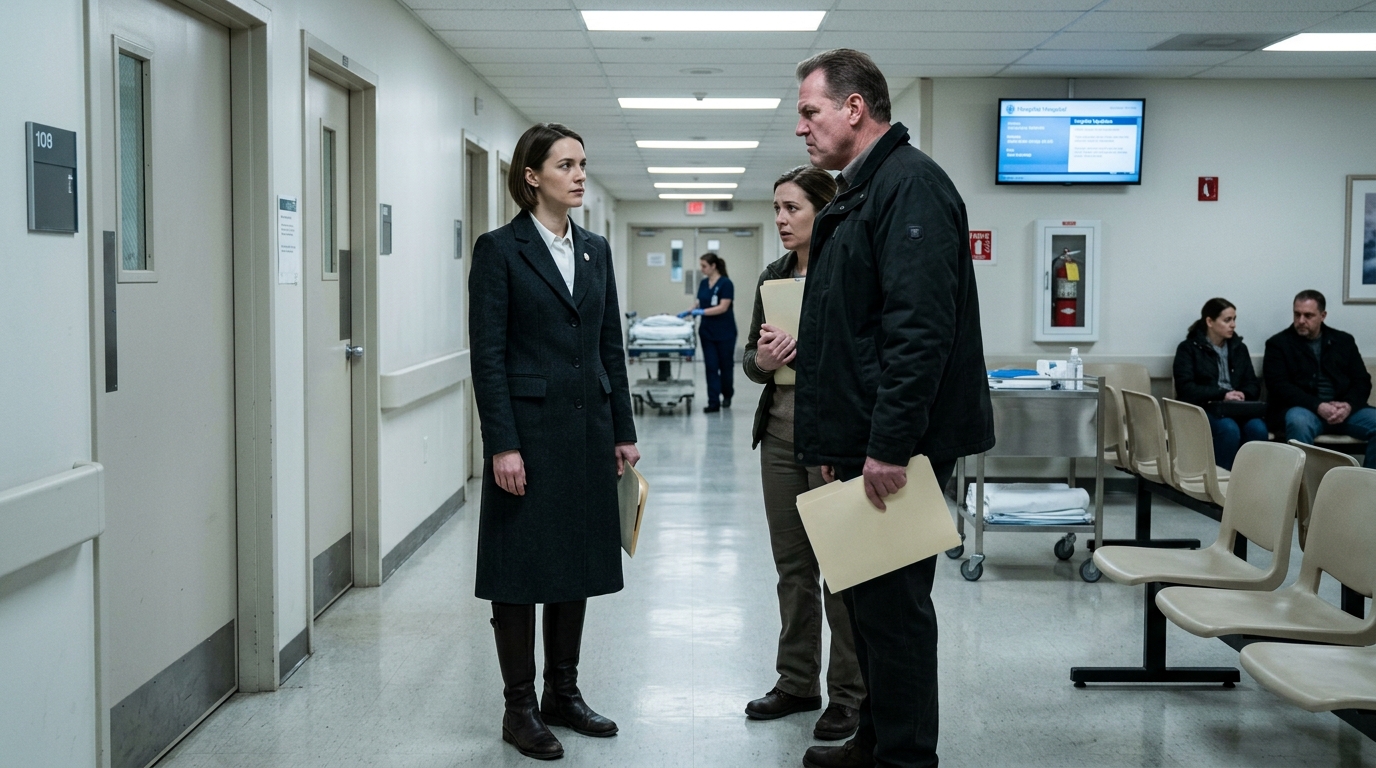
She crossed the polished floor toward the third-floor elevator, her badge clipped discreetly to her lapel.
The elevator doors chimed, opening to a hushed corridor where the air conditioning blew ice-cold against the back of her neck.
She turned the corner toward the private ICU suite, her footsteps muffled by the commercial carpet.
There they sat.
Russell occupied a stiff plastic chair, his shoulders squared in that rigid, retired-police posture that demanded invisible obedience.
Deline leaned over a smartphone screen, her fingers tapping a nervous, jerky rhythm against the plastic casing.
Neither of them looked up as she approached.
They were waiting for a daughter who used to shrink, a daughter who used to wait for permission to occupy space.
Maris stopped three feet from the doorway, her hands resting quietly at her sides.
The overhead fluorescent light caught the silver edge of her collar pin.
She did not speak.
She simply waited for the exact second their eyes would finally rise to meet hers.
CHAPTER 2: THE STOLEN BLUEPRINT
Russell shifted his weight against the rigid plastic of the waiting room chair.
His boots scraped sharply over the linoleum floor, a calculated sound meant to demand compliance without a word spoken.
He didn’t look at her face; he looked at her lapel, scanning for a weakness that no longer existed.
“You shouldn’t have come,” Russell said, his voice dropping into that flat, authoritative register he used when clearing a hostile room.
“Silas doesn’t need distractions right now, especially not from someone who couldn’t even finish what she started.”
Maris did not blink, nor did she adjust her posture.
She felt the heavy, worn fountain pen resting safely in her coat pocket, its metal casing cold against her thumb.
The air in the corridor smelled of stale floor wax and distant antiseptic, pressing down on her shoulders with the weight of old expectations.
“He’s stable,” Maris said, her tone level and devoid of any defensive edge. “The chart says his potassium levels dropped during the night.”
Deline finally looked up from her phone screen, her lips thinning into a hard, defensive line.
“How would you know what the chart says?” Deline snapped, her fingers clutching the plastic casing until her knuckles turned white. “You’re just passing through. You don’t belong on this floor.”
“I am a visiting consultant,” Maris replied, stepping slightly closer. “And your son’s attending physician happens to use the public health framework I published last year.”
Deline’s breath hitched, a faint, involuntary twitch betraying her sudden panic.
She had spent seven years convincing the extended family that Maris was a failure, an ungrateful dropout who couldn’t survive outside their rules.
Hearing a hospital full of strangers use Maris’s professional title was an insult to the narrative they had carefully constructed.
Russell stood up, towering over her with the imposing posture of a man accustomed to backing people into corners.
“You always had to make everything about your little ambitions,” Russell muttered, stepping into her personal space to crowd her out. “Stepping over family just to prove a point.”
Maris held her ground, refusing to yield an inch of the hallway floor.
She reached into her bag with her free hand, her fingers brushing against a manila folder filled with printed grant archives and university correspondence.
The digital trail of academic theft was locked securely inside that folder, waiting for the precise moment to dismantle their smug certainty.
Silas stirred behind the open door of the ICU suite, letting out a weak, raspy cough that punctured the tense silence.
Russell glared down at her, his eyes narrowing into cold slits.
“Leave before you cause a scene we all regret,” Russell warned, his voice a low, gravelly threat.
Maris let out a slow, measured breath, her thumb tracing the smooth metal barrel of the hidden pen.
“The only scene here is the one you’ve been staging for thirty years,” Maris said quietly. “And the paperwork is finally catching up to the lies.”
CHAPTER 3: THE TRANSACTIONAL COFFEE
Deline sat at a corner table with exposed brick walls, her manicured fingers wrapped tightly around a paper espresso cup as if holding onto a lifeline.
She didn’t stand when Maris arrived; she simply gestured to the empty metal chair opposite her with a sharp, practiced tilt of her chin.
“You look well,” Deline said, studying Maris’s gray wool coat with an assessing, critical eye. “Busy, but well.”
Maris slid into the chair without removing her coat, letting the manila folder slide quietly onto the scratched wooden tabletop.
The café smelled of roasted chicory and damp pavement, the background murmur of espresso machines filling the tense space between them.
“You wanted to talk about Silas,” Maris said, her voice cutting straight through the pleasantries without a trace of warmth.
Deline’s jaw tightened, a brief micro-twitch betraying her frustration at being denied the upper hand.
“He’s your brother, Maris,” Deline murmured, leaning forward to lower her voice into a conspiratorial whisper. “Family doesn’t keep score when someone’s health is on the line.”
“Is that why you called me here?” Maris asked, her fingers tracing the edge of the hidden fountain pen in her pocket. “To ask for favors while pretending the last seven years didn’t happen?”
“We only want what’s practical,” Deline snapped, her mask slipping as her tone turned sharp. “With your position, your influence at the hospital, it would take one phone call to get him transferred to your department.”
Maris picked up her own black coffee, her expression completely indifferent to the plea disguised as a demand.
“I don’t run admissions, and I certainly don’t vouch for people who build careers on stolen work,” Maris said quietly.
Deline slammed her paper cup down onto the wood, coffee sloshing over the rim as her face flushed with sudden, hot anger.
“You always were ungrateful,” Deline hissed, her eyes darting around to see if anyone was listening. “We gave you a roof, we gave you guidance, and you act like a stranger.”
“You gave me a cage and called it protection,” Maris replied, standing up smoothly while leaving her coffee untouched. “Keep your coffee, Deline. You’re going to need all the leverage you have left.”
CHAPTER 4: THE FORGED VISA
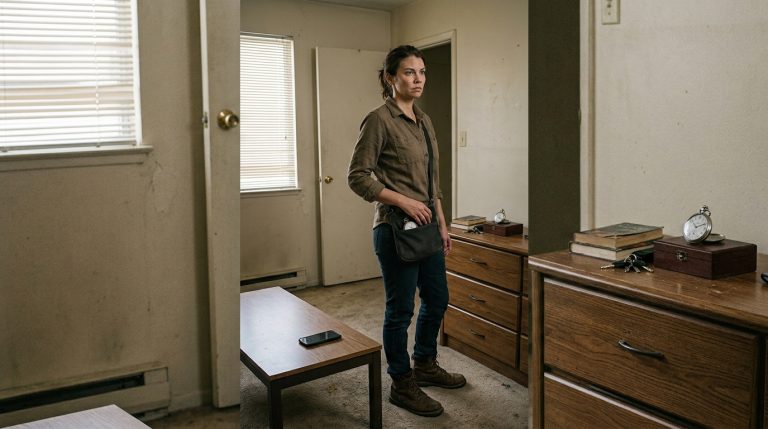
She dropped the envelope onto the narrow wooden desk, its stiff paper surface sliding across the scarred grain.
The room smelled of commercial carpet cleaner and dry air-conditioning, a sterile box far away from any sense of home.
She sliced the top open with the edge of her thumb, pulling out the formal inquiry bearing the federal seal.
Her eyes scanned the dense legal text down to the sponsoring physician line, where an unauthorized signature sprawled across the bottom.
It was Deline’s handwriting, but the name printed above it was Dr. Maris Crane, used as a silent guarantor for a cousin’s immigration paperwork.
No consultation, no warning, no consent—just a calculated assumption that Maris’s credentials could be plundered like old family furniture.
The air in the room felt suddenly thin, tightening against her chest as the full scope of their entitlement snapped into sharp focus.
They hadn’t just tried to erase her from family portraits; they had weaponized her hard-earned professional standing while pretending she didn’t exist.
She pulled a heavy brass pen from her bag, uncapping it with a crisp, metallic click that broke the quiet.
“I do not consent,” she muttered aloud, her hand steady as she drafted the formal legal refusal across a blank sheet of paper.
She signed her name with sharp, deliberate strokes, making sure every letter stood firm and unyielding against the margin.
She slipped the document back into the envelope, sealing the flap with a final, hard press of her palm.
There would be no dramatic phone calls, no screaming matches in a crowded kitchen, and no requests for explanations.
She tossed the envelope onto the center of the desk next to her laptop, a quiet landmine waiting for the federal agency to detonate it.
Her phone buzzed against the nightstand, flashing Deline’s incoming number in a silent, persistent rhythm.
She let it ring out, watching the screen go dark before sliding the device facedown into the shadows.
CHAPTER 5: THE PUBLIC RECKONING
The conference hall fell completely silent as she stepped up to the microphone, the low hum of the sound system fading into the background.
Rows of seated medical professionals looked up expectantly, their faces illuminated by the pale glow of digital presentation screens.
Maris did not look at her prepared notes; she looked straight out into the dim expanse of the audience, anchoring herself in the quiet truth of her own experience.
“I used to believe that love would look like support,” Maris began, her voice steady, clear, and carrying effortlessly across the room. “I believed the people who raise you would always want the best for you.”
A faint rustle of paper rippled through the front rows as listeners leaned in closer, catching the raw, uncompromising weight in her tone.
“Then I learned that some only love you when you match the story they’ve written in their heads,” she continued, her fingers resting lightly against the cold metal stem of the mic. “When you start becoming something they didn’t author, when you succeed without their permission, it is not always celebrated.”
In the second row, a visiting colleague from Texas shifted uncomfortably, though Maris didn’t break her gaze.
She wasn’t naming names, but the underlying architecture of systemic erasure hung heavily in the air, undeniable and stark.
“Sometimes it is resented,” she said, letting the words breathe in the charged silence of the hall. “They try to gatekeep your access, they try to rewrite your research, and they try to make you smaller so they can remain comfortable.”
A heavy, collective tension settled over the room as listeners recognized the hard reality of the narrative she was dismantling.
“But survival is also a kind of success,” Maris said, her voice dropping into a quiet, resolute register. “And I stopped asking to be invited to a table when I realized I could build my own.”
She stepped back from the podium as a slow, deliberate wave of applause began to rise from the center aisle, swelling until it filled the entire auditorium.
She did not smile or wave; she simply turned and walked toward the side exit, leaving the applause behind her like an echo of a storm she had finally weathered.
Her phone buzzed deep inside her coat pocket, vibrating against her ribs with a frantic, pulsing rhythm.
She pulled it out as she pushed through the heavy metal exit doors into the cool evening air, glancing down at the screen.
Deline’s name flashed across the display alongside a new text message: Please answer me, Maris. You’ve gone too far this time.
CHAPTER 6: THE FINAL BOUNDARY
The phone vibrated again in her palm, a relentless electronic pulse demanding an audience she no longer owed.
She pressed the power button, plunging the screen into absolute darkness.
The evening air smelled of damp asphalt and distant pine, carrying the steady, grounding hum of highway traffic far beyond the neighborhood.
There would be no final shouting match, no tearful confessions, and no desperate pleas accepted at midnight.
They had spent decades engineering her absence, assuming her silence was a weakness they could exploit whenever their polished image cracked.
She slipped the dark device into her coat pocket, her fingers brushing against the solid, comforting weight of the steel fountain pen.
She turned away from the glow of the avenue, walking back toward her temporary quarters with steady, unbroken strides.
The federal rejection letter sat on the hotel desk, a quiet, immutable boundary that no amount of family entitlement could ever cross.
When she reached the door, she unlocked it with a single, fluid twist of her wrist, stepping inside without a backward glance.
She packed her single suitcase that night, folding her clothes with the precise, methodical care of a woman who owned every square inch of her life.
By morning, she was back in Seattle, where the gray Pacific light filtered softly through her apartment window.
She stood barefoot on her kitchen floor, waiting for a simple ceramic kettle to come to a boil.
The stainless-steel nameplate rested on the counter near the stove, reflecting the quiet morning sun without a speck of dust on its surface.
Dr. Maris Crane.
She poured the hot water into a plain white mug, the steam rising in a thin, unhurried curl toward the ceiling.
Outside, families walked past on the sidewalk, parents calling out names and fumbling with jackets in the crisp autumn air.
She watched them for a quiet second, feeling neither bitterness nor longing, only the profound, unshakable weight of her own peace.
She didn’t need their applause, their table, or their permission to matter.
She had built a life entirely from scratch, and for the first time, the silence didn’t feel like a cage.
It sounded like home.