A Quiet Defiance: The Invisible Architecture of Mercy in the Mud of the Liry Valley
CHAPTER 1: The Weight of Rust
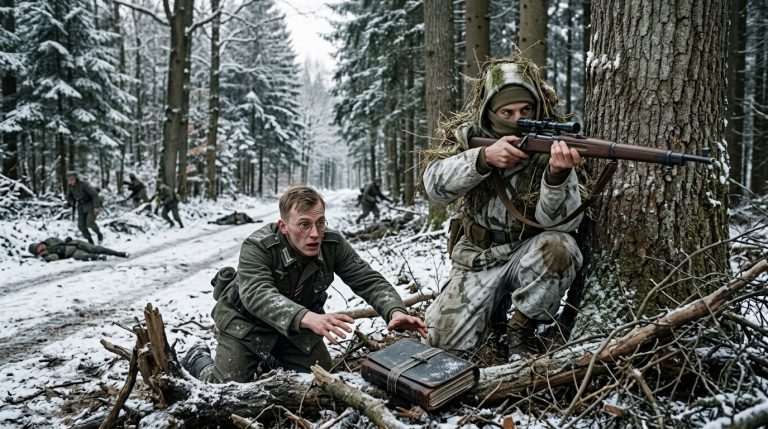
The Liry Valley did not breathe; it exhaled rot. It was a thick, wet mist that tasted of cordite and the damp wool of coats that had not been dry for three weeks. Jimmy Dalton knelt in the soft, yielding mud of his foxhole, his fingers tracing the jagged edge of his entrenching tool. The metal was cold—a biting, insistent cold that seeped through his gloves and settled deep into his marrow.
Beyond the low lip of his position, the fog clung to the trees like a shroud. Somewhere to the north, the dull, rhythmic thud of artillery provided the heartbeat for a dying world. It was a sound he had learned to translate: one, two, three—a pause—then the whistle of steel seeking soft earth.
He looked to his left. The space where Private Eddie Kowalsski had been yesterday morning was now just a shallow crater filled with gray water. The ripple in that water was the only thing moving. Eddie had been nineteen, a machinist’s son with a laugh that sounded too bright for the dull, gray terror of Italy. He was gone, evaporated by a 20mm autocannon from a scout car that had appeared out of the fog, rattled the position with cruel efficiency, and vanished before the dust could even settle.
Jimmy gripped the handle of the shovel, his knuckles white. The military manuals sitting in the captain’s office back at headquarters spoke of “authorized defensive measures.” They talked about fields of fire and interlocking defenses. They were clean, printed pages filled with diagrams that assumed a world that made sense. But out here, there were no bazookas, no mines, just the relentless, grinding hum of the German 222 scout cars. They were the predators, and the infantry were the livestock, waiting for the butcher to arrive on a schedule of dawn patrols.
He felt a sudden, sharp ache in his chest—a phantom weight. He reached into his pack and felt the coiled mass of barbed wire. It was thirty feet of rusted, ugly metal. It did not look like a weapon. It looked like trash pulled from a rail yard pile in Gary. Yet, as he stared into the swirling, suffocating fog, the architecture of the solution began to coalesce in his mind, not as a command, but as a desperate prayer.
The road was narrow up ahead, squeezed tight between two ancient oak trees. It was the only route the scouts took; they were fast, but they were slaves to their own momentum. He knew the weight of those cars. He knew how a single, well-placed interruption could turn that speed into a funeral pyre.
A branch snapped somewhere in the mist. Jimmy’s heart hammered a frantic, uneven rhythm against his ribs. He froze, his breath hitching in his throat. Was it the patrol? Was it just the wind, or the ghost of a machine coming to finish the job? He looked at the shovel, then at the empty hole where Eddie had been, and he felt the shift. The fear was still there, cold and sharp, but underneath it, something harder was taking root. He wasn’t just a soldier anymore. He was a switchman. And he knew exactly how to make a train jump its track.
CHAPTER 2: The Breaking Point
The silence that followed the snapping branch was heavier than the mist. Jimmy remained crouched, his muscles coiled like a rusted spring. He held his breath, waiting for the crunch of boots on gravel, the harsh snap of a German command, or the sudden, searing light of a flare. But there was only the steady, maddening drip of water from the oak leaves above and the distant, low-frequency rumble of the front line—a sound that had become the background music to his exhaustion.
He didn’t move. He let the realization settle: he was alone in the no-man’s-land between the Allied lines and the German-held ridges. If he stood up, he was a target. If he stayed down, he was merely waiting to be found.
Jimmy shifted his weight, the mud squelching softly against his boots. The shovel handle was hard against his palm, a familiar texture from the rail yards back in Gary. Back then, a broken coupler meant a delayed shipment, a headache for the foreman, and a few hours of back-breaking labor in the rain to get the steel moving again. Here, a broken system meant a body bag. The scale was different, but the mechanics of failure remained identical.
He crawled backward, keeping his profile low, the barbed wire coil digging into his side like a persistent, metallic parasite. Every movement was a calculation of friction and shadow. He knew the layout of the valley by heart now—not by map, but by the memory of where men had fallen. He crept past the depression where Private Kowalsski had been, the earth now smoothed over by the indifferent rain. It felt like a violation to leave it as it was, an unfinished task.
The transition back to the company perimeter was a grueling, slow-motion affair. He navigated by the smell of the damp wool blankets that shielded the entrance to the command barn. When he finally slipped into the relative safety of the rear defensive line, he didn’t head for his own foxhole. He went toward the glow of a singular, flickering lantern in the distance—the barn.
Captain Morrison’s quarters were not a place of comfort, but of administration. The air inside was thick with the scent of unwashed men, stale tobacco, and the sharp, clinical bite of damp paper. Morrison sat at a makeshift desk, a wooden crate balanced on empty ammunition boxes. He was writing a letter, his brow furrowed in the dim light. His uniform was cleaner than Jimmy’s, a fact that always felt like a physical affront.
Jimmy stood at the entrance, his presence marked only by the drip of mud from his hem. He did not salute; he was too tired for the performance.
“Corporal,” Morrison said, not looking up. His voice was tired, devoid of the sharp edge of command he maintained for the enlisted men. “I expected you back hours ago.”
“I was scouting, sir,” Jimmy said, his voice raspy.
Morrison paused his pen. He finally looked up, his eyes tracing the grime on Jimmy’s face, the way his hands were balled into fists. “There is no patrol scheduled for your squad, Dalton. You’re pushing yourself. The entire division is exhausted. We’re waiting on supply. Bazookas, mines, artillery support—it’s all in the pipeline. We just need to hold.”
“The men are dying in the pipeline, sir,” Jimmy said, stepping into the circle of lantern light. “The scouts are mapping us every single day. They know exactly where we eat, where we sleep, and where we bury the ones who didn’t make it to the next rotation. They aren’t fighting us; they’re hunting us.”
Morrison sighed, a long, weary sound that seemed to deflate his shoulders. “I know the casualty reports, Corporal. I see the names. Chen, Harrison, Vargas. I read the telegrams before they leave this office. But we are soldiers. We operate within the doctrine we’re given. Unauthorized field modifications aren’t just dangerous; they’re a breach of order that risks more lives than it saves. Imagine if a tripwire tripped one of our own supply trucks. Think of the logistics, the confusion.”
“I’m thinking about the men,” Jimmy replied, his voice barely a whisper, yet it held a structural, unyielding weight. “I’m thinking about how the manual doesn’t have a chapter on how to survive when you have nothing left to fight with. I’m not talking about grand strategy, sir. I’m talking about a few pieces of wire and a way to make them slow down. Just slow them down.”
Morrison stared at him, the lantern light casting long, flickering shadows across his features. The Captain looked older than his years, a man caught between the reality of the mud and the abstract requirements of the brass. “You’re asking me to let you turn this company into a trap-setter, Dalton. You’re asking me to approve, by my silence, a violation of everything we were trained to uphold.”
“I’m asking you to let me fix the road,” Jimmy said.
Morrison turned back to his letter, his hand trembling almost imperceptibly. “Go to your foxhole, Corporal. That is an order. And if I hear of any ‘unauthorized modifications’ in this sector, I will have no choice but to initiate disciplinary action.”
Jimmy lingered for a moment, watching the way the light played off the ink-stained paper. He understood the subtext. He wasn’t being warned; he was being given the only response an officer could give—a formal denial that would allow him to look the other way, provided Jimmy stayed beneath the threshold of official notice.
He turned and walked back out into the rain. The night felt different now. The hopelessness that had defined his weeks in the valley had been replaced by a singular, sharp clarity. He reached into his pack, his fingers closing around the cold, rusted barbs of the wire. The captain had issued his denial, and in doing so, he had implicitly accepted the burden of the secret.
Jimmy walked toward the edge of the perimeter, his steps measured and silent. The real work wasn’t in the barn with the paperwork; it was in the mud, where the truth of the war was being written in iron and blood. He would go back to the oak trees. He would make the wire hum.
CHAPTER 3: The First Wire
The air in the Liry Valley at three in the morning did not move; it settled. It was a heavy, stagnant blanket of moisture that carried the metallic tang of the distant front. Jimmy moved with the practiced, predatory grace of a man who had stopped caring about the noise he made and started caring only about the purpose of his placement. He had left the command barn with a weight that had nothing to do with the physical burden of the equipment in his pack. It was a clarity, a sharp, cold focus that stripped away the exhaustion.
He reached the narrow bend between the two oak trees. The road here was a ribbon of churned, gray mud, rutted by the heavy treads of supply trucks and the lighter, more aggressive prints of the scout cars. He knelt, his knees sinking into the slush. His heart was steady. The fear had not vanished, but it had been reorganized; it was now a tool, a heightened sense of alertness that allowed him to see the terrain not as a landscape, but as a system of failures waiting to happen.
He pulled the first entrenching tool from his pack, the metal cold and biting. He drove it into the bank on the left side of the road, angling it back, driving it down with a rock he found nearby. He didn’t rush. He listened. The artillery to the north was sporadic now, the sounds softened by the thickening fog. He hammered the blade home, the sound of metal on stone muffled, insignificant against the vast, crushing silence of the valley.
He moved to the right side, twelve paces across, and repeated the process. The rhythmic thud-thud-thud of the shovel was a familiar comfort. It brought back the rail yards in Gary—the same smell of iron, the same tactile satisfaction of a repair done right, even when the company wouldn’t provide the parts. He was the only one who could see the logic of it. The officers looked for tactical manuals; Jimmy looked for the structural weakness in the line.
He hauled the coil of barbed wire out, the barbs snagging on his wool coat. He didn’t mind. He reached across the gap, testing the tension. He needed it taut, a wire that hummed with potential energy. He wrapped the first end around the handle of the buried shovel, pulling until the barbs bit into his palms. He wasn’t wearing his gloves anymore; he needed the feedback of the metal.
As he worked, his foot brushed against something hard, buried in the mud near the root of the oak tree. He paused, his breath hitching. He reached down, fingers digging into the muck, and pulled out a jagged, bent piece of steel—a shovel handle, snapped clean at the base, its metal pitted with deep, ancient rust.
It was a discarded remnant, likely left by a construction crew or a previous patrol that had suffered a catastrophic equipment failure. It shouldn’t have mattered. But as Jimmy stared at the mangled shape of the metal, he felt a strange, cold shiver of recognition. It was a mirror of his own desperation. Someone else had tried to fix something here, and they had failed. The shovel hadn’t been strong enough.
He dropped the piece of scrap back into the hole, his jaw tightening. He wouldn’t fail. He checked the tension again, the wire singing a low, sharp note in the damp air. He set the height—fourteen inches. Not enough to clear, too low to jump. He buried the shovels, smoothing the mud over the disturbed earth until the road looked as it had before: empty, tired, and deceptive.
He stood up, his joints popping, his back a map of aches. The setup was invisible, a silent, lethal promise waiting for the morning patrol. As he crouched in the ditch on the far side of the road, waiting, the reality of what he had done began to sink in. He wasn’t just a soldier; he was a component in a machine of his own design. He looked at his hands, slick with the dark, iron-scented mud, and for the first time in weeks, the dread of the morning patrol felt like something he could influence. The scout car would come, as it always did, with its autocannon and its arrogance. But this time, it would be met by a force it hadn’t been programmed to recognize.
He closed his eyes, listening to the rhythm of the valley. He wasn’t waiting for the war to end anymore; he was waiting for the first crack in the system. The wire was taut. The trap was set. Now, he simply had to survive until the dawn.
CHAPTER 4: The Silent Pivot
The stillness of the Liry Valley began to fracture at precisely 6:43 a.m. It started as a low-frequency hum, barely a tremor in the soles of Jimmy’s boots, before sharpening into the distinct, grinding whine of a German straight-six engine. The fog was still thick, a gray, suffocating wool that pressed against Jimmy’s eyes, yet he didn’t need to see the scout car to know it was coming. He could feel it in the tension of the wire stretched tight between the two oaks, a vibration that hummed against his fingertips where he held his own M1.
He lay pressed into the mud, his breathing shallow and rhythmic. Beside him, Private Morrison—the one from the Southside of Gary—was pressed into the earth, his face a mask of pale, dirt-streaked resolve. They weren’t speaking; there was no need. The silence between them was an agreement, a heavy, shared burden that had formed in the dark of the previous night.
Then, the car appeared. It emerged from the white expanse of the fog like a ghost, its sharp, angular lines looking alien against the softened, natural curves of the trees. An SDK-FZ 222. It moved with a casual, predatory confidence, the commander’s hatch open, his head swiveling slowly as he scanned the treeline. The autocannon, a 20mm snout of cold, dark steel, was traversed to the right, sweeping the empty space where they had been only days before.
Jimmy felt a sudden, sharp ache in his chest—the ghost of a sound. “Look out, Jimmy!” It was Kowalsski’s voice, a phantom echo of the morning the 222 had found them in the fog weeks ago. He pushed the memory down, locking it behind the same gate that held back his exhaustion. He wasn’t the prey anymore.
The car accelerated, the driver eager to clear the narrow stretch between the oaks. The engine note rose, a rising, mechanical shriek that promised death. Jimmy tracked the front right wheel with his eyes. It was a blur of mud-caked rubber and steel, spinning with a lethal, unstoppable rhythm.
The wire was fourteen inches off the ground.
The impact didn’t sound like a collision; it sounded like the earth itself snapping. There was a sudden, violent screech of metal on metal—a high, piercing note that eclipsed the rumble of the engine. The wire, taut and unforgiving, caught the axle with the precision of a guillotine.
The effect was not a halt, but a total, physics-defying reversal of momentum. The front right wheel locked. The axle seized. But the car, traveling at fifteen miles per hour, had too much kinetic energy to stop. It pivoted, the entire heavy frame of the vehicle swinging forward and up, turning the road into a fulcrum.
Jimmy watched, paralyzed, as the rear of the scout car lifted, the massive weight of the chassis defying gravity for a fraction of a second. It rolled—a slow, ponderous tumble that threw mud and debris into the air like a spray of dark, wet confetti. The vehicle slammed down onto its side, then continued, flipping onto its roof with a final, crushing impact that shook the very ground beneath Jimmy’s chest.
The engine sputtered and died. Then, there was a ringing, absolute silence.
Jimmy didn’t wait. He was up, his legs pumping, his mind already calculating the variables. “Go!” he hissed to Morrison.
They sprinted toward the wreck, rifles leveled, their boots finding purchase in the churned earth. The car was a broken thing, its wheels spinning uselessly in the air, a plume of acrid, black smoke beginning to curl from the engine compartment. The commander had been thrown clear, a dark, crumpled shape on the edge of the road, but the driver was scrambling, a dazed, frantic motion inside the crushed cage of the windscreen.
Jimmy reached the vehicle, the metallic tang of hot oil and scorched metal stinging his throat. He saw the wire. It was still wrapped around the shovel handles, still taut, a jagged, weeping wound in the mud. He realized with a sudden, sinking clarity that this was it—the moment the war shifted. They hadn’t used a bazooka; they hadn’t used an anti-tank gun. They had used the very landscape to break the enemy.
He pulled the German driver free, his own hands shaking as he gripped the man’s jacket. The boy was no older than him, his face a mask of blood and confusion. When he looked up, there was no hate in his eyes—only a profound, hollow emptiness. Jimmy passed him to Morrison, who was already signaling for the rest of the squad.
Jimmy stepped back, his eyes searching the road. He found the wire again, glinting in the pale light. He didn’t want the others to see it—not yet. He moved quickly, his fingers raw and slick with grease, unwrapping the wire with a desperate urgency. He coiled it, the rusted metal biting into his palms, and shoved it deep into his pack, burying it under the damp, heavy weight of his spare socks.
By the time Captain Morrison arrived, his face flushed with a mixture of confusion and suppressed alarm, the road looked like the site of an impossible accident. The scout car lay inverted, a shattered monument to a mechanical failure that defied explanation.
Morrison walked around the wreck, his eyes scanning the road for mines, for craters, for anything that might justify the destruction. He looked at Jimmy, his gaze sharp, probing. “Corporal,” he said, his voice quiet, almost a warning. “Scout cars don’t just flip. What happened here?”
Jimmy stood at attention, his breath hitching, the weight of the wire in his pack feeling like a leaden anchor. He met the captain’s eyes, and for a fleeting, terrifying moment, he saw the question Morrison was asking—a question about the integrity of the unit, the cost of the order, and the terrifying, beautiful simplicity of the truth.
“The road is treacherous, sir,” Jimmy said, his voice flat and perfectly steady. “Mud, incline, speed. Sometimes things just give way.”
Morrison looked at him for a long, heavy moment. The air around them felt tight, charged with the unsaid. Finally, the captain turned away, his shoulders settling. “Document the wreckage. And get this man to the medic.”
As Jimmy turned to follow, he caught Morrison’s eye one last time. There was no recognition, no relief—only a grim, shared understanding that the silence had been bought, and that the bargain would have to be honored again, and again, until the fog finally lifted.
CHAPTER 5: The Underground Network
The rain had turned the Liry Valley into a singular, cohesive smear of brown and gray. It wasn’t just mud; it was an obstacle, a slow-motion quagmire that dictated the speed of everything that moved within it. Jimmy sat in the shallow, water-logged dugout of his foxhole, his fingers busy, perpetually busy. He was cleaning a piece of wire he’d salvaged, the metal stained with the dark, iron-scented silt of the valley.
He could feel the shift in the air. It wasn’t just the change in weather. The Germans had altered their rhythm. For the past two days, the scout cars—those sleek, gray predators that had haunted their every move—had stopped running their standard, high-speed morning loops. They were moving in pairs now. They moved at half-throttle. And every hundred yards, the commanders would dismount, their boots sinking into the muck as they paced the verges, scanning the road with binoculars, searching for the very thing Jimmy had planted in the dark.
Word had spread. It had moved through the company with the quiet, inexorable logic of an underground river. He hadn’t told anyone, not really. He had simply been cleaning a piece of wire in the mess barn, and Morrison—the other one, the private—had watched, and then he had asked, and then he had practiced, and then he had disappeared into the fog with a coil of his own. Now, the rumors were coming back: a car flipped near the logging road, a patrol stalled near the river.
Jimmy felt a prickle of alarm. It was too much. The “wire” was becoming a local legend, and legends were dangerous. They invited inspection. They invited the kind of cold, methodical scrutiny that the Battalion command was finally starting to apply.
He heard the crunch of boots on the saturated earth. He looked up to see Private Ali standing at the edge of his foxhole. Ali’s face was drawn, his eyes underscored by the violet shadows of extreme sleep deprivation. He dropped a heavy coil of wire into the mud at Jimmy’s feet. It was rusted, bent in places, and clearly salvaged from a perimeter fence near the river.
“They’re looking, Jimmy,” Ali said, his voice a low, jagged rasp. “They’re walking the roads now. They’re finding the shovels. I think they know.”
Jimmy took the coil. It felt heavy, a cold, unyielding weight. “Then stop,” he said, though he knew it was already too late. “If they’re looking, don’t set them. You don’t have to.”
“It’s the only thing that works,” Ali retorted, his voice rising, a flash of frantic, desperate emotion breaking through his calm. “Since we started this, no one in my squad has been hit by artillery. Not one. If we stop, the scout cars come back. If they come back, we die. It’s that simple, isn’t it?”
Jimmy looked at the coil in his hands. It was the “Kintsugi” of their situation—the crack they were trying to fill with wire and scrap metal, hoping the weld would hold the structure of their lives together. But it wasn’t just about defense anymore. It was about the fact that they were all sitting in the same wet, freezing holes, waiting for a signal that might never come, and the wire was the only thing that felt like an act of will.
“You have to be smarter,” Jimmy said, his voice dropping to a conversational tone, the tone of a switchman explaining a hazard to a new recruit. “Don’t go where they expect. Don’t use the standard narrows. They’re looking for the trees? Move to the open. They’re looking for the shade? Go for the sun. Change the variable. If they’re hunting, you have to be the shadow.”
Ali stared at him, the desperation in his eyes slowly yielding to a pragmatic, hard-edged calculation. He nodded, once. “I’ve got a spot near the ridge. It’s wide, but the slope is steep. If I catch them there, they’ll have to swing wide. It might work.”
As Ali turned to head back to his position, the distant, rhythmic thrum of an engine echoed across the valley. It was a 222, but the sound was different—cautious, methodical, pulsing with a slow, grinding intensity. The Germans were learning. They were adapting, just as Jimmy had.
Jimmy sat back, his hands retreating into the warmth of his coat. He felt the cold iron of the wire against his palm, a reminder of the fragility of the peace they had engineered. They were holding a line that didn’t exist, fighting a battle that the army refused to acknowledge, and every wire they laid was a challenge to the chaos of the world.
He didn’t know if they would survive the week. He didn’t know if the Captain would finally decide to make an example of someone. He only knew that the ground beneath him was vibrating, and he was the one who had learned how to read the language of the metal. He adjusted his pack, the weight of the tools a comfort, and waited for the next shift in the valley’s heartbeat.
CHAPTER 6: The Captains Confrontation
The barn smelled of old hay and the sharp, antiseptic sting of the field medic’s station, but beneath that, there was something else—the dry, papery scent of records. Jimmy stood just inside the threshold, his boots coated in the heavy, slate-colored clay of the valley. He had been summoned. Not by a messenger, but by a glance—the brief, jagged look Captain Morrison had shot his way during the morning muster.
Morrison was standing by a small, scarred wooden table. Spread out across it, incongruously crisp against the grime of the barn, were three pages of technical sketches. Measurements. Angles. The exact tension required to snap an axle.
Morrison didn’t look up as Jimmy approached. He was tracing the line of a diagram with a steady, clinical finger. “I spent the last two hours interviewing the men, Dalton. Privates, corporals, radio operators. It’s a remarkable network you’ve built. Efficient. Quiet. Almost entirely invisible.”
The air in the barn felt thin. Jimmy didn’t answer. He stood at ease, his hands hanging at his sides, his fingers curled into the palms where the barbs had bitten deep. He watched Morrison’s face—not a villain’s face, but the face of a man who was drowning and had just realized he was holding an anchor.
“The official response from Battalion came back this morning,” Morrison said, his voice devoid of color. He tapped the pages. “They’ve reviewed the reconnaissance data. They’ve seen the decline in vehicle sightings. They’ve noted the ‘improvement’ in our defensive posture. And they have ordered an immediate, unit-wide investigation into ‘unauthorized field modifications’.”
Morrison finally looked up. His eyes were tired, the red-rimmed fatigue of a man who hadn’t slept since the war began. “You made them look good, Dalton. You reduced the casualty rate, you stopped the artillery, and you did it all while ignoring my direct orders. You’ve put me in a position where I have to choose between the men in this barn and the men in Division headquarters.”
“I did what worked, sir,” Jimmy said, his voice low but steady. “The manual didn’t save Eddie Kowalsski. It didn’t save Brennan. I didn’t see the manual out there when the autocannons were tearing us apart.”
“And that is the problem!” Morrison’s voice flared, a sudden, sharp crack that echoed against the wooden slats of the barn. He stepped closer, his shadow looming long and distorted in the lantern light. “You think this is just about wires and shovels? You’ve broken the chain, Corporal! You’ve shown these men that they don’t need the army, that they don’t need the command, that they can solve the war themselves in the mud, with scrap iron and luck.”
Jimmy felt a strange, detached calm. He saw the flicker of the lantern light on the diagrams—the very plans he had drawn, the very secrets he had shared. “They aren’t looking for a new command, sir. They’re looking for a way to stay alive.”
Morrison looked away, his gaze drifting to the open barn door, where the rain was turning the world into a gray, featureless smear. “Division wants a scapegoat. They want to know who initiated this. They want to know who is responsible for the ‘insubordination’ that has supposedly ‘compromised’ the division’s logistical integrity.”
Jimmy felt his heart rhythm hitch, a sudden, sharp skip. He knew what was coming. The “equal intellect” of the command meant they would not act with malice, but with a cold, terrifying pragmatism.
“If I report you, Dalton, the court-martial is certain. You’ll be stripped of rank, sent to the rear, and the wire method will be purged from the records. The casualties will rise again, I know that. But the division will have its order restored.” Morrison paused, his voice softening. “If I don’t report you, I am complicit. I am as guilty as you are.”
Jimmy looked at the drawings—the maps, the angles, the diagrams of death. He saw the decoy secret—the wire—and he realized, with a sudden, sinking dread, that Morrison was looking for a way out. Not for himself, but for the company.
“I won’t tell them it was me,” Jimmy said, his voice flat. “I’ll tell them I acted alone, that I stole the wire, that I threatened the others. I’ll give them the scapegoat they want.”
Morrison turned back to him, his expression unreadable. For a long moment, the only sound was the steady, rhythmic drumming of the rain on the barn roof. “You really believe that, don’t you? That it’s that simple. That you can just take the blame and walk away?”
Morrison leaned forward, his voice a whisper that carried the weight of a thousand lost nights. “They don’t want a scapegoat, Dalton. They want the method. They want to know how it works so they can claim it for themselves, codify it, put their stamp on it, and take the credit for the lives you saved. They’re coming for the wire, Jimmy. And when they do, they won’t care who you are. They’ll just turn you into a footnote in a manual you never got to write.”
Jimmy felt a tremor of realization. The secret wasn’t just the wire—it was the fact that the command was just as desperate, just as broken, and just as willing to steal the very ingenuity they had forbidden.
“Then we don’t give it to them,” Jimmy said.
Morrison laughed, a dry, humorless sound. “It’s too late. The reports are already being filed. The investigation is moving. What are you going to do, Corporal? Fight the entire division?”
Jimmy didn’t answer. He looked at the diagrams one last time, then turned and walked out into the rain, the cold, wet air hitting his face like a physical blow. He wasn’t afraid anymore. He was something else. He was a man who had finally realized that the machine he was fighting wasn’t just the Germans—it was the very structure he had been trying to serve. And now, he had to decide what to break first.
CHAPTER 7: The Final Probe
Jimmy walked through the rain with the deliberate, heavy-footed gait of a man who had nothing left to lose. The mud clutched at his boots, a familiar, sucking sound that accompanied every step, but he didn’t care. The Captain’s warning wasn’t just a threat; it was a map. He had realized, finally, that the command wasn’t going to punish the method—they were going to harvest it, and in doing so, they would erase the very men who had made it work.
He headed toward the hidden cache near the river, a place where he and the others had stashed the extra coils of wire and the spare shovels. It was supposed to be empty, a silent vault of rusted iron.
As he approached the oak thicket where the cache was concealed, he stopped. The air felt wrong—too still, too punctuated by the absence of the forest’s usual night-time rustle. He knelt, his eyes scanning the ground. The mud had been disturbed. Someone had been here. He pushed aside the wet, matted leaves and found the hole they had dug. It was empty. The coils of wire, the spare entrenching tools—everything was gone.
Then, he saw it. Stuck into the soft earth at the edge of the hole was a single, clean shovel handle. It wasn’t one of theirs. It was standard issue, sharp, polished, and stamped with the Division’s serial number. A calling card. The investigation hadn’t just been paperwork; it had been an occupation. They were tracking the supply.
The vibration in his boots started again. It was the same grinding, mechanical whine he had heard days ago, but this time, it was closer. Much closer.
He moved into the brush, his hand hovering over the M1, his heart beating a steady, brutal cadence. Through the shifting veil of the fog, he saw them: two 222 scout cars, moving in tandem, their engines throttled down to a low, predatory growl. They weren’t patrolling. They were sweeping. And they were heading directly toward the logging road where Ali had set the last wire.
“Ali,” he whispered, the name a jagged fragment of sound. If the Germans were moving in formation, they knew exactly where the traps were. The secret wasn’t a secret anymore; it was a pre-mapped defensive grid that the enemy was currently dismantling.
He began to run. He ignored the mud, the exhaustion, the stinging cold of the rain against his face. He cut through the undergrowth, his mind a blur of tactical calculations. Therefore/But. If they knew the locations, then the traps weren’t just useless—they were lures. The Germans were using the intelligence to bait the Americans out of their positions, to draw them into the open so they could be wiped out by artillery.
He burst onto the logging road just as the lead scout car reached the bend—the very bend where Ali had set the wire. The car slowed, its nose dipping, the commander leaning out of the hatch with a flare gun in his hand. He wasn’t looking for a wire; he was looking for a target.
Jimmy didn’t think. He didn’t calculate. He dove into the ditch on the opposite side of the road, his rifle leveled. He had one chance. If he fired, he exposed his position. If he didn’t, Ali was dead.
He squeezed the trigger. The M1 cracked, a sharp, solitary report that ripped through the fog. The round sparked off the car’s armored side, a useless, pathetic gesture. The German commander swiveled, his binoculars finding Jimmy in the dark. The autocannon began to traverse.
“Get out of here, Ali!” Jimmy shouted, his voice cracking.
The scout car roared, its engine pitch climbing as it lunged forward, not toward the wire, but toward Jimmy. He scrambled back, his boots slipping on the slick, treacherous bank. He was exposed, alone, and the very system he had spent weeks perfecting was turning into a death trap.
He didn’t run away. He turned toward the road, toward the weight of the wire he still carried in his pack. He would have to trigger it himself, but not for the Germans. He would trigger it to save the road—to collapse the bridge, to block the path, to turn this entire, fragile, secret theater into a wall of iron and stone.
He lunged for the shovels, the metal cold and biting in his hands, as the scout car’s autocannon began to pulse, tearing the world apart with light and sound.
CHAPTER 8: The Denouement
The 20mm rounds chewed through the oak trunks with terrifying ease, splintering wood into shrapnel that whipped through the air like hornets. Jimmy threw himself against the base of the bank, the earth shuddering under the force of the impacts. The scout car was accelerating, its engine a manic, rising shriek that vibrated in his teeth. It was coming for him—not to capture, but to erase.
He didn’t run. He shifted his grip on the entrenching tool, his hands slick with a mixture of mud and his own sweat. He looked at the road, at the ruts where their “unauthorized” work had held for weeks, and he realized the Captain was right: the method was a temporary fix for a broken machine. But he wasn’t trying to save the machine anymore. He was trying to stop the bleeding.
He braced his boots against the slope, his muscles locked in a desperate, singular focus. The scout car was thirty yards out, twenty, fifteen. The commander was still leaning out, his face a mask of cold, professional intensity. Jimmy didn’t reach for his rifle. He reached for the pack at his hip. He didn’t pull out the wire. He pulled out the heavy, iron bolt-pin he had scavenged weeks ago from a rail yard, a piece of industrial salvage he’d carried like a talisman.
As the car surged forward, Jimmy jammed the iron pin deep into the soft, rain-weakened crevice between two large boulders at the edge of the ditch. He struck it with the back of his shovel, driving it in until only a fraction remained exposed. It was a simple, brutal fix—a mechanical interference.
The scout car’s front right tire struck the pin with the impact of a mallet against glass. The rubber shredded, the rim buckled, and the vehicle swerved with a violent, jarring lurch that sent it skidding sideways across the churned mud. It didn’t flip this time. It slammed into the bank with a sickening, metallic crunch that silenced the autocannon instantly. The engine groaned once, a dying, mechanical rattle, and then went still.
Jimmy stood up. His chest heaved, his lungs burning with the sharp, cold air. The smoke from the wreck began to drift across the road, mingling with the fog to create a suffocating, gray curtain. The commander had been thrown clear again; he lay motionless against the bank. The driver was trapped, the cabin crumpled like a soda tin.
It was over. There were no cheers, no triumphant music, no sense of glorious victory. There was only the sound of the rain, hitting the metal of the wreck with a hollow, rhythmic ping.
Private Morrison and Ali appeared through the mist, their faces gaunt, their rifles lowered. They looked at the wreck, then at Jimmy, who stood still, his hands resting on the shovel handle. He wasn’t a hero. He was just a man who had seen a problem and applied a fix.
“Is it done?” Ali asked, his voice barely a breath.
Jimmy nodded. “It’s done.”
He walked over to the wreck, his boots heavy, every step a release of the tension that had held him together since Italy. He reached out and touched the scorched metal of the fender. It was cooling already. He pulled a small, frayed cord from his pocket—a piece of the very wire that had caused all of this—and tied it to the mangled front bumper. It was a tiny, insignificant mark, a symbolic closure for the work they had done. He wasn’t marking a victory; he was marking a repair.
The next few weeks were a blur of movement—the refit, the transition, the slow, mechanical march toward the end of the line. The investigation into the wire method went nowhere; the records were lost in the chaos of the repositioning, the “unauthorized” nature of their work becoming a convenient hole in the history of the 34th.
When Jimmy finally boarded the transport ship in Naples, he didn’t look back at the Italian coast. He looked at his hands. The skin was healed, the callouses hardened by the labor, but the memories of the Liry Valley were carved into him deeper than any scar.
He returned to Gary. The blast furnaces were still roaring, the rail yards still smelled of coal dust and iron, and his old foreman welcomed him back like he’d only been gone for a lunch break. He married Dorothy in the spring. He had his kids. He did his shifts. He lived a life that was quiet, structured, and profoundly ordinary.
He never spoke of the wire, or the scouts, or the way the earth had moved under his boots in the gray, suffocating fog. But every March 12th, he would sit in his living room, the quiet hum of the house a stark contrast to the roar of the valley, and he would wait for the phone to ring.
When it did, he would hear Morrison’s voice, or Williams’s, or Jackson’s. They wouldn’t talk about medals. They wouldn’t talk about the doctrine or the command. They would talk about the rain, and the mud, and how they had managed to fix the road when nobody else could. And in those moments, in the quiet, steady warmth of his home, Jimmy Dalton knew the truth of what they had done. It hadn’t been about the war, or the glory, or even the survival. It had been about the simple, stubborn act of making something work, of holding a line that didn’t exist, and of never letting the world derail, no matter how many times it tried.
He was a switchman. He had kept the cars on the track. And that, he realized, was enough.