A Heartbeat in the Dust: The Unbroken Legacy of William Briggs and the Rhythm of Resurrection
CHAPTER 1: The Weight of Two Minutes
The businessman hit the concrete with the finality of a falling oak. Two-forty-three p.m. Exactly. William noted the time not because he was checking a watch, but because the rhythm of the city—the screech of a delivery truck, the rhythmic thud of a jogger’s shoes—had stuttered and stopped.
The man’s phone skittered across the pavement, the screen cracking in a spiderweb pattern. Leather briefcase. Gray suit. A life designed by spreadsheets and quarterly meetings.
William stood up from his bench, his shopping cart groaning as the wheels hit a crack in the stone. His knees, ground down by decades of hard marches and harder winters, popped like dry kindling. He didn’t rush. Rushing was for those who still believed time was a commodity. He walked with the measured, rolling gait of a man who knew exactly how long it took for the oxygen to leave a brain.
When he reached the man, the crowd had already formed a circle—a human wall of trembling hands and wide, useless eyes. A woman near him dropped her latte; the plastic lid popped off, splashing mocha across the clean, gray concrete. The smell was cloying, sickly sweet against the sharp tang of the city’s exhaust.
William dropped to his knees. The impact jarred his spine, but his hands—thick, calloused, and stained with the grease of a thousand mechanical repairs—were steady. He pressed his fingers into the man’s neck. The skin was pale, waxy, already beginning to lose its tension.
No pulse.
“Get back!” William commanded, his voice a low, gravel-edged rumble that cut through the hysterical shouting of the onlookers.
He reached into the man’s jacket, tearing at the tie, the fabric of the expensive silk shirt yielding under the force of his practiced thumbs. He tilted the head, opened the airway, and blew. He felt the cold, stagnant air of the man’s lungs push back against him—the physical signature of a life that had flickered out.
“Someone call 911!” a woman shrieked, clutching her phone as if it were a talisman.
“They’re coming,” William muttered to himself, not looking up. He began the compressions.
He didn’t count out loud. He didn’t need to. He simply counted the beat of his own pulse, driving his palms down into the sternum with a mechanical intensity. Compress. Release. Compress. Release. Each push forced blood into the dormant, darkened chambers of the man’s heart.
Sirens began to wail, a dissonant, rising harmony that signaled the arrival of the system. A moment later, two paramedics—Jake and Maria—burst through the crowd, their movements crisp, bright, and frantic.
“Step aside, old man!” Jake shouted, his face tight with the adrenaline of the scene. “We’ve got him!”
William didn’t move. He continued the compression, his eyes locked onto the man’s slack jaw. He felt a sudden, sharp discrepancy—a glint of something beneath the businessman’s collar. A small, golden locket, dislodged by the fall, pressed cold against the man’s throat. It was out of place, a sentimental weight in a life of numbers.
“Sir, I said move!” Jake lunged, his hand grabbing William’s shoulder.
William stopped, but his grip remained anchored to the man’s chest for a fraction of a second longer than necessary. He looked up at Jake. His pale, blue eyes weren’t those of a vagrant; they were the eyes of a man who had seen the line between the living and the dead drawn in the mud of a rice paddy and knew exactly how to smudge it.
“He’s at three minutes,” William said, his voice terrifyingly calm. “If you do what the book says, you’ll lose him by the time you hit the curb. If you want him back, you need to listen.”
Jake pulled him back, but for a second, the world seemed to hold its breath. The silence of the crowd, the pulsing blue light of the ambulance, the cracked phone on the ground—it all centered on the space between them.
Then, the businessman’s chest gave a dry, rattling heave, a sound like paper tearing. Not a breath, not a life—just the ghost of a machine trying to remember how to function.
“What is that?” Maria whispered, her hand hovering over her med-kit. “That’s not agonal breathing.”
William leaned forward, his focus absolute. “That’s him fighting,” he said softly. “But he’s losing.”
CHAPTER 2: The Rhythm of Restoration
The air in the plaza didn’t just move; it shivered.
William didn’t stand, even though his muscles screamed for the reprieve of gravity. He stayed locked in his crouch, his hands hovering centimeters above the businessman’s chest, waiting. The rhythmic beep-beep-beep of the AED monitor, once a flat, unrelenting death knell, had transformed into a jagged, uneven heartbeat. It was a chaotic, beautiful mess of a sound.
Jake was still frozen, his hands hovering uselessly over the man’s abdomen. The professional mask he wore—the one that defined his authority, his protocol, and his safety—was fraying at the edges. He looked at William, then at the monitor, his breath hitching in his chest.
“He’s back,” Maria breathed, her voice barely audible over the sudden, suffocating silence of the onlookers. She moved with a dazed, mechanical grace, pulling the oxygen mask back over the businessman’s face.
William felt a sudden, cold wave of vertigo, a phantom sensation of humid air and the thick, suffocating smell of swamp water. For a heartbeat, the concrete plaza vanished. He wasn’t in downtown; he was back in a rice paddy, the sky a bruised purple, his hands deep inside a man whose name he’d forgotten thirty years ago. The flashing red and blue lights of the ambulance blurred into the strobe of mortar fire.
He blinked, forcing the phantom memory back into the dark corner of his mind where he kept his ghosts. He was here. It was October. The businessman was breathing.
“Keep him steady,” William rasped, his voice sounding like dry leaves skittering across pavement. He pushed himself up, his knees cracking with the resonance of a gunshot. The effort left him breathless, a familiar, stinging heat radiating through his chest.
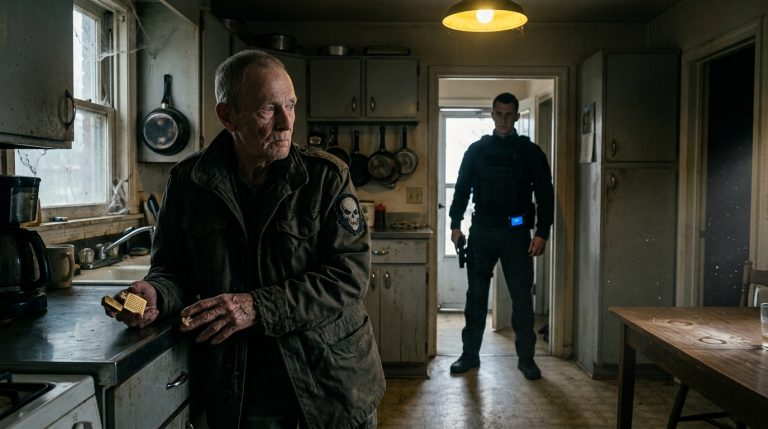
“Sir, you—” Jake started, but the words died in his throat. He looked at William—really looked at him. He saw the duct tape on the elbows of the threadbare green jacket, the tangled white beard, and the deep, permanent lines etched into the weathered face. He looked at the shopping cart, filled with the debris of a life lived in the margins. Then he looked at the businessman, who was beginning to moan, a low, guttural sound of returning consciousness.
“You’re not a doctor,” Jake said, though the accusation had lost its edge. It was a question, an attempt to anchor himself back to the world of rules and degrees.
William leaned against his cart, his hands trembling slightly as he reached into his pocket to retrieve a worn, plastic-wrapped photograph. “No,” he said, his gaze fixed on the businessman’s face, now flushed with the first, faint hint of returning blood. “I’m just a man who knows that dead is a state of mind until the brain stops cooling. The books are for when you have time to consult them. I didn’t have time.”
The plaza was no longer a place of entertainment. The phones were still out, but the people were quiet, their faces shifted from the hunger of spectacle to the shock of witnessing something that defied the laws they lived by.
Maria knelt by the patient, her touch careful, almost reverent. “His pulse is erratic, but it’s holding. Vitals are climbing.” She looked up at William, her eyes wide. “That angle—that pressure—how did you know?”
“Battlefield improvisation,” William said, his attention drifting. He watched as the businessman’s eyelids fluttered, a pale blue iris struggling to focus on the gray, overcast sky. “When you’re fighting for a heartbeat in a hole in the ground, you don’t worry about rib fractures. You worry about the clock. The clock is the only enemy that never sleeps.”
The businessman’s hand twitched, fingers scraping against the concrete. His eyes locked onto William’s, a look of profound, terrified confusion.
William took a half-step back. He felt the weight of the moment—the desire to disappear back into the crowd, back to his bench, back to the invisibility that had been his shield for three decades. He didn’t want the gratitude; he didn’t want the questions. He wanted the quiet, the safety of being ignored.
“He’s coming around,” Jake said, his voice now crisp, though his hands were still shaking. He began to clear the perimeter, his movements defensive, as if he were protecting William from the encroaching crowd. “We need to get him to the unit. Now.”
As the paramedics began the choreographed dance of loading the stretcher, the businessman clutched at the lapel of his ruined gray suit. His eyes remained fixed on William, a desperate, anchoring connection. He couldn’t speak, but his look was a silent, agonizing question: Why?
William looked away, his gaze falling on the rusted wheels of his shopping cart. Because I couldn’t let him go, he thought, though he didn’t say it. Because if I let him die, then the others… the ones in the photograph… they die all over again.
“He’s stable,” William said to Jake, his voice regaining its command. “Don’t let them monitor him too fast. He’s going to be in shock. The transition back… it’s the hardest part.”
Jake hesitated, a flicker of something like respect crossing his face. He nodded, once, a sharp, professional gesture that signaled a strange, new understanding. “We’ll handle it, sir. Thank you.”
As the ambulance doors slammed shut, sealing the businessman inside a cocoon of clinical safety, the sirens began to wail again—not a warning this time, but a steady, driving rhythm. The vehicle pulled away, the tires hissing on the damp concrete.
William stood alone in the center of the plaza, the center of a void. The crowd began to disperse, the normalcy of the day rushing back in to fill the silence. The smell of roasted chestnuts returned, stronger than before, sickeningly sweet.
He walked to his bench, the shopping cart rattling over the uneven stone. He sat down, the wood cold and unforgiving beneath him. He reached into his jacket, his fingers brushing the plastic-wrapped photograph. He felt the familiar, heavy ache in his chest—not the ache of a failing heart, but the ache of a purpose that had been forced out of its hiding place.
He looked down at his hands. They were still stained with the grease of his life, and now, faint, dried streaks of the businessman’s sweat.
He was tired. He was older than he had been ten minutes ago, and the world was beginning to look sharper, more demanding. He knew what would happen next: the authorities would come, the cameras would find him, and the quiet, iron-gray cage of his anonymity would be shattered.
He leaned his head back against the cold metal of the bench, watching a single, brittle leaf drift down from an oak tree. It landed in the gutter, right next to his cart. He didn’t move to pick it up. He just sat, waiting for the ripple effect of his intervention to reach him. The clock had started again, and this time, he couldn’t stop it.
CHAPTER 3: The Admirals Shadow
William did not look up when the black SUV crested the rise of the plaza. He knew the sound before he heard it—the low, guttural thrum of a heavy engine, the subtle, authoritative tire-scrub against the pavement. It was a sound he hadn’t heard in years, a sound that belonged to the world of command, of decisions made in climate-controlled rooms, and of consequences that rippled across oceans.
He remained on the bench, his hands resting on the handles of his cart. The cart felt less like a collection of possessions now and more like a tether, the only thing keeping him from drifting away into the sudden, sharp scrutiny of the onlookers.
The SUV stopped ten feet away. The passenger door opened with a click that sounded unnaturally loud in the quiet square. A man stepped out. He was dressed in a Navy dress uniform, white and immaculate, a stark contrast to the grimy, oil-stained reality of the plaza. Three stars gleamed on his shoulder boards, catching the weak, watery light of the late October afternoon.
Vice Admiral Marcus Webb didn’t move toward William immediately. He stood still, his gaze traversing the scene—the discarded coffee cup, the cracked phone on the ground, the ragged edges of William’s green jacket. When his eyes finally settled on William, they weren’t those of an Admiral. They were the eyes of a man remembering the taste of dirt and the cold, searing certainty of a pocketknife blade.
“Iron Lung,” the Admiral said. The voice was strained, a tight, controlled sound that threatened to snap under the weight of thirty years of unspoken history.
William finally looked up. He didn’t rise. He didn’t offer a salute. He simply watched, his pale, clear eyes tracing the small, jagged scar that traced its way up the Admiral’s neck, hidden only by the high, stiff collar of his tunic. “You’ve aged, Marcus.”
“I’ve survived,” the Admiral replied. He took a step forward, his polished black shoes clicking on the grit of the plaza. “There’s a difference.”
“Is there?” William asked. He shifted, the duct-taped elbow of his jacket scraping against the bench. “Because from where I’m sitting, we both ended up in the same place. I just took a longer, quieter road to get here.”
Marcus stopped, his hands clasped behind his back. The distance between them felt charged, a bridge of history spanning the gulf between the man who had ordered the impossible and the man who had performed it. “I spent three decades looking for you, William. I sent letters to the VA. I contacted the records office. They told me you were ghosted.”
“I didn’t want to be found,” William said. He reached into his cart, pulling out a small, frayed cloth bag. He didn’t offer it, but he held it tight. “The army has a way of erasing the things they don’t want to remember. The dead, the inconvenient, the ones who break the rules to save a life. I didn’t want to be another casualty of their paperwork.”
“You were a hero,” Marcus insisted, his voice rising, a sudden, raw edge of frustration cutting through his composure. “You were the best medic I ever had.”
“I was a man with a knife and a bad habit of refusing to quit,” William corrected. “And that was enough to get me thrown out with the trash.”
A sudden, sharp gust of wind swirled through the plaza, picking up the discarded leaf from the gutter and spinning it in a chaotic dance around William’s feet. The temperature dropped, a biting, autumnal chill that seemed to seep through the layers of William’s worn clothes. He shivered, a subtle, involuntary motion he couldn’t suppress.
Marcus noticed. He glanced at the shopping cart, then back at William, his expression softening. “You’re freezing, William.”
“I’ve been cold for thirty years,” William said. “It’s the only way I know I’m still awake.”
“That stops today.” Marcus took another step, his presence dominating the space. “I’m not here to offer you a medal, and I’m not here to ask for an apology. I’m here because there are young men, sitting in classrooms, being taught how to patch up a wound by someone who has never felt the heat of a burning body, never felt the sickening snap of a rib under pressure. They need to know what you know.”
“They don’t want to know,” William said. He gestured toward the empty space where the ambulance had been. “They want protocols. They want books. They want a world where death is a sequence of events that can be solved with the right switch. They don’t want the mess of it.”
“Then show them the mess,” Marcus said. “Show them why the book is wrong.”
William remained silent, his gaze fixed on the Admiral’s stars. He felt the weight of the photograph in his pocket—the faces of the young soldiers, smiling, oblivious to the fact that they were already ghosts. He felt the pull of the offer, the terrifying, seductive possibility that he could, for the last time, force the world to see the truth.
But as he looked at the Admiral, he realized the shift. The man who had once been a lieutenant bleeding in a rice paddy was now a man who held the power to disrupt the system that had discarded them both. And the businessman… he was just one life. William had three hundred and forty others that he had kept alive in the silence of his own mind.
“I have conditions,” William said, his voice finally firming, a core of steel rising through the exhaustion.
Marcus inclined his head. “Name them.”
“I don’t want a salary. I don’t want a title. I don’t want a uniform.” William stood up, his knees popping, his frame dwarfed by the Admiral’s clean, commanding stature. “I want the files. Every casualty report from Fire Base Delta that you classified. I want to know who they were, where they went, and why you let the paperwork bury them.”
Marcus hesitated, a flicker of something dark and ancient passing through his eyes. It was a secret—a Layer 1 decoy—a piece of history buried beneath the varnish of his rank. “That’s a heavy price for a medical instructor, William.”
“Everything has a price, Marcus,” William said, stepping closer, the smell of damp earth and iron clinging to him. “You paid yours in blood. I paid mine in years. It’s time we audited the bill.”
CHAPTER 4: The Architecture of Silence
The VA hospital did not smell like life. It smelled of floor wax, scorched coffee, and the metallic, low-frequency hum of machines designed to extend existence rather than celebrate it. William walked with his hands tucked deep into the pockets of his green jacket, the fabric rough against his skin. Every step on the linoleum floors felt like a betrayal of the uneven stone and earth he had known for three decades.
Marcus walked beside him, his stride measured and silent. The Admiral’s presence was a barrier; the nurses and orderlies parted for him, their eyes flicking to William with a mixture of confusion and guarded skepticism. To them, William was an anomaly—a piece of the outside world that had been dragged in by an authority figure who usually stayed in the upper echelons of policy.
“They’re waiting in the simulation suite,” Marcus said, his voice low. “The medical staff. Residents, mostly. They’ve heard about the Thompson Plaza incident. They’ve seen the clips online.”
“Clips,” William repeated, the word tasting like ash. “They saw a show. They didn’t see the work.”
“Then show them the work,” Marcus replied, stopping before a set of double doors marked Medical Simulation & Training. “And William? Don’t apologize for being right.”
William pushed the door open. The room was a sterile, high-tech theater of modern medicine. There were plastic mannequins wired for every conceivable trauma, monitors flashing in bright, artificial colors, and a group of young, scrub-clad doctors standing in a semi-circle. They were young enough to be the grandsons of the men William had served with. They looked clean, their hands soft, their eyes full of the kind of certainty that only comes from textbooks.
As William entered, the conversation in the room evaporated. The silence that followed wasn’t respectful; it was wary.
William walked to the center of the room. He didn’t look at the doctors. He looked at the primary mannequin on the table—a state-of-the-art model with a synthetic chest. He reached out and touched the plastic sternum. It was hard, unyielding, a poor imitation of the delicate, fragile architecture of human life.
“You’ve been taught that the heart is a mechanical pump,” William began, his voice rasping against the high ceilings. “You’ve been taught that if the pump fails, you follow the flow chart. You push the epinephrine. You deliver the shock. You count to thirty.”
He looked up, his gaze sweeping the room. “But what happens when the chart is wrong? What happens when the body decides it’s finished?”
A young resident in the front row cleared his throat. “Sir, the protocols are based on years of peer-reviewed data. They represent the statistical best chance of survival for the patient.”
William turned to the resident. His hand, hidden in his pocket, gave a sudden, sharp tremor—a rhythmic, involuntary flutter that mirrored the pulse he had fought so hard to bring back in the plaza. He squeezed his fingers into a fist, forcing the muscle to steady.
“Statistics are for the living,” William said, his voice dropping into the quiet, dangerous tone he had used in the rice paddies. “I’m talking about the ones who have already crossed the line. You follow the protocol when you want to protect your career. You use iron-lung techniques when you want to save the life.”
“That’s dangerous,” the resident insisted, his confidence wavering. “You’re describing traumatic injury, not resuscitation.”
“I’m describing the difference between a death certificate and a person,” William snapped. He grabbed a pair of surgical gloves from the cart, his movements stiff and precise.
He didn’t use the AED. He didn’t check the digital readout. Instead, he placed his hands on the mannequin’s chest, positioning them low, over the xiphoid process. He felt the resistance of the plastic, the way it fought back against his touch.
“In the field, in the mud, in the dark—the only tool you have is your own body,” William said. He began the compressions, not with the measured, robotic cadence of the residents, but with a visceral, jarring force. Compress. Release. Compress. Release.
The sound of his knuckles hitting the hard plastic base of the mannequin was rhythmic and aggressive. It filled the sterile room, a sound of primitive labor.
“You watch the face,” William said, his breathing shallow, his focus narrowing. “You look for the color change. You listen for the snap. You force the air in until the lungs remember they exist. You don’t ask for permission. You don’t look at the monitor.”
He paused, his chest heaving. The tremor in his hand was getting worse, a rhythmic instability that he could feel all the way up his arm. He pressed his knuckles harder into the plastic, trying to pin his weakness to the table.
“You have to be willing to break them,” he continued, his voice barely audible. “You have to be willing to destroy what’s broken before you can fix it. That’s the part the book leaves out. The cost.”
He looked up at the residents. Their expressions had shifted. The skepticism remained, but beneath it, there was a raw, uncomfortable curiosity. They were looking at his hands—not as medical instruments, but as tools that had been used, weathered, and hardened by a war they only knew from history books.
Marcus stepped forward, his eyes locked on William’s. The Admiral wasn’t looking at the training; he was looking at the man. And for the first time, William saw a flicker of doubt in Marcus’s face—a realization that the “Iron Lung” he had brought back from the park was not the same man who had saved him in the paddy. The cost William had paid was finally catching up to him, a debt that was coming due in the fluorescent glare of the hospital room.
William pulled his hands back from the mannequin. They were shaking, a visible, undeniable betrayal. He shoved them back into his pockets, his posture slumping.
“I’m done for today,” William said, his voice flat. He turned and walked toward the door, leaving the silent, stunned group of doctors behind him. The hum of the hospital machinery suddenly felt deafening, a relentless, mechanical pulse that seemed to mock the fragile, human rhythm he had been fighting for all his life.
CHAPTER 5: The Ghost in the Archive
The administrative wing of the VA was a labyrinth of beige walls and low-hanging fluorescent lights that hummed with a monotonous, mind-numbing frequency. William moved through the halls with the practiced stealth of a man who had spent three decades navigating shadows. He wasn’t supposed to be here; the Admiral’s promise of “full access” was a diplomatic gesture that didn’t necessarily extend to the night-shift security protocols of the records department.
He reached the archives, a heavy steel door that looked more suited for a vault than a library. Using a keycard Marcus had pressed into his hand earlier—a thin, plastic lifeline—he gained entry.
Inside, the air was thick with the scent of decaying paper and the dry, metallic tang of oxidization. Row upon row of metal filing cabinets stretched into the darkness, a vast, silent graveyard of soldiers whose stories had been officially concluded. William felt the weight of them as he walked, his footsteps muted by the dust-laden carpet.
He didn’t need a catalog. He knew the year. He knew the location. He knew the designation of the unit: Fire Base Delta, 1969.
He found the drawer, his hands moving with a fluid, confident grace that belied the tremor he had felt in the simulation suite. He pulled. It opened with a harsh, protesting screech of metal on metal that shattered the silence.
The folders were yellowed, brittle at the edges. He began to flip through them, his eyes scanning the typewritten pages with predatory intensity. Name after name, report after report—the bureaucratic record of a war that had been fought in the mud and the blood.
He was looking for the specific file, the one detailing the casualty count that Marcus had kept hidden. He found it near the bottom of the stack, a thick, stapled bundle titled Project Delta: Statistical Recovery and Resource Allocation.
As he leafed through the pages, he stopped. His finger froze on a document dated November 14, 1969. It was a transfer order, signed by a name he hadn’t thought about in thirty years: Colonel Elias Thorne.
Thorne. The man who had ordered the wounded left behind. The man William had struck.
There was a note paper-clipped to the back of the order, an internal memo that had clearly been meant for eyes that were never supposed to see it. It detailed not the casualties, but the “efficiency of resource depletion”—a cold, calculated argument for why saving the wounded was a strategic liability.
William felt the room tilt. The paper in his hand seemed to vibrate. This wasn’t just a military decision; it was a manifesto of indifference. And Thorne, the man who had effectively ended William’s career, was still alive, living in the sun-drenched comfort of Florida, likely never having given a second thought to the men who had been left in the paddy.
He heard a sound—the distinct, rhythmic click of heels on the hallway linoleum outside the archive door. He dropped the file, his heart hammering against his ribs, but he didn’t run. He grabbed a small, seemingly insignificant yellow sheet from the file—the one with Thorne’s signature—and shoved it into the pocket of his green jacket.
The door swung open, the light from the hallway spilling into the room. A security guard stood in the doorway, his silhouette imposing against the harsh, white light.
“Sir? You’re not authorized to be in here after hours.”
William stepped out of the shadows, his face an impenetrable mask of calm. He didn’t look like an infiltrator; he looked like a ghost that had wandered too far from its grave. “The Admiral sent me,” William said, his voice low, steady, and entirely lacking the tremor that had plagued him in the training suite.
The guard looked at the keycard William held—the one Marcus had provided. He hesitated, his posture shifting from defensive to uncertain. “Admiral Webb? He… he didn’t mention an evening inspection.”
“He doesn’t like to announce his movements,” William said, walking past the guard with a purposeful stride. “Neither do I.”
He emerged into the hallway, the cool, sterile air of the hospital feeling like oxygen after the stifling atmosphere of the archive. He had the signature. He had the proof that the man who had destroyed his life had done so not out of tactical necessity, but out of a perverse, systematic cruelty.
He didn’t need the pension. He didn’t need the benefits. He needed the confrontation.
As he walked toward the exit, his hand went to his pocket, clutching the piece of paper. The tremor in his fingers was gone, replaced by a cold, hard, and terrifyingly clear resolve. The final movement of his life wasn’t going to be played out in a hospital or on a park bench. It was going to end where it began—with the man who had decided that some lives were worth less than others.
He pushed through the hospital doors and stepped out into the night. The city was quiet, the air crisp and biting. William Briggs, the ghost of Fire Base Delta, started walking. He wasn’t waiting for the Admiral anymore. He wasn’t waiting for instructions. He was, for the first time in thirty years, moving toward a resolution that he had been building, one breath at a time, since the day he first learned to hold a life together with nothing but his own two hands.
CHAPTER 6: The Final Beat
The villa sat behind a wall of white stucco, draped in flowering bougainvillea. It was a place designed for silence, for the comfortable, air-conditioned ease of a retirement bought with the currency of other men’s lives. William walked up the driveway, his boots silent on the pavers. He didn’t look like a man seeking violence; he looked like a weary traveler who had finally reached the end of an impossible road.
He knocked. Three times. The sound was flat, final.
When the door opened, the man who stood there was smaller than the Colonel William remembered. Elias Thorne wore a silk robe, his hair thinned to a translucent silver, his hands steady as he held a crystal glass of amber liquid. He peered at William, eyes squinting against the fading light.
“Can I help you?” Thorne’s voice was the same—clipped, precise, the voice of a man who dealt in percentages.
“I’m here about the audit,” William said. He reached into his pocket and pulled out the yellowed sheet of paper. He held it out.
Thorne took it. As his eyes scanned the document—the signature, the memo, the cold calculation of human value—the color drained from his face. He didn’t drop the glass. He didn’t shout. He simply leaned against the doorframe, his breath hitching in a way that sounded, to William’s ears, exactly like the agonal gasp of a dying man.
“You,” Thorne whispered, the recognition settling in like a frost. “The medic.”
“I was the man who kept them breathing while you were busy calculating their worth,” William said. He stepped inside, closing the door behind him. The air in the house was cool, sterile. “I spent thirty years wondering if you ever lost a night of sleep. I see now that you didn’t.”
Thorne sat down on a leather armchair, his movements brittle. “It was a war, Briggs. You were a soldier. You knew the cost.”
“I knew the cost,” William agreed, his voice steady. “But I never made the currency.”
William stood over him, not as an adversary, but as a witness. He didn’t hit him. He didn’t need to. He watched as the reality of the signature—the irrefutable proof of his own coldness—crumbled Thorne’s composure. The man’s hands began to shake, the glass of amber liquid rattling against his teeth. It was a beautiful, devastating realization: the protocol that Thorne had used to dictate the lives of others was now the only thing he had left to define his own existence, and it was failing.
“You aren’t going to kill me,” Thorne said, his voice a frantic, high-pitched plea for logic. “That would be… against the protocol.”
“Protocol doesn’t apply here,” William said. “I’m not a medic anymore, and you aren’t a Colonel. We’re just two men at the end of a very long, very dark road.”
William reached down and picked up a small, silver pen from the side table. He turned it over in his calloused fingers. The light caught the metal, reminding him of a surgical tool, a pen, a piece of wire—the improvisations of a man who refused to let death win. He placed the pen on the table in front of Thorne.
“You’re going to write it down,” William said. “The names of the men in the paddy. The truth about why you left them. You’re going to give them back their humanity, Elias. And then, you are going to live with the truth. That is your sentence.”
Thorne looked at the pen, then up at William. The silence in the room stretched, heavy and profound, until finally, the man reached out. The pen moved across the page, a jagged, trembling confession that echoed through the quiet house.
The aftermath was not a storm, but a settling. William left the villa as the sun dipped below the horizon, painting the sky in shades of bruised purple and gold. He walked back to the street, his limbs light, the heavy, metallic ache in his chest finally gone.
He found a bench near the water, a small park overlooking the bay. He pulled the photograph from his pocket—the group of young soldiers, their smiles bright and defiant. He sat for a long time, watching the tide pull away from the shore, leaving the sand clean and exposed.
He didn’t need the cart anymore. He didn’t need the ghosts.
He thought of the businessman in the plaza, the breath he had forced into him, the way a pulse had returned to the world because he had refused to let it slip away. He thought of the medics at the VA, the ones he had taught, the ones who would carry the rhythm forward.
His own breath was steady now. Deep. Uninterrupted. He took a small, silver repair kit from his pocket—the one he had carried since the war—and finally fixed the hinge of his compass, snapping it into place with a definitive, satisfied click. The needle spun, wobbled, and then settled, pointing true North.
He wasn’t Iron Lung anymore. He was just William. And for the first time, in a life defined by the desperate struggle to keep others from fading, he allowed himself to simply exist. He closed his eyes, the smell of salt air and blooming flowers filling his lungs, and in the deepening twilight, he drifted into a sleep that felt, for all the world, like peace.